As an Amazon Associate, we earn from qualifying purchases. This post contains affiliate links – if you buy through them, we may earn a commission at no extra cost to you.
There’s no single best adhesive for a car headliner. There’s a best one for your roof, your fabric and how you plan to apply it. Three things decide it: whether the fabric has already fallen down or is just starting to sag, whether you’re spraying a large area or touching up a small spot, and how hot your car gets inside. These products differ on exactly that — spray cans against brush-on bottles, fast tack against long open time, and listed heat limits that range from 170°F to 200°C. Most buyers split between the 3M Headliner & Fabric Adhesive for a full redo and the Headliner Repair Glue with Brush for a quick spot fix.
| # | Product | Best for | |
|---|---|---|---|
| 1 | 3M Headliner & Fabric Adhesive | Best Overall | Check Price |
| 2 | Permatex 27828 Body Shop Adhesive | Best Heavy-Duty Spray | Check Price |
| 3 | 3M Super Trim Adhesive 08090 | Best for Professional Trim Work | Check Price |
| 4 | DAP Weldwood Landau Top & | Best Spray Contact Cement | Check Price |
| 5 | 3M Hi-Strength Spray Adhesive 90 | Strongest Permanent Bond | Check Price |
| 6 | 3M Super 77 Multipurpose Adhesive | Most Versatile Multi-Surface | Check Price |
| 7 | S-18 All-Purpose Adhesive | Best Brush-On Contact Cement | Check Price |
| 8 | AK Trading Headliner Foam Adhesive | Best Heat-Resistant Formula | Check Price |
| 9 | Headliner Repair Glue with Brush | Best for Quick Spot Repairs | Check Price |
| 10 | Gorilla Heavy Duty Spray Adhesive | Best Repositionable Option | Check Price |
1. 3M Headliner & Fabric Adhesive

Best for: someone redoing a whole sagging headliner at home.
A full headliner job means covering a large, curved surface before the glue sets. You need working time, and you need a spray that won’t soak through the fabric and stain it. This 3M can is built for that job — the listing names automotive headliners directly, and the formula dries clear, so any overspray on the roof panel won’t show through light-colored cloth.
The 30 to 60 minute dry time is the number that matters here. That’s how long the formula takes to dry. The adjustable nozzle lets you switch between a wide fan for big panels and a tighter pattern for edges and corners.
This isn’t the pick for someone chasing one small drooping corner — a brush bottle reaches into a tight gap better. It’s also not for anyone who wants the fabric stuck instantly — you’ll be holding it in place for a while.
Good if:
- You’re replacing the whole headliner fabric, not patching it.
- You want time to reposition the cloth before it grabs.
- Your headliner is a light color and you can’t risk dark glue lines.
Skip it if:
- You only have one small sagging spot near the visor.
- You’d rather press glue on with a brush than spray it.
2. Permatex 27828 Body Shop Heavy Duty Headliner and Carpet Adhesive

Best for: a hot-climate driver who needs the bond to survive summer.
Heat is what kills headliner repairs. A car parked in the sun bakes the roof panel, and a glue that softens up there lets the fabric drop again. Permatex states a high-temperature formula that holds strength up to 170°F (77°C). That figure is the reason to pick this one over a general craft spray.
The listing also calls out water resistance against rain, sleet and snow. That sounds odd for an interior part until you remember leaks around a sunroof or a window seal — a damp headliner board is a real thing in older cars. It dries clear, so the neat appearance holds.
Beyond headliners, the seller lists carpet, trunk linings and inside door panels. So if you’re fixing several loose interior pieces in one session, a single can sees you through the whole job. The listing describes it as a heavy-duty spray with extreme holding power.
Good if:
- Your car sits outside in real heat.
- You’ve had a headliner drop before and don’t want a repeat.
- You also need to reattach carpet or a door panel.
Skip it if:
- You want a slow, forgiving glue you can reposition for a long time.
- You’re only fixing a tiny tear and prefer brush control.
3. 3M Super Trim Adhesive 08090

Best for: trim work where the material is light and the panel is metal.
This one is labeled for industrial and occupational use only, and the listing says it’s not for consumer sale or use. That’s worth reading twice before you buy. It tells you the seller positions this as a shop product, not a driveway product, and the safety and handling expectations follow from that.
What it does well, per the listing, is attach lightweight trim materials and create a long, secure bond on impervious metal surfaces. It’s also a positioning adhesive, which means it’s meant to hold a piece in place while you work rather than carry the full load forever. It dries to a clear, low-profile color, and it can bond styrene.
So the fit here is a specific one: light trim fabric going onto a bare metal roof panel or a trim panel, in a setting where you know how to handle industrial aerosols. It’s a poor match for a home DIYer, and the consumer-use restriction alone rules it out for most readers.
Good if:
- You’re doing trim work in a shop environment.
- You’re bonding lightweight material to bare metal.
- You need a clear-drying positioning adhesive.
Skip it if:
- You’re a home user — the listing says it’s not for consumer use.
- Your headliner is thick foam-backed cloth rather than light trim.
4. DAP Weldwood Landau Top & Trim HHR Solvent Type Spray

Best for: a large job where you want contact-cement grip.
Contact cement works differently from a standard spray. You coat the surface, let it flash, then press — and it bonds on contact. The listing describes a web formula that does exactly that, and states it’s ready in 1 to 3 minutes.
The coverage figure is the standout number: up to 79 square feet per can at 1 gram per square foot on a single surface. Full cure takes about 24 hours, and after full cure the glue is high heat and water resistant. It’s listed for interior and exterior use, and for foams, upholstery fabric, vinyl, plastics, metals, carpeting, laminate and car roof liners.
The listing carries a California Proposition 65 cancer and reproductive harm warning. That’s a handling consideration you should factor in.
Good if:
- You’re covering a large headliner board in one go.
- You want a bond that grabs in a couple of minutes.
- You’re comfortable working with solvent contact cement and ventilation.
Skip it if:
- You need time to reposition fabric after it touches.
- You’d rather avoid a product with a Proposition 65 warning.
5. 3M Hi-Strength Spray Adhesive 90

Best for: industrial bonding of panels, not a car interior.
Read the listing carefully here: this is for industrial use only, not for consumer use, and it’s not for sale in California. It also contains 1,1-Difluoroethane. Those aren’t small print — they tell you this can is aimed at a workshop, not a garage.
What it offers is a high-strength, fast, contact-type adhesive with a variable-width web spray pattern, plus high-temperature and moisture resistance. The listed applications are interior construction, insulation, HVAC, office partitions, and large surface bonding of wood, laminates, particle board and MDF. Headliner fabric isn’t among them.
That’s the honest read: it’s a strong permanent adhesive, but the seller’s own application list points at building materials rather than automotive cloth. If you’re bonding a headliner, the products above fit the job better. If you’re in a shop bonding MDF panels, this is the one built for it.
Good if:
- You’re bonding wood, laminate or MDF panels in a shop.
- You need a fast contact-type bond with high heat resistance.
- You’re set up for industrial products and their handling needs.
Skip it if:
- You’re a home user — the listing says it’s not for consumer use.
- You’re bonding headliner fabric; it’s not in the listed applications.
6. 3M Super 77 Multipurpose Permanent Spray Adhesive Glue

Best for: a first-timer who wants a single can to stretch across several jobs.
Super 77 is the generalist of this group. The listing names a long material list — paper, cardboard, fabric, insulation, plastic, metal, wood, felt, fiberglass, foam and leather. If you’ve got a loose headliner corner and a sagging door card and a bit of trim, a single can handles the whole list.
The bond time is listed as 15 seconds to 30 minutes. That’s a wide range, and it’s the useful part: you can spray, wait a little, and still have time to position the fabric. The listing says it’s initially repositionable while giving long-lasting strength, and that it helps create soft, non-dimpling glue lines. Low soak-in and low yellowing are both stated.
The trade-off is that it’s a multipurpose adhesive, not a headliner-specific one. For a full roof redo on a car that bakes in the sun, a formula with a stated high-temperature figure is the safer call. For spot work and mixed materials, this is the flexible choice.
Good if:
- You want a single adhesive to cover headliner, trim and general repairs.
- You need repositioning time before the bond sets.
- You’re bonding foam, felt or fabric without dimpling.
Skip it if:
- You want a formula with a stated high-temperature rating for a hot roof.
- You’re doing a full professional-grade headliner replacement.
7. S-18 All-Purpose Adhesive 8 oz

Best for: brush-on control with porous and non-porous materials.
Not everyone wants a spray. Aerosol drifts, it’s hard to aim into a tight gap, and you can’t easily control the amount. This is an 8 oz brush-on contact cement, and the listing says the formula adheres both porous and non-porous materials — so it handles fabric on one side and a metal or plastic panel on the other.
Films made from it are stated to give excellent peel strength, aging properties and resistance to oil. The listing also calls out bonding SBR rubber and neoprene to metal, and multiple types of plastic to other materials.
The brand has been making adhesives in the United States since 1949, per the listing. It’s a contact cement, so it’s a press-and-hold product rather than a repositionable one, and a small bottle suits patches and edges more than a full roof panel.
Good if:
- You prefer brushing glue on over spraying it.
- You’re bonding fabric to a non-porous surface like metal or plastic.
- You want water and oil resistance in the cured film.
Skip it if:
- You’re covering a whole headliner board and want spray coverage.
- You need to slide the fabric around after it makes contact.
8. AK TRADING CO. Heavy Duty Headliner Foam Spray Adhesive 12oz

Best for: the hottest cars and the strictest air-quality rules.
The headline number here is temperature: the listing states it withstands up to 200 degrees Celsius. It also says the formula is VOC compliant, which matters if you’re working in a space where solvent fumes are a problem, and it dries clear.
The listed applications are headliners, seats, carpets and foam materials, and it bonds foam, fabrics, plastics and rubbers. Weatherproof and water-resistant are both stated, along with resistance to water ingress. For someone in a very hot climate, or someone repairing a car that lives outdoors, the heat and moisture claims are the reason to look here.
The trade-off is that VOC-compliant formulas can behave differently from the solvent-heavy sprays — you may find the tack and open time suit you less if you’re used to a fast contact cement. And like the other sprays, it’s a whole-panel tool rather than a precision patcher.
Good if:
- Your car sees extreme heat.
- You want a VOC-compliant formula for indoor or enclosed work.
- You’re bonding foam-backed headliner material.
Skip it if:
- You only need to fix a small tear and want brush control.
- You prefer a fast-grabbing contact cement.
Where These Overlap
Several of these do the same job, and the choice between them comes down to how you like to work rather than what they can do. The 3M Headliner & Fabric Adhesive, the Permatex 27828 and the AK Trading Headliner Foam Adhesive are all headliner-focused sprays with clear-dry formulas and stated heat resistance. If you’re redoing a full roof panel, any of the three is a reasonable route, and the deciding factor is which listed temperature and cure detail matches your climate.
The 3M Super 77 and the Gorilla Heavy Duty Spray Adhesive sit close together too — both are multipurpose and both dry clear. The difference is that Super 77 lists a bond time of 15 seconds to 30 minutes. That gap is the whole decision.
Genuinely different: the S-18 is the only brush-on contact cement here, the Headliner Repair Glue with Brush is the only built-in-brush spot repairer, and the 3M Super Trim Adhesive 08090 and 3M Hi-Strength Spray Adhesive 90 are both labeled for industrial use only, which separates them from the rest for a home buyer.
Still Not Sure?
How do I know if I should patch or replace the whole headliner?
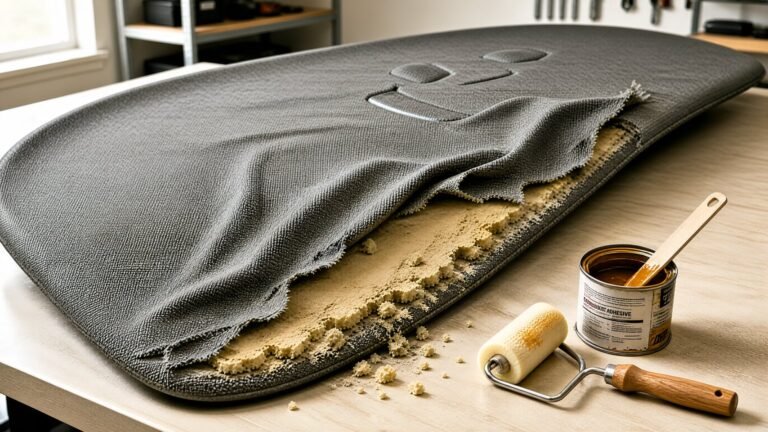
Look at how much fabric has let go. One corner or a strip near the visor is a patch job — the Headliner Repair Glue with Brush is built for that, with a brush in the cap and an initial cure of 5 to 10 hours. If the cloth is hanging across most of the roof, or the foam backing has turned to powder, you’re replacing the material, and a full-coverage spray like the 3M Headliner & Fabric Adhesive is the better fit. Patching a roof that’s failing everywhere just moves the problem.
Will these work on a foam-backed headliner, or only on cloth?
Foam-backed fabric is the common construction, and the listings differ on how explicitly they address it. The AK Trading Headliner Foam Adhesive names foam materials directly in its application list, and the DAP Weldwood lists foams among its surfaces.
What actually causes a headliner to fall down in the first place?
Heat and moisture, mostly. The foam backing between the cloth and the roof board breaks down over years of temperature cycling, and once it turns to dust the cloth has nothing to grip. That’s why the listed heat figures matter — Permatex states strength up to 170°F (77°C), and AK Trading states resistance up to 200 degrees Celsius. Choosing a formula with a stated high-temperature rating is how you avoid doing the job twice.
Do I need to worry about fumes when I use these?
With the solvent-based sprays and contact cements, yes. Several listings carry handling warnings — the DAP Weldwood lists a California Proposition 65 cancer and reproductive harm warning, and the 3M Hi-Strength Spray Adhesive 90 states it contains 1,1-Difluoroethane. If fumes are your main concern, the AK Trading formula is listed as VOC compliant, and the Headliner Repair Glue with Brush is described as VOC-free and non-toxic.
If you’re replacing the whole headliner, the 3M Headliner & Fabric Adhesive gives you the working time and clear finish that job needs. If you’re chasing one drooping corner, the Headliner Repair Glue with Brush gets in there without opening a full aerosol. Pick your situation first, then check the listing for today’s details.
Frequently Asked Questions
What adhesive works best for a car headliner that keeps falling down?
It depends on why it fell. If the foam backing has crumbled, no adhesive fixes that — the fabric needs to come off and the old foam needs to go before anything new goes on. If the fabric is sound and just detached, a headliner-specific spray with a stated heat rating is the right tool. The Permatex 27828 lists strength up to 170°F (77°C), and the AK Trading Headliner Foam Adhesive lists resistance up to 200 degrees Celsius.
Can I use a regular spray adhesive like 3M Super 77 on a headliner?
You can, and the listing names fabric, foam and felt among the materials it bonds, with a bond time of 15 seconds to 30 minutes and repositioning before it sets. What it doesn’t carry is a stated high-temperature figure the way the headliner-specific formulas do. In a car that bakes in summer sun, a formula with a listed heat limit is the safer choice for a roof panel.
How long do I have to position the fabric before the glue grabs?
It varies a lot across these products, and it’s the number to check before you buy. The DAP Weldwood is ready in 1 to 3 minutes. The 3M Headliner & Fabric Adhesive dries in 30 to 60 minutes. The 3M Super 77 lists 15 seconds to 30 minutes, and the Gorilla Heavy Duty Spray Adhesive allows repositioning up to 10 minutes. For a first headliner job, a longer window is easier to work with.
Do I need to remove the old headliner fabric before gluing new material on?
Usually yes, if the foam backing has broken down. If the original fabric is still attached and just loose at the edges, you can often work adhesive back under it. The S-18 suits that kind of edge and corner repair.
Conclusion
Pick the one that matches your roof and your patience, then test it on a hidden corner before you commit to the whole panel. If you’re still unsure, grab a small can first you’ll learn more from one afternoon of practice than from any spec sheet.