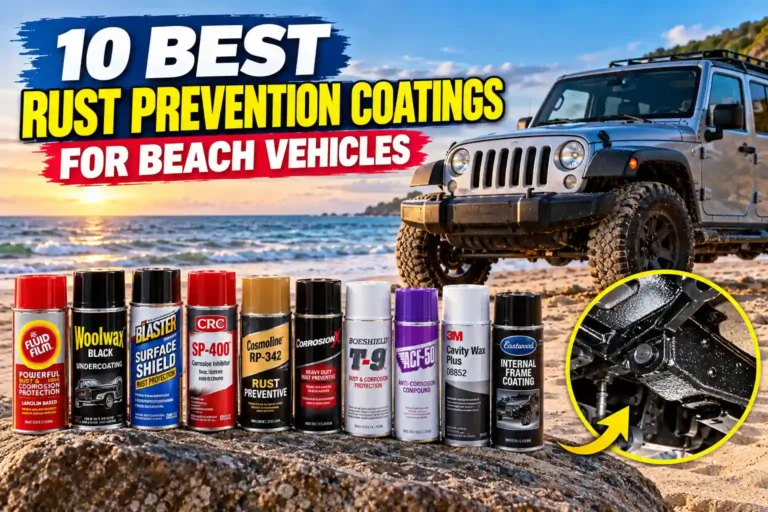
The best rust prevention coatings for beach vehicles reduce contact between vulnerable metal, moisture, and salt. The right choice depends on the area: exposed underbody metal, small hardware, and enclosed body cavities need different application methods. No coating makes driving through seawater harmless.
For routine maintenance, compare soft-film products such as Fluid Film, Woolwax, and Surface Shield. For a wax barrier, consider CRC SP-400 or Cosmoline RP-342. Internal panels and frame sections need a separate decision about access, preparation, and cavity coverage.
This 2026 guide compares published product information and application roles. The recommendations are research-based, not results from a controlled beach-exposure test. Awards describe suitability for particular jobs rather than a proven longest-lasting coating.
Best Rust Prevention Coatings for Beach Vehicles at a Glance
Choose by treatment area and film type before comparing pack sizes. Each row links to the product reviewed; several are multipacks of one coating. A few aerosols do not necessarily provide enough material for a whole vehicle.
| # | Product | Best For / Category | Amazon |
|---|---|---|---|
| 1 | Fluid Film AS11 Aerosol, 3-Pack | Best for Routine Soft-Film Maintenance | Check Price on Amazon |
| 2 | Woolwax Black Aerosol, 3-Pack | Best for a Black Lanolin Undercoating | Check Price on Amazon |
| 3 | B’laster Surface Shield, 6-Pack | Best for Multiple Aerosol Applications | Check Price on Amazon |
| 4 | CRC SP-400 Corrosion Inhibitor Aerosol | Best for a Waxy Protective Film | Check Price on Amazon |
| 5 | Cosmoline RP-342 Heavy Aerosol, 6-Cans | Best for an Amber Wax Barrier | Check Price on Amazon |
| 6 | CorrosionX Heavy Duty, 12 oz Aerosol | Best for a Thick Non-Hardening Film | Check Price on Amazon |
| 7 | Boeshield T-9, 12 oz Aerosol | Best for a Thin Wax Finish | Check Price on Amazon |
| 8 | ACF-50 Anti-Corrosion Compound, 13 oz | Best for Thin-Film Detail Protection | Check Price on Amazon |
| 9 | 3M Cavity Wax Plus 08852, 18 oz | Best for Professional Cavity Treatment | Check Price on Amazon |
| 10 | Eastwood Internal Frame Coating, 14 oz Black | Best for a Curing Internal-Frame Coating | Check Price on Amazon |
10 Rust Prevention Coatings for Beach Vehicles Reviewed
Soft films suit ongoing inspection and renewal, wax barriers provide a different finish, and cavity products target enclosed structures. Match the following recommendations to the actual metal surface and your ability to prepare and reach it.
1. Best for Routine Soft-Film Maintenance: Fluid Film AS11 Aerosol, 3-Pack
Best for: Owners who will inspect and refresh compatible underbody metal regularly.
Fluid Film uses a lanolin-based corrosion-preventive film rather than a hard paint layer. The linked option contains three 11.75-ounce aerosol cans of the same product.
Its practical appeal is a coating you can inspect and renew at exposed edges and wash-worn areas. Clean away salt and abrasive sand before application. A soft film does not restore metal already lost to corrosion, and it can collect dirt where exposed.
Key Features
- Lanolin-based corrosion inhibitor.
- Aerosol format for accessible areas.
- Linked AS11 three-can pack.
Pros
- Fits an inspect-and-refresh maintenance plan.
- Useful for targeted application without bulk spray equipment.
Cons
- Exposed areas require ongoing inspection.
- Soft residue can retain surface dirt.
Buying Decision
Choose Fluid Film for a maintenance routine you will continue after beach trips, rather than treating one application as permanent rustproofing.
2. Best for a Black Lanolin Undercoating: Woolwax Black Aerosol, 3-Pack
Best for: Owners who want a pigmented soft underbody coating.
Woolwax Black is a lanolin-based undercoating for automotive undercarriages. The linked version is three 12-ounce cans with an extension wand, rather than the clear product or a gallon kit.
The black finish changes the appearance of the coated metal, so take inspection photos before covering it. Treat its thickness as an application characteristic, not proof that it outperforms every thinner coating. Confirm coverage inside accessible seams and follow the current instructions.
Key Features
- Black lanolin-based undercoating.
- Three 12-ounce cans in the linked pack.
- Extension wand included in this listing.
Pros
- Clearly identified pigmented version.
- Aerosol package suits smaller jobs and touch-ups.
Cons
- Black coating makes the original surface harder to see.
- Not a substitute for removing loose corrosion.
Buying Decision
Choose Woolwax Black when you want this finish and a renewable coating. Prefer a transparent option when seeing the substrate is the priority.
3. Best for Multiple Aerosol Applications: B’laster Surface Shield, 6-Pack
Best for: Owners planning broader coverage or maintaining more than one vehicle.
Surface Shield is a lanolin-based rust protectant that leaves a moisture barrier. The linked purchase is a six-can pack, so compare it as a supply of one coating rather than a mixed detailing kit.
B’laster advertises extended protection, but beach sand, splash, cleaning, and coverage affect service life. Check high-exposure areas rather than relying on the longest time printed in marketing. It is a rust-prevention product, not a rust remover.
Key Features
- Lanolin-based protective barrier.
- Aerosol application.
- Linked six-can supply.
Pros
- Convenient supply for repeated applications.
- Manufacturer documents automotive and outdoor use.
Cons
- Multipack can be excessive for one small touch-up.
- Advertised duration is not a beach-use guarantee.
Buying Decision
Choose Surface Shield when its application process and pack size fit the work. Buy by required coverage and inspection access, not a claimed maximum lifespan.
4. Best for a Waxy Protective Film: CRC SP-400 Corrosion Inhibitor Aerosol
Best for: Owners protecting compatible metal where a waxy barrier is appropriate.
CRC SP-400 is a corrosion inhibitor that deposits a protective waxy film. Its role differs from a soft lanolin product and from a paint-restoration coating.
Prepare the metal and allow the film to develop according to the current label before exposing it to service. Consider whether you will later need to remove the coating for repairs or painting. Avoid assuming that a wax film can withstand direct abrasion from beach sand indefinitely.
Key Features
- SP-400 corrosion-inhibitor formulation.
- Waxy barrier rather than decorative paint.
- Aerosol format.
Pros
- Defined barrier-coating role.
- Useful for selected metal-protection projects.
Cons
- Film condition still needs checking after exposure.
- Future refinishing may require removal.
Buying Decision
Choose SP-400 for an approved metal surface where a wax barrier fits. Use a dedicated cavity product when enclosed panels are the main target.
5. Best for an Amber Wax Barrier: Cosmoline RP-342 Heavy Aerosol, 6-Cans
Best for: Owners who prefer a translucent amber protective coating.
RP-342 Heavy produces an amber petroleum-wax coating that dries to the touch. The linked listing is a six-can supply of the Heavy version, which should not be confused with the black variant.
A translucent film lets you see more of the underlying surface than an opaque black finish. It still needs preparation and inspection, particularly where sand or repeated washing wears the film. Follow the specified drying conditions before driving or adding other products.
Key Features
- Amber, translucent wax film.
- Dry-to-touch finish after the specified drying period.
- Six-can Heavy-version listing.
Pros
- Visible distinction from opaque coatings.
- Useful when you want a wax-barrier approach.
Cons
- Amber appearance may not suit every visible component.
- Requires planned preparation and drying.
Buying Decision
Choose RP-342 Heavy when its wax finish and larger supply suit the job. Do not buy the six-pack without estimating how much coating you need.
6. Best for a Thick Non-Hardening Film: CorrosionX Heavy Duty, 12 oz Aerosol
Best for: Owners treating approved metal exposed to repeated moisture and splash.
CorrosionX Heavy Duty forms a thick, non-hardening protective film. The manufacturer describes it as self-healing and resistant to water displacement, including marine exposure.
Those characteristics make it relevant to selected components on a coastal vehicle. They do not establish a safe application for every seal, sensor, connector, or moving part. Check the instructions for the actual assembly and keep it away from friction surfaces.
Key Features
- Heavy Duty formulation.
- Non-hardening, self-healing film.
- Linked 12-ounce aerosol.
Pros
- Manufacturer documents demanding wet-environment uses.
- Thick-film alternative to lighter protective sprays.
Cons
- Residue may be undesirable on frequently handled parts.
- Component compatibility needs checking.
Buying Decision
Choose Heavy Duty when you specifically want a persistent thick film on approved metal. A thinner product can suit more confined, lightly exposed details.
7. Best for a Thin Wax Finish: Boeshield T-9, 12 oz Aerosol
Best for: Owners protecting smaller approved metal parts and hardware.
Boeshield T-9 uses a solvent carrier and paraffin wax to leave a thin waxy film after evaporation. Boeshield documents automotive applications alongside its tool and equipment uses.
The thinner finish is useful when you do not want a heavy soft coating on accessible hardware. It is not the same as a thick chassis covering. Apply the required film, allow it to develop, and inspect splash-exposed locations after use.
Key Features
- Paraffin-wax protective film.
- Moisture-displacing application.
- Single 12-ounce aerosol listing.
Pros
- Thin-film option for selected parts.
- Documented automotive use.
Cons
- Not a replacement for extensive cavity treatment.
- Abrasion and washing can require renewed coverage.
Buying Decision
Choose T-9 for smaller compatible metal-protection tasks. Use a product and application system designed for the job if the goal is full underbody coverage.
8. Best for Thin-Film Detail Protection: ACF-50 Anti-Corrosion Compound, 13 oz
Best for: Owners treating approved seams, fasteners, and accessible metal details.
ACF-50 is an anti-corrosion compound that forms an ultra-thin fluid film. Lear Chemical describes its ability to penetrate tight areas and displace moisture.
Its role is targeted corrosion prevention rather than a hard chassis finish. Apply it only where the product and vehicle guidance allow, using controlled quantities. A thin, clear film can be difficult to inspect visually, so record where you treated the vehicle.
Key Features
- Ultra-thin corrosion-preventive fluid film.
- Penetrating, moisture-displacing behavior.
- Linked 13-ounce aerosol.
Pros
- Useful for approved small-detail applications.
- Leaves a transparent rather than opaque coating.
Cons
- Coverage can be hard to judge by appearance alone.
- Not an abrasion-resistant hard coating.
Buying Decision
Choose ACF-50 for a specific thin-film maintenance task. It should complement a planned protection strategy rather than replace inspection of the entire vehicle.
9. Best for Professional Cavity Treatment: 3M Cavity Wax Plus 08852, 18 oz
Best for: Repair professionals protecting internal body panels and structural enclosures.
3M Cavity Wax Plus is designed for enclosed automotive areas such as door skins, rocker panels, and frame rails. Its non-hardening, self-healing wax is a different tool from a general exposed-underbody spray.
The compatible 3M applicator wand kit is sold separately. Proper access and spray coverage matter more than simply spraying through the nearest opening. The product is labeled for industrial or occupational use, making this a professional repair option.
Key Features
- Dedicated internal-panel cavity wax.
- Non-hardening, self-healing formulation.
- Compatible wand kit sold separately.
Pros
- Clear role in enclosed automotive structures.
- Purpose-built cavity application system is available.
Cons
- Professional-use product.
- Additional access and application equipment may be needed.
Buying Decision
Choose Cavity Wax Plus through a suitable repair workflow when internal panels need protection. Do not substitute it indiscriminately for an exposed chassis coating.
10. Best for a Curing Internal-Frame Coating: Eastwood Internal Frame Coating, 14 oz Black
Best for: Owners undertaking a prepared internal-frame treatment project.
Eastwood Internal Frame Coating uses phenolic resin and zinc-phosphate chemistry for enclosed frame surfaces. Unlike the soft films above, it is a curing coating that requires a defined preparation and application process.
Remove loose material and prepare the frame according to Eastwood’s instructions. Internal access and the supplied application arrangement need checking before work begins. Encapsulating a prepared surface does not restore a frame weakened by deep corrosion.
Key Features
- Original 14-ounce black aerosol version.
- Phenolic-resin and zinc-phosphate coating.
- Designed for enclosed frame surfaces.
Pros
- Distinct role for prepared internal-frame work.
- Curing alternative to non-hardening films.
Cons
- Preparation is more involved than a maintenance touch-up.
- Not a repair for structural metal loss.
Buying Decision
Choose Eastwood for a planned internal-frame coating job with suitable access. Have serious frame corrosion assessed before covering it.
How We Chose These Rust Prevention Coatings
We compared manufacturer-described film types, intended applications, preparation needs, and identifiable purchase variants. The list includes maintenance sprays, wax barriers, a professional cavity wax, and a curing internal-frame coating because coastal corrosion is not limited to one accessible surface.
Selection focused on:
- Application area: exposed metal versus enclosed cavities.
- Film behavior: soft, waxy, thin-fluid, or curing.
- Preparation: contamination removal, drying, and rust assessment.
- Access: aerosol reach, extension equipment, and inspection options.
- Maintenance: realistic ability to inspect and renew coverage.
Manufacturer salt-spray claims can inform product development, but they do not directly establish years of service on your beach vehicle. Sand abrasion, vehicle design, washing, and application quality all change the result.
How to Choose a Coating for Coastal Driving
Choose a coating by exposure, existing surface condition, compatibility, and maintenance access. A thick film may suit one location while an enclosed seam needs a penetrating cavity treatment. The preparation and inspection plan should be decided before buying cans.
Separate Underbody and Cavity Work
Exposed chassis areas are easier to see but face direct splash and abrasion. Doors, rockers, and boxed frame sections can hide contamination and incomplete coverage.
Plan those jobs separately. Use existing approved access points and the correct applicator; do not drill holes or fill openings simply because a spray wand will fit.
Remove Salt Before Adding a Barrier
A corrosion inhibitor is not a substitute for cleaning salt and sand away. Clean the target area, remove loose material, and allow the surface to reach the condition required by the product label.
Moisture-displacing claims do not mean coating a salt-contaminated surface is an acceptable shortcut. Investigate peeling factory coatings and trapped contamination before covering them.
Distinguish Surface Rust from Structural Damage
A prepared surface with light rust is a different problem from scaling, perforation, or weakened mounts. Some products permit application over suitably prepared corrosion, but none replaces missing metal.
If a frame, brake line, suspension mount, or other critical component looks compromised, arrange an assessment before coating. An opaque finish can make later visual checks harder.
Check Material and Component Compatibility
A coating approved for metal is not automatically suitable for rubber boots, adhesives, plastic covers, paint-protection film, or electrical assemblies. Check both product guidance and vehicle service information.
Keep coatings off brake friction surfaces, tire tread, belts, exhaust components, and other prohibited areas. For hybrids and EVs, follow manufacturer restrictions around high-voltage assemblies and battery enclosures.
Budget for Access and Coverage
Count any required wands, masking, preparation materials, and safe access equipment. Aerosols are convenient for touch-ups, while a larger job may call for a professional application process.
Estimate coverage from the product’s current instructions. Buying a multipack without a plan can still leave hidden areas untreated or encourage excessive application in places that should remain clear.
How to Prepare and Protect a Beach Vehicle
A useful process starts with inspection and contamination removal, then applies the selected coating only to approved areas. Verify coverage after application and inspect it again after real beach exposure rather than assuming a uniform service life.
- Inspect the underside and record existing corrosion with photos.
- Remove salt and loose sand using a cleaning method approved for the vehicle.
- Dry and prepare the target surface as the coating instructions require.
- Protect excluded components and identify drain openings before spraying.
- Apply the specified film using the correct nozzle, wand, and access points.
- Respect drying, curing, ventilation, and protective-equipment requirements.
- Check for missed areas, unwanted overspray, and blocked drains.
- Reinspect after beach trips and washing; renew worn film as needed.
Use appropriate lifting equipment and rated supports if working underneath. Never rely on a jack alone. Professional access can be the more practical choice for a complete treatment.
Maintaining Protection After Beach Trips
Remove salt deposits and inspect exposed coating after coastal use. Cleaning and coating maintenance need to work together: leaving salt in place is not a sound way to preserve the appearance of a protective film.
Pay attention to splash-exposed edges, fasteners, wheel-well areas, and places where sand accumulates. Use wash pressure and cleaning chemicals consistent with the vehicle and coating instructions, then touch up any film that has been removed.
Do not set a universal annual or multi-year renewal interval from this list. A vehicle occasionally parked near the shore and one repeatedly driven on wet sand have different exposure patterns. Keep a simple record of inspections, cleaning, and touch-ups.
conclusion
Start with Fluid Film, Woolwax, or Surface Shield if you want a soft-film maintenance system and will inspect it regularly. Compare CRC SP-400 and RP-342 if you prefer a wax barrier, and consider CorrosionX Heavy Duty, Boeshield, or ACF-50 for compatible targeted applications.
For hidden structures, decide separately between professional cavity-wax treatment and a prepared curing internal-frame coating. The useful choice is the product whose instructions match the location and maintenance plan, not the one with the longest advertised protection period.
Frequently Asked Questions
Coastal ownership raises questions beyond choosing a coating, including trailer use, galvanic corrosion, repairs, and warranty coverage. These answers address those separate decisions without treating a protective spray as a complete vehicle-preservation system.
Is a ceramic paint coating the same as underbody rust protection?
No. A ceramic paint coating is intended for compatible finished exterior surfaces. It does not provide coverage inside frame rails, behind panels, or across unprotected underbody metal simply because it makes the paint repel water.
Can I use the same product on a boat trailer?
Only when the product and trailer manufacturer permit that application. Trailer immersion and repeated wetting can differ from vehicle road splash. Check brakes, bearings, wiring, and other assemblies separately rather than spraying the entire trailer indiscriminately.
Will rustproofing affect my vehicle warranty?
Warranty treatment depends on the manufacturer, coverage terms, application, and any resulting damage. Check the written warranty and ask about the proposed product and locations before treatment. Keep the product details and application record.
Does stainless-steel hardware eliminate coastal corrosion?
No. Stainless grades vary in resistance, and dissimilar-metal contact can create galvanic corrosion under suitable conditions. Replacement hardware must match the required material, strength, and assembly design, not just look corrosion resistant.
Can an electronic rust-prevention module replace a coating?
Do not treat an electronic module as a substitute for the vehicle maker’s cleaning and corrosion-care guidance. Ask for vehicle-specific independent evidence supporting any performance claim. Maintain inspection and physical protection of vulnerable surfaces regardless of the accessory.
Should corrosion protection be addressed after collision repairs?
Yes. Repairs can disturb factory primers, seam sealers, and cavity protection. Ask the repairer how they will restore corrosion protection according to the vehicle maker’s repair procedures, including areas hidden after reassembly.