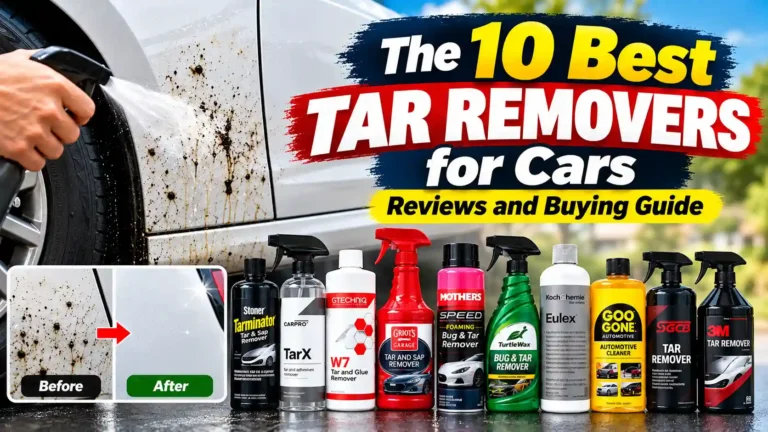
The best tar removers for cars loosen sticky asphalt spots that regular shampoo leaves behind. Choosing the right one can save unnecessary rubbing on lower doors, rocker panels, and the areas behind your wheels after driving through roadwork.
Surface compatibility matters as much as cleaning strength. A solvent intended for painted metal may be unsuitable for headlights, vinyl wraps, paint protection film, or nearby rubber trim. Broader bug-and-tar cleaners offer a different balance when your car collects several types of road contamination.
This guide compares ten tar-removal products using published specifications, manufacturer directions, and verified product listings. These are research-based recommendations, not hands-on test results, with buying decisions based on the deposit, surface, and cleanup routine.
Best Car Tar Removers: Quick Comparison
Use the table to identify your most likely match, then read the surface limits in its review. Each link leads to the specific product and format discussed rather than an Amazon search or category page.
This article contains affiliate links. If you buy through them, we may earn a commission at no extra cost to you.
| # | Product | Best For / Category | Amazon |
|---|---|---|---|
| 1 | Stoner Tarminator 91154, 10 oz | Controlled tar spots on compatible painted exteriors | Check Price on Amazon |
| 2 | CARPRO TarX, 500 mL with sprayer | Dedicated tar decontamination | Check Price on Amazon |
| 3 | Gtechniq W7 Tar and Glue Remover, 500 mL | Appropriate Gtechniq-coated paint | Check Price on Amazon |
| 4 | Griot’s Garage Tar and Sap Remover 10873, 22 oz | Tar and sap in the same detailing routine | Check Price on Amazon |
| 5 | Mothers Speed Foaming Bug & Tar Remover 16719, 18.5 oz | Foam application and broader material coverage | Check Price on Amazon |
| 6 | Turtle Wax T-520A Bug and Tar Remover, 16 fl oz | Occasional mixed exterior deposits | Check Price on Amazon |
| 7 | Koch-Chemie Eulex, 1 liter | Tar and adhesive cleanup on solvent-resistant surfaces | Check Price on Amazon |
| 8 | Goo Gone Automotive Cleaner, 24 oz | Asphalt plus stickers and sticky residue | Check Price on Amazon |
| 9 | SGCB Tar Remover, 500 mL | Compact dedicated tar-removal bottle | Check Price on Amazon |
| 10 | 3M General Purpose Adhesive Cleaner 08984, quart | Workshop tar, adhesive, and wax removal | Check Price on Amazon |
The 10 Best Tar Removers for Cars Reviewed
Choose these tar removers according to where the deposit sits and how you intend to clean afterward. The most useful product is the one you can apply correctly on your finish, with its required preparation and follow-up.
1. Best for Controlled Spot Treatment: Stoner Tarminator 91154
Best for: Localized tar deposits on compatible painted exterior panels.
Tarminator is a direct purchase for the familiar black dots that remain on paint after washing. The linked 10-ounce aerosol is a dedicated tar-and-sap product, so its purpose is clear before it enters your kit.
Stoner specifies a cool surface and small working areas. Its directions allow roughly 30 to 60 seconds of treatment, with rinsing before the product sits longer than one minute. Applying through a cloth offers more control near neighboring materials.
That control is essential: the manufacturer excludes headlights, clear plastics, decals, rubber trim, and other solvent-sensitive materials. This is a targeted paint-cleaning tool with specific boundaries.
Key Features
- 91154 formula in a 10-ounce aerosol can.
- Intended for tar, sap, asphalt residue, and related contamination.
- Short treatment window followed by prompt rinsing.
- Cloth application option helps confine treatment.
Pros
- Clear role when shampoo leaves sticky tar behind.
- No dilution or separate mixing bottle required.
- Practical for treating a few deposits at a time.
Cons
- Important exclusions around headlights and trim.
- Short contact-time limit requires attention.
- Aerosol overspray can complicate work near sensitive parts.
Buying Decision
Buy Tarminator for isolated spots on approved paint when you can control application and rinse immediately afterward. Consider Mothers’ foam if the material you need to treat is excluded by Tarminator and explicitly permitted by Mothers.
2. Best for a Dedicated Decontamination Stage: CARPRO TarX
Best for: Detailers planning separate tar removal before finishing or protection.
TarX fits a deliberate detailing sequence where tar removal has its own place between washing and subsequent finishing work. This listing supplies 500 mL with a sprayer, a practical format for treating affected panels rather than buying a bulk container.
CARPRO identifies tar and adhesive removal as core uses. The manufacturer’s process begins on a dry surface and finishes with car shampoo, so plan a cleanup wash instead of treating it as a final detailing spray.
The linked Amazon formulation carries a restriction stating that it is not for sale or use in California. Ingredient descriptions such as orange-peel-derived solvents also do not establish compatibility with every plastic, film, or coating.
Key Features
- 500 mL bottle supplied with a sprayer.
- Tar and adhesive-removal purpose.
- Dry-surface application in the published process.
- Shampoo wash follows treatment.
Pros
- Fits a structured wash-and-decontamination routine.
- Useful bottle format for repeated localized work.
- Addresses adhesive contamination as well as tar.
Cons
- Linked formulation excludes California sale and use.
- Requires follow-up washing.
- Surface-specific compatibility still needs checking.
Buying Decision
Choose TarX when tar removal is a regular detailing task and the formulation is appropriate for your location and finish. Choose a broader spot cleaner if you only occasionally find a few mixed deposits after washing.
3. Best for a Gtechniq Care Routine: Gtechniq W7 Tar and Glue Remover
Best for: Suitable painted surfaces maintained with compatible Gtechniq coatings.
W7 offers a defined role for owners already maintaining Gtechniq-coated paint. The brand identifies compatibility with its coatings and positions the solvent-based cleaner for tar and glue deposits.
The manufacturer’s application guidance uses a microfiber cloth, short dwell time, and rinsing. Keeping the cleaner on a controlled working area is especially useful on a car with several materials close together.
Its exclusions are extensive: avoid plastics, decals, rubber, vinyl, PPF, wraps, and smart repairs. Gtechniq also states that the product cannot ship to California. Coating compatibility should never be interpreted as permission to spray the entire exterior.
Key Features
- Linked 500 mL, approximately 16.9-fluid-ounce format.
- Solvent-based tar and glue cleaner.
- Gtechniq identifies compatibility with its protective coatings.
- Cloth-based application followed by rinsing.
Pros
- Relevant fit within an established Gtechniq routine.
- Handles two recurring sticky-contamination problems.
- Specific published application and exclusion guidance.
Cons
- Unsuitable for PPF, wraps, plastics, and smart repairs.
- Requires careful avoidance of adjacent trim.
- Manufacturer lists a California shipping restriction.
Buying Decision
Choose W7 for compatible paint when its coating-system fit matters. Skip it for a film-covered or wrapped treatment area, and select a product explicitly approved for that material instead.
4. Best for Tar and Tree Sap Together: Griot’s Garage Tar and Sap Remover
Best for: Owners whose cars collect asphalt on lower panels and sap under trees.
Griot’s Garage 10873 targets tar, grease, asphalt, and tree sap with a d-limonene solvent blend. The linked 22-ounce bottle is a useful middle ground for owners who need more than a tiny spot-treatment supply.
The brand lists clear coat, most plastics, wheels, and chrome among its intended surfaces. The qualification “most plastics” matters: identify the actual component and test before treating it broadly.
The listing specifies dry-surface application and excludes PPF and vinyl wraps. This makes it a good candidate for an unwrapped exterior that faces different sticky deposits, provided you follow the current bottle’s cleanup directions.
Key Features
- Specific 10873 product in a 22-ounce bottle.
- d-Limonene-based solvent blend.
- Published tar, asphalt, grease, and sap applications.
- Intended for dry-surface spot treatment.
Pros
- Covers two common ownership problems in one bottle.
- Useful size for ongoing exterior maintenance.
- More relevant than a bug-only product for sticky asphalt.
Cons
- Not intended for PPF or vinyl wraps.
- Plastic compatibility is qualified rather than universal.
- Dry-surface preparation affects its place in the wash sequence.
Buying Decision
Buy Griot’s 10873 if tar and sap are recurring issues on approved exterior materials. Choose a film-approved cleaner when the deposit is on a wrap or PPF rather than exposed paint.
5. Best Foaming Option: Mothers Speed Foaming Bug & Tar Remover
Best for: Drivers who want clinging foam and published compatibility with more exterior materials.
Mothers Speed 16719 stands out for its no-drip foam rather than a conventional liquid solvent format. Foam helps make the treatment area visible and can be convenient around intricate body details.
Mothers includes paint, chrome, glass, metal, plastic, acrylic, vinyl wrap, and clear PPF in its published surface description. That gives this product a different role from several dedicated solvents here, though the instructions for your specific film or finish still matter.
The product addresses bugs, tar, sap, and road grime, with spot-cleaning and prewash uses. That versatility suits mixed contamination; it does not prove that it will outperform dedicated solvents on every thick asphalt deposit.
Key Features
- 18.5-ounce aerosol, product 16719.
- No-drip penetrating foam.
- Manufacturer lists bugs, tar, sap, and road contamination.
- Published material coverage includes wrap and clear PPF.
Pros
- Foam makes localized application easier to see.
- Broad role for mixed exterior contamination.
- Worth considering where other reviewed products exclude film.
Cons
- Aerosol spray still needs control around adjacent areas.
- Broad compatibility requires checking your specific aftermarket material.
- Severe asphalt buildup may call for a different approved approach.
Buying Decision
Choose Mothers if foam handling or its published material coverage solves a problem with dedicated solvents. For exposed paint with persistent asphalt, compare a dedicated tar remover after confirming compatibility.
6. Best for Occasional Mixed Deposits: Turtle Wax T-520A Bug and Tar Remover
Best for: Owners buying their first bottle for a few stubborn spots after washing.
Turtle Wax T-520A is a single 16-fluid-ounce trigger bottle for occasional exterior spot cleaning. The manufacturer’s directions identify bug remnants, sap, tar, and oil deposits, giving it a broader role than a dedicated asphalt-only purchase.
The published sequence starts with washing and drying the car. You then treat the remaining contamination, wipe away the material, and follow with suitable protection.
That routine is straightforward when you find only a few deposits during a post-wash inspection. If large areas repeatedly collect tar, a dedicated tar-removal product may be a more purposeful addition.
Key Features
- Single 16-fluid-ounce T-520A trigger bottle.
- Multiple listed exterior-contamination uses.
- Wash-and-dry preparation before spot treatment.
- Manufacturer recommends protection afterward.
Pros
- Useful starter option for occasional problems.
- Covers several deposits without a large product collection.
- Fits naturally into post-wash inspection.
Cons
- Requires preparation before treatment.
- Less specialized than a dedicated tar solvent.
- Follow-up protection adds time to the job.
Buying Decision
Choose T-520A for occasional mixed contamination on approved surfaces. Buy a tar specialist if road construction leaves asphalt dots on your car after most washes.
7. Best for Multi-Residue Detailing: Koch-Chemie Eulex
Best for: Experienced users cleaning tar and adhesives from confirmed solvent-resistant surfaces.
Eulex is a broader adhesive-and-stain remover with tar among its listed applications. The one-liter format suits a detailer who also encounters sticker residue, resin, oil, or grease on suitable surfaces.
Koch-Chemie specifies solvent-resistant materials and application using a dry absorbent cloth. Its fast evaporation favors controlled working areas rather than covering a large section and walking away.
Use the manufacturer’s restrictions when assessing compatibility. It specifically excludes polycarbonate, polyacrylic, and similar plastics. A broad retailer description should not override those limits or be treated as general PPF approval.
Key Features
- One-liter Eulex format.
- Listed uses include adhesives, resin, grease, and tar.
- Intended for solvent-resistant materials.
- Dry-cloth application and quick evaporation.
Pros
- Useful beyond routine car washing.
- Larger format fits repeated detailing work.
- Cloth application supports localized cleanup.
Cons
- Unsuitable for several common plastic types.
- Broad cleaning purpose requires careful surface identification.
- One liter may be unnecessary for occasional owners.
Buying Decision
Choose Eulex if you regularly tackle different residues and understand the surfaces involved. A smaller, narrowly focused tar product is a simpler purchase for occasional asphalt dots.
8. Best for Asphalt and Sticker Residue: Goo Gone Automotive Cleaner
Best for: Owners who want tar-related cleanup plus help with sticky adhesives.
Goo Gone Automotive lists asphalt, sap, bumper stickers, and gum among its uses. The linked 24-ounce bottle offers a practical reason to buy if sticky residue appears in several forms on your car.
Its automotive purpose distinguishes it from choosing a household adhesive cleaner without checking suitability. Even so, use it only on permitted materials and test first, particularly on repaired or customized finishes.
The published process includes wiping with a clean white cloth and washing with soap and water. Avoid excluded materials such as leather, suede, and upholstery, and do not leave the product sitting on rubber.
Key Features
- Linked 24-ounce automotive spray cleaner.
- Asphalt and adhesive-residue applications.
- Useful for sap and sticker cleanup as well.
- Soap-and-water cleanup follows treatment.
Pros
- Multiple relevant ownership uses from one bottle.
- Convenient spray format for localized deposits.
- Automotive formulation identifies the intended application.
Cons
- Follow-up washing is necessary.
- Unsuitable for several interior materials.
- Not a universal cleaner for rubber or aftermarket films.
Buying Decision
Buy Goo Gone Automotive if adhesive residue and asphalt both justify the purchase. Choose a tar specialist if sticky road contamination is your only recurring problem.
9. Best Compact Tar-Specific Bottle: SGCB Tar Remover 500 mL
Best for: Drivers who want a modest-size bottle dedicated to tar and adhesive deposits.
The linked SGCB product identifies a 500 mL tar and asphalt remover with adhesive-cleaning uses. It fills a straightforward role for an owner who wants a compact specialist rather than a large workshop container.
Keep the purchase focused on that verified purpose. SGCB has different decontamination products and formulations, so match the actual bottle’s label and directions rather than transferring dilution or contact times from another product in the range.
The main tradeoff is the need to check detailed material guidance before treating coatings, film, repaired paint, or unfamiliar plastics. Orange scent or citrus-based marketing should never replace a compatibility check.
Key Features
- Specific 500 mL product listing.
- Dedicated tar and asphalt-removal purpose.
- Listing also identifies adhesive-residue cleanup.
- Compact format suits a small exterior-care kit.
Pros
- Clear specialist role compared with a general cleaner.
- Smaller commitment than a liter or quart container.
- Relevant to both asphalt spots and sticky residue.
Cons
- Exact bottle directions need checking for sensitive finishes.
- Similar brand products should not be assumed interchangeable.
- No basis here for ranking its cleaning speed above other options.
Buying Decision
Consider SGCB when a compact tar-specific bottle fits your needs and its label approves your surface. Prefer a product with an explicit approval for your coating or film when that compatibility determines the purchase.
10. Best Workshop Alternative: 3M General Purpose Adhesive Cleaner 08984
Best for: Experienced users combining tar cleanup with adhesive or wax removal.
3M 08984 is an adhesive cleaner with tar among its documented applications. The linked quart can belongs more naturally in a repair or detailing workflow than in a quick wash kit.
This is relevant when one project includes several residues, such as old adhesive and tar on suitable cured paint. Its wax-removal capability also means existing protection needs attention afterward; do not buy it expecting a maintenance spray.
Avoid fresh or uncured paint and follow the exact regional label. The listing restricts sale in multiple states, so check eligibility before choosing this particular formulation. Its can format also calls for careful dispensing and proper storage.
Key Features
- Specific 08984 quart-can listing.
- Adhesive cleaner with documented tar-removal use.
- Suitable role in repair and detailing preparation.
- Can remove wax as part of residue cleanup.
Pros
- Useful when a project includes more than asphalt contamination.
- Larger format suits recurring workshop work.
- Clear alternative for experienced adhesive-cleanup users.
Cons
- Multiple state sale restrictions affect this listing.
- Not appropriate for fresh or uncured paint.
- Wax removal and can dispensing add aftercare and handling considerations.
Buying Decision
Choose 3M 08984 for a planned residue-removal job when the formulation is permitted and appropriate. A smaller automotive tar remover is a more convenient choice for a few spots during normal washing.
How to Choose the Best Tar Remover for Your Car
Start with the surface and the amount of contamination, then choose an application format you can control. The most aggressive-sounding label is less useful than explicit compatibility and a cleanup sequence you can follow.
Check Paint, Plastic, PPF, and Wrap Compatibility
Identify every material in the treatment area. A lower bumper may combine painted plastic, unpainted trim, clear lenses, rubber seals, and film edges within a few inches.
Gtechniq W7 excludes PPF and wraps; Mothers publishes broader film coverage. Neither fact replaces your film manufacturer’s instructions, especially for aged, repaired, or aftermarket materials.
Choose Dedicated Solvent or Combination Cleaner
A dedicated solvent makes sense when tar dots are the problem that survives ordinary washing. A combination bug-and-tar product becomes attractive when your main task involves several types of exterior residue.
Do not buy a bug-only cleaner for asphalt based solely on its place in an online category. Verify that tar or asphalt is an intended use.
Consider Foam, Trigger Spray, Aerosol, or Can
Foam makes coverage visible, while a trigger bottle suits selected panels. Aerosols can be convenient but require overspray control. A can works for deliberate cloth dispensing rather than a quick spray routine.
Read the product’s application directions before deciding how to use a cloth. Do not improvise a method that conflicts with its label.
Plan for Washing and Protection
Some products need a dry surface after washing; others specify rinsing preparation or prewash use. Follow-up rinsing or shampooing is part of the job, not an optional extra.
Effects on protection vary. Inspect the area after cleanup and maintain wax, sealant, or coating according to the relevant instructions rather than assuming every cleaner strips everything or preserves everything.
Buy for Frequency Rather Than Bottle Size Alone
Occasional spot treatment rarely requires a workshop-size container. Frequent detailers may value a larger supply, but only if it matches the surfaces and jobs they actually encounter.
Include clean towels and the required rinse or wash setup in the buying decision. A suitable small bottle is more useful than a large one you cannot apply correctly.
How to Remove Tar from Car Paint Safely
Tar removal works best as controlled chemical treatment followed by gentle residue removal. Always follow the particular product’s instructions because preparation and contact time differ across this list.
- Move the vehicle into shade and allow the panel to cool.
- Identify paint, film, trim, and nearby excluded materials.
- Remove loose dirt using the preparation method required by the product.
- Test an inconspicuous area and inspect for an unwanted reaction.
- Apply to one manageable treatment area.
- Observe the specified contact time without allowing unwanted drying.
- Lift softened residue with a clean towel or the prescribed method.
- Rinse or wash as directed, then dry and inspect.
- Repeat only as permitted; stop if the material or finish reacts.
- Restore appropriate protection when the cleaning process requires it.
Keep dirty tar-removal cloths separate from glass and final-buffing towels. Change to a fresh working face before the cloth starts spreading softened residue elsewhere.
conclusion
Choosing the best tar remover for your car depends on the type of contamination, the surface you need to clean, and how often you detail your vehicle. Stoner Tarminator is worth considering for targeted tar spots on compatible paint, while CARPRO TarX suits a dedicated decontamination routine. Griot’s Garage Tar and Sap Remover is another option if you regularly deal with both asphalt and tree sap. For broader exterior cleaning, Mothers Speed Foaming Bug & Tar Remover offers a versatile alternative.
Before buying, check the manufacturer’s compatibility instructions, especially for plastic trim, paint protection film, and vinyl wraps. Apply the product as directed, test an inconspicuous area, and wash the treated surface afterward when required.
Frequently Asked Questions
These answers cover the questions most likely to affect tar-remover selection and use. Product-specific directions take priority whenever the finish, formulation, or application method changes.
What is the best tar remover for car paint?
The best choice depends on the paint condition and surrounding materials. Tarminator suits controlled spots on approved paint, while other products may better match coatings, film, foam handling, or broader residue cleanup.
Can tar remover damage clear coat?
Incorrect product selection or use can damage a finish. Choose a cleaner intended for the surface, test first, and respect the specified preparation, contact time, and cleanup directions.
Does tar remover strip wax?
Some products affect or remove wax, but the effect is formulation-dependent. 3M documents wax removal for 08984, while coating-care claims for another product should be checked against the specific protection on your car.
Can I use tar remover on PPF or vinyl wrap?
Only use a cleaner approved for that particular material. Several dedicated solvents here explicitly exclude film and wraps, while Mothers publishes compatibility with them; also check the film manufacturer’s care guidance.
Should I use clay before tar remover?
For identified tar, an appropriate chemical treatment can reduce the amount of mechanical rubbing needed. Inspect afterward and use clay only when remaining contamination warrants it and the finish permits that process.
Can I remove tar with gasoline or household solvent?
A purpose-made automotive product is the more appropriate choice because it provides defined intended uses and directions. Do not substitute an improvised fuel or solvent treatment for verified surface compatibility.
Why is a dark mark still visible after tar removal?
The remaining mark may be staining, finish damage, or a different contaminant. Wash, dry, and inspect before adding more cleaner; repeated chemical exposure will not repair damaged clear coat.