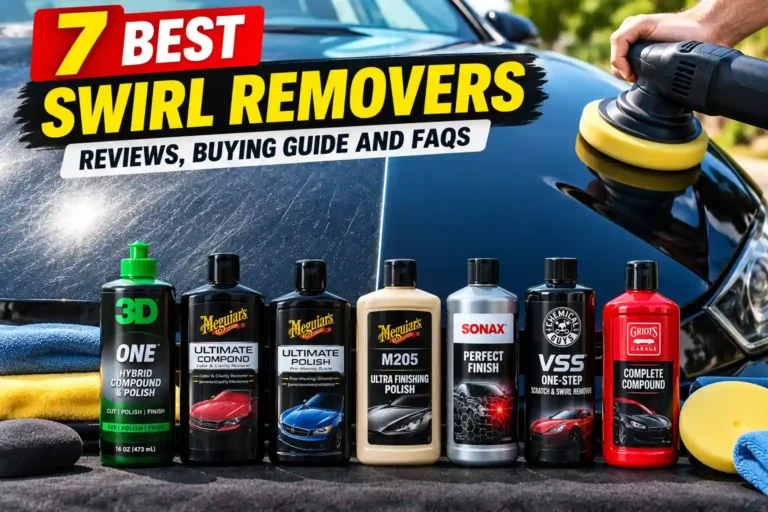
The best swirl remover is the mildest abrasive product that corrects your paint’s defects with a suitable pad and technique. Fine polishes suit light wash marks, while compounds provide more correction when a finishing polish is insufficient.
Swirl removers do not replace missing paint or safely erase every scratch. On clear-coated paint, abrasive correction removes a small amount of the clear layer to improve surface defects. Paint condition and previous polishing therefore matter as much as the product name.
This guide compares seven compounds and polishes using published product information and application guidance. These are research-based recommendations for different needs, without claimed hands-on testing or numerical correction rankings.
Best Swirl Removers of 2026: Quick Comparison
Start with defect severity and whether you will work by hand or machine. Ultimate Polish and M205 focus on refinement; compounds and hybrid products cover jobs that may require more correction.
This article contains affiliate links. If you buy through them, we may earn a commission at no extra cost to you.
| # | Product | Best For / Category | Amazon |
|---|---|---|---|
| 1 | 3D ONE Hybrid Compound and Polish, 16 oz | Pad-controlled correction | Check Price on Amazon |
| 2 | Meguiar’s Ultimate Compound, 15.2 oz | DIY correction beyond a fine polish | Check Price on Amazon |
| 3 | Meguiar’s Ultimate Polish, 16 oz | Fine swirls before waxing | Check Price on Amazon |
| 4 | Meguiar’s M205 Ultra Finishing Polish, 8 oz | Refining after compounding | Check Price on Amazon |
| 5 | SONAX Perfect Finish, 250 mL | Machine correction with finish flexibility | Check Price on Amazon |
| 6 | Chemical Guys VSS One-Step Scratch & Swirl Remover, 16 oz | A combined cut-and-polish approach | Check Price on Amazon |
| 7 | Griot’s Garage Complete Compound, 16 oz | A compound for an existing Griot’s routine | Check Price on Amazon |
7 Best Swirl Removers Reviewed
3D ONE suits users adjusting correction through pad choice, while Ultimate Compound offers a DIY compounding route. Ultimate Polish and M205 handle finer work. SONAX Perfect Finish, Chemical Guys VSS, and Griot’s Complete Compound provide additional approaches for different equipment and paint conditions.
1. Best for Pad-controlled correction: 3D ONE Hybrid Compound and Polish, 16 oz
Best for: Machine-polishing users who want one liquid for different correction stages.
3D ONE combines compound and polish functions in a single liquid. Its correction and finishing behavior depend on the pad, machine, paint, and technique rather than the bottle alone.
The manufacturer describes using a cutting setup for stronger correction and a softer pad for refinement. That flexibility suits someone who already owns a polisher and wants to adjust the process without buying a separate liquid for every stage.
One liquid does not guarantee one pass or one pad. Test an area first, inspect the finish, and decide whether the result needs refinement. A separate protective product is still needed afterward.
Key Features
- Hybrid compound-and-polish formula.
- Correction can be adjusted through pad and machine choice.
- Manufacturer describes cutting and finishing applications.
- Linked bottle contains 16 oz.
Pros
- One liquid can serve different correction stages.
- Useful for users building a machine-polishing process.
Cons
- Pad selection remains essential.
- A one-stage finish is not assured on every paint system.
Buying Decision
Choose 3D ONE when you want flexibility and are willing to test pad combinations. Choose a dedicated fine polish if the paint needs only light refinement.
2. Best for DIY correction beyond a fine polish: Meguiar’s Ultimate Compound, 15.2 oz
Best for: Owners addressing swirls and oxidation that need more than gloss enhancement.
Meguiar’s Ultimate Compound is an abrasive correction product for suitable glossy automotive paint. It targets defects such as swirls, oxidation, and scratches within the limits of the remaining finish.
Meguiar’s supports hand or dual-action application. Hand work can suit a small area, while a machine is more practical when consistent correction is needed across large panels.
This is a compound, so do not choose it automatically for a nearly defect-free car. Start with the mildest effective combination, and inspect for haze before deciding whether a finishing polish is needed.
Key Features
- Abrasive compound for paint correction.
- Hand or dual-action polisher application.
- Designed for defects on suitable glossy paint and clear coat.
- Linked G17216 listing identifies 15.2 oz.
Pros
- Offers a hand-application route for small jobs.
- Useful when light finishing polish is insufficient.
Cons
- Can be more aggressive than very mild swirls require.
- Some finishes may need a refining step afterward.
Buying Decision
Choose Ultimate Compound for defects that justify compounding after a test spot. Choose Ultimate Polish first if the problem is limited to fine towel marks and mild swirls.
3. Best for Fine swirls before waxing: Meguiar’s Ultimate Polish, 16 oz
Best for: Owners refining light defects and improving gloss on suitable glossy paint.
Meguiar’s Ultimate Polish is a prewax finishing product for fine swirls and towel marks. The formula also contains conditioning oils that enhance the appearance of paint, particularly darker colors.
Its role is different from Ultimate Compound. Use it when a mild refining step is enough, or when a compounded test area needs a clearer finish before protection.
Evaluate defect removal as well as immediate gloss. A richer-looking panel does not by itself prove that every mark has been corrected. Persistent scratches may need a different process, while deeper damage may be better left alone.
Key Features
- Fine polishing action for light defects.
- Conditioning oils support gloss and color depth.
- Intended as a preparation step before wax.
- Hand or machine application for suitable paint.
Pros
- A mild starting option for fine wash marks.
- Useful for refinement before applying protection.
Cons
- Limited suitability for heavier defects.
- Enhanced gloss alone is not proof of complete correction.
Buying Decision
Choose Ultimate Polish when fine swirls are the main issue. Step up to a compound only when a careful test shows that a milder approach is insufficient.
4. Best for Refining after compounding: Meguiar’s M205 Ultra Finishing Polish, 8 oz
Best for: Detailers removing light defects or refining a previous correction stage.
Meguiar’s M205 Ultra Finishing Polish is designed to remove light defects and refine the surface after more aggressive correction. It is an abrasive finishing polish rather than a protective sealant.
The manufacturer describes swirl removal and a deep-gloss finish. Pad choice and technique still determine whether your particular paint finishes cleanly, especially on surfaces that mar easily.
The linked M20508 bottle contains 8 oz. That smaller format may suit an occasional project, but owners correcting several vehicles should compare quantities before purchasing. Do not assume every M205 listing is the same bottle size.
Key Features
- Abrasive finishing polish for light defects.
- Suitable for refinement after compounding.
- Designed to improve gloss and surface clarity.
- Linked M20508 configuration contains 8 oz.
Pros
- Clear role in a two-stage correction process.
- Small bottle suits limited or occasional projects.
Cons
- Not a dedicated heavy-cut compound.
- Provides no substitute for final paint protection.
Buying Decision
Choose M205 for light correction or the finishing stage after compounding. Choose a compound when the test spot confirms that the defects need more cut.
5. Best for Machine correction with finish flexibility: SONAX Perfect Finish, 250 mL
Best for: Machine-polishing enthusiasts choosing a pad to balance cut and gloss.
SONAX Perfect Finish is a machine-polishing product designed to combine defect correction with a refined finish. The brand’s US guidance allows dual-action or rotary use with suitable pads.
Its useful feature is the ability to adapt the correction process to the surface. A finish that responds well to one pad can need another pad or an extra refining stage on a different car.
This is not a reason for a beginner to start with a rotary machine. Choose equipment you can control, follow the product guidance, and establish the result on a small test area before proceeding.
Key Features
- Machine polish for correction and finishing.
- Silicone-free polishing formula.
- US guidance supports suitable dual-action and rotary setups.
- Linked bottle contains 250 mL, about 8.5 fl oz.
Pros
- Useful for tailoring cut and finish through pad choice.
- Can fit an established machine-correction workflow.
Cons
- Less suitable for buyers seeking simple hand application.
- Paint response still determines whether refinement is needed.
Buying Decision
Choose Perfect Finish when you have machine-polishing experience and want a flexible polish. Choose a hand-approved option for a small manual touch-up.
6. Best for A combined cut-and-polish approach: Chemical Guys VSS One-Step Scratch & Swirl Remover, 16 oz
Best for: DIY detailers considering a single corrective liquid for light to moderate defects.
Chemical Guys VSS is marketed as a combined compound and polish for light to moderate scratches, swirls, and oxidation. It aims to correct defects and leave a glossy finish without switching liquids.
That makes it worth considering for an enhancement project where the goal is a cleaner-looking finish rather than removal of every visible mark. Use a test spot to see whether the selected pad leaves acceptable clarity.
One-step refers to the corrective liquid, not the whole detail. Washing, preparation, inspection, and protection remain separate jobs. Deeper scratches are not automatically safe to remove because the product mentions scratch correction.
Key Features
- Combined compound-and-polish formulation.
- Intended for light to moderate paint defects.
- Single 16 oz bottle in the linked listing.
- Designed to combine correction and gloss improvement.
Pros
- Reduces the need to switch corrective liquids.
- Fits a practical paint-enhancement project.
Cons
- Cannot assure a finished result on every paint system.
- Protection and preparation remain separate steps.
Buying Decision
Choose VSS if a combined liquid suits your project and a test spot produces the finish you want. Choose a dedicated fine polish for very light marring.
7. Best for A compound for an existing Griot’s routine: Griot’s Garage Complete Compound, 16 oz
Best for: Owners who need correction before returning to wax or sealant.
Griot’s Garage Complete Compound is designed to remove paint defects and leave a surface ready for protection. The manufacturer emphasizes microfiber wipe-off and suitability for automotive paint, including clear coat.
It is a correction product rather than a wax, despite the word complete. You still need clean paint before use and a separate protective step afterward.
Its place in this list is as an alternative compounding route for someone already comfortable with Griot’s products. Judge the actual finish under good lighting; the manufacturer’s wax-ready description does not guarantee every paint system will need no refinement.
Key Features
- Paint-correction compound.
- Manufacturer identifies clear-coat compatibility.
- Designed for microfiber residue removal.
- Linked 10862 bottle contains 16 oz.
Pros
- Fits a correction-then-protection workflow.
- Useful alternative for existing Griot’s users.
Cons
- Compounding may be unnecessary for faint swirls.
- Some paints may still require a finer finishing step.
Buying Decision
Choose Complete Compound when correction is needed and you prefer the Griot’s system. Choose a fine polish when the paint mainly needs mild refinement.
Swirl Remover vs. Compound vs. Polish: What Is the Difference?
A swirl remover can be a compound, a fine polish, or a combined correction product. The term describes the intended problem more reliably than it describes a fixed level of abrasiveness.
- Compound: Usually provides stronger defect correction, with a possible need for refinement.
- Finishing polish: Targets lighter defects or improves clarity after compounding.
- Hybrid compound and polish: Can offer different correction levels with different pads and techniques.
- Glaze: May improve appearance by temporarily concealing defects rather than removing them.
- Wax or sealant: Adds protection and may improve appearance, but is not a replacement for abrasive correction.
Do not compare cut numbers across brands as though they use one universal scale. The pad, paint, machine, and operator all influence the result.
How We Chose These Swirl Removers
We compared identifiable correction products, manufacturer descriptions, supported application methods, and practical limitations. Each recommendation serves a specific task rather than representing an overall laboratory winner.
Our selection criteria were:
- Correction role: Fine polish, compound, or hybrid formula.
- Application method: Hand suitability or machine-focused use.
- Paint compatibility: Guidance for suitable glossy automotive finishes.
- Process flexibility: Whether pad changes can alter correction and finishing.
- Follow-up needs: Inspection, possible refinement, and protection.
- Product clarity: Correct listing identity and bottle size where specified.
We did not measure clear-coat removal, dust generation, polishing speed, or correction percentages. Those results would require controlled testing on comparable paint systems.
How to Choose the Best Swirl Remover
Choose a swirl remover by assessing the paint, starting with the mildest plausible process, and testing before treating the whole vehicle. A more aggressive bottle is not automatically a better purchase.
Identify the Marks Before Buying
Swirls are fine surface scratches that become conspicuous under a concentrated light source. Other problems, including mineral deposits, oxidation, and deep etching, may require a different assessment.
Wash first and inspect clean paint. Do not compound a deposit that could be removed with a suitable cleaner. If paint is peeling, cracked, or showing clear-coat failure, polishing cannot restore the missing coating.
Match the Product to the Defect
For fine wash marks, start with a finishing polish and a suitable mild pad. For defects that remain after a sensible test, a compound or hybrid may be appropriate.
Stop when further improvement would require disproportionate paint removal. Leaving a deeper isolated mark can be the better choice, particularly on older paint or a panel with an unknown repair history.
Choose Hand or Machine Application Realistically
Hand application can suit a small area when the chosen product approves it. Correcting an entire vehicle evenly by hand is a much larger effort.
A dual-action machine can make broad-panel work more consistent, but it still requires technique and attention. Follow the machine, pad, and liquid instructions rather than copying one speed or pressure setting across every combination.
Budget for Pads and Inspection
A polish bottle is only part of the purchase. Suitable pads, clean towels, masking materials, lighting, and final protection all affect the process.
Keep enough pads available to avoid continuing with a saturated or contaminated pad. Inspect after each test area and change one variable at a time so you can understand what improved the result.
Check Paint History and Surface Type
Previously polished paint, unknown repaints, and thin edges require caution. A paint-thickness gauge can help assess a panel, but a basic reading on metal usually does not isolate the remaining clear coat.
Do not apply ordinary abrasive correction to matte paint or satin finishes. Wraps, paint protection film, and specialty surfaces require their own approved methods.
How to Remove Swirl Marks from Car Paint
Remove swirls through a controlled correction process on clean, suitable paint. Test the least aggressive practical combination and expand the work only after checking the result.
- Wash the vehicle thoroughly and dry it with clean equipment.
- Remove contamination where necessary using compatible products and methods.
- Inspect the finish under good lighting and note damaged or uncertain areas.
- Protect sensitive trim and avoid aggressive work on sharp edges.
- Select a mild starting pad and liquid combination.
- Test a small area following the equipment and product directions.
- Remove residue gently and inspect before changing the process.
- Refine with a milder combination if the corrected area shows haze.
- Prepare the surface as required for your chosen wax, sealant, or coating.
- Apply protection and improve the washing habits that caused the marks.
A successful test spot should improve the defects while leaving acceptable clarity. If the paint becomes unusually hot, the pad behaves unpredictably, or damage becomes apparent, stop and reassess.
Common Swirl-Removal Mistakes
The main mistakes are using excessive cut, working with dirty pads, trusting gloss alone, and trying to remove every scratch. A controlled process gives you more useful information than repeatedly polishing the same spot.
Starting with the Strongest Compound
Heavy correction can remove more paint than a light defect needs. Start mild and escalate only after inspecting the test result. A bottle’s scratch-removal claim is not a reason to skip assessment.
Using One Dirty Pad for the Whole Car
Residue and contamination change pad behavior. Clean or replace pads as the process requires, and never continue with a pad that has touched the ground before it is properly cleaned.
Mistaking Immediate Gloss for Defect Removal
Polishing oils can change how the surface looks. Inspect the actual marks under suitable lighting, and use the preparation method required by your next protective product. Avoid assuming a dramatic shine proves complete correction.
Chasing Scratches Through the Clear Coat
Some marks are too deep to remove safely. Touch-up, professional repair, or accepting a remaining defect may be appropriate. More passes are not an automatic solution when the paint’s remaining thickness is unknown.
Returning to the Same Wash Routine
Correction does not make paint immune to scratching. Rinse loose dirt, use clean wash media, avoid dragging gritty towels across panels, and maintain the tools that touch the finish.
conclusion
Choose Ultimate Polish for fine wash marks and prewax refinement. Choose M205 when light correction or finishing after compounding is your main task. Both belong in a milder correction process rather than a heavy-cut starting point.
Consider 3D ONE or SONAX Perfect Finish when you have a machine and want to tune results through pad selection. Ultimate Compound and Griot’s Complete Compound suit defects that justify compounding, while VSS offers another combined cut-and-polish approach.
Let the test spot decide the final process. The best result is a useful improvement with sensible paint preservation, followed by protection and better wash habits.
Frequently Asked Questions
Ceramic coatings, fresh paint, supplies, and unusual residue can complicate a correction project. These answers cover additional situations beyond selecting and using the products above.
Can I polish a ceramic-coated car without affecting the coating?
Abrasive polishing can reduce or remove a ceramic coating. If correction is needed, plan for appropriate surface preparation and renewed protection afterward. Ask the installer about the coating system and any service implications before starting.
How long should I wait before polishing freshly repainted panels?
Use the waiting period given by the body shop or paint-system manufacturer. Paint systems and curing conditions vary, so a universal number of days is unreliable. Tell the shop whether you plan to polish, seal, or coat the repaired panel.
Why does my polishing pad show the car’s paint color?
Color transfer can occur when polishing a single-stage paint that has no separate clear coat. Unexpected color transfer on a finish believed to be clear-coated can indicate a problem. Stop and verify the paint system before continuing.
Can I use a household drill instead of a car polisher?
A household drill is not a direct substitute for a dedicated automotive polisher. Purpose-made drill correction kits may suit specific small-area work, but follow that kit’s instructions. Avoid improvising a full-panel correction setup with an unsuitable backing plate or pad.
Can I mix two swirl removers to make a stronger polish?
Do not mix correction products unless the manufacturers explicitly approve the combination. Different abrasives and carriers may behave unpredictably together. Adjust an approved pad-and-liquid process instead of making an untested mixture.
Can I reuse towels that contain dried polishing residue?
Wash them appropriately before reuse and inspect them for hardened residue or embedded debris. Keep towels with stubborn contamination away from paint. A towel that feels soft overall can still contain particles that mar the finish.