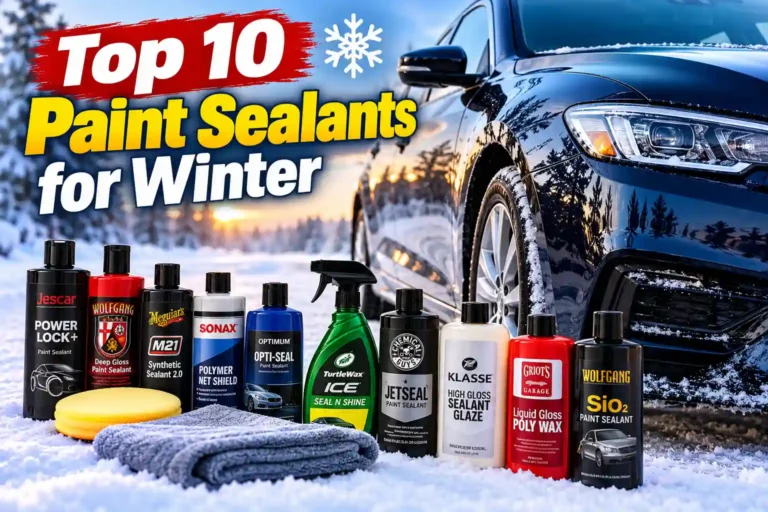
Paint sealants for winter add a sacrificial protective layer to prepared paint and can make routine cleaning easier. They do not prevent every scratch, stop stone chips, or replace washing after driving through salty road spray.
The useful choice depends on where you can apply it, how long the car can remain dry, and whether you prefer a traditional liquid or a spray-and-wipe product. A sealant with a long advertised lifespan is less useful if freezing weather prevents correct application.
This guide compares ten options through published product information and application guidance. Recommendations reflect suitability for different winter-care routines, rather than hands-on testing or a measured road-salt endurance ranking.
Best Paint Sealants for Winter: Quick Comparison
Choose a traditional liquid for a planned fall detail, a wipe-on sealant for fewer application stages, or a maintenance spray for suitable wash days. The list includes dedicated sealants and clearly identified synthetic or hybrid alternatives.
This article contains affiliate links. If you buy through them, we may earn a commission at no extra cost to you.
| # | Product | Best For / Category | Amazon |
|---|---|---|---|
| 1 | Jescar Power Lock Plus, 16 oz | Traditional polymer protection | Check Price on Amazon |
| 2 | Wolfgang Deep Gloss Paint Sealant 3.0, 16 oz | Gloss-focused prewinter detailing | Check Price on Amazon |
| 3 | Meguiar’s M21 Synthetic Sealant 2.0, 16 oz | Reflective finish with synthetic protection | Check Price on Amazon |
| 4 | SONAX Polymer Net Shield, 340 mL | Section-by-section application | Check Price on Amazon |
| 5 | Optimum Opti-Seal, 8 oz with Applicator | Wipe-on protection without routine buffing | Check Price on Amazon |
| 6 | Turtle Wax ICE Seal N Shine, 16 oz | Simple spray-and-wipe maintenance | Check Price on Amazon |
| 7 | Chemical Guys JetSeal, 16 oz | A dedicated liquid-sealant routine | Check Price on Amazon |
| 8 | Klasse High Gloss Sealant Glaze, 16.9 oz | An acrylic-sealant approach | Check Price on Amazon |
| 9 | Griot’s Garage Liquid Gloss Poly Wax, 16 oz Kit | A synthetic-protection application kit | Check Price on Amazon |
| 10 | Wolfgang SiO2 Paint Sealant | An SiO2-enhanced liquid sealant | Check Price on Amazon |
10 Paint Sealants for Winter Reviewed
Jescar and Wolfgang Deep Gloss suit a planned prewinter detail, while Opti-Seal reduces the usual application stages. SONAX favors small-section work, Turtle Wax suits maintenance sessions, and the remaining picks offer different formulas or application preferences.
1. Best for Traditional polymer protection: Jescar Power Lock Plus, 16 oz
Best for: Owners preparing a daily driver before sustained winter weather.
Jescar Power Lock Plus is a polymer sealant that can be spread by hand or machine. It suits owners who want a dedicated protective step after washing and any necessary paint preparation.
Jescar specifies application above 50°F, a 15 to 30 minute setting period, and at least 12 hours without rain or washing. Those requirements make a mild fall day or suitable garage more practical than an exposed driveway during freezing weather.
Its appeal is a clear application process rather than a promise to survive every winter. Choose it when you can prepare the surface and protect the fresh application from moisture.
Key Features
- Polymer sealant for prepared automotive paint.
- Hand or machine application.
- Manufacturer specifies application above 50°F.
- Requires a dry curing window after application.
Pros
- Works with a hand applicator or existing polishing equipment.
- Published timing helps plan a prewinter detail.
Cons
- Unsuitable for an unheated driveway below its recommended temperature.
- Needs protection from rain during initial curing.
Buying Decision
Choose Power Lock Plus for a planned prewinter application with indoor parking afterward. Choose a maintenance spray when your routine favors shorter, more frequent sessions.
2. Best for Gloss-focused prewinter detailing: Wolfgang Deep Gloss Paint Sealant 3.0, 16 oz
Best for: Enthusiasts who can leave their car sheltered after application.
Wolfgang Deep Gloss Paint Sealant 3.0 combines polymer protection with an emphasis on a rich, reflective finish. It makes sense for an owner who wants to finish a fall detail with protection and an improved appearance.
The brand directs users to apply a thin layer, wait 30 to 45 minutes before removal, and allow at least 12 hours before moisture exposure. Overnight dew therefore matters even when the forecast shows no rain.
Wolfgang markets resistance to road salt and environmental contamination. Treat that as a protective-product claim, not evidence that salt can safely remain on the vehicle until spring.
Key Features
- Liquid polymer paint sealant.
- Can be applied by hand or machine.
- Thin application followed by microfiber removal.
- At least 12 hours of dry curing specified.
Pros
- Fits a complete wash, preparation, and protection routine.
- Useful for buyers prioritizing gloss alongside protection.
Cons
- Requires more waiting than a simple wipe-on product.
- Dew can interfere with the recommended curing conditions.
Buying Decision
Choose Wolfgang when finish appearance and sheltered curing both fit your plans. Opti-Seal is more convenient if you want to avoid a traditional haze-and-buff stage.
3. Best for Reflective finish with synthetic protection: Meguiar’s M21 Synthetic Sealant 2.0, 16 oz
Best for: Drivers who prefer a conventional liquid sealant from Meguiar’s.
Meguiar’s M21 uses a synthetic polymer formula designed to add gloss and water beading. Its role is the final protective step on paint that has already been cleaned and, if needed, corrected.
The brand also describes a visual reduction in fine scratches and swirls. That wording matters: improving their appearance does not establish that M21 abrasively removes those defects.
For winter preparation, use it because its liquid format suits your detailing routine. Do not choose it as a substitute for swirl correction or expect a deeper finish to prove superior salt resistance.
Key Features
- Synthetic polymer sealant.
- Manufacturer emphasizes reflective gloss and water beading.
- Liquid format with wipe-off removal.
- Linked listing is the M2116, 16 oz bottle.
Pros
- Clear role as a final paint-protection step.
- Suitable for buyers already using a conventional liquid-wax routine.
Cons
- Visual swirl improvement is not permanent correction.
- Needs a separate cleaning and preparation stage.
Buying Decision
Choose M21 when you want synthetic protection in a familiar liquid format. Buy an abrasive polish separately if swirl removal is also part of your project.
4. Best for Section-by-section application: SONAX Polymer Net Shield, 340 mL
Best for: Owners who prefer finishing each small area before moving on.
SONAX Polymer Net Shield is a wax-free hybrid paint sealant supplied in an aerosol can. SONAX describes water repellency and reduced dirt adhesion, with protection advertised for up to six months.
Its instructions differ from traditional haze-and-buff liquids. Work on clean, dry paint in partial areas, spread the product, and buff without allowing it to dry. Do not coat the entire vehicle and return later to remove it.
The advertised duration is not a measured winter result for your climate. Its practical advantage is a clearly defined small-section process that suits owners who like checking their work as they go.
Key Features
- Wax-free hybrid paint sealant.
- Aerosol format, 340 mL.
- Apply and remove in small sections.
- Manufacturer says not to let the product dry.
Pros
- Avoids a whole-car hazing stage.
- Small-area workflow makes coverage easier to monitor.
Cons
- Requires timely buffing.
- Aerosol handling and storage need attention to the label.
Buying Decision
Choose Net Shield when working one section at a time suits you. Choose a traditional liquid if you prefer applying across larger areas before removal.
5. Best for Wipe-on protection without routine buffing: Optimum Opti-Seal, 8 oz with Applicator
Best for: Drivers who want fewer application stages after preparing their paint.
Optimum Opti-Seal is a concentrated polymer sealant that is spread thinly and allowed to flash. It avoids the normal apply, haze, and buff sequence of conventional liquid sealants.
The manufacturer identifies no cleaners, fillers, or polishing abrasives in the formula. That makes surface preparation a separate job. Applying it over oxidation will not turn it into a corrective polish.
Using too much can produce streaking, which Optimum advises removing with a clean microfiber towel. The product fits a careful, light-handed application style rather than generous spraying across every panel.
Key Features
- Concentrated polymer formula.
- Wipe-on application without routine residue removal.
- No cleaning or polishing abrasives.
- Linked 8 oz configuration includes an applicator.
Pros
- Fewer application stages than traditional liquid sealants.
- Useful when you want a separate, noncorrective protection step.
Cons
- Overapplication can leave streaks.
- Does not clean or correct neglected paint.
Buying Decision
Choose Opti-Seal when simplicity matters after preparation. Choose Power Lock Plus if you prefer a conventional liquid that sets before buffing.
6. Best for Simple spray-and-wipe maintenance: Turtle Wax ICE Seal N Shine, 16 oz
Best for: Owners who can refresh protection during suitable winter wash days.
Turtle Wax ICE Seal N Shine is a hybrid sealant spray that combines protective polymers with carnauba wax. It is a hybrid option rather than a wax-free traditional sealant.
The manufacturer directs users to wash and dry the vehicle, apply a small number of sprays per panel, and spread with microfiber. It is not a spray-on, rinse-off product, even though other products in the same aisle use that method.
Its main appeal is fitting protection into an ordinary wash routine. That can be useful during a mild winter break, provided the panel temperature and weather meet the label requirements.
Key Features
- Hybrid polymer and carnauba spray formula.
- Application to washed, dried surfaces.
- Microfiber spreading rather than rinse-off application.
- Linked listing is a single 16 oz bottle.
Pros
- Fits short maintenance sessions.
- Requires no machine for spreading.
Cons
- Still needs a clean surface and suitable application weather.
- Not the right choice for buyers seeking a wax-free formula.
Buying Decision
Choose Seal N Shine if regular upkeep is more realistic than one long detailing session. Choose a traditional liquid for a dedicated fall preparation routine.
7. Best for A dedicated liquid-sealant routine: Chemical Guys JetSeal, 16 oz
Best for: Detailers who want a separate protection stage after polishing.
Chemical Guys JetSeal is a synthetic paint sealant applied with an applicator and removed after its prescribed setting period. It fits a deliberate preparation-and-protection process.
The brand markets environmental and UV protection, but those claims do not establish a winter endurance ranking against the other products here. Application conditions, wash chemicals, and driving exposure remain important.
Use the standard gloss-paint product linked here rather than assuming JetSeal Matte has identical instructions. A similar name does not mean the same intended finish.
Key Features
- Synthetic liquid paint sealant.
- Applicator-based spreading with subsequent removal.
- Separate protection step after surface preparation.
- Standard JetSeal formulation for a glossy finish.
Pros
- Fits an established wash-and-polish workflow.
- Can be applied without buying a machine.
Cons
- Includes a setting and removal stage.
- Standard and matte variants require deliberate selection.
Buying Decision
Choose JetSeal when you prefer its conventional application method. Choose Opti-Seal if avoiding a separate buffing stage matters more.
8. Best for An acrylic-sealant approach: Klasse High Gloss Sealant Glaze, 16.9 oz
Best for: Owners who want acrylic protection on already-clean paint.
Klasse High Gloss Sealant Glaze is an acrylic sealant despite the word glaze in its name. It should not be confused with a temporary gloss glaze or the separate Klasse All-In-One cleaner product.
Its place in a winter routine is after cleaning and preparation. Treat it as protection for an existing finish, not a shortcut for removing oxidation or embedded contamination.
Apply sparingly and follow the bottle’s removal and curing directions. The useful distinction is its acrylic-sealant format, not an assumption that more layers automatically create proportionally more protection.
Key Features
- Acrylic paint sealant.
- Distinct from Klasse All-In-One.
- Liquid format intended for prepared surfaces.
- Linked bottle contains 16.9 oz.
Pros
- Offers an alternative to polymer-and-wax hybrid sprays.
- Keeps cleaning and protection as separate steps.
Cons
- Does not replace paint cleaning or correction.
- Requires attention to thin, even application.
Buying Decision
Choose Klasse if you specifically want an acrylic sealant. Choose Seal N Shine if spray-and-wipe maintenance better matches your available time.
9. Best for A synthetic-protection application kit: Griot’s Garage Liquid Gloss Poly Wax, 16 oz Kit
Best for: Buyers who also need a hand applicator and removal towel.
Griot’s Garage Liquid Gloss Poly Wax uses synthetic polymer technology, so the wax name should not lead you to classify it as a conventional carnauba paste. The linked 10916 kit pairs the liquid with application accessories.
The included hand applicator and removal towel can make sense for a buyer starting with few supplies. Check the selected kit contents before purchasing, particularly when sellers offer different bundles.
Griot’s positions Poly Wax for prepared, defect-free paint. It belongs at the protection stage, after any correction, and does not replace the compound or polish needed for swirl removal.
Key Features
- Synthetic polymer-based liquid protection.
- Linked 10916 kit contains a 16 oz bottle.
- Kit configuration includes a hand applicator and removal towel.
- Intended as protection after paint preparation.
Pros
- Accessories suit buyers assembling basic supplies.
- Hand application avoids the need for a polisher.
Cons
- Existing detailers may already own suitable accessories.
- Does not correct swirls before sealing.
Buying Decision
Choose the kit when you need the accessories as well as the liquid. If your shelves already contain applicators and towels, compare bottle-only alternatives.
10. Best for An SiO2-enhanced liquid sealant: Wolfgang SiO2 Paint Sealant
Best for: Enthusiasts who want an SiO2-enhanced alternative to traditional sealant formulas.
Wolfgang SiO2 Paint Sealant is a separate product from Deep Gloss Paint Sealant 3.0. It is marketed as an SiO2-enhanced sealant with water-repellent properties, gloss, and surface slickness.
The SiO2 description does not make it equivalent to a professionally installed, multiyear ceramic coating. Buy it as a sealant and plan for maintenance based on the vehicle’s exposure.
The product information specifies approximately 12 hours before full moisture protection. A dry garage or reliable sheltered period is therefore still part of the buying decision, even with a ceramic-related ingredient on the label.
Key Features
- SiO2-enhanced paint sealant.
- Distinct from Wolfgang Deep Gloss 3.0.
- Designed to add water repellency and gloss.
- Approximately 12 hours specified for full moisture protection.
Pros
- Offers an SiO2-enhanced option in a sealant format.
- Fits a dedicated prewinter detail.
Cons
- Does not remove the need for sheltered curing.
- Should not be treated as a multiyear coating installation.
Buying Decision
Choose this Wolfgang if you want an SiO2-enhanced sealant and can provide suitable curing conditions. Choose a simpler maintenance spray if application time is your main constraint.
Paint Sealant vs. Wax vs. Ceramic Coating for Winter
A paint sealant provides surface protection, while an abrasive polish corrects defects. Wax, sealant, and coating labels can overlap, so read the actual product instructions rather than judging protection by one word on the bottle.
- Traditional sealant: Usually a synthetic or acrylic protective product applied after preparation.
- Hybrid sealant wax: Combines protective polymers with wax or other ingredients.
- SiO2 spray or sealant: Uses ceramic-related chemistry without necessarily being a multiyear coating.
- Dedicated ceramic coating: A separate installation process with its own preparation, curing, and maintenance requirements.
None of these repairs chipped paint or seals existing rust. Exposed metal and damaged paint need appropriate repair, particularly where winter roads are salted.
How We Chose These Winter Paint Sealants
We compared documented formulas, application methods, curing instructions, and the practical demands of winter upkeep. The categories describe buyer suitability, not laboratory-proven superiority.
The main selection criteria were:
- Product identity: A clearly identifiable sealant or labeled hybrid alternative.
- Application method: Hand spreading, spray-and-wipe, or wipe-on protection.
- Curing demands: Whether a dry sheltered period affects practicality.
- Preparation: A clear distinction between protection and correction.
- Maintenance fit: Whether the product suits planned detailing or shorter upkeep sessions.
- Purchase clarity: Specific bottles or kits rather than unidentified bundles.
No equal-condition winter test was performed. We therefore do not assign numerical salt-resistance scores or promise that one application lasts until spring.
How to Choose a Paint Sealant for Winter
Choose a winter paint sealant by matching its temperature limits, application method, and curing requirements to the conditions you can provide. After that, consider how often you can wash and refresh protection.
Start with Your Application Space
A dry, suitably warm workspace can matter more than the formula’s marketing claims. Jescar specifies application above 50°F, while several products require a substantial dry period afterward.
Check both the air and panel conditions against the label. A garage that remains near freezing is shelter, but it may still be too cold for the chosen product. Schedule the work before sustained winter weather when possible.
Separate Buffing Time from Curing Time
Removing visible residue does not necessarily mean the protective film is ready for rain. Follow the product’s separate instructions for removal, water exposure, additional coats, and washing.
Allow for dew as well as rain. If the vehicle must remain outside overnight, check whether the available dry period is long enough before starting.
Buy for Your Maintenance Routine
A traditional liquid makes sense when you can complete a full preparation session. A spray may suit someone who can wash regularly and wants to add protection during those visits.
Neither approach excuses sealing over dirt. If winter grime remains on the panel, clean it first rather than using the protection product as a waterless wash.
Treat Advertised Durability as Conditional
Exposure, mileage, wash chemistry, preparation, and storage all affect longevity. An advertised maximum is not a calendar guarantee for a daily driver on treated highways.
Judge the finish after a proper wash. Dirt can change water behavior, and strong beading alone does not measure resistance to every form of damage.
Check Your Existing Finish
Use glossy-paint products only where their instructions allow. Matte paint, satin finishes, vinyl wraps, and paint protection film need finish-specific approval.
If the car already has a coating, follow that system’s maintenance guidance. An additional sealant can change its surface behavior, so compatibility matters more than adding another product for its own sake.
How to Apply Paint Sealant Before Winter
Apply paint sealant to clean, prepared paint under the conditions specified by its manufacturer. Preparation and curing deserve as much attention as the spreading step.
- Wash thoroughly and rinse away loose road film.
- Inspect for tar, iron contamination, and bonded deposits. Treat only what requires removal using compatible products.
- Correct defects if needed and appropriate for the remaining paint condition.
- Follow the chosen sealant’s preparation requirements and dry the surface.
- Apply a thin, even layer with clean equipment.
- Remove residue according to that product’s directions. Do not copy the timing from a different sealant.
- Keep the vehicle dry for the specified curing period.
- Resume suitable washing and inspect the finish during winter maintenance.
Do not clay automatically before every application. Mechanical decontamination can mar paint, so use it when the surface needs it and include any necessary refinement in your plan.
Common Winter Sealant Mistakes
The most common mistakes are applying too cold, using too much, ignoring curing, and treating a paint sealant as a replacement for cleaning. Avoiding these problems makes the application more consistent.
Applying a Thick Coat
More product can increase streaking and removal effort. Spread the amount specified by the label and use good lighting to check coverage rather than building a visibly heavy layer.
Sealing Over Salt Film
Protection products do not make dirty paint clean. Remove contamination through a suitable wash before touching the surface with an applicator or towel.
Expecting Paint Sealant to Protect the Undercarriage
Paint sealant is not an underbody rust treatment. Wheel wells, seams, exposed metal, and the underside require their own cleaning and maintenance based on the vehicle’s condition and manufacturer guidance.
Waiting Until Protection Has Completely Failed
Inspect during routine washing and maintain the finish when suitable conditions return. Plan around the product’s instructions instead of waiting for a fixed advertised anniversary.
conclusion
Choose Jescar Power Lock Plus for a conventional polymer application when you have suitable warmth and a dry curing period. Wolfgang Deep Gloss is a useful alternative when gloss is a major part of the project.
Choose Opti-Seal if fewer application stages matter most. For regular spray-and-wipe upkeep, consider Turtle Wax ICE Seal N Shine. SONAX Polymer Net Shield fits owners who prefer completing small sections immediately.
The right purchase is the product you can apply correctly and maintain through your local winter. Leave room in the budget for clean towels, washing supplies, and any necessary paint repairs.
Frequently Asked Questions
Winter storage, repairs, and unusual contamination raise questions beyond choosing and applying a sealant. These answers address those additional situations.
Can paint sealant make snow slide off without brushing?
Do not rely on sealant to make snow slide off safely. Snow weight, ice bonding, panel shape, and temperature vary. Clear the vehicle with appropriate tools before driving, even if the paint has a fresh protective layer.
Can I apply sealant over newly repainted panels?
Follow the body shop’s or paint manufacturer’s waiting period before sealing fresh paint. Refinish systems vary, so there is no single safe interval for every repair. Tell the shop which product you plan to use.
What should I do if my sealant bottle freezes?
Check the manufacturer’s storage guidance and ask whether the product remains usable. Thawing does not establish that the formula still performs correctly. Do not apply a product with persistent unusual separation or texture without manufacturer advice.
Will sealant stop bird droppings from etching paint?
Sealant does not guarantee protection against bird-dropping etching. Remove the deposit promptly with a suitable cleaning method and avoid dry scraping. The protective layer should be treated as extra help, not permission to leave contamination in place.
Can I use paint sealant on windshield wipers?
Do not apply paint sealant to wiper blades unless the product explicitly approves that use. Rubber care and automotive paint protection are different applications. Use the vehicle and blade manufacturer’s cleaning guidance.
Should I seal a car that will stay in storage all winter?
A compatible sealant can be part of preparing clean paint for storage, but it is only one part of the plan. Dry the vehicle thoroughly and address the storage environment, cover suitability, battery care, and tire requirements separately.