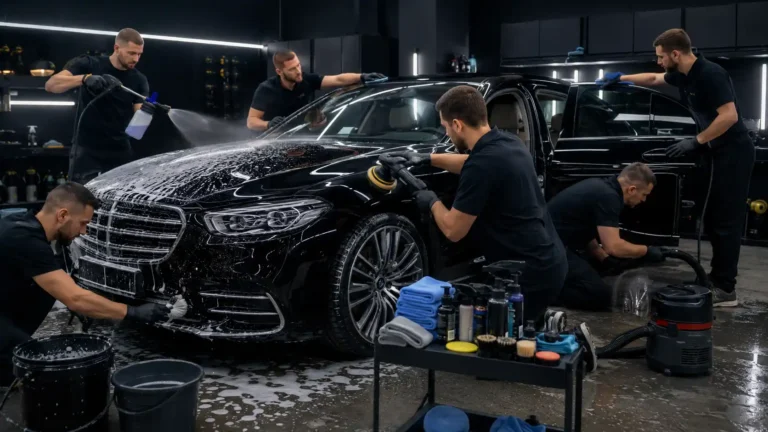
Full car detailing is a thorough cleaning, restoration, and protection process for a vehicle’s interior and exterior. Unlike a basic car wash, which primarily removes loose surface dirt, detailing can involve deeper cleaning, paint decontamination, polishing, and surface protection depending on the vehicle’s condition and the service package.
The exact meaning of a “full detail” can vary between detailing businesses. Some packages focus mainly on deep cleaning and protection, while others include additional services such as clay-bar decontamination, paint polishing, engine-bay cleaning, or ceramic coating.
The goal is to restore the vehicle’s appearance as much as reasonably possible, clean areas that are often missed during routine washing, and protect surfaces so they are easier to maintain. The International Detailing Association describes detailing as thorough cleaning and reconditioning of both the interior and exterior of a vehicle.
What Is Included in Full Car Detailing?
A full detail normally combines interior and exterior cleaning, but there is no single universal package that every detailer follows. Services vary according to the vehicle’s condition, the detailer’s process, and the level of service purchased.
A typical full detail may include:
- Exterior washing and drying
- Wheels and tire cleaning
- Interior vacuuming
- Cleaning of dashboard, console, doors, and other interior surfaces
- Carpet, mat, or upholstery cleaning
- Interior and exterior glass cleaning
- Paint decontamination when necessary
- Paint polishing or correction as an optional or higher-level service
- Wax, sealant, or another protective treatment
- Final inspection and finishing work
The important distinction is that paint correction, ceramic coating, engine-bay cleaning, and other intensive services are not automatically included in every package. Always check the actual service description before booking.
Exterior Detailing
Exterior detailing focuses on cleaning, decontaminating, improving, and protecting the vehicle’s outside surfaces.
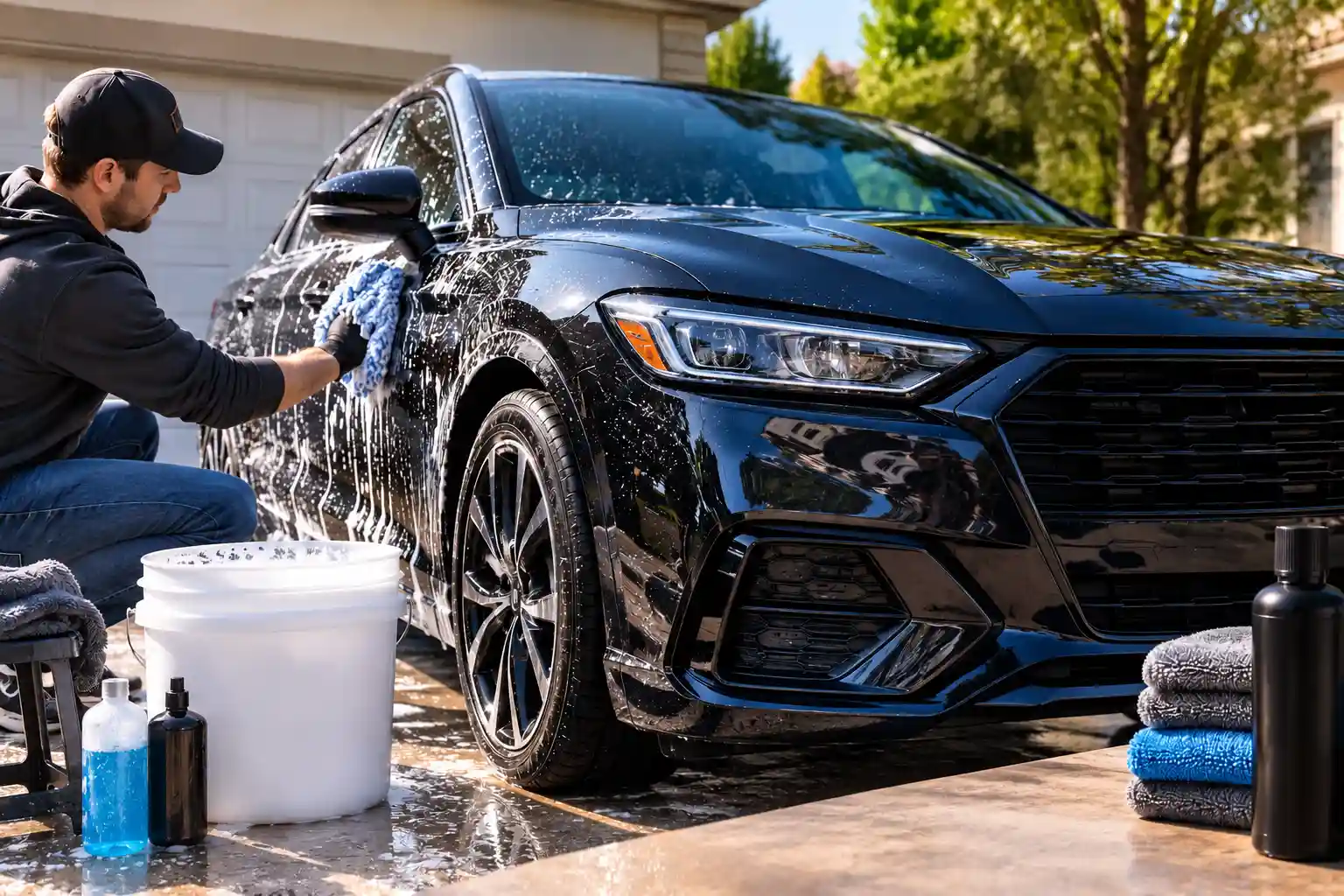
A typical exterior process starts by removing loose dirt and road grime. The vehicle is then washed and dried before additional treatments are performed if necessary.
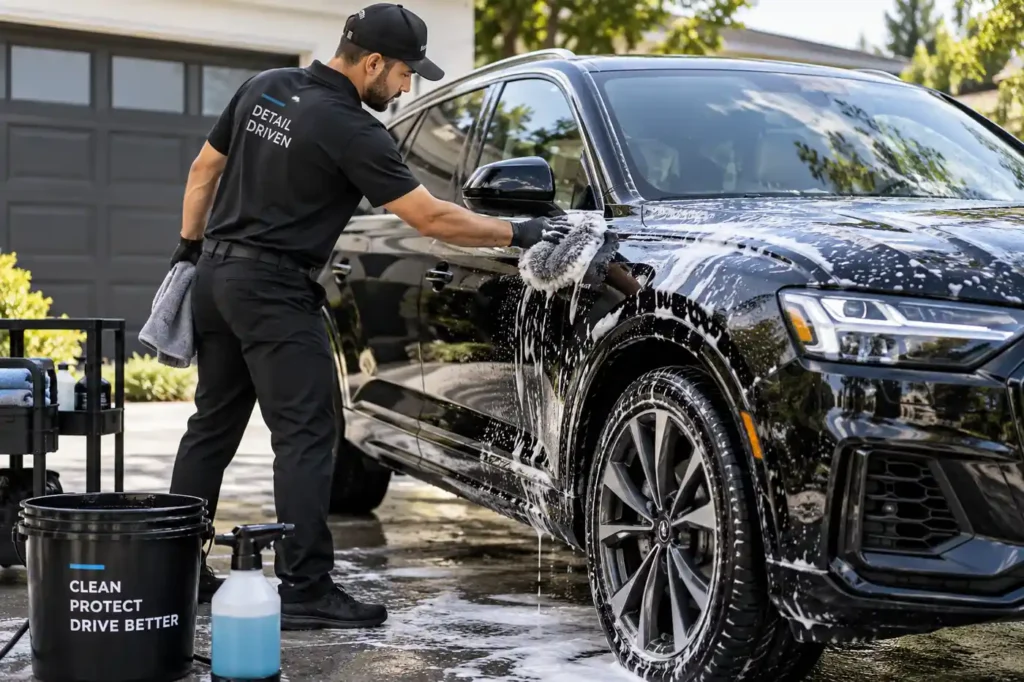
Exterior detailing may include:
- Hand washing
- Wheel and tire cleaning
- Pre-washing
- Paint decontamination
- Clay-bar treatment
- Glass cleaning
- Trim cleaning
- Paint polishing
- Wax or sealant application
- Tire dressing
The exact process depends on the condition of the vehicle. A well-maintained car may only need washing and protection, while a neglected vehicle may require additional decontamination or correction.
Interior Detailing
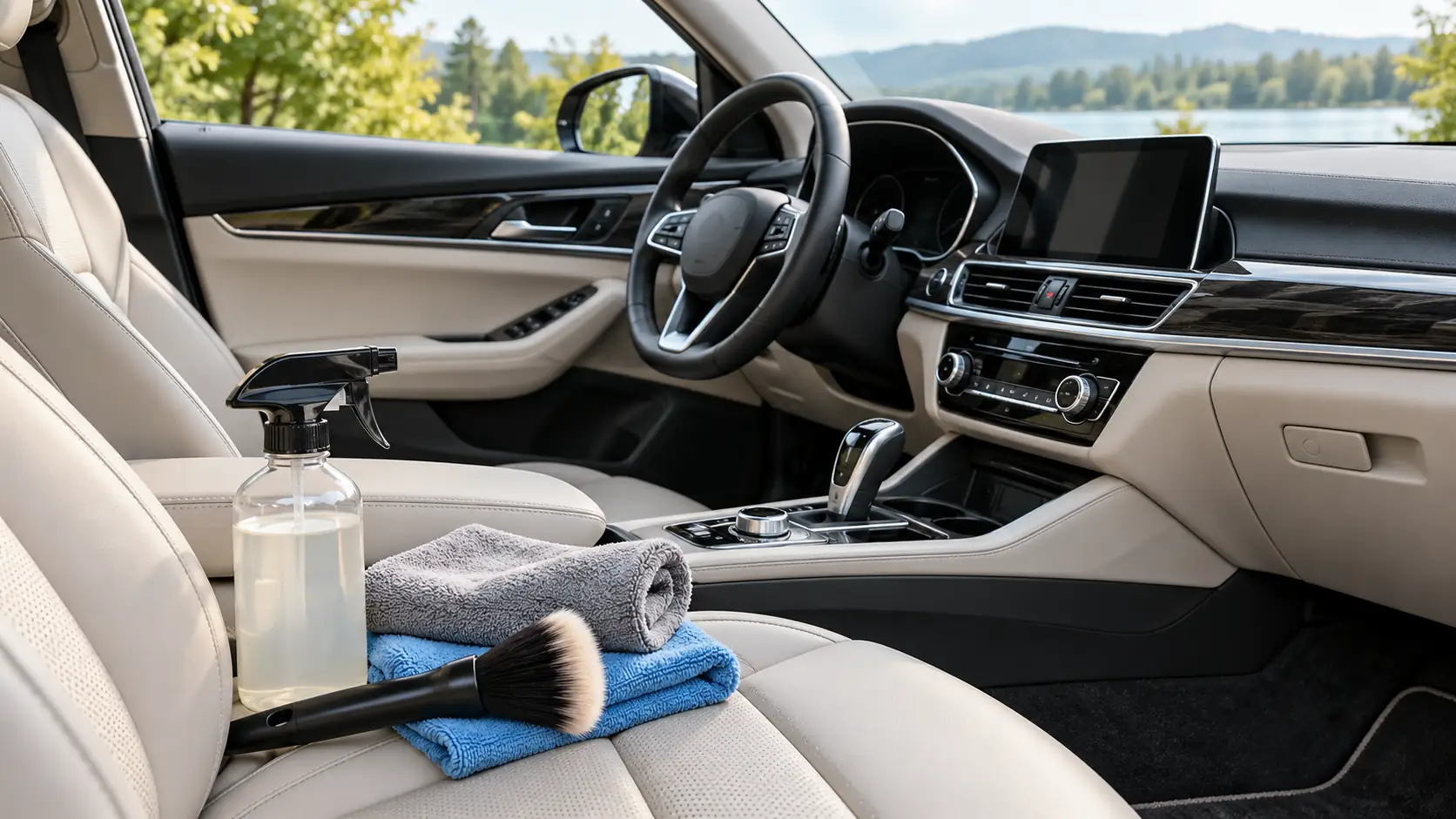
Interior detailing is a deeper cleaning process for the vehicle’s cabin.
It normally addresses surfaces such as:
- Seats
- Carpets
- Floor mats
- Dashboard
- Center console
- Door panels
- Interior plastics
- Vinyl surfaces
- Leather surfaces when applicable
- Interior glass
- Hard-to-reach areas
Vacuuming removes loose debris, while brushes, appropriate cleaners, extraction, or other methods may be used when deeper cleaning is necessary.
The correct method depends on the material. Leather, fabric, vinyl, plastics, and other interior surfaces should not automatically be treated with the same cleaning product.
Wheels and Tires
Wheels and tires are often cleaned separately because they collect road grime, brake dust, and other contamination.
A wheel-safe cleaner and appropriate brushes can help remove buildup from wheel faces, spokes, barrels, and other accessible areas. Tires may also receive a dedicated cleaning treatment before a dressing is applied.
The correct cleaner depends on the wheel’s finish and the product manufacturer’s instructions.
Glass and Mirrors
Glass cleaning is normally part of a full detail because dirty or streaked glass affects both appearance and visibility.
Detailers may clean:
- Windshield
- Side windows
- Rear glass
- Mirrors
- Other accessible exterior glass
The goal is to remove fingerprints, dust, film, and residue without leaving distracting streaks.
Engine Bay Detailing
Engine-bay cleaning is sometimes included in higher-level detailing packages, but it should not be assumed to be part of every full detail.
It generally involves removing visible dirt, dust, and grime from accessible areas under the hood.
Because the engine compartment contains electrical components, connectors, sensors, and other sensitive parts, cleaning methods should follow appropriate product and vehicle guidance rather than simply applying large amounts of water.
Paint Decontamination
Washing removes loose dirt, but some contaminants can remain bonded to the paint.
Depending on the vehicle’s condition, detailing may include chemical or mechanical decontamination.
A clay bar, for example, is designed to remove bonded surface contamination that normal washing may leave behind. The International Detailing Association recognizes clay as a detailing process used for removing embedded contamination.
Decontamination should normally be performed before polishing or applying paint protection.
Paint Correction and Polishing
Paint correction is a separate process from ordinary cleaning.
Polishing uses abrasives to reduce or remove certain paint defects, such as swirl marks and some light scratches, depending on their depth and the condition of the paint. The IDA defines polishing as the process of using a rotary or dual-action tool to remove swirls or smooth the paint to a high-gloss finish.
However, not every full detail requires paint correction.
If the paint is already in good condition, cleaning and protection may be enough. More serious defects may require a dedicated paint-correction service.
This distinction matters because correction is not simply another cleaning step. It changes the paint surface and requires appropriate technique and equipment.
Paint Protection
After cleaning and any necessary correction, a protective product may be applied.
Common options include:
- Wax
- Paint sealant
- Spray protection products
- Ceramic coatings
These products differ in application, durability, maintenance requirements, and cost.
A wax or sealant may be appropriate for someone who wants relatively simple paint protection, while a ceramic coating involves a more involved preparation and application process.
Do not assume that a ceramic coating is automatically included in a standard full-detail package. It is commonly treated as a separate service or upgrade.
Full Car Detailing vs. a Basic Car Wash
The main difference between full car detailing and a basic car wash is the scope and depth of the cleaning. A basic car wash primarily removes loose dirt and surface grime, while full car detailing involves more thorough cleaning of the vehicle’s interior and exterior, along with services such as paint decontamination, polishing, and surface protection when included in the package. Because detailing covers more areas and requires more detailed work, it generally takes longer than a routine car wash.
| Basic Car Wash | Full Car Detailing |
| Primarily removes loose surface dirt | Addresses interior and exterior surfaces |
| Usually focuses on exterior cleaning | Includes deeper interior cleaning |
| Generally a faster service | Usually requires substantially more time |
| Limited surface treatment | May include decontamination and protection |
| Usually does not correct paint defects | May include polishing or correction as an additional service |
| Limited attention to small areas | More detailed attention to trim, glass, wheels, and interior surfaces |
A basic car wash is useful for routine cleaning, while full car detailing is a more comprehensive process designed to clean, maintain, and, where appropriate, restore and protect different vehicle surfaces.
However, the two services can overlap. A particularly thorough car wash may include services that some businesses also describe as detailing, so it is worth checking exactly what a detailing package includes before booking.
Full Car Detailing Step by Step
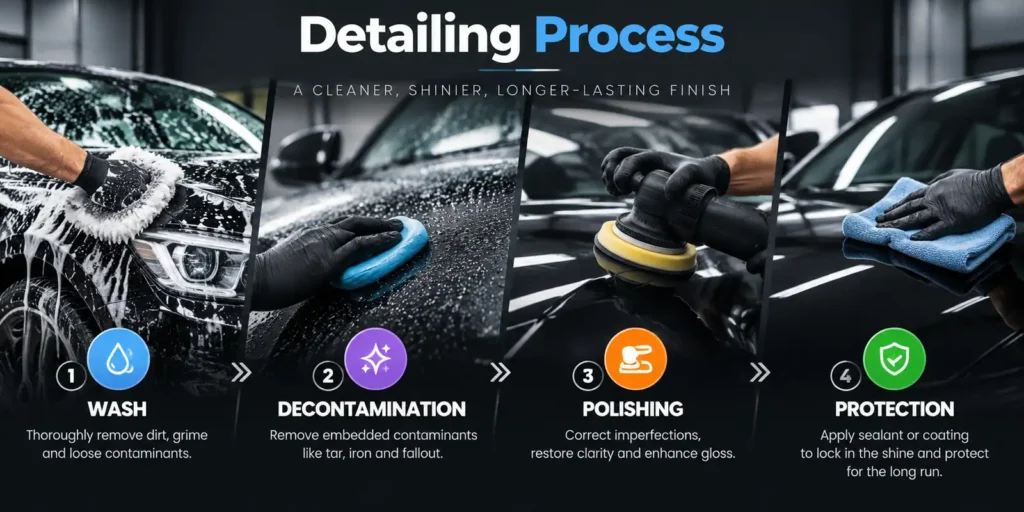
A full car detailing process combines several cleaning, decontamination, restoration, and protection tasks. The exact order can vary between detailers, and not every vehicle needs every step. For example, paint correction is only necessary when the paint has defects that justify polishing, while engine-bay cleaning and ceramic coating may be separate services.
The practical goal is simple: inspect the vehicle, clean it thoroughly, correct problems when necessary, protect the surfaces, and check the finished work.
Step 1: Inspect the Vehicle
Before cleaning begins, inspect the interior and exterior to determine what the vehicle actually needs.
Check for:
- Heavy dirt and road grime
- Stains and spills
- Pet hair
- Brake dust
- Bonded paint contamination
- Water spots
- Swirl marks and scratches
- Damaged or faded trim
- Worn or heavily soiled interior materials
This inspection helps prevent unnecessary work and identifies areas that may require specialized treatment.
Step 2: Remove Trash and Loose Interior Debris
Remove personal belongings, trash, floor mats, and loose debris from the cabin and cargo area.
Removing this material first makes the rest of the interior cleaning easier and prevents dirt from being moved from one surface to another.
Step 3: Clean the Wheels and Tires
Wheels and tires are cleaned before or during the exterior wash, depending on the detailer’s process.
Brake dust, road grime, and tire residue can accumulate heavily in these areas. Appropriate wheel cleaners, tire cleaners, brushes, and wash tools should be selected according to the wheel finish and product instructions.
Accessible wheel-well areas can also be cleaned at this stage.
Step 4: Pre-Wash the Exterior
A pre-wash loosens loose dirt and road grime before the wash mitt or other contact wash media touches the paint.
The purpose is to reduce the amount of abrasive contamination on the surface before contact cleaning.
This step may involve a hose rinse, pressure washer, or suitable pre-wash product, depending on the equipment and detailing method.
Step 5: Wash the Exterior
After pre-washing, the vehicle is thoroughly washed using an automotive shampoo and appropriate wash media.
The focus is on removing remaining surface contamination while minimizing unnecessary friction against the paint.
Areas such as the body panels, glass, trim, and other exterior surfaces should be cleaned according to their material and condition.
Step 6: Decontaminate the Paint if Needed
Washing does not always remove contaminants that have bonded to the paint.
After washing, inspect the paint for remaining contamination. If necessary, a chemical or mechanical decontamination process can be used.
A clay bar is one option for removing certain bonded surface contaminants that remain after normal washing.
Not every vehicle needs this step. A properly maintained vehicle may require little or no additional decontamination.
Step 7: Dry the Vehicle
Dry the exterior using appropriate drying towels, equipment, or a combination of both.
The objective is to remove remaining water without unnecessarily rubbing contamination across the paint.
Careful drying is especially useful before polishing or applying paint protection because the surface needs to be clean and dry for those processes.
Step 8: Inspect the Paint
Once the paint is clean and dry, inspect it under suitable lighting.
Look for:
- Swirl marks
- Fine scratches
- Water spots
- Oxidation
- Dullness
- Remaining contamination
- Other visible paint defects
This is the point where you decide whether the vehicle needs polishing or paint correction.
A full detail does not automatically require paint correction.
Step 9: Polish or Correct the Paint if Necessary
If the paint has defects that can reasonably be improved through polishing, the appropriate correction process can be performed.
Polishing can reduce certain defects such as swirl marks and some light scratches, depending on their depth and the condition of the paint.
The amount of correction required depends on the paint condition, defect severity, available equipment, and the amount of correction that can be safely performed.
Deeper scratches may not be safely removable through polishing alone.
Step 10: Apply Paint Protection
After the paint has been cleaned and any necessary polishing has been completed, a suitable protective product can be applied.
Common options include:
- Wax
- Paint sealant
- Spray protection products
- Ceramic coatings
The right choice depends on the desired durability, maintenance routine, application requirements, and budget.
A ceramic coating should not be assumed to be part of a standard full-detail package. It is commonly offered as a separate service because proper preparation and application require additional work.
Step 11: Clean Exterior Details
Finish the exterior by cleaning smaller or easily overlooked areas, such as:
- Exterior glass
- Mirrors
- Trim
- Emblems
- Door jambs
- Accessible crevices
These finishing steps help remove residue and improve the overall appearance of the vehicle.
Step 12: Vacuum the Interior
Thoroughly vacuum the cabin and cargo area.
Pay attention to:
- Seats
- Carpets
- Floor mats
- Trunk or cargo area
- Seat gaps
- Under-seat areas
- Crevices
Different vacuum attachments can make it easier to reach narrow spaces and remove loose debris.
Step 13: Deep Clean Carpets and Upholstery if Needed
If the vehicle has stained or heavily soiled fabric surfaces, additional cleaning may be necessary.
Depending on the material and level of contamination, this can involve appropriate cleaners, brushes, extraction, or other suitable methods.
Heavy stains, odors, or embedded contamination may require more specialized treatment than a standard interior detail.
Step 14: Clean Interior Surfaces
Clean the dashboard, center console, door panels, trim, plastics, vinyl, and other appropriate surfaces.
The cleaning product should match the material being treated. A product that is suitable for one interior material may not be appropriate for another.
The goal is to remove dust, dirt, fingerprints, and residue without unnecessarily altering the surface.
Step 15: Clean the Interior Glass
Clean the inside of the windshield, side windows, rear glass, and interior mirrors.
Interior glass can develop a film from dust, fingerprints, and airborne residue, so careful cleaning helps improve clarity and reduce distracting streaks.
Step 16: Condition or Protect Interior Materials When Appropriate
Some interior materials may benefit from a compatible conditioner or protectant after cleaning.
Depending on the vehicle, this may include:
- Leather
- Vinyl
- Plastic
- Other manufacturer-approved surfaces
Always use a product appropriate for the specific material and follow the vehicle or product manufacturer’s guidance.
Protection is not automatically necessary for every interior surface.
Step 17: Perform a Final Inspection
The final inspection is the last quality-control step.
Walk around the vehicle and check for:
- Missed dirt
- Remaining stains
- Streaked glass
- Water spots
- Cleaner residue
- Uneven tire dressing
- Missed trim
- Debris in crevices
- Interior areas that still need attention
Correct any obvious problems before considering the detailing job complete.
What Is Usually Not Included in a Standard Full Detail?
A standard full detail does not have one universal list of included services. Each detailing business sets its own packages, so a service described as a “full detail” at one shop may include more or fewer services than a package at another.
Some jobs are commonly offered as separate services or upgrades because they require additional labor, specialized products, equipment, or preparation. Before booking, check the package description to see exactly what is included.
Heavy Stain or Pet Hair Removal
Removing ordinary dirt and debris is typically part of interior detailing, but heavy stains, deeply embedded dirt, and extensive pet hair removal can require considerably more time and specialized techniques.
For severe contamination, a detailer may charge an additional fee or recommend a separate deep-cleaning service.
Mold or Biohazard Cleanup
Mold, bodily fluids, and other biohazard contamination should not automatically be treated as routine interior detailing.
These situations can require additional safety precautions, specialized cleaning procedures, and appropriate disposal methods. If a vehicle has significant mold or biohazard contamination, confirm that the detailing provider specifically handles this type of work before booking.
Extensive Paint Correction
Basic exterior detailing can clean and improve the appearance of paint without correcting every visible defect.
Extensive paint correction, especially multi-stage correction, requires additional machine polishing, inspection, and labor. It is therefore often offered as a separate service rather than being included in a standard full detail.
Paint correction should also be based on the actual condition of the paint. A vehicle with well-maintained paint may not need it at all.
Ceramic Coating
A ceramic coating is a dedicated paint-protection service rather than an automatic part of every full detail.
Proper coating installation generally involves thorough cleaning, paint decontamination, surface preparation, and controlled application. Some vehicles may also require paint polishing before the coating is applied.
Because of the additional preparation and application requirements, ceramic coating is commonly sold separately or as a higher-level package.
Headlight Restoration
Cleaning headlights is different from headlight restoration.
Restoration is intended to improve the appearance and clarity of headlights that have become oxidized, cloudy, or otherwise degraded. Depending on the condition, the process can require specialized polishing and refinishing steps.
For this reason, headlight restoration is commonly offered as an additional service rather than being included in every full-detail package.
Engine-Bay Detailing
Engine-bay cleaning varies significantly between detailing businesses.
Some detailers include light engine-bay cleaning in certain packages, while others offer it separately. Because the engine compartment contains electrical components, connectors, sensors, and other sensitive parts, it should be cleaned using an appropriate method rather than treated exactly like exterior bodywork.
Do not assume engine-bay detailing is included simply because a service is advertised as a “full detail.” Check the package description before booking.
What Does This Process Achieve?
A properly planned full detail should leave the vehicle cleaner, more consistent, and easier to maintain than when the process started.
However, the result depends on the vehicle’s starting condition and the services performed. Detailing can remove dirt and contamination and can improve certain cosmetic defects, but it cannot restore every damaged surface or permanently remove every scratch.
The most effective approach is to perform only the services the vehicle actually needs rather than treating every full detail as a fixed list of expensive treatments.
How Long Does Full Car Detailing Take?
There is no reliable single time estimate for every full detail.
The time required depends on:
- Vehicle size
- Interior condition
- Exterior contamination
- Number of seats
- Stains
- Pet hair
- Paint condition
- Decontamination requirements
- Paint correction
- Coating or protection chosen
- Whether the engine bay is included
A lightly used compact car may require substantially less work than a large SUV with heavily contaminated paint, stained upholstery, and extensive pet hair.
For that reason, a detailing business should evaluate the vehicle rather than promising the same completion time for every car.
How Often Should You Get Your Car Detailed?
There is no universal detailing interval that applies to every vehicle.
The appropriate frequency depends on:
- How often you drive
- Where you park
- Weather conditions
- Road salt exposure
- Dust and pollen
- Pet use
- Children or frequent passengers
- Existing paint protection
- Your desired appearance
A vehicle that receives regular washing and interior maintenance may need fewer intensive details than a neglected vehicle.
Instead of following a rigid calendar, use the vehicle’s condition as the main guide.
Daily Driver
A daily driver may benefit from periodic full detailing combined with regular maintenance cleaning.
The more frequently the vehicle is exposed to dirt, weather, passengers, pets, and road contamination, the more often deeper cleaning may become useful.
Seasonal Detailing
Some owners prefer a deeper cleaning at the beginning or end of seasons.
This can make sense when a vehicle has experienced:
- Winter road salt
- Heavy summer dust
- Frequent rain
- High pollen exposure
- Long road trips
Before Selling the Vehicle
A thorough detail can improve the vehicle’s presentation before a private sale or trade-in.
It cannot guarantee a higher selling price, but a cleaner interior and exterior can make the vehicle easier to evaluate and present.
Do You Need Full Detailing or Just a Car Wash?
The right service depends on the condition of the vehicle.
A basic wash may be enough when:
- The vehicle is already well maintained.
- You only need loose dirt removed.
- The interior is clean.
- The paint does not require decontamination or correction.
A full detail makes more sense when:
- The interior needs deep cleaning.
- The paint feels contaminated.
- Wheels and tires have heavy buildup.
- The vehicle has accumulated stains or debris.
- You want to refresh existing protection.
- You are preparing the vehicle for sale.
- The vehicle has been neglected for an extended period.
Paint correction may be appropriate when:
- Swirl marks are noticeable.
- Light scratches are affecting the appearance.
- Oxidation or other paint defects need correction.
- You specifically want to improve paint clarity and gloss.
Paint correction should not automatically be added simply because a vehicle is being detailed.
Is Full Car Detailing Worth It?
Full detailing can be worthwhile when the vehicle needs more than routine cleaning.
It is particularly useful when you want to:
- Deep-clean the interior.
- Remove bonded exterior contamination.
- Improve the appearance of the paint.
- Refresh surface protection.
- Prepare a vehicle for sale.
- Restore a neglected vehicle’s appearance.
However, not every vehicle needs every available detailing service.
A well-maintained car may only need routine washing, interior cleaning, and periodic protection. Adding expensive correction or coating services without a clear reason can be unnecessary.
The best detailing plan is the one that addresses the vehicle’s actual condition.
Conclusion
Full car detailing is a comprehensive cleaning and surface-care process that can cover both the interior and exterior of a vehicle. Unlike a routine wash, it can involve deeper interior cleaning, paint decontamination, polishing, and protection.
The exact services included in a “full detail” vary, so it is important to check the package before booking. Paint correction, ceramic coating, engine-bay cleaning, headlight restoration, and heavy stain treatment are often separate services rather than automatic parts of every package.
For most vehicle owners, the most sensible approach is to match the detailing work to the vehicle’s condition rather than automatically choosing the most expensive package. Clean first, correct only when necessary, and use protection that fits how the vehicle is actually maintained.
FAQs
FAQs About Full Car Detailing
Is engine-bay cleaning included in a full car detail?
Not always. Engine-bay cleaning depends on the detailing package and may be offered as an optional service. Because the engine compartment contains electrical components and other sensitive parts, it should be cleaned using an appropriate method.
Is pet hair removal included in full car detailing?
Basic vacuuming is usually part of interior detailing, but extensive pet hair removal may cost extra. Deeply embedded hair can require additional tools and labor, so check whether heavy pet-hair removal is included before booking.
Is headlight restoration included in a full detail?
Usually, headlight restoration is a separate service rather than a standard part of full car detailing. Restoration involves more than cleaning and may require polishing or other specialized steps to improve cloudy or oxidized headlights.
Does a full car detail include paint correction?
Not necessarily. A full detail may clean and protect the paint without correcting defects. Paint correction is a separate process that uses polishing to reduce certain paint imperfections and is often offered as an additional service.
Is ceramic coating included in a full car detail?
Usually not. Ceramic coating is generally a separate paint-protection service or an upgrade because it requires additional surface preparation and careful application. Always check the specific detailing package before assuming a coating is included.
Does full car detailing remove mold?
Not necessarily. Significant mold contamination requires more specialized cleaning and safety procedures than routine interior detailing. If a vehicle has substantial mold contamination, confirm that the detailing provider specifically offers mold-remediation or appropriate specialized cleaning services.
What should I check before booking a full car detail?
Check the service list and confirm which interior, exterior, paint-care, and optional services are included. In particular, ask about heavy stain or pet-hair removal, paint correction, ceramic coating, headlight restoration, and engine-bay cleaning so you know exactly what the quoted service covers.