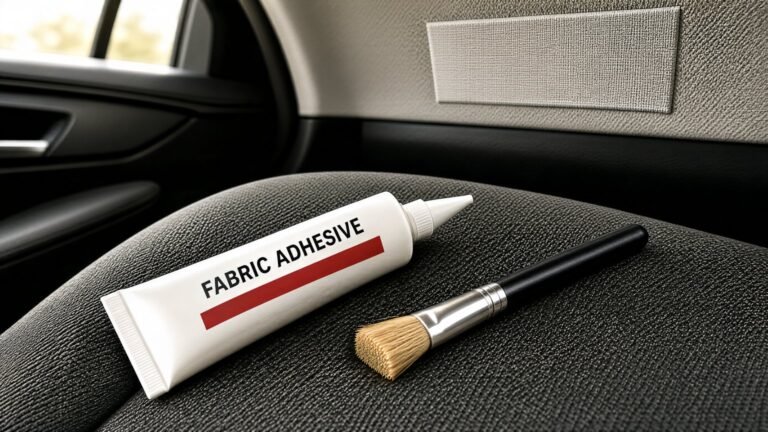
There’s no single best glue for car interior fabric. The right one depends on what you’re gluing, whether you want a spray or a squeeze bottle, and how much heat that spot sees in summer. Some of these products are aerosols built for big fabric areas; others are brush-on liquids for edges and small tears. For a full headliner job, the 3M Headliner & Fabric Adhesive is the spray pick; for a torn seat or trim edge, the Loctite Vinyl, Fabric & Leather is the flexible pick.
As an Amazon Associate, we earn from qualifying purchases. This post contains affiliate links – if you buy through them, we may earn a commission at no extra cost to you.
| # | Product | Best for | |
|---|---|---|---|
| 1 | 3M Headliner & Fabric Adhesive | Best Overall | Check Price |
| 2 | Permatex Headliner & Carpet Adhesive | Most Heavy-Duty | Check Price |
| 3 | DAP Weldwood Landau Top & | Strongest Contact Bond | Check Price |
| 4 | 3M Super 77 | Most Versatile Spray | Check Price |
| 5 | Loctite Vinyl Fabric & Leather | Best for Vinyl & Leather Trim | Check Price |
| 6 | Automotive Super Glue Liquid | Best for Small Interior Fixes | Check Price |
| 7 | Headliner Repair Glue 100ML | Easiest Headliner Repair | Check Price |
| 8 | Car Headliner Spray Adhesive | Best Full-Interior Spray | Check Price |
| 9 | Headliner Glue Heat Resistant | Most Heat Resistant | Check Price |
| 10 | Automotive Headliner Adhesive 3.53 oz | Best Compact Applicator | Check Price |
1. 3M Headliner & Fabric Adhesive

Best for: someone reattaching a full headliner in one go.
A full headliner is a big, floppy piece of foam-backed fabric, and it needs an adhesive you can spray over a wide area before the glue grabs. This 3M can is built for that job, with an adjustable nozzle so you can widen or narrow the spray pattern as you work across the roof. The listing gives a dry time of 30 to 60 minutes, which is enough working time to position the fabric before it sets.
The trade-off is that you have to move with some purpose. Once that window closes, repositioning gets harder, so a helper matters on a large roof panel. It also dries clear, which keeps light-colored fabric looking clean. This isn’t the pick for a tiny tear or a trim edge – the spray is too broad for that, and you’d waste most of it. It’s for the person doing the whole ceiling, not a spot fix.
Good if:
- Your headliner has dropped across a large area, not just one corner
- You can work steadily for an hour with someone helping
- You want a clear-drying finish on light fabric
Skip it if:
- You’re fixing a small tear or a single loose edge
- You want a brush for tight, controlled placement
2. Permatex 27828 Body Shop Heavy Duty Headliner and Carpet Adhesive

Best for: someone who needs the bond to hold in serious heat.
Heat is what kills a headliner repair. A car parked in the sun turns into an oven, and a glue that softens up there will let the fabric drop again. This Permatex listing states it maintains high strength at temperatures up to 170°F (77°C), and it’s marketed as heavy-duty for headliners, carpet, trunk linings and inside door panels. That temperature figure is the reason to pick it over a general-purpose spray.
It’s also water-resistant, which the listing ties to rain, sleet and snow. That matters less inside a car, but it does help with trunk linings and door panels that see moisture. It dries clear. It’s a spray, so it suits broad areas better than a narrow seam. For a small tear, this is more coverage than you need.
Good if:
- Your car bakes in the sun and you’ve had a repair fail before
- You’re doing carpet, trunk lining or door panels, not just the roof
- You want a heavy-duty spray for a large area
Skip it if:
- You only need to fix one small spot
- You want precise, brush-on control
3. DAP Weldwood Landau Top & Trim HHR Solvent Type Spray

Best for: someone gluing two surfaces that must bond on contact.
This is a contact adhesive, and that changes how you use it. You spray both surfaces, let them get tacky, then press them together – and the bond happens on contact. The listing says it’s ready in 1 to 3 minutes, so there’s very little room to adjust once the two pieces meet. That’s the trade-off: a fast, strong grab, but no second chances on placement.
The listing covers up to 79 square feet per can at 1 gram per square foot on a single surface, and it reaches full cure in about 24 hours. It’s listed for foams, upholstery fabric, vinyl, plastics, metals, carpeting, car roof liners and headliners, and it’s high heat and water resistant after full cure. One thing the listing states plainly: it carries a California Proposition 65 warning for cancer and reproductive harm, so read that before you buy.
Good if:
- You’re bonding two flat surfaces that meet cleanly
- You want a fast, permanent grab
- You’re working on foam, vinyl or laminate as well as fabric
Skip it if:
- You need time to slide and adjust the fabric into place
- You want to avoid a product with a Prop 65 warning
4. 3M Super 77 Multi-Surface Spray Adhesive

Best for: someone who wants a versatile spray for many small jobs.
Super 77 isn’t a headliner-specific glue, and that’s the point. The listing calls it ideal for light-duty materials including foils, plastics, papers, cardboard, fabric, insulation and leather. It allows repositioning within 2 to 3 minutes, so you get a little wiggle room before it sets. It’s a mist spray with no soak-through on most substrates, and it covers up to 190 square feet.
The catch is right there in the listing: light-duty. If your headliner has come down, this isn’t the heavy-duty bond that job wants. Where it earns its place is the small stuff – a loose fabric corner, a bit of trim, a craft or repair job elsewhere in the car. It’s also listed at less than 30% VOC emissions. Think of it as the versatile can, not the specialist.
Good if:
- You want a versatile spray that handles fabric, paper, plastic and craft jobs alike
- You need a few minutes to reposition before it grabs
- You’re doing light-duty repairs, not a full headliner
Skip it if:
- Your headliner has actually dropped and needs a heavy-duty bond
- You need a glue rated for high heat
5. Loctite Vinyl Fabric & Leather

Best for: someone mending a torn seat or a split trim edge.
Seats and trim bend, stretch and fold every time you get in the car, so the glue there has to stay flexible. This Loctite listing is built for exactly that: a flexible adhesive that withstands bending and torsion, made for vinyl seats, cushions, tarps and outdoor gear. It sets in 10 minutes and cures fully in 24 hours. It dries clear and the listing says it won’t yellow or go brittle with age or sunlight.
It’s also waterproof, which suits rainwear and outdoor gear as much as car interiors. The limit is the format. This is a 1 fl oz liquid in a squeeze bottle, so it’s for seams, tears and edges – not for spraying a whole roof panel. If your headliner has dropped, this is the wrong tool. If you have a split in a seat or a peeling trim edge, it’s the right one.
Good if:
- You’re repairing a tear in a vinyl seat or a trim edge
- The repaired area has to bend and flex afterward
- You want a clear finish that won’t yellow
Skip it if:
- You’re reattaching a full headliner
- You need to cover a large area quickly
6. Automotive Super Glue Liquid

Best for: someone fixing tiny gaps, clips and hard plastic trim.
This is a thin cyanoacrylate, not a fabric glue, and the listing is clear about where it goes: trims, panels, headlight housings and dashboard components. The thin formula flows into tight gaps and microcracks where a gel can’t reach. It’s listed to bond plastic, rubber and metal, and to withstand engine vibration, road shocks, oil exposure and temperatures from -40°F to 230°F (-40°C to 110°C).
The 1.76 oz size is a workshop format, aimed at garages, body shops and fleet maintenance. It has a precision dropper tip and an anti-clog cap. The trade-off is that this isn’t the glue for fabric — the listing covers plastic, rubber and metal parts, not upholstery or headliner cloth. Buy it for clips, seams and hard parts – not for cloth.
Good if:
- You’re bonding hard plastic, rubber or metal interior parts
- You need glue that flows into a hairline gap
- You want a larger bottle for frequent garage use
Skip it if:
- You’re gluing fabric, headliner cloth or upholstery
- You need a flexible bond on something that bends
7. Headliner Repair Glue 100ML

Best for: a first-timer fixing a small sagging headliner spot.
Not everyone wants to pull a whole roof panel. This iYanoc glue is a 100 ml liquid aimed at quick headliner repair, and the listing says it bonds leather and fabric and stays strong at high temperatures. It’s described as waterproof and non-flammable, with good toughness after curing. For a beginner dealing with a corner that’s come loose, a bottle like this is easier to control than a spray.
The listing also pushes wide use – leather, wallpaper, sofa, canvas, sponge and automotive interior. That breadth is the thing to weigh. It’s a general-purpose repair glue marketed for headliners, not a spray built for large panels. For a small area or a single loose edge, that’s fine. For a full roof, you’d want a spray.
Good if:
- You have a loose corner or a small sagging section
- You want a squeeze bottle you can control by hand
- You want a glue you can also use on leather and canvas
Skip it if:
- You’re redoing an entire headliner
- You want a spray for fast, even coverage
8. Car Headliner Spray Adhesive

Best for: someone doing a full interior refresh from start to finish.
This Wqapey spray is aimed at whole-interior work. The listing says it bonds sagging headliner fabric, vinyl seats, leather upholstery, plastic trim, door panels, carpet and foam, and resists vibration, summer heat and cold without bubbling or peeling. It’s a fine mist nozzle, so it goes into narrow gaps without thick buildup or drips, and you can reposition within minutes. That repositioning window is what makes it friendlier for a first DIY job than a contact adhesive.
The listing also states a low-odor, non-corrosive formula that won’t stain, crack or fade fabric, leather or plastic. It’s a large-capacity aerosol, and the listing claims one can completes a full headliner repair. It’s a spray, so a small tear means overspray you don’t need.
Good if:
- You’re covering a large area like a full roof liner or carpet
- You want a few minutes to line the fabric up
- You’re a beginner doing your first interior repair
Skip it if:
- You only have a tiny tear to fix
- You want brush-on precision
9. Headliner Glue for Cars Heat Resistant Car Headliner Adhesive 5.29oz

Best for: someone in a hot climate who wants brush-on control.
This SEPOVICA glue is a 5.29 oz liquid with a built-in brush, and the listing states a temperature range of -40°F to 248°F (-40°C to 120°C). The listing says it stays strong through summer heat, sunlight, humidity and freezing winters without softening, cracking or peeling after full cure.
The brush is the other draw. It eliminates the overspray and waste of aerosols, so you apply exactly where you need it – loose edges, small tears, sagging sections and trim corners. It dries clear and stays flexible, which helps on light-colored fabric. The instructions say to apply to both surfaces, wait 1 to 5 minutes until tacky, press firmly, then allow 24 hours for full cure. The limit is scale: a brush is slow across a whole roof.
Good if:
- Your car gets very hot in summer
- You want precise, brush-on placement with no overspray
- You’re fixing edges, small tears or trim corners
Skip it if:
- You’re covering a large panel and want speed
- You want a spray for even coverage
10. Automotive Headliner Adhesive 3.53 oz

Best for: someone who wants a small brush-in-cap bottle for touch-ups.
This Nozerix glue is a 3.53 oz clear liquid with a built-in brush, made for bonding headliner fabric and leather. The listing describes a brush-on formula for applying adhesive to compatible materials during interior repair, and it dries clear when used as directed. The small size is the whole idea: it’s a touch-up bottle, not a job-size can.
The listing is careful about application. It says to apply according to the product instructions and allow sufficient time for curing before the area goes back into use, and it notes that application conditions may affect the bonding process. That’s honest, and it’s worth reading before you start. It’s listed for compatible fabric, leather and roof lining materials. If you have a small edge lifting, this fits. If you have a whole roof down, it doesn’t.
Good if:
- You want a small bottle for a single touch-up
- You prefer a brush applicator over a spray
- You’re working on fabric or leather edges
Skip it if:
- You’re repairing a large area
- You want a spray for fast coverage
Where These Overlap
Some of these are close enough that the choice barely matters. The 3M Headliner & Fabric Adhesive and the Permatex Headliner & Carpet Adhesive are both clear-drying sprays aimed at headliners and carpet. The Permatex listing states a 170°F (77°C) strength figure; the 3M listing states a 30-to-60-minute dry time. If heat is your worry, that stated figure decides it. If working time is your worry, the dry time does.
The brush-on headliner glues – SEPOVICA’s Headliner Glue Heat Resistant and Nozerix’s Automotive Headliner Adhesive 3.53 oz – overlap in the same way. Both are clear, brush-applied liquids for fabric and leather edges. The SEPOVICA listing states a -40°F to 248°F (-40°C to 120°C) range; the Nozerix listing states no temperature figure at all. That’s the only real separator between them.
The genuinely different ones are the Loctite Vinyl Fabric & Leather and the Automotive Super Glue Liquid. One is a flexible glue for seats and trim that bend. The other is a thin, rigid glue for hard plastic and metal. They don’t compete.
Still Not Sure?
How do I know if I need a spray or a brush-on glue?
It comes down to area. A spray covers a wide, flat panel fast, which is what a dropped headliner needs – the 3M Headliner & Fabric Adhesive and the Car Headliner Spray Adhesive are both built for that. A brush gives you control on a small tear, a loose edge or a trim corner, with no overspray to clean up. If you can cover the repair with your hand, a brush-on like the Headliner Glue Heat Resistant is the easier tool. If it’s bigger than that, go spray.
Will the glue hold up to summer heat inside a parked car?
That’s the failure point for most headliner repairs, so check the stated temperature range before you buy. The Headliner Glue Heat Resistant lists -40°F to 248°F (-40°C to 120°C). The Permatex Headliner & Carpet Adhesive states strength up to 170°F (77°C). The Automotive Super Glue Liquid lists -40°F to 230°F (-40°C to 110°C), but it’s for hard parts, not fabric. A glue with no stated heat range is a guess in a hot climate.
What’s the most common mistake people make with headliner glue?
Using a contact adhesive when they needed repositioning time. The DAP Weldwood Landau Top & bonds on contact and is ready in 1 to 3 minutes, so once the fabric touches the roof, it’s set. A first-timer lining up a big, floppy panel usually needs a few minutes to shift it. A spray that allows repositioning within 2 to 3 minutes, like the 3M Super 77, or one the listing says you can reposition within minutes, like the Car Headliner Spray Adhesive, is far more forgiving.
Can I use one of these glues on a torn seat instead of a headliner?
Only the flexible ones. The Loctite Vinyl Fabric & Leather is the pick here – the listing says it withstands bending and torsion and is made for vinyl seats and cushions. The Automotive Super Glue Liquid is the opposite: it’s for hard plastic, rubber and metal, and it isn’t meant for cloth or upholstery that flexes.
More Adhesives Worth Considering for Car Interior Fabric
Aleene’s Fabric Fusion Glue is a permanent, washable no-sew fabric glue that dries flexible, listed for clothing, denim, polyester, cotton and flannel. It’s a fabric-craft glue rather than an automotive one, so it suits a loose piece of interior cloth better than a roof panel under heat.
Automotive Adhesive is a 100 ml clear silicone sealant marketed as car trim glue. Silicone sealants stay flexible and handle weather, which suits trim and seams, though a sealant isn’t the same as a fabric adhesive.
Headliner Repair Glue is a 150 ml heat-resistant upholstery adhesive sold for car headliners. It’s another liquid option in the same family as the brush-on picks above, and the larger bottle suits someone with several spots to fix.
One Last Thing
Most situations land in one camp or the other. If your headliner has dropped across the roof, you want a spray built for large fabric panels – the 3M Headliner & Fabric Adhesive for working time, or the Permatex Headliner & Carpet Adhesive if heat is your main worry. If you have a torn seat or a peeling trim edge, you want the Loctite Vinyl, Fabric & Leather. Pick your situation first, then check the listing for the temperature figure and the dry time. Those two numbers decide whether the repair lasts.
Frequently Asked Questions
What glue works best on car headliner fabric?
The 3M Headliner & Fabric Adhesive is built for automotive headliners and gives 30 to 60 minutes of dry time to position the cloth. The Permatex Headliner & Carpet Adhesive is the alternative if heat is your concern – its listing states strength up to 170°F (77°C). For a small sagging corner rather than the whole roof, a brush-on headliner glue gives you more control.
How long should I wait before using the car after gluing the headliner?
Follow the cure time on the listing, not the dry time. The DAP Weldwood Landau Top & and the Headliner Glue Heat Resistant both say to allow 24 hours for full cure strength. A glue that feels dry to the touch isn’t at full strength yet, so give it the full cure window before you drive with the windows down.
Will headliner glue work on leather or vinyl seats too?
Sometimes, but check the listing. The Loctite Vinyl, Fabric & Leather is made for exactly that – vinyl seats, cushions and leather – and stays flexible through bending. The Headliner Repair Glue 100ML listing says it bonds leather and fabric. What you don’t want is a rigid cyanoacrylate like the Automotive Super Glue Liquid, which is listed for plastic, rubber and metal parts and isn’t meant for upholstery that flexes.
Do I need to remove the headliner to repair it?
Not for a partial repair. The Car Headliner Spray Adhesive listing describes a mist nozzle that reaches into narrow gaps, which is aimed at repairing a sagging liner without taking the panel out. Brush-on glues are also made for reaching loose edges and sagging sections in place. A full re-cover is a different job and usually means dropping the panel.
Conclusion
Before you buy, check the label for heat ratings and make sure the glue is safe for the material you’re fixing. Pick up a small bottle first and test it on a hidden spot. If it holds after a hot afternoon in the car, you’ve found your match.