Learning how to remove water spots etched into paint requires understanding the difference between mineral deposits sitting on the surface and actual damage to your car’s clear coat. Fresh water spots can often be removed with a suitable automotive water spot remover, but etched water spots usually require polishing to improve or eliminate the visible marks. The correct treatment depends on how deeply the water spots have affected the finish.
Water spots commonly develop when hard water, sprinkler water, or rainwater evaporates on your vehicle, leaving behind mineral deposits and other contaminants. When these deposits remain on the paint or repeatedly dry under unfavorable conditions, they can cause dull rings, cloudy patches, or microscopic surface damage that ordinary car washing cannot fix.
The good news is that many light water spot etchings can be corrected with an appropriate automotive polish. However, deeper etching may require professional paint correction, and attempting to remove every mark can unnecessarily thin the clear coat. This guide explains how to identify etched water spots, remove them safely, choose the right polishing method, and prevent water spots from damaging your paint again.
What Causes Water Spots Etched Into Car Paint?
Water spots develop when water evaporates and leaves behind dissolved minerals, contaminants, or chemical residues. Common sources include hard tap water, garden sprinklers, rainwater contaminated by airborne pollutants, and water left on a freshly washed vehicle.
Not all water spots cause paint damage. The severity depends on the composition of the residue, exposure conditions, and how long the contamination remains on the surface.
There are two common types of water spot problems:
1. Mineral Deposits on the Paint Surface
These water spots occur when dissolved minerals remain on the paint after water evaporates. They may appear as white dots, cloudy rings, or chalky residue.
Surface deposits can often be removed using a dedicated automotive water spot remover or another compatible cleaning product. In some cases, additional paint cleaning or mechanical decontamination may be necessary.
2. Etched Water Spots in the Clear Coat
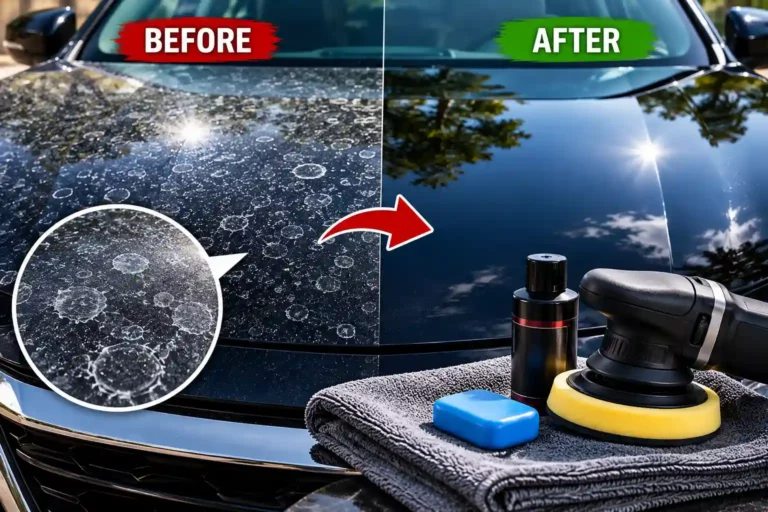
Etched water spots are more difficult to remove because the marks extend into the paint’s surface rather than existing entirely as removable residue. They may appear as dull rings, circular outlines, or shallow depressions that remain visible even after the vehicle has been washed thoroughly.
Depending on the severity, an appropriate finishing polish or paint correction compound may improve or remove these marks by leveling a very small amount of the surrounding clear coat.
Understanding the difference between surface deposits and etched water spots is essential because using stronger chemicals or scrubbing harder will not correct a defect that requires paint polishing.
How to Tell If Water Spots Are Etched Into Paint
Before attempting water spot removal, determine whether the marks are surface contamination or actual paint defects.
Start by washing the affected panel with a suitable automotive shampoo and drying it with a clean microfiber towel. Inspect the paint under good lighting to see whether the spots remain.
If the marks are still visible, try a dedicated automotive water spot remover suitable for your paint finish. Follow the manufacturer’s instructions and test the product on a small, inconspicuous area first.
Examine the surface again after removing the product and rinsing or wiping as directed.
Signs that the water spots may be etched include:
- Circular rings or dull outlines that remain after proper cleaning.
- Cloudy marks that are visible under direct sunlight or inspection lighting.
- Reduced gloss in the affected areas compared with the surrounding paint.
- Persistent marks that do not respond to a suitable surface cleaning treatment.
These signs suggest that polishing may be necessary, although they do not establish the exact depth of the damage.
Avoid using your fingernail to test whether the paint is etched. Pressing or scratching the surface does not reliably determine the depth of water spot damage and may introduce additional marks.
How to Remove Water Spots Etched Into Paint Step by Step
The safest approach is to begin with the least aggressive method and increase the level of correction only when necessary. You should not use a machine polisher or abrasive compound before determining whether a milder treatment can solve the problem.
Step 1: Wash and Dry the Affected Panel
Park your vehicle in a shaded area and allow the paint to cool before starting.
Wash the affected panel with automotive shampoo and clean water. Remove loose dirt, road grime, and other debris that could scratch the paint during the correction process.
Rinse the panel thoroughly and dry it with a clean microfiber towel. Inspect the remaining marks before proceeding.
Step 2: Try a Dedicated Water Spot Remover
Before polishing the paint, try a water spot remover specifically formulated for automotive finishes.
Apply the product according to its instructions and work on a small section at a time. Some products use chemical cleaning ingredients, while others combine cleaning with mild polishing action.
Do not assume that every water spot remover works in the same way. Some are designed primarily for mineral deposits, while others may also help improve light surface marks.
Keep the paint cool, avoid allowing the product to dry on the surface, and rinse or wipe it away as directed.
If the marks disappear, there is no reason to proceed with more aggressive paint correction. If visible rings remain after proper cleaning, the paint may have sustained actual etching.
Avoid using household vinegar as your default solution for etched paint. It may help dissolve certain mineral deposits, but it will not repair an etched clear coat, and incorrect use can create additional problems.
Step 3: Decontaminate the Paint if Necessary
After cleaning, check whether the paint still feels rough or gritty. This may indicate bonded contamination that ordinary washing has not removed.
If additional decontamination is necessary, an appropriate clay bar or clay mitt used with sufficient lubricant can help remove certain bonded particles before polishing.
However, claying is not automatically required for every water spot problem. If the paint feels smooth and is free of bonded contamination, you can generally proceed without it.
Clay can introduce light marring, so avoid unnecessary mechanical contact, particularly on soft paint or dark-colored vehicles.
Step 4: Polish the Etched Water Spots
Polishing is often the most effective way to correct shallow water spot etching that remains after cleaning.
Choose a quality automotive polish formulated for your paint type. Start with a finishing polish and a soft foam applicator or pad before considering a more aggressive compound.
For a small affected area, hand polishing may improve light etching. Use a clean foam applicator, work a small section with controlled pressure, and follow the product’s application instructions.
For larger areas or more persistent defects, a dual-action machine polisher can provide more consistent correction. If you are new to machine polishing, practice on an inconspicuous area and follow the polisher and polish manufacturer’s instructions.
A safe correction process involves:
- Applying a small amount of polish to the appropriate applicator or pad.
- Working on a manageable section of clean, dry paint.
- Using controlled movements and avoiding excessive pressure or heat.
- Removing the polishing residue as directed.
- Inspecting the finish under suitable lighting before deciding whether another pass is necessary.
Always start with the least aggressive effective combination. Polishing removes a small amount of paint or clear coat to level surface defects, so repeated correction should be limited.
Do not keep polishing simply because a faint mark remains. Some water spot etching may be too deep to remove safely without removing an excessive amount of clear coat.
Step 5: Inspect the Results Before Repeating
After polishing, wipe away the residue and inspect the corrected area under direct or angled lighting.
Compare the treated area with the surrounding paint. Look for remaining rings, haze, scratches, and changes in gloss.
If the water spot etching has disappeared or improved sufficiently, stop correcting the area. Further polishing will remove additional clear coat without necessarily producing a meaningful improvement.
If the marks remain pronounced, consider having a professional detailer assess the paint before using a stronger compound or more aggressive correction method.
Step 6: Apply Paint Protection
Once the surface is clean and the correction is complete, apply an appropriate paint protection product.
Car wax, synthetic sealant, and ceramic protection products can make routine cleaning easier and help protect the finish from environmental contamination. Follow the product’s preparation and application instructions.
If you plan to apply a ceramic coating, check whether the coating requires a specific panel preparation or cleaning procedure after polishing.
Keep in mind that paint protection does not permanently prevent water spots or make the finish immune to etching. Prompt drying and regular maintenance remain important even on coated vehicles.
When Are Water Spots Too Deep to Remove With Polishing?
Not every etched water spot can be safely removed at home.
Light etching may respond well to a finishing polish, while more pronounced defects may require a stronger correction process. The difficulty is determining how much clear coat can safely be removed and how deep the defect extends.
Consider professional paint correction if:
- Water spot rings remain clearly visible after mild polishing.
- The defects cover large areas of the vehicle.
- The paint has already undergone multiple polishing treatments.
- You notice clear coat peeling, cracking, or other signs of finish failure.
- Removing the marks appears to require aggressive compounding or wet sanding.
Wet sanding can remove material much more aggressively than routine polishing and should not be treated as a normal DIY water spot removal method.
If a defect extends too deeply into the clear coat, complete removal may not be possible without compromising the finish. In severe cases, repainting may be necessary.
The objective should always be to improve the paint safely, not to remove every visible mark at any cost.
How to Prevent Water Spots From Etching Into Paint
Preventing water spots is generally easier than correcting etched paint. A few changes to your washing and drying routine can significantly reduce the amount of mineral residue left on your vehicle.
Dry Your Car Immediately After Washing
Do not allow rinse water to evaporate naturally when you can safely dry the vehicle instead.
Use a clean, high-quality microfiber drying towel or a suitable car dryer to remove standing water. Pay particular attention to horizontal surfaces, mirrors, trim, and areas where water collects.
Drying becomes especially important when the water contains a high concentration of dissolved minerals.
Wash in the Shade
Wash your vehicle when the paint is cool and water is less likely to evaporate rapidly.
Working in the shade or during cooler parts of the day gives you more time to rinse and dry each section before minerals can remain on the surface.
Our guide to the best time of day to wash your car explains how washing conditions affect water spots and residue.
Use Better Rinse Water When Possible
If your tap water is particularly hard, consider using filtered or deionized water for the final rinse.
Deionized water contains far fewer dissolved mineral ions than ordinary mineral-rich tap water, helping reduce the mineral residue left behind as water evaporates.
This can be especially helpful when washing a vehicle outdoors or when thoroughly drying every panel is difficult.
Remove Sprinkler Water and Contamination Promptly
Avoid parking where irrigation sprinklers repeatedly spray your vehicle. Sprinkler water can contain dissolved minerals that leave conspicuous spots as it dries.
If your car becomes wet from a sprinkler, rinse and dry it promptly when practical rather than allowing repeated deposits to accumulate.
The same principle applies to other contaminants that can damage automotive finishes, including bird droppings and tree sap.
Maintain Your Paint Protection
Regularly maintaining an appropriate wax, sealant, or ceramic coating can help keep the vehicle easier to clean.
However, strong water beading does not guarantee protection against water spot etching. Droplets can remain on a protected surface and leave mineral deposits as they evaporate.
Does Paint Color Affect How Visible Water Spot Etching Is?
Paint color influences how easily water spot damage can be seen, but it does not determine whether the clear coat can become etched.
Black and other dark-colored vehicles often reveal water spot rings, cloudy patches, and changes in gloss more clearly than lighter-colored vehicles. White and silver paint may conceal some defects visually, although the underlying damage can still occur.
Metallic and pearl finishes can also show uneven reflections when mineral etching affects the surface.
Regardless of color, use the same basic approach: clean the paint, identify whether the marks are removable deposits or actual defects, and polish only when correction is necessary.
Frequently Asked Questions
Can water spots etched into paint be removed completely?
Light etching can often be removed or significantly improved through appropriate polishing. Deeper defects may remain if removing them would require excessive clear coat removal. The result depends on the depth of the etching and the condition of the paint.
Does vinegar remove etched water spots from car paint?
Vinegar can help dissolve certain mineral deposits, but it cannot repair a depression etched into the clear coat. A dedicated automotive water spot remover is a better starting point because it is designed for vehicle care. Follow the product instructions and avoid leaving acidic cleaners on the finish.
Can I remove etched water spots by hand?
Yes, mild etching may improve with a suitable paint polish and a foam applicator. Work in small sections and inspect the results frequently. A machine polisher may provide more consistent correction over larger areas, but it also requires proper technique and care.
Will a clay bar remove etched water spots?
A clay bar removes certain bonded contaminants from the paint surface. It does not level an etched defect in the clear coat, so it cannot reliably remove true water spot etching. Use clay only when additional decontamination is needed.
How long does it take for water spots to etch into car paint?
There is no universal timeline. The risk depends on the water’s mineral content, other contaminants, environmental conditions, and how the water interacts with the finish. Water spots may remain as removable deposits or develop into more difficult defects. Removing residue promptly is the safest approach.
Can ceramic coating prevent water spot etching?
No ceramic coating makes automotive paint completely immune to water spots. Coatings can make cleaning easier, but mineral deposits may still remain on the surface and cause spotting or etching under unfavorable conditions.
Do I need to polish the entire car to remove water spots?
Not necessarily. If the defects are limited to a particular panel, localized correction may be sufficient. However, polishing only selected areas can produce differences in gloss if the surrounding paint has a different level of correction. Assess the finish carefully before deciding how much of the vehicle needs treatment.
Can water spots on car windows be removed with paint polish?
Glass and automotive paint require different correction methods. Use a glass-safe water spot remover or suitable glass polishing product intended for automotive glass. Do not automatically apply paint correction products to glass or assume the same polishing technique will work on both surfaces.
Conclusion
Knowing how to remove water spots etched into paint starts with recognizing that mineral deposits and actual clear coat damage require different treatments. Begin with a thorough wash and a compatible water spot remover. If the marks remain and appear to be etched, a suitable finishing polish may improve or remove shallow defects.
Use the least aggressive correction method that produces the desired result, inspect the paint frequently, and avoid unnecessarily removing clear coat. For deep or persistent etching, professional assessment is safer than repeatedly increasing polishing strength.
Most importantly, prevent future problems by washing your car in suitable conditions, drying it promptly, removing mineral deposits early, and maintaining appropriate paint protection. These habits help preserve your vehicle’s gloss and reduce the likelihood of needing more extensive paint correction.