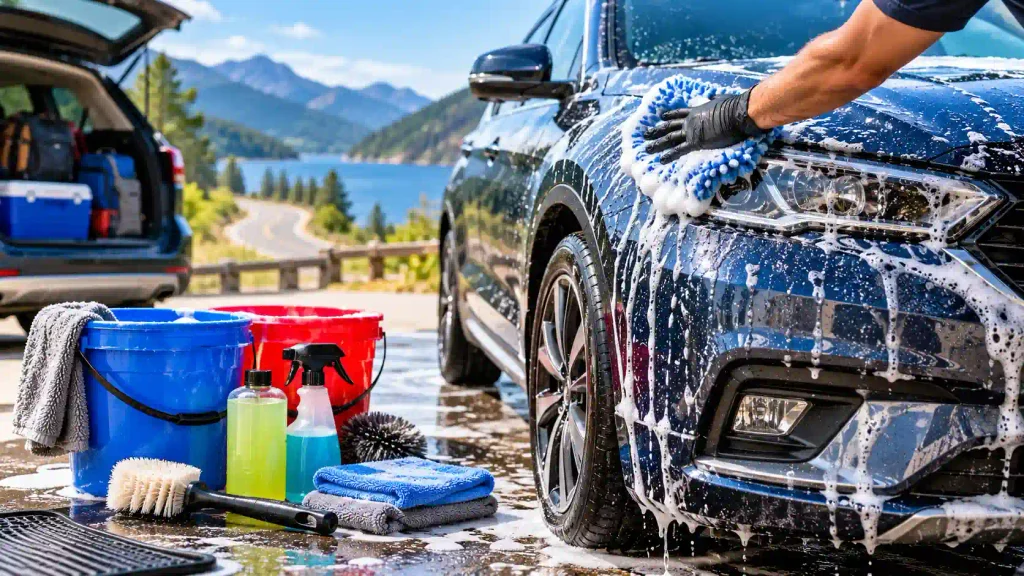
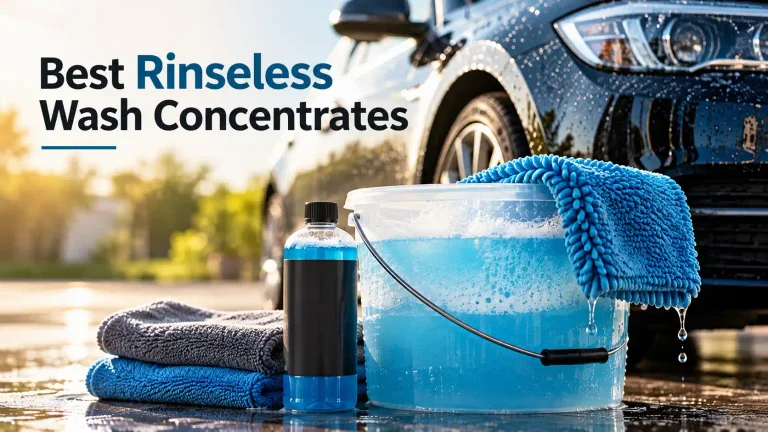
A rinseless wash concentrate lets you clean a car with a bucket of diluted solution, suitable wash media, and drying towels. You skip the final hose rinse, which makes routine washing more practical when you live in an apartment, work inside a garage, or want to reduce setup time.
The best choice depends on what you want left on the paint. Some products focus on cleaning without added wax. Others also deposit wax or SiO2-related protection. Dilution, surface compatibility, towel requirements, and bottle size all affect whether a concentrate is a good purchase for your routine.
For a first purchase, start by comparing Optimum No Rinse V6, P&S Absolute, DIY Detail T2, and McKee’s N-914 V2. The remaining picks offer specific reasons to choose a protective finish, a particular brand’s care system, or a larger container.
Best Rinseless Wash Concentrates at a Glance
Use the category column to narrow the list before comparing prices. Most owners need one main rinseless concentrate, not a shelf full of similar products.
This article contains affiliate links. If you buy through them, we may earn a commission at no extra cost to you.
| Product | Best For / Category | Amazon |
|---|---|---|
| Optimum No Rinse Wash & Shine Version 6 | Best Overall | Check Price on Amazon |
| P&S Absolute Rinseless Wash | Best for Buyers Concerned About Hard Water | Check Price on Amazon |
| DIY Detail Rinse Less Wash T2 | Best for a Simple Coating-Maintenance Routine | Check Price on Amazon |
| McKee’s 37 N-914 Rinseless Wash V2 | Best for Cleaning Without Added Wax | Check Price on Amazon |
| Koch-Chemie Rapid Rinseless Wash | Best for Light-Soil Exterior Maintenance | Check Price on Amazon |
| CARPRO ECH2O Concentrate | Best for Rinseless Washing and Glossy Spray Maintenance | Check Price on Amazon |
| Wolfgang Uber Rinseless Wash | Best for a Highly Concentrated Bucket Mix | Check Price on Amazon |
| Optimum No Rinse Wash & Wax | Best for a Carnauba-Enhanced Maintenance Wash | Check Price on Amazon |
| Ethos Hybrid Ceramic Rinseless Wash | Best for a Temporary Slick Finish | Check Price on Amazon |
| XPEL Rinse Free Car Wash | Best for an XPEL PPF Care Routine | Check Price on Amazon |
| Opti-Coat No Rinse Ceramic Rinseless Wash | Best for Opti-Coat Ceramic Maintenance | Check Price on Amazon |
| McKee’s 37 N-914 Rinseless Wash & Wax | Best for Existing Wax Maintenance | Check Price on Amazon |
| Wolfgang Uber SiO2 Rinseless Wash | Best for a Structured Wash-and-Protect Process | Check Price on Amazon |
| Duragloss Rinseless Wash with Aquawax | Best for Buyers Ready to Purchase a Gallon | Check Price on Amazon |
Confirm the formula, bottle size, seller, and package contents before ordering. Each link above leads to an individual product listing.
The 14 Best Rinseless Wash Concentrates, Reviewed
1. Best Overall — Optimum No Rinse Wash & Shine Version 6
Best for: Owners building a dependable, everyday rinseless-wash routine.
Optimum No Rinse, usually called ONR, is our overall starting recommendation because its published instructions cover both the basic wash and several secondary detailing jobs. Version 6 is the current formula reviewed here; check the version on the listing when comparing older blue bottles.
The bucket mixture is straightforward: 1 fluid ounce in 2 gallons of water. Wash and dry one section before continuing. Optimum supports use on ceramic coatings, paint protection film, and matte paint, giving owners with different vehicle finishes a useful first option.
Key Features
- Measured bucket dilution: One ounce treats 2 gallons, making a regular wash easy to prepare without estimating by eye.
- Multiple supported uses: Separate dilutions cover clay lubrication, quick detailing, glass, and interior cleaning.
- Finish compatibility: Manufacturer guidance includes coated paint, PPF, and matte finishes; follow the relevant surface instructions.
Pros
- A clear starting point when you want one concentrate to learn with and keep using.
- Secondary uses can reduce duplicate purchases if you label and mix each bottle correctly.
- The linked 32-ounce bottle provides 32 two-gallon batches at the stated wash dose, before allowing for other uses.
Cons
- Different secondary uses require different dilutions; the bucket recipe is not universal.
- Heavy mud or excessive grit still needs removal before contact washing.
Buying Decision
Buy ONR V6 if you want one versatile concentrate for routine washing and occasional detailing tasks. Start with the linked 32-ounce bottle and suitable towels before investing in more equipment. Choose N-914 V2 if your main priority is an explicitly no-wax cleaning formula rather than broad versatility.
2. Best for Buyers Concerned About Hard Water — P&S Absolute Rinseless Wash
Best for: Drivers who want water-conditioning chemistry alongside routine cleaning.
Absolute deserves attention if tap-water mineral content is part of your washing problem. P&S describes polymers that encapsulate and emulsify dirt, along with water softening intended to reduce the chance of hard-water spotting.
That claim supports its place on the shortlist, but it does not make drying optional. Work with wet wash media, clean towel faces, and prompt drying rather than leaving solution to evaporate. The linked listing is one quart of concentrate.
Key Features
- Water-conditioning formulation: P&S emphasizes softening the wash water, a relevant feature when choosing a concentrate for tap-water use.
- Polymer cleaning system: Designed to manage dirt during a rinseless wash instead of relying on a conventional rinse cycle.
- Broad stated compatibility: Manufacturer applications include paint, coatings, wraps, PPF, trim, and selected interior materials.
Pros
- Gives hard-water-conscious buyers a specific formulation feature to compare.
- A quart is a manageable purchase before committing to bulk refills.
- Useful to shortlist when you maintain a mix of painted and protected surfaces.
Cons
- Water conditioning does not establish a guarantee against spots.
- It is not a substitute for removing etched mineral marks or deep interior stains.
Buying Decision
Buy Absolute if water conditioning is a deciding factor in your maintenance wash. Compare it with ONR using your own water and normal technique before purchasing a gallon. If your vehicle already has etched spots, budget for an appropriate separate treatment rather than expecting this wash to correct them.
3. Best for a Simple Coating-Maintenance Routine — DIY Detail Rinse Less Wash T2
Best for: Owners who want a cleaning-focused wash before their chosen finishing product.
DIY Detail combines polymer and surfactant cleaning in a pH-balanced concentrate. Its current guidance calls for 1 ounce in 2 gallons, followed by washing and drying individual panels. The linked T2 product is a 16-ounce bottle.
The practical appeal is keeping cleaning separate from a heavy protection layer. DIY Detail describes the finish as suitable for a final detail spray if desired, while supporting ceramic coatings and PPF. That makes it a useful fit when you already have a topper you like.
Key Features
- Hybrid cleaning chemistry: Surfactants address traffic film while polymers support lubrication and dirt management.
- Coating and PPF support: Intended for routine cleaning without stripping existing protection when used as directed.
- Straightforward dosing: One ounce per 2 gallons keeps the basic bucket setup simple.
Pros
- A clear fit when you want to select your finishing product independently.
- The smaller bottle limits the initial commitment while you learn the process.
- Does not require a foam cannon to perform its main bucket-wash job.
Cons
- The 16-ounce bottle yields fewer standard batches than a 32-ounce option at the same dose.
- Cleaning alone does not provide the dedicated protection step some buyers want.
Buying Decision
Buy DIY Detail T2 if you already use a separate protection product and want to simplify the wash stage. Choose the small bottle for your first comparison. Consider a wash-and-wax option instead if your main aim is combining cleaning and added protection in one session.
4. Best for Cleaning Without Added Wax — McKee’s 37 N-914 Rinseless Wash V2
Best for: Owners who want to preserve the appearance and water behavior of existing protection.
N-914 V2 is the clearest pick here for buyers who specifically do not want added wax. McKee’s describes a cleaning formula that avoids leaving a film that changes the look or water behavior of an existing wax, sealant, or coating.
Use 1 ounce in 2 gallons for rinseless washing. The manufacturer also supports matte and satin finishes. This is a different product from N-914 Rinseless Wash & Wax, reviewed later, so the name on the bottle matters.
Key Features
- No added wax: Designed to clean while preserving the character of the protection already on the vehicle.
- Matte and satin support: A relevant compatibility statement for owners who need to avoid unwanted gloss changes.
- V2 update: McKee’s identifies improved lubricity and easier cold-climate drying as changes from the original formula.
Pros
- A focused choice when maintaining an existing coating is more important than adding a fresh topper.
- The linked 32-ounce bottle makes 32 standard two-gallon batches at the wash dose.
- Simplifies comparisons because the intended role is cleaning rather than wash-and-protect.
Cons
- Does not add the wax layer offered by the similarly named Wash & Wax version.
- Secondary cleaning and preparation uses need their own instructions, not the basic wash mix.
Buying Decision
Buy N-914 V2 if added wax or a gloss-enhancing topper is exactly what you want to avoid. It is an especially sensible shortlist choice for owners who monitor an existing coating’s behavior. Choose the separate Wash & Wax formula only when adding protection is part of the plan.
5. Best for Light-Soil Exterior Maintenance — Koch-Chemie Rapid Rinseless Wash
Best for: Owners who regularly clean lightly soiled paint, glass, and exterior plastic.
Rapid Rinseless Wash has a clearly defined task: quick exterior cleaning of lightly soiled vehicles. Koch-Chemie’s US instructions specify a 256:1 water-to-product dilution, or half an ounce per gallon, for bucket washing.
The manufacturer describes a smooth finish and retention of previously applied waxes and polishes. Its stated light-soil role is useful buying information: use it to maintain a car before dirt builds up, rather than selecting it as a heavy-contamination cleaner.
Key Features
- Defined maintenance role: Intended for light exterior soil, helping you match the purchase to the actual job.
- US bucket and spray guidance: Both methods are covered in the manufacturer’s regional instructions.
- 1-liter concentrate: The linked product offers roughly 33.8 fluid ounces in one bottle.
Pros
- Good fit for a frequent wash routine that keeps contamination manageable.
- Exterior paint, glass, and plastic applications cover the main visible body surfaces.
- Useful when you prefer a product with a narrowly stated purpose and documented mixing guidance.
Cons
- Heavy mud and bonded contamination fall outside its stated light-soil maintenance role.
- Regional instructions differ slightly; follow the US bottle rather than mixing ratios from another market.
Buying Decision
Buy RRW if your vehicle is usually only lightly dirty and you want a clearly specified exterior wash. Pair it with a measuring tool and clean wash media. If neglected paint is the main problem, solve the contamination issue first rather than choosing a concentrate by reputation alone.
6. Best for Rinseless Washing and Glossy Spray Maintenance — CARPRO ECH2O Concentrate
Best for: Enthusiasts who want one concentrate for several exterior cleaning formats.
ECH2O is sold as a waterless wash and quick-detailer concentrate, but CARPRO’s US distributor also publishes a rinseless bucket method. Its rinseless dilution is different from its spray-cleaning mix, so choose the recipe for the job rather than treating all uses alike.
CARPRO describes a SiO2 hybrid formula for cleaning and gloss on coated or uncoated surfaces. The reviewed listing is the 500 mL bottle. It makes sense if you will use both bucket washing and spray maintenance, not simply because you want another ceramic-labeled product.
Key Features
- Multiple exterior uses: Published applications include rinseless washing, waterless cleaning, detailing, and clay lubrication.
- Gloss-focused formulation: Combines a SiO2 hybrid framework with lubricating ingredients.
- Rinseless-specific dilution: The US distributor lists 1 part concentrate to 200 parts water; follow your current bottle’s method.
Pros
- Can fill more than one role in a deliberately small exterior-care kit.
- Useful for owners who enjoy a glossy finishing step between full details.
- The 500 mL bottle lets you evaluate the process without purchasing a gallon.
Cons
- Haze may require a final wipe, adding work compared with a straightforward wash-and-dry routine.
- It is not a coating-preparation wipe; its lubricants can interfere with coating bonding.
Buying Decision
Buy ECH2O if you will use its spray-maintenance roles as well as rinseless washing. Keep separately labeled bottles for each dilution. If you only want a basic bucket cleaner with no added wax or gloss-focused finish, N-914 V2 is a more direct comparison.
7. Best for a Highly Concentrated Bucket Mix — Wolfgang Uber Rinseless Wash
Best for: Drivers who want a measured three-gallon wash batch and secondary spray uses.
The original Wolfgang Uber Rinseless Wash makes 3 gallons of wash solution from 1 ounce of concentrate. That is a useful difference when comparing bottles, because similar package sizes do not necessarily provide the same quantity of usable wash solution.
Wolfgang also publishes recipes for waterless washing, clay lubrication, and detail spray. Choose this original version if you want that multi-use routine without specifically shopping for the separate SiO2 formula.
Key Features
- One-ounce, three-gallon mix: A clear high-dilution wash recipe for buyers comparing concentrate consumption.
- Polymer lubrication: Designed to help the wash medium glide while managing dirt.
- Several documented applications: Different recipes cover washing, pre-treatment, clay lubrication, and detailing.
Pros
- The dose provides more water per ounce than the common one-ounce, two-gallon recipes.
- A useful purchase if you routinely prepare a larger bucket batch.
- Secondary mixes can be practical when you already own labeled sprayers.
Cons
- Concentration alone does not prove superior cleaning or lower total wash cost.
- The many recipes increase the chance of mixing the wrong strength if bottles are not labeled.
Buying Decision
Buy original Uber if its three-gallon recipe fits your routine and you will use the secondary mixes. Compare the bottle price against the amount of solution you actually prepare. Choose Uber SiO2 instead when added protective chemistry, rather than dilution economy, is your priority.
8. Best for a Carnauba-Enhanced Maintenance Wash — Optimum No Rinse Wash & Wax
Best for: Owners who want to wash and add a wax-containing finish in one routine.
The green ONR Wash & Wax formula adds a different purpose to the familiar rinseless process: a carnauba-enhanced protection layer during cleaning. It is not simply another bottle size of blue Wash & Shine.
Optimum positions it as a wash-and-wax product for panel-by-panel washing and drying. The linked listing is one 32-ounce bottle. This makes the most sense when convenience matters more than keeping the cleaning and protection stages completely separate.
Key Features
- Carnauba-enhanced formula: Combines rinseless cleaning with added gloss and protection.
- Bucket-wash concentrate: The linked product specifies 1 ounce per 2 gallons of water.
- Separate green ONR variant: Clearly distinguish it from blue Wash & Shine when buying or refilling.
Pros
- A convenient option when you want added wax during a routine wash.
- Fits a simple wash-and-dry session without another separate application pass.
- The 32-ounce size is practical for ongoing maintenance without buying bulk immediately.
Cons
- Added protection is unnecessary when you want an unaltered existing coating surface.
- Wash-deposited wax does not establish the same durability as a separately applied protection system.
Buying Decision
Buy green ONR if your goal is a clean car with added wax from the same wash session. Choose blue ONR or N-914 V2 if you want to decide on protection afterward. For a maintained daily driver, this is a convenience purchase rather than a shortcut around paint preparation.
9. Best for a Temporary Slick Finish — Ethos Hybrid Ceramic Rinseless Wash
Best for: Buyers who want hybrid cleaning chemistry and a temporary protective finish.
Ethos Hybrid combines surfactants and polymers with SiO2-related chemistry. The manufacturer describes the remaining protective layer as temporary, an important distinction from a dedicated ceramic coating.
Its published bucket guidance allows dilution up to 1:256, followed by washing and drying. The linked product is the 16-ounce concentrate. The appeal is a combined cleaning-and-finish routine without a large first purchase.
Key Features
- Hybrid formulation: Surfactants and polymers address cleaning and dirt management together.
- Temporary protective finish: Ethos describes added slickness without presenting the wash as a replacement for a full coating.
- Concentrated bucket use: Published directions cover microfiber or sponge washing, with optional panel pre-wetting.
Pros
- A small bottle is a manageable way to evaluate a protective rinseless formula.
- Useful for drivers who want cleaning and a fresh finish in the same session.
- Fits a compact setup built around a bucket, sprayer, and clean towels.
Cons
- A deposited finish may be unwanted when evaluating the original coating’s water behavior.
- Temporary protection means you should still plan your main protection routine independently.
Buying Decision
Buy Ethos Hybrid if a temporary slick finish is a benefit you want after washing. Start with the linked 16-ounce bottle before buying more. Choose a cleaning-focused alternative if you prefer to control every finishing product separately.
10. Best for an XPEL PPF Care Routine — XPEL Rinse Free Car Wash
Best for: Owners who prefer maintenance products from their paint-protection-film brand.
XPEL Rinse Free Car Wash is a logical shortlist option for an owner already maintaining XPEL film. The linked 16-ounce concentrate is identified as PPF-safe, and XPEL publishes a simple wash-one-section, dry-one-section procedure.
Its instruction sheet calls for 1 ounce in 1 gallon of water. That makes the concentrate consumption higher than several one-ounce, two-gallon options, so include dilution in the value comparison. Brand familiarity is useful, but it does not make the bottle automatically more economical.
Key Features
- PPF-care fit: Provides a named rinse-free option from a paint-protection-film manufacturer.
- Polymer lubrication: Designed to encapsulate dirt during contact washing.
- One-ounce, one-gallon recipe: A specific mixing instruction rather than a generic rinseless ratio.
Pros
- Makes product selection easier for owners already following an XPEL care routine.
- Simple published steps support a predictable panel-by-panel method.
- The 16-ounce bottle allows a trial before moving to a larger container.
Cons
- The stated dose uses more concentrate per gallon than many other picks.
- A same-brand wash does not replace checking instructions for your particular film or coating.
Buying Decision
Buy XPEL Rinse Free if matching your established XPEL care routine matters more than maximizing dilution. Compare the cost per prepared bucket, not just the bottle price. For an uncoated car with no XPEL-specific preference, ONR is the broader starting recommendation.
11. Best for Opti-Coat Ceramic Maintenance — Opti-Coat No Rinse Ceramic Rinseless Wash
Best for: Owners who want a rinseless wash designed around existing ceramic protection.
Opti-Coat No Rinse adds SiO2 and UV inhibitors to a rinseless maintenance formula. Optimum supports it on coated and uncoated vehicles, but explicitly advises against using it when preparing for polishing or new protection application.
That restriction helps define who should buy it. The linked 16-ounce bottle suits an owner maintaining existing protection, while blue ONR is the better same-brand comparison for preparation work.
Key Features
- Coating-maintenance formulation: Includes SiO2 and UV inhibitors according to the manufacturer.
- One ounce per 2 gallons: Uses a straightforward bucket dilution for normal washing.
- Documented preparation restriction: Deposited ingredients can interfere with bonding of subsequent protection products.
Pros
- A clear product choice when existing ceramic maintenance is the main task.
- The manufacturer explains when its original blue formula is preferable.
- A 16-ounce bottle is enough to assess whether this maintenance approach suits you.
Cons
- It is the wrong default for washing immediately before a new coating or sealant application.
- Added ingredients are not essential for every coated vehicle; compatible plain maintenance washes remain options.
Buying Decision
Buy Opti-Coat No Rinse if you want its protective maintenance chemistry on a car that is already coated. Keep blue ONR or another appropriate cleaner for preparation sessions. You do not need both for ordinary washing unless your routine genuinely includes those different jobs.
12. Best for Existing Wax Maintenance — McKee’s 37 N-914 Rinseless Wash & Wax
Best for: Owners who want added gloss and protection alongside regular low-water washing.
N-914 Rinseless Wash & Wax is the protective alternative to cleaning-focused N-914 V2. McKee’s describes polymers that leave a slick, glossy finish complementary to existing wax.
The manufacturer specifies 1 ounce in 2 gallons for washing, then a clean towel for drying each section. A stronger separate recipe makes a quick detailer. The reviewed product is the individual 32-ounce bottle, not a sponge-and-wash bundle.
Key Features
- Wash-and-protect purpose: Adds a finish during cleaning rather than simply revealing existing protection.
- Standard bucket recipe: One ounce per 2 gallons for rinseless washing.
- Quick-detailer application: A separate stronger dilution covers light fingerprints and dust maintenance.
Pros
- A practical option when your current care routine already centers on wax.
- Lets you maintain a finished appearance without another separate product pass after every wash.
- A 32-ounce bottle provides room for both wash batches and occasional detailer mixes.
Cons
- The similar V2 name can lead to buying the wrong formula.
- The protective finish is unnecessary for coating-preparation work or a no-added-wax routine.
Buying Decision
Buy this version when added protection is a deliberate part of your wash routine. Choose N-914 V2 when your priority is cleaning without an added wax finish. Check the full “Wash & Wax” name through the link above before ordering.
13. Best for a Structured Wash-and-Protect Process — Wolfgang Uber SiO2 Rinseless Wash
Best for: Owners who want SiO2-enhanced maintenance with detailed towel-method instructions.
Uber SiO2 adds protective chemistry to Wolfgang’s rinseless range. It is a distinct formula with its own instructions: 1 ounce in 2 gallons, rather than the original Uber’s three-gallon recipe.
Wolfgang outlines small-section washing and immediate drying, and recommends planning enough microfiber towels for the session. That makes it a useful pick for owners who prefer a clearly organized multi-towel process and want a deposited hydrophobic finish.
Key Features
- SiO2-enhanced formulation: Designed to leave gloss, slickness, and a hydrophobic layer during maintenance.
- Product-specific dosing: One ounce in 2 gallons; do not transfer the original Uber recipe automatically.
- Detailed towel method: Published guidance includes soaking wash media and working small sections before drying.
Pros
- Useful when adding protection is part of the purchase goal.
- The detailed method helps buyers plan their towel supply before starting.
- Secondary uses provide flexibility when mixed according to their own instructions.
Cons
- The towel method creates laundry and requires enough clean media upfront.
- A hydrophobic wash finish is not evidence of a professionally installed ceramic coating.
Buying Decision
Buy Uber SiO2 if you want protective washing and are comfortable with a planned microfiber routine. Include towels in the budget before purchasing. Choose original Uber for its different concentration and multi-use role, or N-914 V2 when added protection is unwanted.
14. Best for Buyers Ready to Purchase a Gallon — Duragloss Rinseless Wash with Aquawax
Best for: Frequent washers who already prefer a wash-and-wax formula.
Duragloss combines rinseless washing with Aquawax for owners who want a protective finish during cleaning. Its product guidance focuses on dusty or mildly dirty vehicles, a sensible role for routine maintenance between more involved details.
The linked listing is the 932 one-gallon container. Its stated mix is half an ounce per gallon of water. This is a bulk purchase, so the buying decision depends on whether you already know you want this type of finish and will use it regularly.
Key Features
- Aquawax-containing formula: Adds protection and gloss as part of the wash routine.
- One-gallon container: The linked 932 product is a single 128-fluid-ounce container.
- Maintenance dilution: Half an ounce per gallon provides a clear dosing basis for repeated use.
Pros
- A bulk option for an established routine instead of repeated small-bottle purchases.
- The stated dose gives 128 two-gallon batches from a gallon before other uses or losses.
- Suited to maintaining ordinarily clean vehicles rather than treating every wash as a deep detail.
Cons
- A gallon takes more storage space and ties up more money before you know whether you like it.
- The wax-containing finish does not suit every preparation or coating-maintenance preference.
- Heavy grit requires removal first; the mild-soil role should guide your expectations.
Buying Decision
Buy the gallon if you already prefer wash-and-wax maintenance and wash often enough to use it. For a first rinseless purchase, a smaller ONR Wash & Wax or N-914 Wash & Wax bottle is the more manageable commitment. Compare current seller offers before choosing bulk solely for presumed savings.
What Is a Rinseless Wash Concentrate?
A rinseless wash concentrate is mixed with water and used to clean one section of a vehicle before that section is dried. Its cleaning and lubricating ingredients help manage dirt during contact washing without requiring a traditional final rinse.
Three distinctions matter before buying:
- Rinseless washing: Uses a bucket mixture, wet wash media, and separate drying towels.
- Waterless washing: Usually uses a spray-and-wipe method; the product and dilution must support it.
- Traditional washing: Uses shampoo followed by a water rinse to remove the washing solution.
Some concentrates support more than one method. That does not make their dilution recipes interchangeable. A regular shampoo also does not become rinseless simply because you stop rinsing it.
Rinseless is most convenient for manageable maintenance dirt. Heavy mud, sand, or caked grit calls for removing the bulk contamination before contact. The purchase should reduce unnecessary setup without encouraging you to drag debris across the finish.
How We Chose These 14 Concentrates
We researched manufacturer descriptions, instructions, compatibility guidance, and individual Amazon product listings. These recommendations reflect product suitability and documented features, not a hands-on comparison test.
We considered:
- Actual rinseless support: A concentrate must have a documented rinseless application.
- Mixing requirements: The dose needed for a useful bucket batch.
- Surface fit: Paint, existing protection, PPF, and specialty finishes where explicitly supported.
- Remaining finish: Cleaning-focused products versus wax- or SiO2-enhanced maintenance formulas.
- Practical setup: Wash media, sprayers, drying, and towel laundry.
- Purchase commitment: Individual bottles versus bulk containers.
These are 14 distinct formulas, including different functional versions from the same brand. Different bottle sizes of the same formula are not counted as separate products. The “best for” labels are editorial buying recommendations, rather than laboratory rankings.
Which Rinseless Wash Should You Buy?
Choose according to the result you want, then purchase one suitable bottle and the towels needed to use it correctly.
| Your main priority | Start by comparing | Buying consideration |
|---|---|---|
| A first general-purpose concentrate | ONR V6 | Broad documented uses and a manageable 32-ounce size |
| Tap-water conditioning | P&S Absolute | Still requires prompt drying; conditioning does not guarantee no spots |
| Cleaning with separately chosen protection | DIY Detail T2 or N-914 V2 | Avoid buying a protective formula you do not need |
| Frequent light-soil exterior cleaning | Koch-Chemie RRW | Match its stated maintenance role |
| Several spray and bucket applications | CARPRO ECH2O or original Wolfgang Uber | Plan separate labeled dilutions |
| Added wax during washing | Green ONR or N-914 Wash & Wax | Choose these intentionally over the plain cleaning variants |
| An existing brand-specific protection routine | XPEL or Opti-Coat No Rinse | Confirm the requirements of your installed film or coating |
| A protective maintenance finish | Ethos Hybrid or Wolfgang Uber SiO2 | A wash-deposited layer is different from a dedicated coating |
| Bulk wash-and-wax use | Duragloss 932 | Buy a gallon after deciding the formula suits your needs |
How Do You Choose the Right Concentrate?
The right concentrate fits your surface and washing process. A highly diluted formula is useful, but dilution alone cannot establish which product cleans best or produces the lowest total cost.
Decide Whether You Want Added Protection
Choose a cleaning-focused product when you already have a coating or finishing routine you like. N-914 V2 specifically targets washing without an added wax film, while DIY Detail describes a cleaning finish suitable for your chosen detail spray afterward.
A wash-and-wax or SiO2-enhanced concentrate suits a different goal: adding a finish during washing. That can be convenient, but it changes what is on top of the paint. Opti-Coat No Rinse explicitly belongs in maintenance rather than preparation for new protection.
Check the Actual Finish
A product approved for glossy paint is not automatically approved for every wrap, satin film, or matte finish. Look for specific compatibility guidance and follow the film or coating manufacturer’s care instructions.
If a coating is new, its cure and first-wash requirements take priority over your normal maintenance schedule. Do not start cleaning early simply because a bottle says “ceramic safe.”
Compare Cost per Prepared Batch
Use the dose for the intended task, not just the bottle size. A 32-ounce concentrate using 1 ounce per two-gallon batch provides 32 batches before product losses or other uses.
The comparison changes with stronger dosing. XPEL’s published recipe uses 1 ounce per gallon, while original Wolfgang Uber specifies 1 ounce per 3 gallons. Neither figure proves better cleaning; both affect how quickly you consume the bottle.
Calculate:
Cost per wash batch = bottle price × ounces used per batch ÷ ounces in the bottle.
Include extra product used for pre-spray and secondary mixes. Towels, laundering, and storage also contribute to the cost of your routine.
Choose Your Wash Media Before You Start
Two practical approaches are:
- Multiple towels: Soak clean towels, use fresh faces, and place used towels in a separate container. This helps keep dirt out of the original solution but creates more laundry.
- A suitable rinseless sponge or mitt: Follow the product and tool instructions for releasing dirt and refreshing the wash medium. Inspect it often rather than assuming a bucket insert eliminates all contamination.
The concentrate does not make a dirty wash medium safe. Budget for enough clean material to finish the vehicle without stretching one contaminated towel across several panels.
Match the Method to the Dirt
Light dust and ordinary maintenance soil are different from gritty deposits on lower panels. Inspect the car before mixing the bucket.
Remove substantial mud, sand, and grit first. Use appropriate separate treatments for bonded contamination when required. A normal maintenance concentrate does not replace an iron remover, tar remover, or paint-correction process.
Rinseless Mixing Guide for the Reviewed Products
These recipes describe bucket washing. Follow the current bottle if its instructions differ, especially when formulations or regional labels change.
| Product | Published bucket-wash guidance |
|---|---|
| ONR Wash & Shine V6 | 1 fl oz per 2 gallons of water |
| DIY Detail T2 | 1 fl oz per 2 gallons |
| N-914 V2 | 1 fl oz per 2 gallons |
| Koch-Chemie RRW, US guidance | 0.5 fl oz per gallon |
| CARPRO ECH2O | US distributor lists 1 part concentrate to 200 parts water; follow the current method on your bottle |
| Original Wolfgang Uber | 1 fl oz per 3 gallons |
| ONR Wash & Wax | Linked product specifies 1 fl oz per 2 gallons |
| Ethos Hybrid | Manufacturer specifies dilution up to 1:256 |
| XPEL Rinse Free | 1 fl oz per gallon |
| Opti-Coat No Rinse | 1 fl oz per 2 gallons |
| N-914 Wash & Wax | 1 fl oz per 2 gallons |
| Wolfgang Uber SiO2 | 1 fl oz per 2 gallons |
| Duragloss Rinseless with Aquawax | Linked product specifies 0.5 fl oz per gallon |
| P&S Absolute | Measure according to the current concentrate label |
A US fluid ounce is about 29.6 mL; a US gallon is about 3.79 liters. One ounce per 2 gallons is approximately 1 part product to 256 parts water. Ratio notation varies between brands, which is why the actual dose is often easier to follow.
How Should You Perform a Rinseless Wash?
Work one manageable section at a time and keep clean material between the dirt and the paint.
- Inspect the car: Identify heavy grit, mud, or contamination that needs separate removal.
- Prepare the area: Choose shade and cool panels where possible, with space for clean and used towels.
- Measure the concentrate: Use the product’s bucket recipe and enough solution to wet your wash media properly.
- Pre-wet where directed: Use a suitable labeled mixture to soften maintenance dirt before contact.
- Wash gently: Use light pressure and a clean towel face or refreshed wash medium.
- Dry the section: Follow the product’s method and move to the next area only after finishing the current one.
- Separate dirtier areas: Keep lower-body, wheel, and tire tools away from cleaner paint-care media.
- Check the finish: Re-clean missed dirt with fresh solution and media rather than rubbing it with a dry towel.
- Clean your equipment: Launder used towels and wash tools according to their care instructions.
For a large truck or SUV, use additional clean media and solution when needed. The smallest advertised water quantity is not a requirement you must meet at the expense of technique.
Common Mistakes That Waste Product or Damage the Finish
- Substituting regular shampoo: A rinseless product must support direct drying without a final rinse.
- Using the wrong version: Wash & Shine, Wash & Wax, and ceramic variants serve different purposes.
- Guessing dilution: Too much product increases consumption and can make finishing harder; too little falls outside the prescribed method.
- Returning dirty towels to clean solution: This transfers contamination back into the wash supply.
- Treating every surface alike: Wheels, tires, matte paint, and film can need different instructions or tools.
- Trying to wipe away heavy grit: Remove bulk contamination before contact rather than trusting lubrication alone.
- Applying new protection over an unsuitable wash film: Follow the complete preparation process required by the protection product.
Conclusion
For most first-time buyers, ONR Wash & Shine V6 is our overall starting recommendation. P&S Absolute deserves a closer look for water conditioning, while DIY Detail T2 and N-914 V2 fit owners who prefer choosing protection separately.
Choose a wax- or SiO2-enhanced formula only when that finish is part of your goal. XPEL and Opti-Coat also give existing customers a clear brand-specific maintenance option. Buy a gallon after you know the formula fits your habits, not just because the container looks like better value.
Start with one concentrate, enough clean wash media, and a measuring tool. Check the individual Amazon links above, match the right formula to your car, and follow its instructions consistently.
Frequently Asked Questions
1. Is Rinseless Washing Safe for Paint?
Rinseless washing can be appropriate for paint when the product, dirt level, wash media, and technique suit the task. Lubrication helps, but does not eliminate the possibility of scratching. Remove heavy debris first and use clean material with light pressure.
2. Is Rinseless Wash the Same as Waterless Wash?
No. Rinseless washing uses a diluted bucket solution and drying stage, while waterless cleaning normally uses a spray-and-wipe process. Some concentrates support both, with different dilutions and instructions.
3. Which Concentrate Should a Beginner Buy?
ONR V6 is our overall starting recommendation for a general-purpose routine. N-914 V2 is worth comparing when avoiding added wax is the main priority. Begin with a manageable bottle and spend part of the budget on suitable towels.
4. Can You Use Rinseless Wash on Ceramic Coatings?
Yes, when the concentrate is approved for the coating and you follow its maintenance instructions. A compatible cleaning-focused wash does not have to contain SiO2. Protective wash formulas are an optional maintenance choice rather than an automatic requirement.
5. Does Every Rinseless Wash Add Wax?
No. N-914 V2 is explicitly positioned to clean without an added wax film, while green ONR and N-914 Wash & Wax are protective variants. Read the complete product name instead of choosing by brand alone.
6. Can You Use a Rinseless Wash in a Foam Cannon?
Only if the product explicitly supports that method. The bucket recipes in this guide do not establish foam-cannon compatibility. Use purpose-made foaming products and their equipment-specific instructions when foam application is your goal.
7. Can Rinseless Wash Remove Mud or Road Salt?
A rinseless concentrate can clean suitable maintenance contamination, but heavy deposits should be removed before contact washing. Salt can also collect in the underbody and areas a paint-wiping method does not reach. Plan additional washing according to the contamination and conditions.
8. Do You Need Distilled Water?
Not for every product. ONR is designed to work with normal tap water, while local water quality can still affect your experience. Follow the product instructions and dry promptly rather than assuming any water choice removes the need for drying.
9. How Many Washes Does a Bottle Provide?
Divide the bottle volume by the concentrate used per batch. A 32-ounce bottle at a one-ounce dose provides 32 batches before losses or secondary uses. Extra pre-spray, larger vehicles, and different recipes change the total.
10. Is a Rinseless Wash a Replacement for Wax or Ceramic Coating?
A cleaning-focused wash does not replace protection, and a protective wash does not automatically match a dedicated wax, sealant, or coating. Choose your main protection according to exposure and maintenance needs. Treat protection added during washing as part of that routine, not proof of a complete coating system.