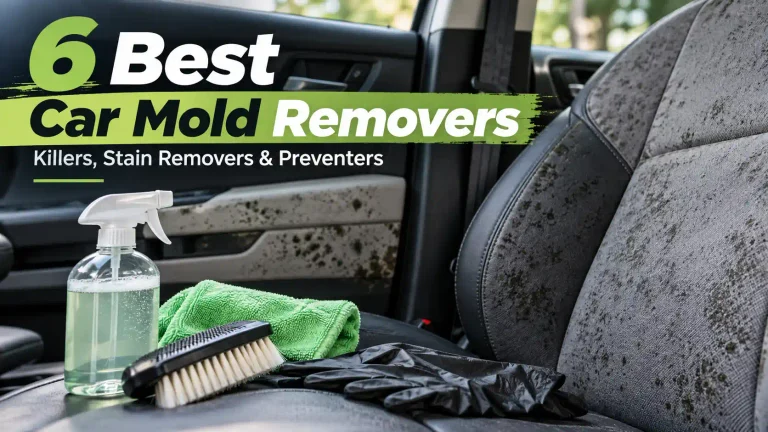
The best mold removers in 2026 do not all perform the same job. A stain cleaner can improve appearance without providing a registered mold-treatment claim, while a mold-control product may leave discoloration behind. A preventer also cannot compensate for ongoing dampness.
This guide compares six individual household products for labeled treatment, stain removal, and inhibition on compatible surfaces. It explains what each purchase is useful for and why a brighter surface is not proof that a mold problem has been resolved.
These are research-based reviews using current product information and cleanup guidance. We did not perform mold-kill, material-safety, or regrowth tests, and we do not recommend applying household formulas indiscriminately to a car interior.
Quick Product Comparison: Killers, Stain Removers and Preventers
| Product | Best For / Category | Amazon |
|---|---|---|
| Concrobium Mold Control, 32 oz | Best Bleach-Free Mold-Control Starting Point | Check Price on Amazon |
| RMR-141 RTU Disinfectant and Mold & Mildew Killer, 1 gallon | Best Ready-to-Use Disinfectant Refill | Check Price on Amazon |
| RMR-86 Instant Mold & Mildew Stain Remover, 1 gallon | Best Bulk Stain-Removal Option | Check Price on Amazon |
| Mold Armor Rapid Clean Remediation, 32 oz | Best Multi-Action Hard-Surface Option | Check Price on Amazon |
| CLR Mold & Mildew Stain Remover, 32 oz | Best Bleach-Free Foaming Stain Cleaner | Check Price on Amazon |
| Wet & Forget Indoor Mold & Mildew Disinfectant Cleaner, 64 oz | Best Bleach-Free Mildew-Inhibition Refill | Check Price on Amazon |
Our 6 Top Picks Mold Removers in 2026
1. Best Bleach-Free Mold-Control Starting Point — Concrobium Mold Control, 32 oz
Best for: Buyers needing a labeled mold-control product with residual prevention on compatible surfaces.
Concrobium Mold Control is a relevant first choice when you want a bleach-free mold-control formula rather than a stain bleach. The linked 32-ounce trigger bottle is ready to use, and the product is EPA-registered for its labeled mold-control uses.
Its role includes treating existing mold and leaving a barrier intended to help limit future growth when used as directed. Follow the application, drying, removal, and reapplication instructions for the actual material. Do not assume that wiping it away immediately gives the same result as completing the specified process.
Concrobium is not a guarantee that a stained surface returns to its original color. Cosmetic discoloration can remain after treatment, and porous materials can hold contamination beyond the accessible surface. Moisture control and appropriate removal remain part of the job.
Choose this product for its labeled mold-control role and bleach-free format. If you mainly need to remove a leftover stain, a stain-specific product may be more directly useful after the underlying cleanup has been addressed.
Key Features
- 32-ounce ready-to-use trigger bottle.
- EPA-registered mold-control product.
- Bleach-free and odorless formulation as labeled.
- Residual barrier is intended to help prevent regrowth under the directions.
Pros
- Clear distinction from a cosmetic stain remover.
- Convenient small-bottle format for appropriate targeted work.
- Relevant option when bleach is not wanted on a compatible surface.
Cons
- Staining may remain after the mold-control process.
- Prevention does not repair moisture problems.
- Broad material claims do not prove that all porous items can be salvaged.
Buying Decision
Choose Concrobium when labeled mold control and residual prevention are your priorities. Choose CLR for a compatible stain-cleaning task, or seek remediation help when the problem extends into porous backing or hidden areas.
2. Best Ready-to-Use Disinfectant Refill — RMR-141 RTU Disinfectant and Mold & Mildew Killer, 1 gallon
Best for: Users who have an appropriate labeled treatment task and need a ready-to-use refill quantity.
RMR-141 RTU serves a different purpose from RMR-86 below. It is a registered disinfectant with labeled mold and mildew treatment uses, while the manufacturer notes that it does not remove the stains left behind.
The linked listing is a one-gallon ready-to-use bottle. Confirm that format before ordering: a refill needs suitable application equipment and correct storage, while a concentrate would require a different preparation process. Do not invent a dilution ratio for this RTU product.
Follow the received label for the exact organism claim, material, preparation, and wet contact time. A quick wipe that makes a surface look clean does not establish that the fungicidal directions were completed. Hard-surface disinfection and any permitted soft-surface treatment must not be treated as identical uses.
Buy RMR-141 for an appropriate treatment step, not for an instant stain-free appearance or a promise to remediate every moldy item. Large volume is useful only when you have a suitable use and will handle it according to the instructions.
Key Features
- One-gallon RTU refill in the verified linked listing.
- EPA-registered disinfectant with labeled mold/mildew uses.
- Treatment role is separate from cosmetic stain removal.
- Application and wet contact requirements vary by labeled task.
Pros
- Clear treatment-focused role.
- Ready-to-use format avoids concentrate mixing.
- Refill quantity suits repeated appropriate work.
Cons
- Does not remove the residual stains according to the manufacturer.
- Bulk bottle needs suitable application equipment.
- Not a substitute for removing contaminated material or fixing moisture.
Buying Decision
Choose RMR-141 when its labeled treatment use matches your surface and you need a refill. Choose RMR-86 only for the separate compatible staining problem; do not mix the products together.
3. Best Bulk Stain-Removal Option — RMR-86 Instant Mold & Mildew Stain Remover, 1 gallon
Best for: Users removing persistent visible staining from manufacturer-approved surfaces after assessing the underlying mold problem.
RMR-86 is a stain-removal purchase. Its job is reducing discoloration left by mold and mildew, which is different from completing a registered mold-treatment process or removing contaminated porous material.
The linked listing is currently a gallon, so check the selected size and package rather than relying on older references to a small trigger bottle. Use suitable application equipment and follow the label for coverage, dwell, rinsing, ventilation, and protective equipment.
This bleach-based stain cleaner can affect color and some materials. The manufacturer says not to use RMR-86 on metals or fabrics. Confirm the remaining surface restrictions, test an approved material as directed, and protect nearby finishes from overspray.
Its buying appeal is a dedicated formula and refill volume for approved stain work. Do not interpret fast visual improvement as proof that the area is fully remediated. Remaining growth, hidden moisture, or contaminated backing may need a different process even when the surface looks better.
Key Features
- Dedicated mold/mildew stain-removal formula.
- One-gallon linked package.
- Ready-to-use liquid; follow the actual label.
- Manufacturer promotes reduced scrubbing on appropriate stain tasks.
Pros
- Focused choice for discoloration rather than an ambiguous all-purpose claim.
- Bulk format can suit repeated approved stain work.
- Can complement a separate cleanup plan when the material permits it.
Cons
- Manufacturer excludes metals and fabrics; bleach can affect other incompatible finishes.
- Stain removal does not establish complete mold remediation.
- Gallon package needs an applicator and storage space.
Buying Decision
Buy RMR-86 for supported stain removal, especially when refill volume is useful. Skip it when bleach is unsuitable or when the main task is mold treatment rather than appearance.
4. Best Multi-Action Hard-Surface Option — Mold Armor Rapid Clean Remediation, 32 oz
Best for: Users treating label-approved hard nonporous surfaces with a cleaner offering mold-control claims.
Mold Armor Rapid Clean Remediation combines cleaning and labeled mold/mildew treatment and inhibition in a ready-to-use product. The linked 32-ounce trigger bottle is a more manageable purchase than a large refill for a limited appropriate hard-surface job.
The manufacturer promotes visible results in as little as one minute, but it also states that waiting time varies with the intended result. Cosmetic change, sanitizing, disinfecting, and mold-control instructions are different claims; use the specific label directions for your task.
Pre-cleaning, wet coverage, and removal steps matter. A dirty surface that is briefly misted and immediately wiped should not be assumed to meet a disinfectant or fungicide instruction. Keep the scope to compatible labeled materials rather than treating “remediation” as approval for every porous item.
Choose Mold Armor when the actual surface and labeled multi-action process fit. If you need bleach-free stain cleaning specifically, CLR’s product has a clearer purpose for that preference. Persistent dampness still needs correction regardless of the cleaner chosen.
Key Features
- 32-ounce ready-to-use trigger bottle.
- Manufacturer-labeled cleaning, fungicidal, and mildew-inhibition roles.
- Hard nonporous surface focus for the reviewed treatment claims.
- Task-specific waiting and removal instructions.
Pros
- Convenient format for limited suitable work.
- Multiple labeled roles can reduce separate product purchases.
- Manufacturer explicitly distinguishes timing by task.
Cons
- Fast visible results do not establish completion of every treatment claim.
- Surface and contact-time restrictions must be followed.
- Product cannot resolve hidden moisture or all porous contamination.
Buying Decision
Choose Rapid Clean Remediation for an approved hard-surface job where its multi-action label is useful. Choose a stain-only cleaner if you only need compatible cosmetic cleanup after the underlying problem is addressed.
5. Best Bleach-Free Foaming Stain Cleaner — CLR Mold & Mildew Stain Remover, 32 oz
Best for: Buyers who need cosmetic stain cleaning on approved materials without a bleach formula.
CLR’s mold and mildew product is explicitly a stain remover. Its bleach-free foaming format makes it relevant when appearance is the task and the material is listed as compatible.
The foam helps direct application rather than spraying a thin liquid everywhere. Follow the label for the permitted surface, working time, testing, and wipe-off or rinse process. Bleach-free does not mean unrestricted use on every textile, coating, or delicate finish.
Do not treat this cleaner as a mold-killing disinfectant based on the word “mold” in the name. Its EPA Safer Choice recognition is a separate program from a registered fungicidal claim and does not establish sterilization or complete remediation.
Choose CLR when a compatible stain remains and you want a targeted bleach-free cleaning option. If active growth, recurring dampness, or inaccessible contamination is the issue, address those separately rather than buying the cleaner solely because its name sounds comprehensive.
Key Features
- 32-ounce bleach-free stain-remover formula.
- Foaming trigger supports controlled coverage.
- Labeled for a range of specific compatible materials.
- EPA Safer Choice recognition concerns the formulation program, not mold-killing proof.
Pros
- Clear stain-focused role.
- Useful alternative when bleach is not wanted.
- Foam can help target the working area.
Cons
- Not presented here as a registered mold-killing treatment.
- Material testing and label limits still apply.
- Cannot repair moisture problems or restore every stained item.
Buying Decision
Choose CLR for a supported stain-cleaning job without bleach. Choose a labeled mold-control product when treatment is the actual requirement, while still removing contamination and controlling moisture.
6. Best Bleach-Free Mildew-Inhibition Refill — Wet & Forget Indoor Mold & Mildew Disinfectant Cleaner, 64 oz
Best for: Users wanting an indoor cleaner with labeled mildew-inhibition directions and a larger ready-to-use supply.
Wet & Forget Indoor combines household cleaning with registered treatment uses, including a mildewstat role that inhibits mold and mildew growth when used as directed. The reviewed product is the Indoor formula, not the brand’s outdoor or shower-cleaner products.
The linked 64-ounce ready-to-use format gives you more supply than a small trigger bottle. Check the included applicator and follow the label rather than assuming every package has the same sprayer. The manufacturer describes a bleach-free formulation.
Its hard-surface disinfection and any labeled soft-surface sanitizing uses have different requirements. A permitted fabric spot-sanitizing use does not prove that mold inside upholstery foam has been removed. Apply only the directions that match the actual task and material.
Choose this product when its indoor cleaning and inhibition roles fit your maintenance plan. It will not compensate for a leaking pipe, persistently wet surface, or deeply contaminated porous item. The final buying advantage is the labeled function and refill size, not a promise that all future mold is prevented.
Key Features
- 64-ounce ready-to-use Indoor formula.
- Bleach-free manufacturer description.
- Registered household treatment uses and mildew-inhibition role.
- Separate instructions for different surface and treatment claims.
Pros
- Larger supply for repeated appropriate indoor maintenance.
- Useful labeled inhibition role after suitable cleanup.
- Avoids concentrate measuring.
Cons
- Must not be confused with similarly branded outdoor or shower formulas.
- Larger package may need separate application equipment.
- Soft-surface claims do not establish removal from padding or backing.
Buying Decision
Choose Wet & Forget Indoor if its specific cleaning and inhibition directions match your routine. Choose Concrobium for its labeled mold-control barrier approach or CLR for a stain-only task.
Mold Treatment, Stain Removal, and Prevention Are Different
Treatment products have specific label claims, surfaces, organisms, and application requirements. Stain removers address discoloration. Preventers or mildewstats inhibit growth under stated conditions. One formula may have more than one role, but the claims are not interchangeable.
Physical cleanup and moisture control remain essential. The EPA’s mold-cleanup guidance explains that killing mold alone is insufficient and that absorbent materials can be difficult to clean completely. Leaks, condensation, and persistently damp backing must be addressed.
These recommendations cover appropriate household surface tasks. Upholstery, automotive electronics, headliners, coatings, and cabin ventilation systems need material-specific assessment; a general household or fabric claim does not establish that a product can remediate the whole vehicle.
How We Chose These Products
We compared labeled treatment versus stain roles, surface restrictions, ready-to-use formats, linked sizes, bleach-related preferences, application demands, and meaningful limits. We used EPA cleanup guidance to keep product claims separate from a complete remediation plan.
“Best” describes editorial fit for a defined task. EPA registration is not an endorsement or a guarantee of safety on every material. Labels and formulas can change, so follow the received instructions and confirm the exact variant, applicator, seller, and package size before buying.
This article contains affiliate links. If you buy through them, we may earn a commission at no extra cost to you.
Buying Guide: Choose the Role Before the Bottle
The best mold remover depends on whether you need to eliminate existing mold, remove visible stains, or help prevent future growth. Choose a product based on its intended function, surface compatibility, active ingredients, and application requirements. Effective mold cleanup also requires controlling moisture and addressing contamination rather than relying on cleaning chemicals alone.
Decide Whether You Need Cleaning, Treatment, or Stain Removal
Assess what remains and where it is. Visible staining after appropriate cleanup can call for a compatible stain cleaner. Existing growth needs suitable removal and, where chosen, a label-supported treatment. Recurrence requires finding the moisture source.
Ordinary cleaning may be sufficient for some small hard-surface situations; a biocide is not automatically necessary for every cleanup. The EPA’s bleach guidance does not recommend biocides as a routine default. Buy a registered treatment only for a use you can identify and perform correctly.
Read the Actual Surface and Contact Instructions
Check hard nonporous, porous, and soft-surface directions separately. A formula may have different claims on different materials, with different pre-cleaning and wet contact requirements. Do not translate a fabric-sanitizing claim into proof of complete mold removal from padding.
Maintain the condition the label requires for the required period, then follow its removal, rinsing, or drying instructions. Appearance changes can occur before a treatment claim is completed. Choose a product whose method you can actually follow.
Choose Bleach-Free for a Reason, Not as a Safety Guarantee
Bleach can alter color or affect incompatible materials. A bleach-free formula may be more relevant to a particular approved surface, but it still has restrictions. Patch-testing and the material maker’s guidance matter for either type.
RMR-86 and CLR serve stain-cleaning decisions with different formulations. Concrobium and Wet & Forget Indoor provide different labeled mold-control or inhibition approaches. Compare the function first rather than assuming all bleach-free products are equivalent.
Match the Size to the Job
A trigger bottle is convenient for a limited suitable task. A gallon refill makes sense only when you need that volume, have suitable application equipment, and can store it correctly. The reviewed RMR listings are gallons; verify the selected size before ordering.
Do not use a bulk purchase as a reason to tackle widespread or hidden contamination without assessment. Quantity is a packaging decision, not a measure of how serious a problem is safe to handle yourself.
Know When a Product Is Not Enough
Extensive growth, substantial water damage, contaminated porous materials, and suspected hidden contamination can need professional assessment. The EPA’s home-cleanup guidance discusses when a small job may be manageable and when additional help is appropriate. Its building-area guidance should not be treated as a car-interior clearance rule.
For a moldy vehicle, first identify the leak or moisture source and whether seat foam, carpet backing, the headliner, or the ventilation system is involved. Repeatedly spraying accessible surfaces may leave the cause untouched. A suitable professional may recommend removal or replacement of affected material.
A Sensible Cleanup Sequence for an Appropriate Small Surface Task
To clean a small mold-affected surface, first identify and correct the moisture source, assess the material, and follow an appropriate mold-cleanup method. Remove contamination using a product approved for the surface, follow the required contact and removal instructions, and dry the area completely. Extensive mold growth, hidden contamination, or heavily affected porous materials may require professional remediation.
- Identify and correct moisture. Stop the leak or address the dampness before expecting prevention products to work.
- Assess the scope and material. Confirm that the item can be cleaned and that the product supports the exact task. Seek help for extensive, hidden, or unsuitable contamination.
- Prepare the work area. Follow product ventilation and protective-equipment requirements and EPA cleanup precautions. Keep people and pets away from the working area as directed.
- Use one product according to its label. Perform required cleaning, coverage, and contact steps. Do not mix mold cleaners, bleach, ammonia, acids, or other chemicals.
- Remove contamination and residue as instructed. Do not rely solely on killing or bleaching the appearance.
- Dry completely. Follow the chosen product’s drying or barrier-maintenance directions and keep the moisture source controlled.
- Recheck the area. Return of growth or dampness means the cause needs reassessment, not simply more fragrance or a stronger-looking bottle.
Avoid dry brushing or casual vacuuming that spreads contamination. Follow an appropriate cleanup method rather than improvising a household spray treatment for HVAC components or an enclosed vehicle cabin.
Common Mold-Product Mistakes
Common mistakes when using mold removers include confusing stain removal with complete mold cleanup, ignoring product contact times, mixing cleaning chemicals, and overlooking the source of moisture. Even an effective mold-treatment product cannot permanently prevent recurring growth if dampness or hidden contamination remains. Following label instructions and correcting moisture problems are essential parts of proper cleanup.
- Assuming stain disappearance means complete cleanup: Cosmetic improvement does not establish removal from porous backing or hidden areas.
- Ignoring wet contact requirements: A quick wipe may not meet the labeled treatment method.
- Treating registration as universal approval: The label defines where and how a registered product can be used.
- Using fragrance as the final test: Smell alone does not establish that moisture or contamination is gone.
- Mixing cleaners: Use each product only as directed; mixtures can create hazardous reactions or interfere with the method.
- Spraying over an active leak: Prevention products cannot replace moisture control.
Conclusion: Which Mold Product Should You Buy?
Choose Concrobium Mold Control for its bleach-free labeled mold-control and barrier role. Choose RMR-141 RTU for a supported treatment task when a refill quantity is appropriate. Mold Armor Rapid Clean Remediation is relevant to its labeled multi-action hard-surface uses.
Choose RMR-86 or CLR for compatible stain removal, with bleach preference and surface restrictions guiding the choice. Choose Wet & Forget Indoor when its indoor cleaning and mildew-inhibition directions fit the task.
Buy by function and material, then complete the cleanup and drying process. Persistent moisture or hidden contamination needs more than a different spray.
Frequently Asked Questions
What is the best mold remover overall?
There is no universal choice because treatment, staining, and recurrence are different problems. Concrobium is our research-based starting option for a suitable bleach-free mold-control task. Confirm the material and label before use.
Does a mold stain remover also kill mold?
Do not assume so. A stain claim addresses discoloration; a treatment claim requires specific label support and application. RMR-86 and CLR are reviewed here for stain removal.
Is bleach always necessary for mold cleanup?
No. EPA guidance does not recommend biocides as the routine default for every cleanup. Physical removal, drying, and moisture control are central, with a chemical treatment chosen only where appropriate.
Can a mold preventer stop growth permanently?
No permanent result should be assumed. Prevention depends on the product’s conditions, material, maintenance, and moisture control. A continuing leak can defeat the intended process.
Can I spray these products on car seats?
Only a specific material and use supported by both product and vehicle guidance should be considered. A fabric claim does not establish complete cleanup of seat foam, electronics, or cabin systems. Extensive vehicle contamination needs assessment.
Is EPA Safer Choice the same as disinfectant registration?
No. Safer Choice concerns a formulation-recognition program, while registered antimicrobial claims have specific labeled requirements. Neither means unrestricted use on every surface.
Why does the mold return after cleaning?
Moisture may remain, the source may be unresolved, or contamination may extend beyond the visible area. Reassess those causes before repeating treatment. Persistent recurrence can justify professional help.
Should moldy porous material always be saved?
No. Some absorbent materials cannot be adequately cleaned and may require disposal or replacement. Assess the item and contamination rather than assuming a spray can salvage everything.