Paint overspray can be removed from a car safely when you use the right method for the type and severity of contamination. For most light to moderate overspray on painted panels, a properly lubricated clay bar is a practical starting point because it can lift bonded paint particles without aggressive scrubbing. More stubborn contamination may require an automotive-safe solvent remover, followed by light polishing and fresh paint protection.
In this guide on how to remove paint overspray from a car, you’ll learn how to wash and prepare the vehicle, use a clay bar correctly, deal with stubborn overspray, protect the paint afterward, and recognize when professional removal is the safer option.
What Is Paint Overspray and Why Is It Difficult to Remove From a Car?
Paint overspray consists of tiny airborne paint particles that settle onto surfaces outside the area being painted. It can come from nearby construction, automotive painting, industrial work, or other spray-painting activity.
Unlike ordinary dirt, overspray can bond to the vehicle’s exterior surface as it dries. A normal car wash may remove loose contamination but may not remove firmly bonded paint particles. That is why a more targeted approach, such as claying or using an appropriate automotive-safe remover, may be necessary.
Avoid aggressively scrubbing the affected area with an abrasive sponge or rough material. Excessive friction can create marring or scratches in the clear coat.
How to Remove Paint Overspray From a Car With a Clay Bar
A clay bar is often the most practical starting point for removing light to moderate overspray from painted automotive surfaces.
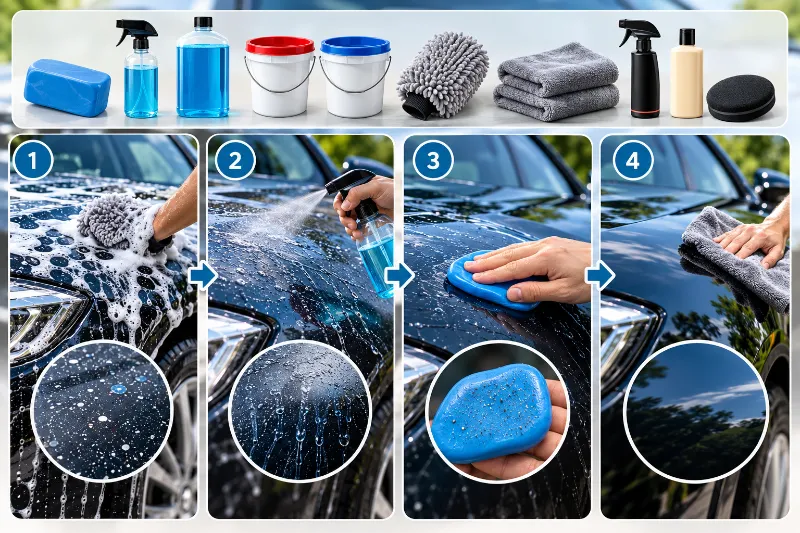
Before starting, gather:
- Automotive clay bar
- Clay lubricant
- Car wash soap
- Two buckets and wash mitt
- Clean microfiber towels
- Automotive-safe solvent remover if needed
- Polish and paint protection product for the final step
Work on a cool, clean surface in the shade whenever possible.
Step 1: Wash the Car Thoroughly
Wash the vehicle first to remove loose dirt, dust, road grime, and other contamination. Claying over a dirty surface can drag loose debris across the paint and increase the chance of marring.
Use a proper car wash soap and thoroughly rinse the vehicle. Dry the affected panels with a clean microfiber towel before beginning the clay process.
Step 2: Apply Plenty of Clay Lubricant
Work on a small section at a time, roughly 2 feet by 2 feet.
Spray enough clay lubricant onto the panel to keep the surface thoroughly lubricated. Do not allow the lubricant to dry while you are working.
Adequate lubrication reduces friction between the clay and paint and allows the clay to move smoothly across the contaminated surface.
Step 3: Gently Glide the Clay Bar Over the Overspray
Flatten the clay bar into a manageable piece and gently move it back and forth over the lubricated panel.
Use light pressure. Let the clay pick up the bonded contamination rather than trying to force the overspray off with aggressive scrubbing.
Continue until the surface feels noticeably smoother. Check the clay frequently and fold or knead it so a clean section is exposed.
Step 4: Wipe and Inspect the Paint
After working a section, wipe away the remaining lubricant with a clean microfiber towel.
Inspect the panel from different angles and lighting conditions. If the surface is smooth and the overspray is gone, continue to the next section.
If paint particles remain, repeat the clay process with fresh lubricant before moving to a stronger removal method.
How to Remove Stubborn Paint Overspray From a Car
Some overspray may not respond completely to clay alone. In that situation, an automotive-safe solvent remover formulated for paint overspray or similar contamination may be appropriate.
Follow the product manufacturer’s directions carefully. Before treating a large visible area, test the product on a small inconspicuous section of the vehicle to check for an unwanted reaction.
Avoid reaching for an arbitrary household solvent simply because it dissolves paint. Solvent strength does not automatically mean compatibility with automotive paint, clear coat, trim, plastics, or existing protection.
Can Goo Gone Remove Paint Overspray From a Car?
Goo Gone may be useful for certain adhesive and residue-removal applications, but suitability for a specific paint overspray situation depends on the exact product, vehicle surface, and contamination.
If considering Goo Gone or another household-oriented remover, check the manufacturer’s directions for automotive paint compatibility and test it on an inconspicuous area first. A dedicated automotive overspray remover is generally easier to evaluate because it is specifically formulated for automotive applications.
How to Finish the Paint After Removing Overspray
Once the overspray has been removed, inspect the paint for haze, light marring, or uneven gloss.
If the finish needs refinement, a suitable light polish can help restore clarity. Afterward, apply an appropriate wax, paint sealant, or other paint-protection product according to its instructions.
Keep in mind that decontamination and solvent use can affect existing surface protection, so reapplying protection after the job can be a sensible final step.
When Should You Call a Professional for Paint Overspray Removal?
Professional help makes more sense when the overspray covers a large portion of the vehicle, involves unusually stubborn industrial coatings, or appears to have affected the clear coat itself.
Professional assistance is also appropriate if you are unsure whether the contamination can be safely removed without polishing or paint correction.
A professional detailer can assess the condition of the paint before deciding whether claying, chemical removal, polishing, or a combination of techniques is appropriate.
What Mistakes Should You Avoid When Removing Paint Overspray?
Avoid these common mistakes:
- Scrubbing aggressively with an abrasive material
- Using a clay bar without sufficient lubricant
- Allowing clay lubricant to dry during the process
- Working on hot paint in direct sunlight
- Continuing to use heavily contaminated clay without folding it
- Applying an unverified household solvent to painted surfaces
- Repeatedly rubbing the same area with excessive pressure
- Skipping the final inspection
- Assuming every type of overspray can be removed with clay alone
A controlled process is safer than trying to remove the contamination as quickly as possible.
Frequently Asked Questions
Can paint overspray damage a car’s clear coat if left untreated?
Yes, paint overspray can become harder to remove as it remains bonded to the vehicle’s surface, and the potential effect depends on the type of paint, exposure conditions, and condition of the clear coat. Removing the contamination carefully and promptly can help avoid unnecessarily aggressive correction later.
If the paint feels rough even after washing, bonded contamination may still be present. CarCareGuy’s guide to DIY car detailing and paint decontamination explains how clay fits into the cleaning and paint-care process.
Is it safe to use a razor blade to remove paint overspray from a car?
No, a razor blade is not a suitable general-purpose method for removing paint overspray from painted car panels because it can scratch the clear coat. Razor techniques are better suited to specific hard surfaces such as glass and should be used cautiously.
For painted panels, start with a less aggressive approach such as proper washing and clay-bar decontamination rather than scraping the overspray directly.
Does a clay bar remove all types of paint overspray?
No, a clay bar does not remove every type of paint overspray. It can remove many bonded surface contaminants, but heavily bonded, industrial, or deeply etched overspray may require an automotive-safe chemical remover, polishing, or professional treatment.
Clay works as a surface-decontamination step, not as a universal solution for every type of paint damage. CarCareGuy’s car detailing checklist also explains the difference between bonded contamination, which clay can address, and actual paint defects that require correction.
How much does professional paint overspray removal cost?
Professional paint overspray removal does not have one fixed price because the cost depends on the affected area, vehicle size, type of overspray, condition of the paint, and whether polishing or paint correction is required.
A small localized area may require considerably less work than a vehicle covered in overspray. For extensive contamination, getting an inspection and written quote from a professional detailer is more useful than relying on a standard per-vehicle price.
Will insurance cover paint overspray damage?
Insurance coverage for paint overspray damage depends on the circumstances, the applicable policy, and whether the responsible party can be identified. If the overspray can be traced to a construction company, contractor, neighboring property, or another responsible party, document the damage and its likely source before arranging professional removal.
Keep photographs of the affected areas, the surrounding location, and any evidence connecting the overspray to the source. Coverage decisions are ultimately determined by the relevant insurer and policy terms.
How to Remove Paint Overspray From a Car Without Damaging the Paint
The safest approach to removing paint overspray from a car is to start with the least aggressive method that can reasonably solve the problem. Wash the vehicle first, work on cool paint, use plenty of clay lubricant, and gently clay small sections rather than aggressively scrubbing the contamination.
If the overspray remains after claying, use an automotive-safe remover only when its label confirms compatibility with the affected surface. Test it on an inconspicuous area first and follow the manufacturer’s directions.
After the overspray is removed, inspect the paint for haze or marring. If the finish needs refinement, a light polish may improve its clarity before applying fresh paint protection. CarCareGuy’s guide to automotive finishing and polishing explains how finishing fits into the paint-care process.
For extensive, industrial, or deeply bonded overspray, professional assessment is the safer option because removing the contamination may require controlled polishing or paint correction rather than additional aggressive rubbing.