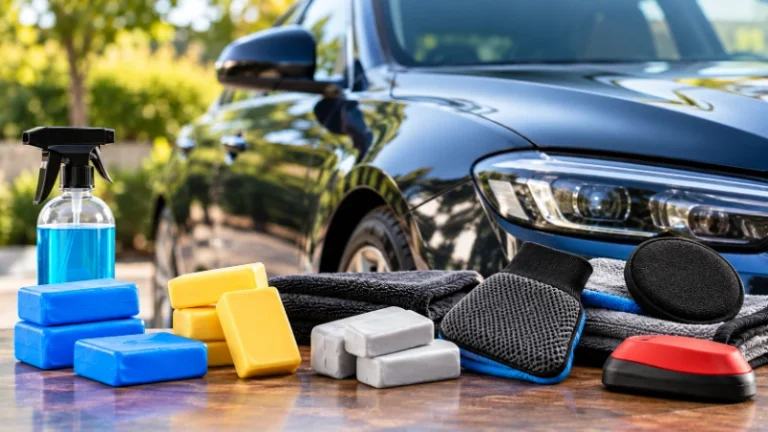
Finding the 10 Best Clay Bar Kits for Beginners in 2026 starts with understanding what clay actually does. A car can look clean after washing but still feel rough because bonded contaminants such as rail dust, brake dust, paint overspray, tree sap mist, and industrial fallout can remain stuck to the surface.
A clay bar removes these embedded contaminants before waxing, sealing, polishing, or applying a ceramic coating. For beginners, a mild clay with plenty of lubricant is usually easier and safer to control than a more aggressive option.
For most first-time users, Meguiar’s Smooth Surface Clay Kit G191700 is a strong starting point because it includes three fine clay bars, Quik Detailer lubricant, and a microfiber towel. Mothers California Gold Clay Bar System 07240 is another beginner-friendly traditional kit, while Chemical Guys OG Clay Bar & Luber Kit CLY_113 is better suited to paint with more noticeable bonded contamination.
This guide compares traditional clay bars, complete clay kits, reusable clay mitts, towels, and synthetic clay tools so beginners can choose the right option based on paint condition, ease of use, included lubricant, reusability, and overall value.
Quick comparison of 10 Best Clay Bar Kits for Beginners in 2026
| Product | Best For | Clay Type | Lubricant Included? | Amazon |
|---|---|---|---|---|
| Meguiar’s Smooth Surface Clay Kit G191700 | Best Overall | Fine traditional clay | Yes | Check Price on Amazon |
| Mothers California Gold Clay Bar System 07240 | Best Traditional Value | Fine traditional clay | Yes | Check Price on Amazon |
| Chemical Guys OG Clay Bar & Luber Kit CLY_113 | Best Medium-Duty Starter Kit | Light/medium traditional clay | Yes | Check Price on Amazon |
| TEAWOO Clay Bars Kit | Best Budget Complete Kit | Traditional clay | Yes, tablets + bottle | Check Price on Amazon |
| Adam’s Polishes Clay Mitt | Best Reusable Mitt | Synthetic clay mitt | No | Check Price on Amazon |
| Nanoskin AUTOSCRUB Fine Grade Wash Mitt | Best Fine Synthetic Mitt | Synthetic clay mitt | No | Check Price on Amazon |
| Mothers Speed Clay 2.0 | Best Handheld Synthetic Clay | Synthetic clay tool | No | Check Price on Amazon |
| Fitosy Car Clay Bar 4 Pack 400g | Best Bulk Clay Pack | Traditional clay | No | Check Price on Amazon |
| IPELY 4 Pack 100g Clay Bar | Best Basic Multi-Bar Pack | Traditional clay | No | Check Price on Amazon |
| Blackline Clay Towel 12 x 12 in | Best Clay Towel | Synthetic clay towel | No | Check Price on Amazon |
Our Top 10 Clay Bar Kits and Beginner Clay Tools for 2026
The first four products are the easiest choices if you want a complete or nearly complete clay setup.
The other six are useful if you already have a proper clay lubricant or detailing spray.
The most important rule is simple:
- Never clay dry paint.
- Clay needs lubrication. Without enough lubricant, the clay can grab the paint and leave marring.
- For a first attempt, work slowly, use light pressure, and check the clay often.
1. Meguiar’s Smooth Surface Clay Kit G191700 — Best Overall
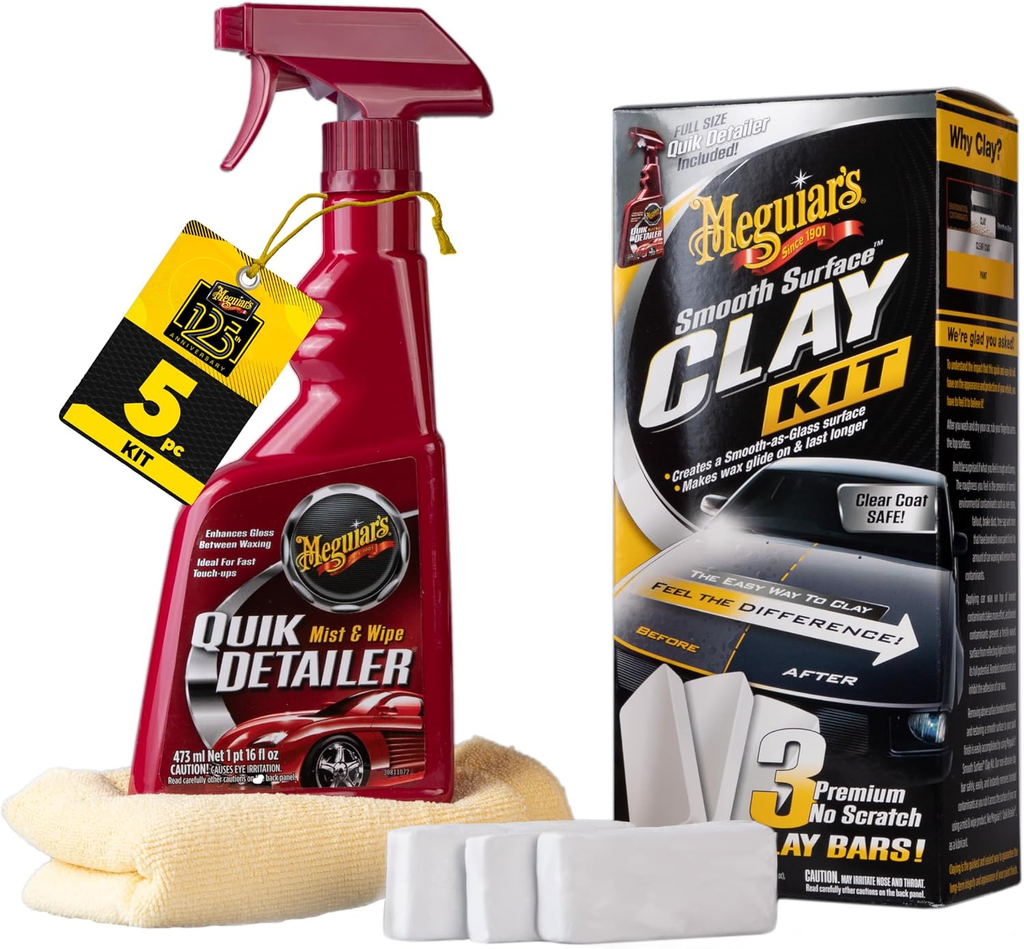
Meguiar’s Smooth Surface Clay Kit is the easiest product to recommend to someone who has never clayed a car before.
The kit includes three 60-gram clay bars, a 16-ounce bottle of Quik Detailer, and a Supreme Shine microfiber towel.
Meguiar’s describes the clay as non-abrasive and safe for automotive paint, including clear coat.
The included Quik Detailer solves the main beginner problem: lubrication.
You do not have to guess which soap mixture or spray to use. Spray the panel until it is wet and slick, then move the clay gently over the surface.
The clay removes bonded contamination such as industrial fallout, overspray, tree sap mist, and road tar that remains after washing.
Three separate bars are also useful for a beginner. If one piece hits the ground, throw it away rather than trying to clean it and reuse it.
Best for: First-time users who want a complete traditional clay kit.
Pros:
- Three fine clay bars
- Dedicated lubricant included
- Microfiber towel included
- Non-abrasive clay
- Safe for clear coat
- Easy to understand
- Good for light to normal contamination
- No extra products needed to start
Cons:
- Fine clay takes longer on heavy contamination
- Traditional clay must be discarded if dropped
- Quik Detailer can run out before the clay does
- Clay takes longer than a synthetic mitt on large vehicles
Buying Decision:
Choose Meguiar’s G191700 if this is your first time using clay.
The kit gives you the right clay grade, a proper lubricant, and enough clay to learn without using an aggressive product.
For most normal daily drivers, this is the safest place to start.
2. Mothers California Gold Clay Bar System 07240 — Best Traditional Value
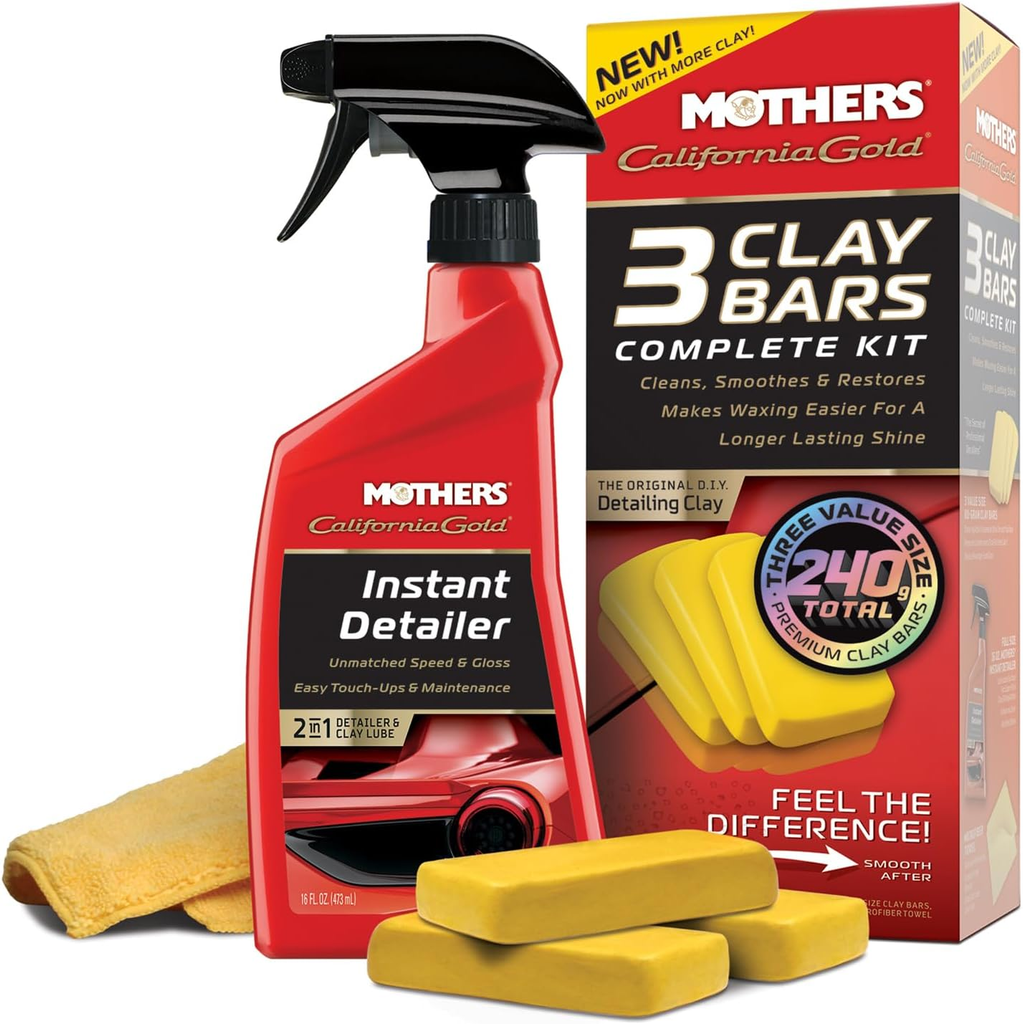
Mothers California Gold Clay Bar System is another complete traditional kit designed around easy hand decontamination.
The current kit includes multiple clay bars, a 16-ounce bottle of California Gold Instant Detailer, and a microfiber towel.
Mothers markets the system for removing embedded contaminants such as paint overspray, industrial fallout, brake dust, tree sap, acid rain deposits, and other bonded material.
The clay is pliable and easy to flatten into a working pad.
That matters for beginners because a softer clay is easier to keep flat against the panel without pressing hard.
The included detailer acts as the lubricant.
Spray a small area, glide the clay over the wet surface, and keep adding lubricant whenever the clay stops moving freely.
Best for: Beginners who want a traditional clay system with plenty of usable clay.
Pros:
- Clay bars included
- Lubricant included
- Microfiber towel included
- Fine clay is easy to control
- Good for clear coat
- Works on paint, glass, chrome, and smooth exterior surfaces
- Good value for a complete setup
- Easy hand application
Cons:
- Traditional clay is slower than a synthetic towel
- Clay must be thrown away if dropped
- Heavily contaminated paint may require several passes
- Included detailer will eventually need replacement
Buying Decision:
Choose Mothers 07240 if you want a simple traditional clay system and prefer a softer, forgiving clay.
It is a strong alternative to Meguiar’s for a first full-car decontamination.
3. Chemical Guys OG Clay Bar & Luber Kit CLY_113 — Best Medium-Duty Starter Kit
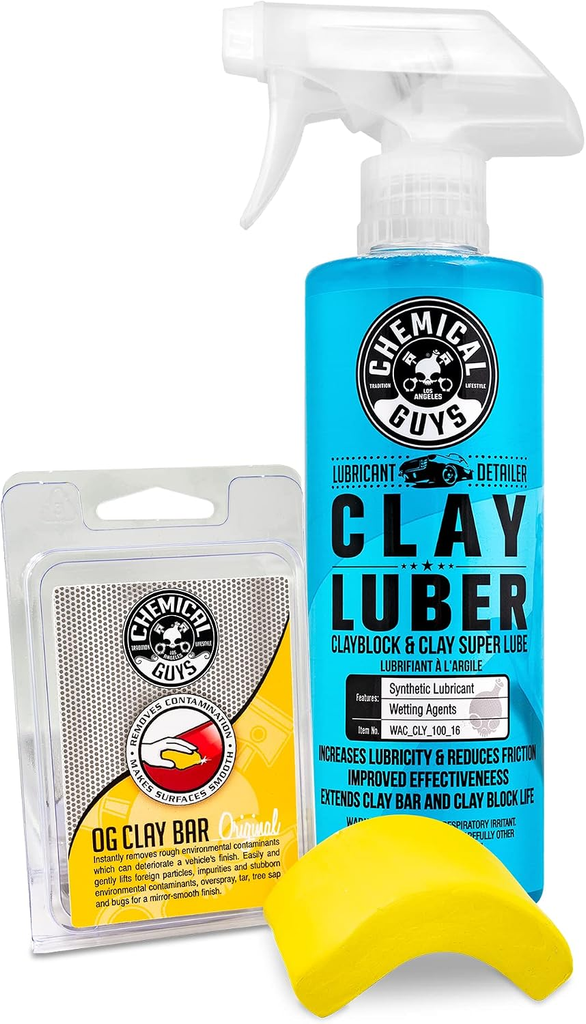
Chemical Guys pairs its OG light/medium clay bar with Clay Luber in this starter kit.
The main difference from the Meguiar’s and Mothers kits is the clay grade.
Chemical Guys positions this bar for light to medium bonded contamination rather than only fine maintenance work.
That can be useful on an older daily driver that has not been clayed for several years.
The Clay Luber is made specifically to reduce drag between the clay and paint.
Chemical Guys lists the system for paint, glass, polished metal, and other smooth exterior surfaces.
Because the clay has more bite than a very mild bar, beginners should use plenty of lubricant and very little pressure.
Let the clay do the work.
Best for: Older paint or cars with more noticeable bonded contamination.
Pros:
- Clay bar and lubricant sold together
- Dedicated Clay Luber
- Stronger than fine maintenance clay
- Removes overspray and fallout
- Works on paint and glass
- Good preparation before polishing
- Simple two-product setup
- Large user base
Cons:
- Medium clay has a higher chance of light marring
- Not the best first choice for soft black paint
- No microfiber towel in the basic two-piece bundle
- May require polishing afterward on sensitive finishes
Buying Decision:
Choose the Chemical Guys kit if the paint feels clearly rough and a fine clay seems too mild.
If the vehicle has soft dark paint and you do not plan to polish afterward, start with Meguiar’s or Mothers instead.
4. TEAWOO Clay Bars Kit — Best Budget Complete Kit
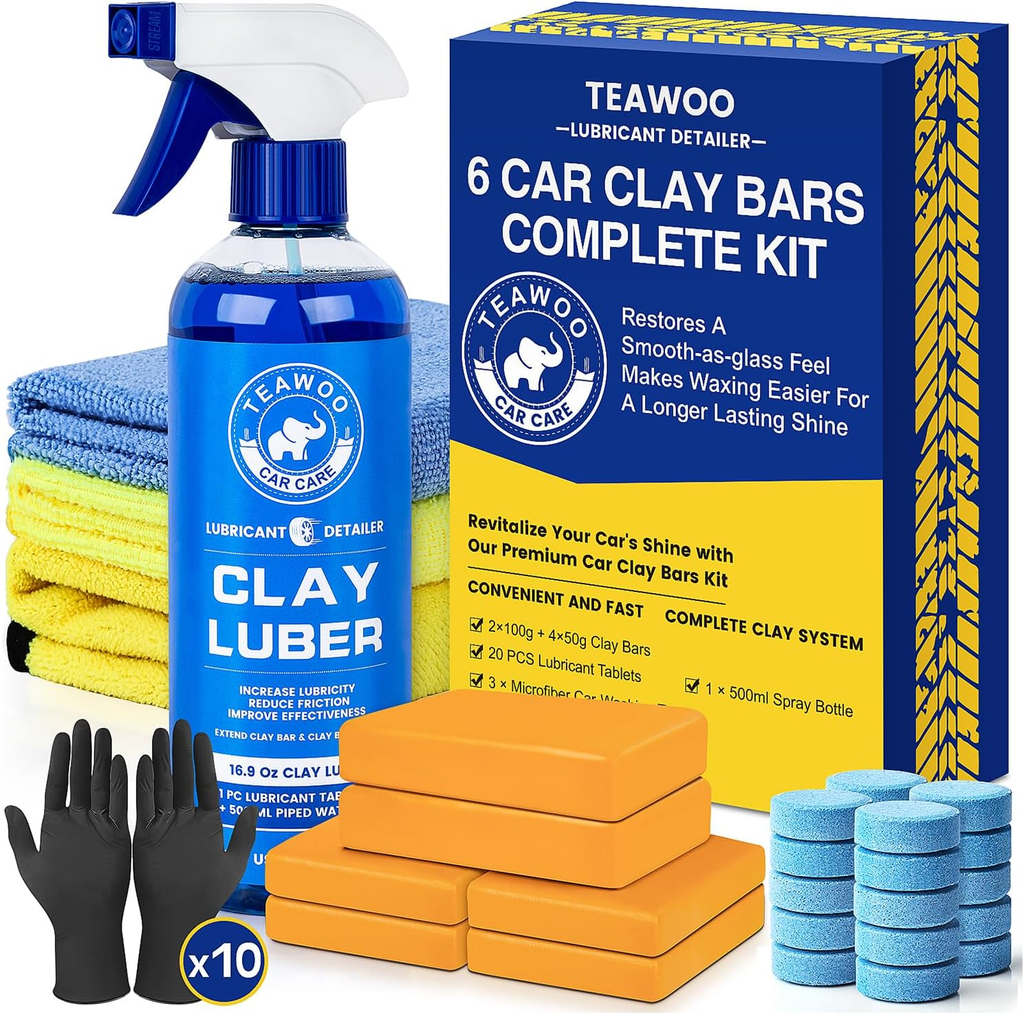
The TEAWOO kit is aimed at buyers who want a lot of clay and basic accessories for a low price.
The kit includes six clay bars, lubricant tablets, a spray bottle, gloves, and microfiber towels.
The tablets dissolve into water to make clay lubricant.
That gives a beginner nearly everything needed for the decontamination step in one box.
The biggest advantage is quantity.
With six bars, dropping one on the ground is less frustrating because you can simply discard it and continue with a fresh piece.
The trade-off is that the lubricant system is more basic than the dedicated Quik Detailer or Clay Luber supplied by the major detailing brands.
Use plenty of solution and do not let the panel dry.
Best for: Beginners who want a low-cost complete kit with several clay bars.
Pros:
- Six clay bars
- Lubricant tablets included
- Spray bottle included
- Microfiber towels included
- Gloves included
- Low cost per bar
- Good for learning
- Easy to discard contaminated clay and use a fresh piece
Cons:
- Lubricant tablets are less convenient than ready-to-use spray
- Product instructions are less detailed than major detailing brands
- Clay grade may feel less consistent than premium kits
- You need to mix lubricant correctly
Buying Decision:
Choose TEAWOO if cost matters and you want enough clay to practice without worrying about wasting an expensive bar.
For the simplest first experience, Meguiar’s or Mothers is still easier.
5. Adam’s Polishes Clay Mitt — Best Reusable Mitt
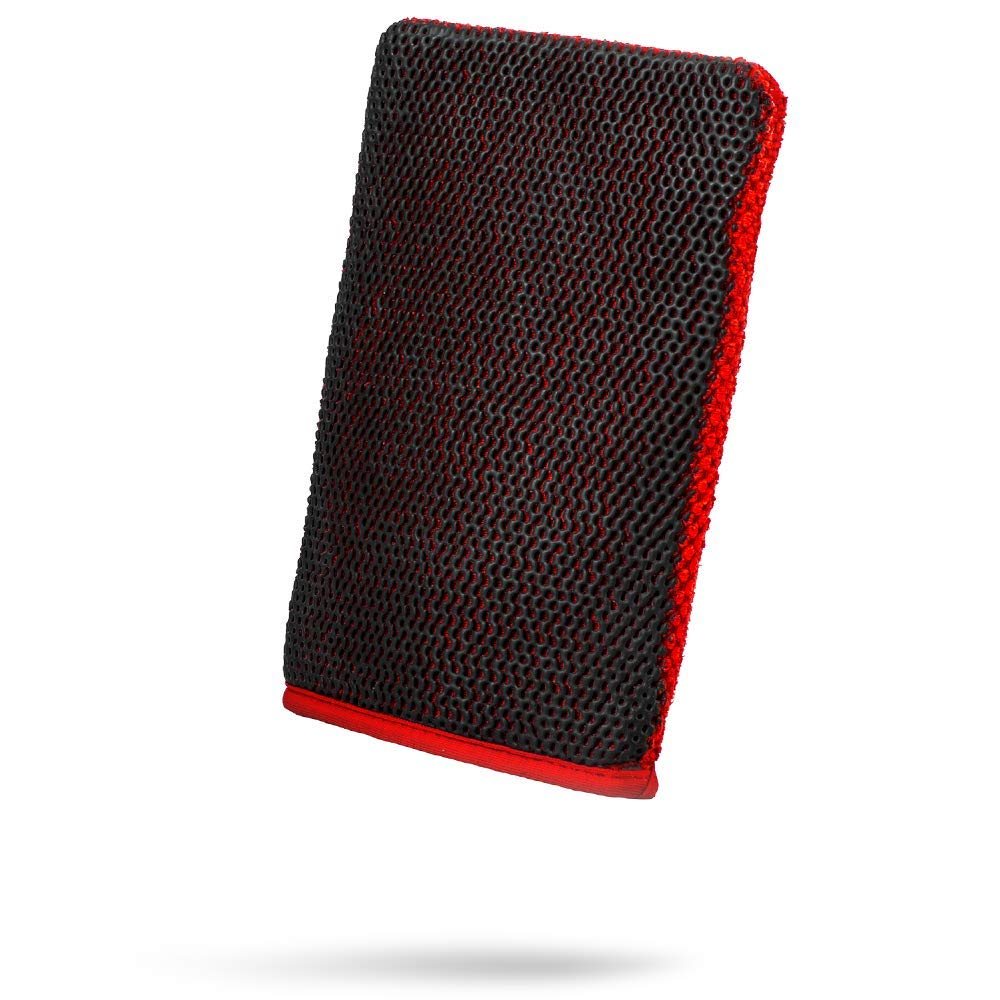
Adam’s Clay Mitt replaces a traditional clay bar with a reusable synthetic clay surface attached to a mitt.
The main advantage is speed.
A mitt covers more area than a small piece of clay, which makes it useful for hoods, roofs, doors, and other large panels.
Adam’s describes this version as medium grade.
It can remove overspray, industrial fallout, rail dust, and other bonded contamination from paint, glass, wheels, and chrome.
Unlike traditional clay, the mitt can be rinsed clean if it is dropped.
That makes it less stressful for a beginner.
However, the medium grade can leave light micro-marring on some paint. Adam’s specifically positions the mitt as useful when machine polishing may follow.
Important: Lubricant is not included. Adam’s recommends using Detail Spray or another suitable clay lubricant.
Best for: Beginners who want a reusable clay tool and plan to polish afterward.
Pros:
- Reusable
- Faster than traditional clay
- Easy to hold
- Can be rinsed if dropped
- Works on paint and glass
- Good for large panels
- Removes medium bonded contamination
- No need to knead clay constantly
Cons:
- Lubricant not included
- Medium grade can leave light marring
- Less precise in tight areas
- Higher initial cost than a basic clay bar
Buying Decision:
Choose Adam’s Clay Mitt if speed and reusability matter more than having the mildest possible clay.
If your car has soft black paint and you are not polishing afterward, use a fine clay kit instead.
6. Nanoskin AUTOSCRUB Fine Grade Wash Mitt — Best Fine Synthetic Mitt
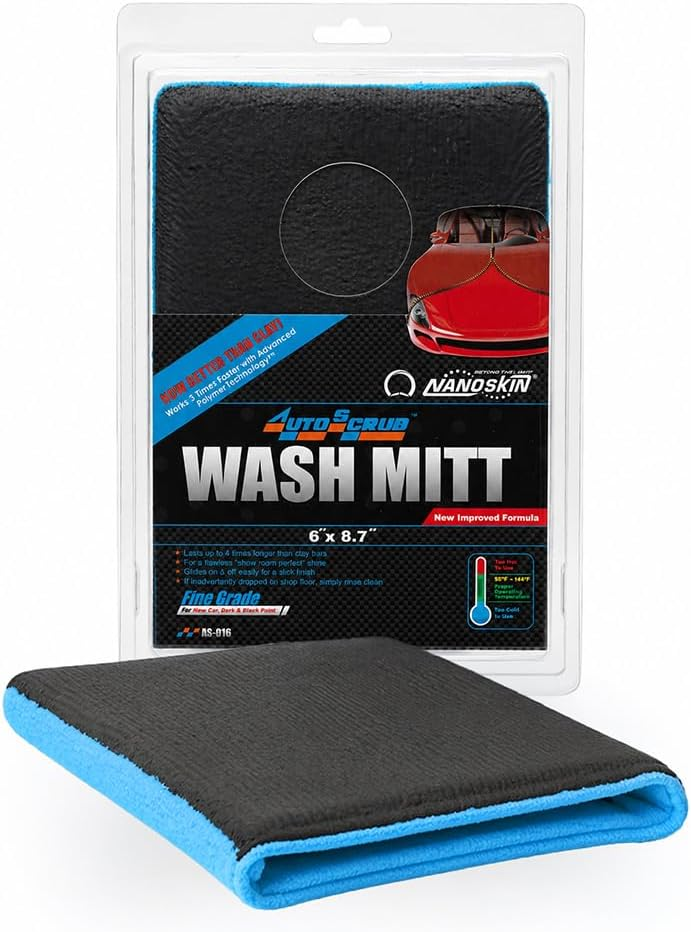
Nanoskin AUTOSCRUB uses a synthetic rubber-polymer surface instead of traditional clay.
The fine-grade version is designed for lighter contamination and dark-colored paint.
Nanoskin lists the mitt for removing overspray, water spots, fresh tree sap, rail dust, brake dust, and industrial fallout from paint, glass, plastic, and metal.
The biggest beginner advantage is recovery after a drop.
If traditional clay falls onto the ground, it should be discarded.
If the AUTOSCRUB mitt falls, Nanoskin says it can be rinsed clean and reused.
The manufacturer also states that the mitt can work much faster than traditional clay on large panels.
Important: Lubricant is not included. Nanoskin says plain water is not adequate and recommends a proper clay lubricant such as GLIDE or a suitable wash solution.
The mitt also needs a short break-in process before first use.
Best for: Beginners who want a fine reusable synthetic clay tool.
Pros:
- Fine grade
- Suitable for lightly contaminated paint
- Good option for dark colors
- Reusable
- Washable
- Can be rinsed after a drop
- Faster on large panels
- Works on paint, glass, plastic, and metal
Cons:
- Lubricant not included
- Needs a break-in step
- Costs more than traditional clay
- Less useful around tight trim and small curves
Buying Decision:
Choose the Nanoskin Fine Grade Mitt if you want a reusable clay alternative but still want a gentler grade.
It is a better synthetic option for lightly contaminated paint than starting with a more aggressive medium mitt.
7. Mothers Speed Clay 2.0 — Best Handheld Synthetic Clay
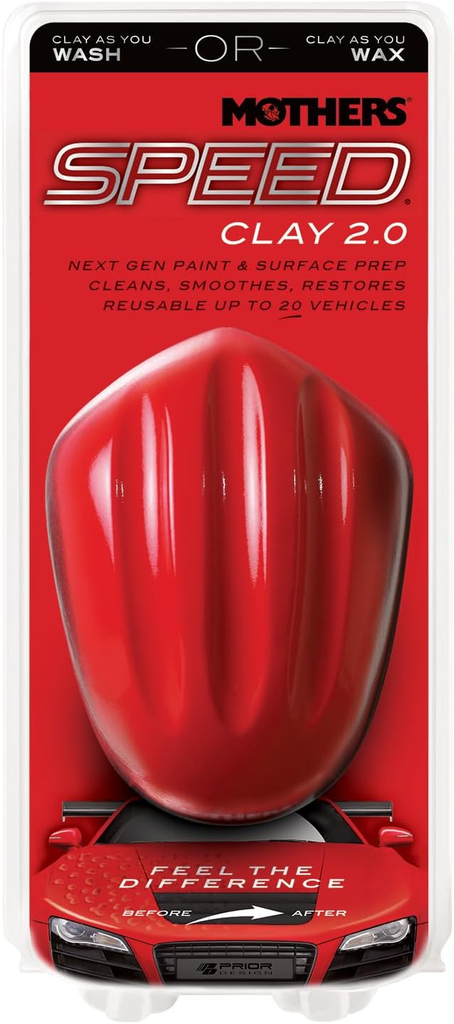
Mothers Speed Clay 2.0 uses a flat synthetic clay surface attached to a handheld tool.
It is easier to grip than a loose clay bar and covers paint faster.
The tool is designed to remove bonded contamination while preparing paint for waxing, sealing, or polishing.
Because the synthetic surface can be rinsed, it is easier to recover if it picks up loose dirt than a traditional clay bar.
The flat design is useful on hoods, roofs, doors, glass, and other large surfaces.
It is less flexible around badges, mirror edges, and tight body lines.
Important: The Speed Clay tool does not include lubricant in this listing. Use a proper detailing spray or clay lubricant.
Best for: Beginners who want an easy-to-hold synthetic clay tool.
Pros:
- Easy grip
- Reusable synthetic surface
- Faster than a small clay bar
- Good on large flat panels
- Can be rinsed
- No need to reshape clay
- Useful on paint and glass
- Good preparation before waxing
Cons:
- Lubricant not included
- Less flexible around tight contours
- Higher cost than a basic clay bar
- Still requires careful lubrication
Buying Decision:
Choose Mothers Speed Clay 2.0 if you do not like handling traditional clay and want something easier to hold.
It is a practical bridge between a clay bar and a full clay mitt.
8. Fitosy Car Clay Bar 4 Pack 400g — Best Bulk Clay Pack
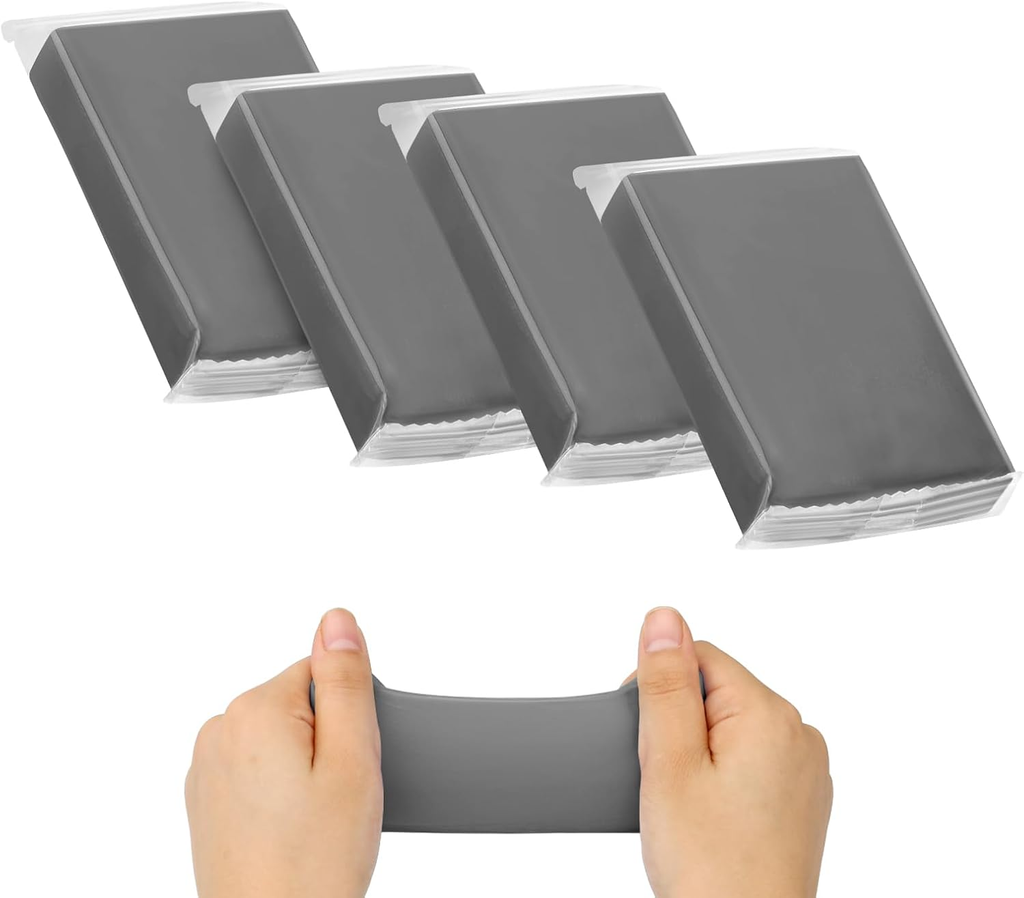
The Fitosy four-pack is a basic clay supply rather than a complete system.
You get four clay bars with a total listed weight of 400 grams.
That is useful if you already own a quick detailer or clay lubricant and simply need more clay.
For a beginner, extra bars reduce the temptation to keep using a contaminated piece.
If one falls onto the ground, discard it.
The product is intended for paint, glass, and exterior detailing work.
Because there is no matched lubricant in the package, you need to provide your own.
Important: Lubricant is not included.
Best for: Buyers who already have lubricant and want several clay bars at a low cost.
Pros:
- Four clay bars
- Large total amount of clay
- Low cost per bar
- Easy to divide into smaller pieces
- Useful for multiple vehicles
- Good backup supply
- Popular Amazon clay-bar format
Cons:
- No lubricant included
- No microfiber towel included
- Less guidance than branded complete kits
- Clay grade is less clearly defined than premium detailing products
Buying Decision:
Choose Fitosy if you already have a good lubricant and want plenty of clay.
For a first-ever clay job with no supplies at home, buy a complete kit instead.
9. IPELY 4 Pack 100g Clay Bar — Best Basic Multi-Bar Pack
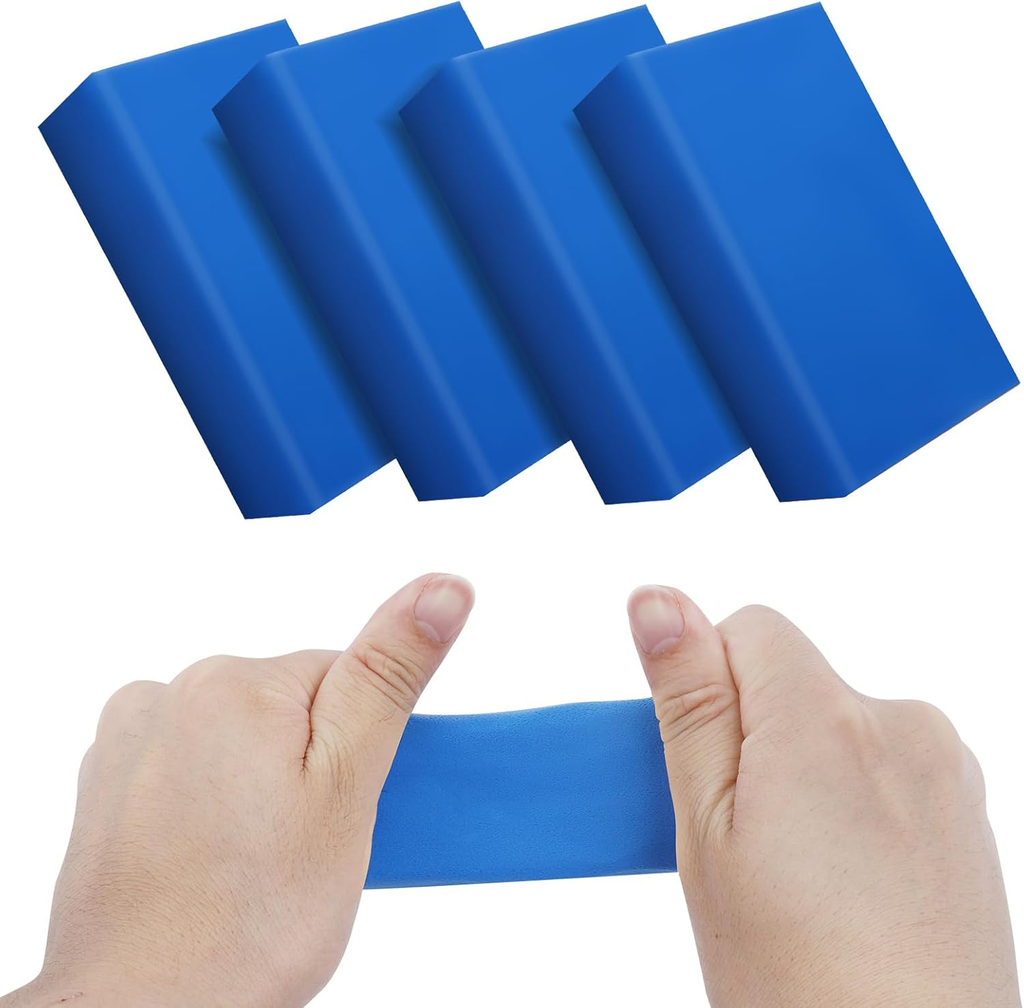
IPELY’s four-pack follows the same simple idea as other bulk clay products.
Each bar is listed at 100 grams, giving you enough clay for several jobs if it is stored correctly and kept clean.
The clay is intended for bonded contamination on automotive paint and other smooth exterior surfaces.
For a beginner, this product makes sense when you already own detailing spray and microfiber towels.
It does not solve the full setup problem on its own.
Use a generous amount of proper lubricant and divide one bar into smaller working pieces instead of holding the full bar.
That way, dropping one piece does not ruin the entire supply.
Important: Lubricant is not included.
Best for: Beginners who already have detailing products and only need clay.
Pros:
- Four bars
- 100 grams per bar
- Good clay quantity
- Easy to split into smaller pieces
- Useful for multiple cars
- Low entry price
- Simple traditional clay format
Cons:
- No lubricant
- No towel
- No complete beginner instructions
- Not as convenient as a matched kit
Buying Decision:
Choose IPELY if you want inexpensive traditional clay and already know what you will use for lubrication.
If you do not already own a safe lubricant, Meguiar’s, Mothers, Chemical Guys, or TEAWOO is easier.
10. Blackline Clay Towel 12 x 12 in — Best Clay Towel
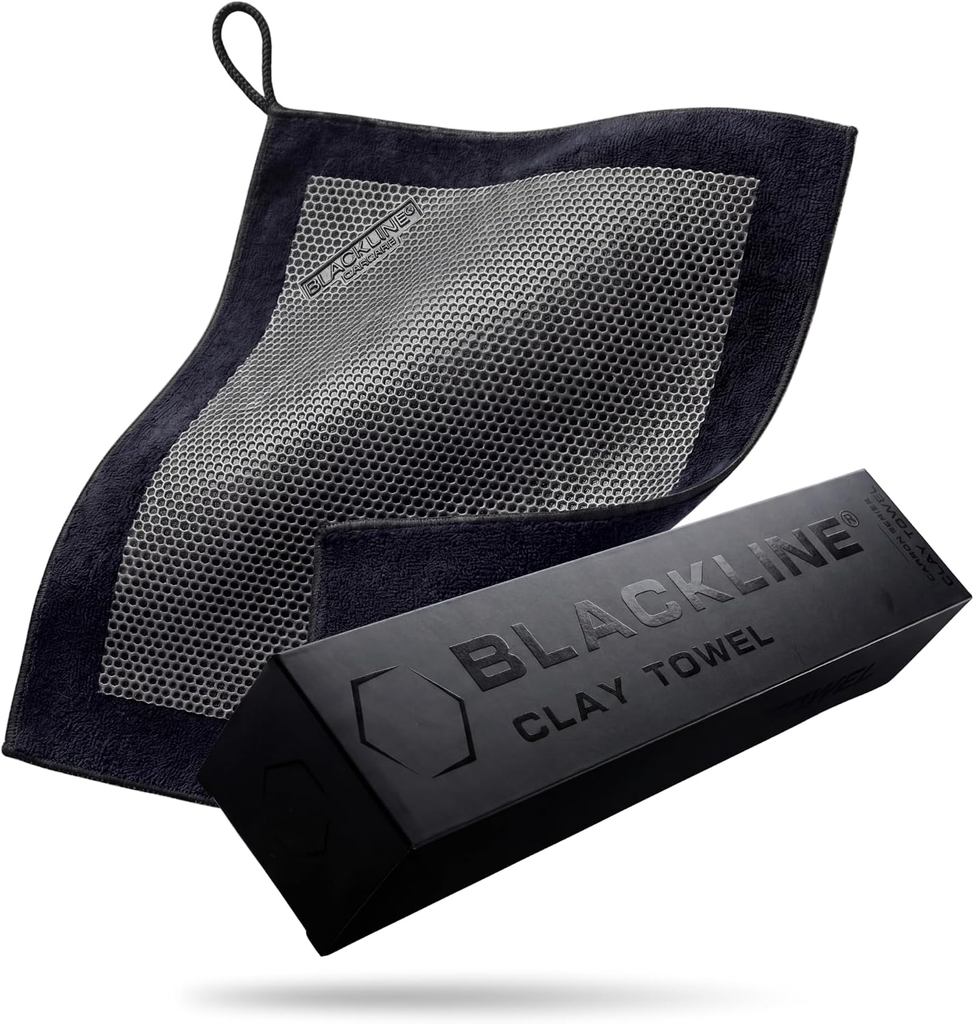
The Blackline Clay Towel uses a synthetic decontamination surface in a towel format.
A clay towel covers large areas quickly and folds in the hand like a microfiber towel.
That makes it useful for doors, hoods, roofs, windshields, and large painted surfaces.
It can also be rinsed and reused, which removes one of the biggest frustrations of traditional clay.
The trade-off is precision.
A towel is not as easy to control around emblems, narrow trim, door-handle recesses, and tight corners.
It also requires proper lubricant.
Important: Lubricant is not included.
Best for: Beginners who want the fastest reusable option for large panels.
Pros:
- Large 12 x 12 inch working area
- Reusable
- Can be rinsed
- Faster than small clay bars
- Easy to fold and hold
- Good for paint and glass
- Useful for larger vehicles
Cons:
- Lubricant not included
- More expensive than basic clay
- Less precise in tight areas
- Synthetic clay can still cause marring if used dry or with heavy pressure
Buying Decision:
Choose the Blackline Clay Towel if you have a large vehicle or want to finish decontamination faster.
For a first-time user who wants maximum control, a traditional fine clay bar is easier to learn with.
Which Clay Bar Kit Should a Beginner Buy?
If you have never used clay before, buy a complete fine-grade kit.
Meguiar’s Smooth Surface Clay Kit G191700 is the easiest first choice because everything needed for the clay step is included.
Mothers California Gold Clay Bar System 07240 is equally practical if you prefer a softer traditional clay and want plenty of material.
Choose Chemical Guys OG Clay Bar & Luber Kit when the paint has more contamination and you may polish afterward.
Choose TEAWOO when price matters and you want a large quantity of clay plus basic accessories.
For reusable synthetic clay, Nanoskin Fine Grade Wash Mitt is the gentler starting point.
Adam’s Clay Mitt has more cleaning bite but carries a higher chance of light marring.
If you want a tool that is easy to grip, Mothers Speed Clay 2.0 is simpler than a loose bar.
Best Clay Option by Situation
| Situation | Better Choice | Product From This Guide |
|---|---|---|
| First clay job | Fine complete kit | Meguiar’s Smooth Surface Clay Kit |
| Traditional kit with lots of clay | Fine clay system | Mothers California Gold |
| Older rough paint | Medium clay + lube | Chemical Guys OG Clay Kit |
| Low-cost complete setup | Multi-piece kit | TEAWOO Clay Bars Kit |
| Reusable mitt | Synthetic mitt | Adam’s Clay Mitt |
| Dark paint | Fine synthetic mitt | Nanoskin AUTOSCRUB Fine Grade |
| Easier handheld tool | Synthetic clay block | Mothers Speed Clay 2.0 |
| Extra clay supply | Multi-bar pack | Fitosy |
| Basic spare bars | Multi-bar pack | IPELY |
| Large SUV or truck | Synthetic towel | Blackline Clay Towel |
What Does a Clay Bar Actually Remove?
Washing removes loose dirt.
Clay removes contamination that has bonded to the surface.
Common examples include:
- Industrial fallout
- Rail dust
- Fine brake-dust particles
- Paint overspray
- Tree sap mist
- Road tar residue
- Environmental deposits
- Embedded grime that survives washing
Clay does not remove scratches.
It also does not remove oxidation or swirl marks.
Those defects require polishing or paint correction.
The easiest way to check whether clay is needed is to wash and dry the car, then lightly move your fingertips across the paint.
If it still feels rough or gritty, bonded contamination is probably present.
Fine Clay vs. Medium Clay
Clay comes in different levels of aggression.
Fine Clay
Fine clay is the best choice for most beginners.
Use it for:
- Newer cars
- Regularly maintained cars
- Dark paint
- Light contamination
- Paint that will not be polished afterward
Fine clay may take more passes, but it has a lower risk of visible marring.
Medium Clay
Medium clay removes contamination faster.
Use it for:
- Older paint
- Heavy fallout
- Overspray
- Vehicles that have never been clayed
- Cars that will be polished afterward
Medium clay can leave light marring, especially on soft paint.
Do not choose stronger clay only because you want to finish faster.
Traditional Clay vs. Synthetic Clay
Both remove bonded contamination, but they behave differently.
Traditional Clay Bar
Advantages:
- Easy to shape
- Fits tight areas
- Fine grades are very gentle
- Low purchase price
- Good feedback through your hand
Disadvantages:
- Must be discarded if dropped
- Needs frequent kneading
- Slower on large panels
- Becomes contaminated over time
Synthetic Clay Mitt, Towel, or Pad
Advantages:
- Reusable
- Rinses clean
- Faster on large areas
- Easier to hold
- Can survive being dropped
Disadvantages:
- Higher initial cost
- Some synthetic products can leave more marring
- Less precise around small details
- Usually sold without lubricant
For a careful first-time user, either can work.
Traditional fine clay gives the most control.
Synthetic clay is faster and easier to reuse.
Do You Need Clay Lubricant?
Yes.
Clay lubricant reduces friction between the clay and paint.
Without enough lubrication, clay can drag, stick, or leave visible marks.
Safe options include:
- Dedicated clay lubricant
- A manufacturer-approved quick detailer
- A rinseless wash mixed at an approved clay-lube ratio
- Another lubricant specifically recommended by the clay manufacturer
Do not assume plain water is enough.
Nanoskin specifically states that plain water is not adequate for its AUTOSCRUB system.
If you are unsure, use the lubricant supplied with the kit.
How to Clay Bar a Car Safely
Clay barring a car is safe when the paint is clean, cool, and well lubricated. The key is to remove bonded contamination with light pressure rather than trying to scrub it away. Work on small sections, keep the surface wet with clay lubricant, and regularly expose a clean clay surface.
Chemical Guys recommends thoroughly washing first, lubricating a small working area, moving the clay gently back and forth, and discarding traditional clay if it falls on the ground.
What Do You Need Before Clay Barring a Car?
For a basic traditional clay-bar process, prepare:
- Car wash soap
- Wash mitt
- Drying towel
- Fine or medium clay bar
- Dedicated clay lubricant or approved detailing spray
- Several clean microfiber towels
- Wax, sealant, or another paint-protection product for afterward
If you are using a synthetic clay mitt, towel, or pad, check its instructions first. Some synthetic systems have specific lubricant, break-in, temperature, or cleaning requirements.
1. Wash the Car Thoroughly
Always wash the vehicle before using clay.
Clay is designed to remove contamination that remains bonded to the surface after normal washing. It should not be used to remove loose sand, dust, mud, or road dirt.
If loose grit remains on the paint, the clay can trap that material and drag it across the clear coat. This increases the risk of fine scratches or marring.
Wash from the top down using a proper automotive shampoo, rinse thoroughly, and pay extra attention to lower doors, rocker panels, wheel arches, and the rear of the vehicle where heavier road contamination often collects.
2. Dry the Vehicle When Required
For a traditional clay-bar process, drying the vehicle usually makes it easier to control the amount of lubricant being used.
Dry the paint with a clean microfiber drying towel rather than allowing water to air-dry.
Some synthetic clay mitts and towels can be incorporated into a wash process, but this depends on the specific product. Follow the manufacturer’s directions rather than assuming every synthetic clay product works the same way.
3. Move the Car Into the Shade
Clay a car on cool paint and away from strong direct sunlight whenever possible.
Heat can cause clay lubricant to evaporate or dry before you finish working the section. A dry surface creates more friction, which increases the chance of the clay dragging or leaving marks.
Nanoskin also specifies clean, cool paint and recommends working out of direct sunlight with its AUTOSCRUB products.
A garage, carport, or shaded driveway is usually easier to work in than direct midday sun.
4. Divide and Flatten Traditional Clay
You normally do not need to use an entire clay bar at once.
Break off a manageable piece and knead it into a flat pad that fits comfortably between your fingers and palm.
Keeping the rest of the clay sealed has two advantages. It prevents unnecessary contamination and gives you a clean replacement if the working piece is accidentally dropped.
Do not make the clay piece too small. You want enough material to hold securely without squeezing it tightly.
5. Test a Small Area First
Before claying the whole vehicle, start with a small section such as part of the hood or roof.
After washing, lightly feel the paint. Bonded contamination often makes the surface feel slightly gritty or rough even though it looks clean.
Testing a small section lets you confirm that:
- The clay grade is appropriate
- The lubricant provides enough slickness
- The clay moves freely
- The paint does not show excessive marring
This is especially useful on soft, dark, older, or previously corrected paint.
6. Spray Plenty of Clay Lubricant
Lubrication is one of the most important parts of safe clay-bar use.
Spray enough product to create a wet, slick working surface. You can also lightly lubricate the face of the clay before the first pass.
A working section of roughly 2 x 2 feet is manageable for traditional clay. Chemical Guys uses the same approximate section size in its clay instructions.
Do not spray an entire vehicle and then start claying. The lubricant may dry before you reach later panels.
If the clay starts grabbing, sticking, or making the surface feel dry, stop and apply more lubricant.
7. Move the Clay Gently Across the Paint
Move traditional clay back and forth across the lubricated surface using light hand pressure.
You may initially feel slight resistance as the clay encounters bonded contamination. After several passes, the clay should begin moving more freely as those particles are removed.
Do not press harder to make the process faster.
Clay removes contamination through contact with the surface, not through heavy pressure. Additional force mainly increases friction and the risk of marring.
Straight, controlled passes also make it easier to see which area has already been treated.
8. Check and Fold the Clay Frequently
Inspect the working side of the clay after each small section.
You may see dark spots or discoloration where the clay has picked up contamination.
When the exposed side becomes dirty:
- Fold the contaminated face inward.
- Knead the clay.
- Flatten it again.
- Continue with a clean surface.
Do not continue rubbing heavily contaminated clay across the paint.
Once you can no longer create a reasonably clean working face, replace that piece.
9. Treat Lower Panels More Carefully
Lower doors, rocker panels, rear bumpers, and areas behind the wheels often contain more road film, tar, and abrasive contamination than the hood or roof.
Consider using a separate piece of clay for these heavily contaminated areas.
This prevents contamination picked up near the bottom of the vehicle from being transferred to cleaner, more visible upper panels.
If you find obvious tar deposits, using an appropriate tar remover before clay may reduce the amount of mechanical work required.
10. Wipe and Inspect Each Section
Once the clay moves smoothly, wipe away the remaining lubricant with a clean microfiber towel.
Then gently feel the surface again.
The treated area should feel noticeably smoother than it did before claying. If roughness remains, apply more lubricant and make another light pass rather than pressing harder.
You do not have to make every panel perfectly smooth in one aggressive pass. Several mild passes are usually safer than one forceful pass.
11. Continue Around the Vehicle
Work one manageable section at a time.
A practical order is:
- Roof
- Hood
- Trunk or rear hatch
- Upper doors and fenders
- Lower doors
- Bumpers
- Exterior glass, if the clay product is approved for glass
Keep separate clean microfiber towels available so you are not wiping freshly clayed paint with a dirty towel.
12. Protect the Paint After Claying
Clay removes bonded contamination, but the process can also reduce or remove existing waxes and sealants.
After claying, inspect the paint and decide whether it needs polishing.
If the finish looks clear and free of noticeable marring, you can normally move to a compatible wax, sealant, or other protection product.
If you are preparing the vehicle for a ceramic coating, follow the coating manufacturer’s full preparation process. This may include chemical decontamination, polishing, and a panel-preparation wipe before applying the coating.
Manufacturers such as Gtechniq and CARPRO specifically include decontamination as part of coating preparation.
What Happens If You Drop a Clay Bar?
If you drop a traditional clay bar on the ground, discard that piece.
Traditional detailing clay is sticky enough to collect tiny particles of sand, grit, and debris almost immediately.
Those particles can become embedded in the clay. Even if the clay looks clean afterward, dragging trapped grit across clear coat can cause scratches.
Trying to rinse or pick debris out of dropped traditional clay is not worth the risk.
Chemical Guys specifically instructs users to discard clay that has been dropped or has become completely soiled.
This is one reason it is useful to divide a large clay bar into smaller pieces before starting.
What If You Drop a Synthetic Clay Mitt or Towel?
Synthetic clay products can be different.
Many reusable synthetic mitts, towels, sponges, and pads are designed to be rinsed clean.
For example, Nanoskin states that its AUTOSCRUB products can be rinsed if dropped and then reused after accumulated contamination has been removed.
Do not assume this applies to every synthetic clay product. Check the manufacturer’s care instructions before putting a dropped tool back on the vehicle.
Can a Clay Bar Scratch Car Paint?
A clay bar can cause fine scratches or marring if it is used incorrectly, but proper lubrication, clean clay, and light pressure greatly reduce the risk.
Clay itself is a mechanical decontamination tool. It makes physical contact with the surface, so technique matters.
Common causes of clay-related marring include:
- Using too little lubricant
- Allowing lubricant to dry
- Pressing too hard
- Using contaminated clay
- Reusing traditional clay after dropping it
- Choosing a clay grade that is too aggressive
- Claying paint that has not been properly washed
- Working on hot panels
- Repeatedly using the same dirty face of the clay
- Trying to remove tar or heavy contamination with excessive pressure
Does Fine Clay Scratch Less Than Medium Clay?
Fine-grade clay is generally the better starting point for beginners, lightly contaminated vehicles, and paint that will not be polished afterward.
Medium or more aggressive clay can remove stubborn bonded contamination faster, but it also has a greater chance of leaving visible micro-marring, particularly on soft or dark paint.
Use the least aggressive clay that can reasonably remove the contamination.
If fine clay works, there is little benefit in moving to a more aggressive grade simply to save a few minutes.
Should You Use Iron Remover Before a Clay Bar?
Yes, an iron remover can be useful before claying, especially when a vehicle has brake dust, rail dust, or industrial fallout.
Iron removers chemically react with ferrous contamination. Removing part of that contamination chemically means the clay has less material to remove through physical contact.
CARPRO describes IronX as a decontamination product designed to break down ferrous contamination from sources including brake dust, rail exposure, and construction fallout.
For a heavily contaminated vehicle, a more complete process can look like this:
- Wash the vehicle.
- Apply iron remover according to its directions.
- Rinse thoroughly.
- Use a suitable tar remover on visible tar spots if required.
- Rinse or wash again as required by the product.
- Clay the remaining bonded contamination.
- Polish if necessary.
- Apply paint protection.
Chemical decontamination first can reduce unnecessary clay contact with the paint.
However, a lightly contaminated vehicle does not always require every step. If the paint only has mild bonded contamination, a proper wash followed by fine clay may be enough.
Never allow an iron remover or tar remover to dry on the surface, and follow the specific product instructions.
Should You Polish a Car After Claying?
You do not always need to polish after using a clay bar.
If fine clay is used carefully on harder paint with plenty of lubrication, the surface may be ready for wax or sealant immediately afterward.
Polishing becomes more useful when:
- The clay caused visible micro-marring
- Medium or aggressive clay was used
- The paint is very soft
- Swirl marks were already present
- Water spots or oxidation remain
- You want higher gloss
- You are carrying out paint correction
- You are preparing for a ceramic coating
Clay and polish perform different jobs.
Clay removes bonded material sitting on the surface.
Polish uses abrasives to refine the paint and reduce visible defects.
Clay will not remove normal scratches, swirl marks, oxidation, or deeper paint defects.
If the paint already looks good after decontamination, polishing only because you used clay may add an unnecessary step.
How Often Should You Clay Bar a Car?
Clay a car when the paint needs decontamination, not simply because a certain number of months have passed.
Claying is a mechanical process, so there is no benefit in repeatedly claying paint that is already smooth and clean.
Consider claying when:
- Paint still feels rough after washing
- You can feel bonded fallout on horizontal panels
- The vehicle has been exposed to industrial pollution
- The car is frequently parked near railways or construction
- Overspray has landed on the paint
- You are preparing the surface for polishing
- You are preparing for a new wax or sealant
- You are carrying out a full coating preparation
A garage-kept vehicle with good paint protection may need mechanical decontamination infrequently.
A daily driver exposed to heavy traffic, rail dust, industrial fallout, outdoor parking, or construction may collect bonded contamination much faster.
Inspect the paint first. Clay only when there is something for the clay to remove.
Can You Use a Clay Bar on Car Glass?
Yes, many automotive clay bars and synthetic clay products can be used on exterior glass when the manufacturer approves that application.
Clay can help remove bonded contamination from:
- Windshields
- Side windows
- Rear glass
- Other smooth exterior glass
Chemical Guys lists automotive glass among the surfaces suitable for several of its clay products, while Nanoskin also specifies glass as an appropriate surface for its AUTOSCRUB system.
Always use lubricant and avoid heavy pressure.
Clay may help with bonded surface contamination, but it is not a universal solution for every type of water spot or mineral etching. Mineral deposits that have chemically affected the glass may require a dedicated glass treatment.
Avoid claying interior glass.
If exterior glass already has a hydrophobic coating or sealant, check the coating manufacturer’s instructions before claying because mechanical decontamination may reduce the existing protection.
Can You Clay Bar a Ceramic-Coated Car?
You can mechanically decontaminate a ceramic-coated vehicle when necessary, but clay should not normally be the first choice for routine coating maintenance.
Start with the least aggressive cleaning method.
A sensible sequence is:
- Wash the vehicle thoroughly.
- Determine what type of contamination is present.
- Try a coating-compatible chemical decontamination product where appropriate.
- Reassess the surface.
- Use very mild mechanical decontamination only if contamination remains.
- Use plenty of lubricant.
- Inspect the treated section afterward.
Mechanical clay makes direct contact with the surface, so aggressive clay or repeated claying may reduce the performance of the existing coating.
Some chemical decontamination products can also affect coatings. For example, CARPRO specifically warns that its IronX LimeScale product may damage ceramic coatings, while other products in its range are designed to be coating-safe.
For that reason, do not assume every iron remover, tar remover, or clay product is automatically safe for every coating.
Follow the coating manufacturer’s maintenance instructions.
Common Beginner Clay-Bar Mistakes
Beginners usually run into problems because of technique rather than because clay is difficult to use.
Not Washing the Car First
Clay is not a substitute for washing.
Loose dirt should be removed before mechanical decontamination begins.
Otherwise, that material can become trapped between the clay and clear coat.
Not Using Enough Lubricant
The panel should remain wet and slick while the clay is moving.
If the clay begins to drag, stop and apply more lubricant.
Nanoskin specifically states that adequate lubrication is essential for AUTOSCRUB and that plain water is not an adequate lubricant for that system.
Using Plain Water Without Checking the Instructions
Water alone does not provide enough lubrication for many clay products.
Use:
- Dedicated clay lubricant
- A manufacturer-approved quick detailer
- A compatible detailing solution
- Another lubricant specifically approved for the clay product
Do not create random soap mixtures unless the product manufacturer recommends them.
Pressing Too Hard
Clay does not need strong downward pressure.
Use light, controlled passes.
If contamination is not coming off, adding more pressure is rarely the best solution. You may need additional passes, chemical decontamination, or a different clay grade.
Working on Hot Paint
Hot paint makes lubricant evaporate quickly.
Move the car into shade and allow hot panels to cool before continuing.
Working Too Large an Area
Small sections are easier to keep wet and easier to inspect.
For traditional clay, roughly 2 x 2 feet is a practical starting point.
Using Dirty Clay
Inspect traditional clay frequently.
When the working face becomes contaminated, fold and knead the clay until you expose a clean section.
Discard clay when it becomes too dirty to produce a clean working surface.
Reusing Dropped Traditional Clay
Do not place traditional clay back onto the vehicle after it has hit the ground.
Replace the piece.
Trying to Remove Everything With Clay
Clay is not the correct tool for every contaminant.
Heavy tar may respond better to tar remover. Ferrous fallout can often be reduced with iron remover. Scratches require polishing rather than clay.
Using the right chemical first can reduce unnecessary mechanical contact with the paint.
Using Aggressive Clay When Fine Clay Would Work
More aggressive is not automatically better.
Start with the mildest grade likely to handle the contamination.
This is particularly important on dark or soft paint.
Skipping the Inspection After Claying
After finishing, inspect the paint under good lighting.
Look for:
- Remaining contamination
- Clay residue
- Streaking
- Light marring
- Existing swirl marks
This tells you whether the next step should be additional decontamination, polishing, or simply paint protection.
Skipping Paint Protection
Claying can weaken or remove previously applied waxes and sealants.
Once decontamination is finished, protect the clean surface again unless the vehicle is moving directly into polishing or another preparation stage.
Frequently Asked Questions About Clay Bar Kits
What is the best clay bar kit for beginners?
Meguiar’s Smooth Surface Clay Kit G191700 is one of the easiest complete options for a beginner because it combines fine clay, lubricant, and a microfiber towel in one kit.
A complete kit removes much of the guesswork involved in choosing a compatible lubricant and clay grade.
For a first attempt, fine clay is generally easier to control than a more aggressive product.
Is Mothers California Gold Clay Bar System good for beginners?
Yes. Mothers California Gold Clay Bar System is suitable for beginners looking for a traditional clay-bar setup with lubricant included.
It gives a new user the main products required for mechanical paint decontamination without needing to build a kit from separate components.
Is Chemical Guys clay too aggressive for beginners?
The Chemical Guys OG light/medium clay can be used by beginners, but it has more cleaning ability than a very fine maintenance clay.
Chemical Guys describes the OG Clay Bar as suitable for light to medium contamination. Beginners should use generous lubrication, light pressure, and small working sections.
For very soft or dark paint, a fine-grade product may be the more conservative first choice.
Do clay bar kits remove scratches?
No. Clay bars remove bonded surface contamination, not scratches in the paint.
Clay may make the finish look cleaner and feel smoother, but scratches, swirl marks, haze, and oxidation normally require polishing or paint correction.
Can a clay bar remove water spots?
Clay may remove some material sitting on top of the surface, but it cannot reliably remove mineral etching that has affected the paint or glass itself.
If water spots remain after washing and decontamination, a dedicated mineral-removal product or polishing step may be required.
Do I need to polish after using clay?
No. Polishing after clay is optional unless the paint has marring or other defects you want to correct.
Fine clay used correctly may leave the paint ready for wax or sealant.
If stronger clay leaves visible marring, polishing can improve the finish.
Can I use water as clay lubricant?
Do not assume plain water is suitable. Use the lubricant recommended for your clay product.
For example, Nanoskin explicitly states that plain water is not adequate lubrication for its AUTOSCRUB products.
Can I use quick detailer as clay lubricant?
Yes, if the clay or quick-detailer manufacturer approves it for that purpose.
Some complete clay kits include a compatible detailing spray specifically for lubrication.
The main requirement is sufficient slickness to prevent the clay from dragging across the paint.
How much lubricant should I use with a clay bar?
Use enough lubricant to keep the working area visibly wet and allow the clay to glide freely.
There is no benefit to trying to conserve lubricant while claying. If the clay starts grabbing the surface, apply more product before continuing.
Is a clay mitt easier than a clay bar?
A synthetic clay mitt is usually faster on large panels, while traditional clay gives more control in small or complex areas.
Synthetic products also have the advantage of being reusable in many cases.
Nanoskin states that its AUTOSCRUB mitt can be rinsed when contaminated or dropped.
Traditional clay remains useful around emblems, narrow body lines, handles, and other areas where a flexible piece of clay is easier to control.
Does a synthetic clay mitt need to be broken in?
Some do. Check the manufacturer’s instructions before first use.
For example, Nanoskin instructs users to break in its AUTOSCRUB surface on lubricated glass before normal use.
Do not assume the same process applies to every clay mitt or towel.
What should I do if a clay bar falls on the ground?
Discard traditional clay immediately if it falls onto the ground.
Fine grit can become embedded in the clay and scratch paint.
Reusable synthetic clay products may be washable, but only reuse them after cleaning if the manufacturer says it is safe.
Can I clay a new car?
Yes. A new vehicle can still have bonded contamination.
Vehicles may collect rail dust, industrial fallout, road contamination, or storage-related deposits during transportation and while sitting at dealerships.
Do not clay a new car automatically. Wash it first and inspect the surface.
Can I clay headlights?
Some clay products can be used on smooth exterior plastic, but check the manufacturer’s approved surfaces first.
Chemical Guys, for example, describes clay lubricant use on smooth exterior surfaces including clear plastic light lenses.
Use a mild clay and plenty of lubricant.
How do I know when the paint is clean enough?
The paint should feel smooth and the clay should move freely across the lubricated surface.
If you can still feel obvious rough particles after wiping the section clean, another light pass may be required.
Do not keep claying a smooth panel simply because you think more passes must be better.
Should I clay before waxing?
Clay before waxing when bonded contamination is present.
Wax protects the surface. Clay prepares the surface by removing contamination that normal washing leaves behind.
The basic order is:
Wash → decontaminate → polish if needed → protect.
Final Decision
For most beginners, Meguiar’s Smooth Surface Clay Kit G191700 is a practical first choice because it includes fine clay, lubricant, and a microfiber towel in one kit.
Mothers California Gold Clay Bar System 07240 is another strong traditional option, while Chemical Guys OG Clay Bar & Luber Kit CLY_113 is better suited to more noticeable light-to-medium contamination.
For reusable options, Nanoskin AUTOSCRUB Fine Grade Wash Mitt, Adam’s Clay Mitt, and Mothers Speed Clay 2.0 are useful alternatives when speed and reusability matter.
Whichever option you choose, use plenty of lubricant, light pressure, and clean clay. The goal is to remove bonded contamination safely and leave the paint smooth and ready for protection.