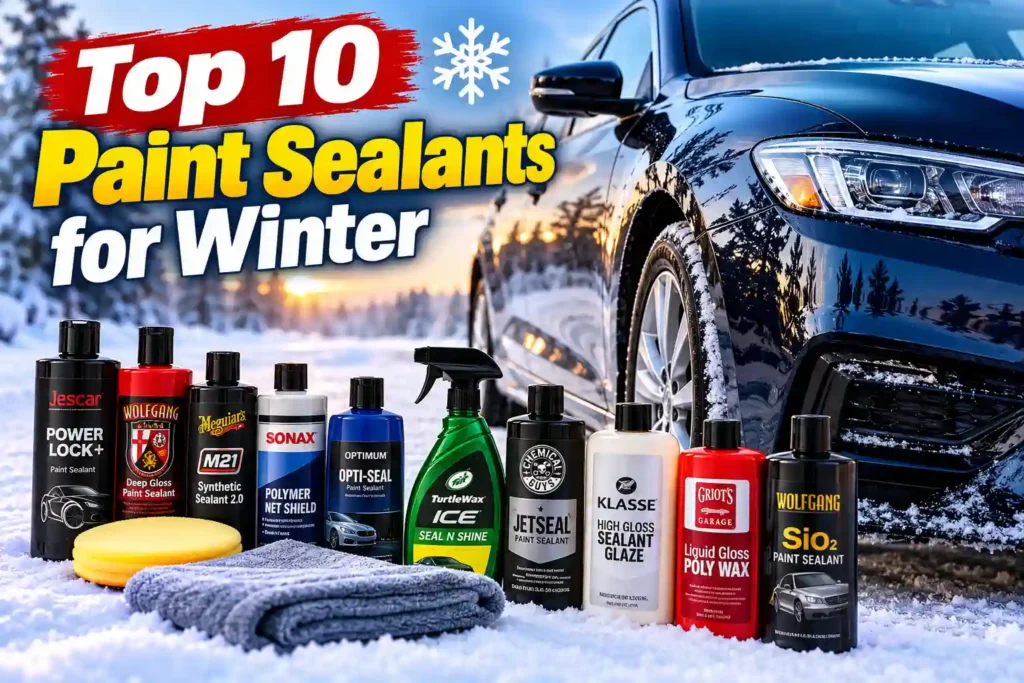
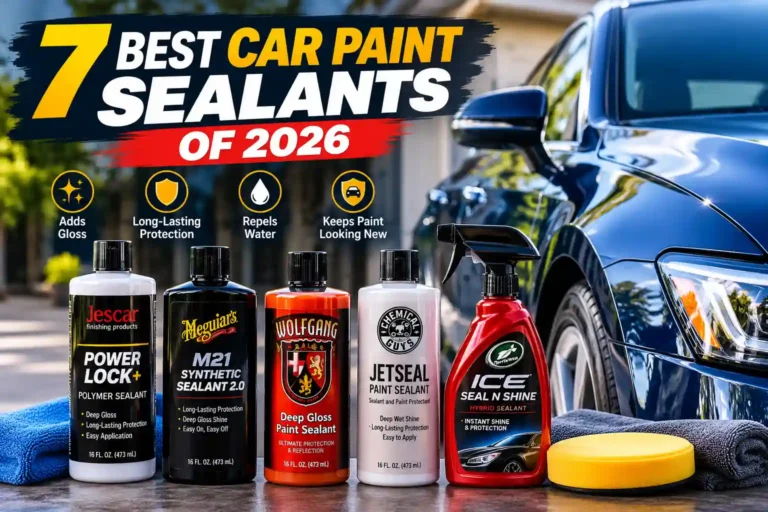
The best car paint sealants of 2026 add gloss and a protective layer to properly prepared paint without requiring a full ceramic-coating installation. The right choice depends on how you like to apply protection, how much preparation you will complete, and whether you want a traditional polymer sealant or a convenient spray hybrid.
Jescar Power Lock Plus is a strong starting choice for owners who want an applicator-applied polymer sealant and can provide its dry curing period. Turtle Wax ICE Seal N Shine suits buyers who prefer a spray-and-wipe routine. The other picks offer different application formats and finishing preferences rather than a guaranteed durability ranking.
This guide compares seven verified product listings using manufacturer information and application guidance checked in October 2026. We have not conducted hands-on gloss, chemical-resistance, or durability testing. Each review explains the features, practical limits, and buying decision so you can choose protection you will use correctly.
Best Car Paint Sealants: Quick Comparison Table
Use this car paint sealant comparison to choose the application style that fits your routine. A product that is easy for you to apply thinly and finish properly is more useful than one selected only for an advertised protection period.
This article contains affiliate links. If you buy through them, we may earn a commission at no extra cost to you.
| # | Product | Best For / Category | Amazon |
|---|---|---|---|
| 1 | Jescar Power Lock Plus Polymer Sealant, 16 oz Listing | Best traditional polymer starting choice | Check Price on Amazon |
| 2 | Meguiar’s M21 Synthetic Sealant 2.0, 16 oz | Best straightforward synthetic liquid alternative | Check Price on Amazon |
| 3 | Wolfgang Deep Gloss Paint Sealant, 16 fl oz | Best for a gloss-focused detailing routine | Check Price on Amazon |
| 4 | Chemical Guys JetSeal Paint Sealant, 16 oz | Best for an existing Chemical Guys care routine | Check Price on Amazon |
| 5 | Griot’s Garage Liquid Gloss Poly Wax 10916, 16 oz Kit | Best synthetic option for a Griot’s workflow | Check Price on Amazon |
| 6 | Turtle Wax ICE Seal N Shine, 16 oz | Best spray-and-wipe hybrid sealant | Check Price on Amazon |
| 7 | SONAX Polymer Net Shield 223300, 340 mL | Best wax-free aerosol sealant format | Check Price on Amazon |
7 Best Car Paint Sealants Reviewed
These car paint sealant reviews connect the documented product features with the application effort and limitations that matter at home. Each recommendation links to one specific listing and ends with a clear purchase decision.
1. Jescar Power Lock Plus: Best Traditional Polymer Starting Choice
Best for: Owners with prepared paint who want an applicator-applied polymer sealant and can keep it dry during early curing.
Jescar Power Lock Plus is a dedicated polymer sealant that can be applied by hand or machine. The verified listing is the 16-ounce version. It suits buyers who enjoy a deliberate protection step after washing and any necessary paint preparation.
The useful buying detail is its application schedule. Jescar’s guide describes a 15–30-minute setting period before residue removal, depending on conditions, and at least 12 hours without rain or washing afterward. Plan that dry period before applying it to a car that must immediately return outdoors.
Thin, even application matters more than covering the panel heavily. Use the correct applicator, clean towels, and a cool surface. Gloss and slickness are finishing benefits; the product should not be treated as a substitute for correcting paint defects.
Key Features
- Dedicated polymer paint sealant.
- Verified 16-ounce listing.
- Hand or machine application under the manufacturer’s guidance.
- Defined setting, buffing, and early water-avoidance instructions.
Pros
- Clear application process for a traditional sealant routine.
- Can suit either hand application or a compatible machine setup.
- Useful when protection is a separate step after paint preparation.
Cons
- Needs planning for the instructed dry period.
- Heavy application adds unnecessary removal work.
- Does not correct scratches or repair clear-coat failure.
Buying Decision
Choose Power Lock Plus if you want a traditional polymer sealant and can provide its curing conditions. Buy an appropriate applicator and clean buffing towels with it. Choose a suitable spray product if the extra setting and dry-storage requirements would keep you from using it consistently.
2. Meguiar’s M21 Synthetic Sealant 2.0: Best Straightforward Liquid Alternative
Best for: Drivers who want a dedicated synthetic liquid for suitable prepared glossy automotive paint.
Meguiar’s M21 uses a synthetic polymer formulation aimed at gloss, a reflective finish, and water beading. The 16-ounce bottle is a practical size for a home detailing kit without committing to a bulk supply.
The product’s appearance-enhancing claims should be read separately from correction. A finish can look better without scratches being permanently removed. If visible swirls are the problem you want solved, inspect the paint and choose an appropriate correction step before protection.
M21 makes sense when you want a familiar liquid-sealant workflow and a dedicated protection product. Follow the current label for application, removal, and any curing requirements. Do not borrow timing from Jescar or another sealant because the liquids look similar.
Key Features
- Synthetic polymer sealant in a 16-ounce bottle.
- Designed for gloss, reflection, and hydrophobic behavior.
- Dedicated protection role rather than a wash product.
- Liquid application and residue-removal process.
Pros
- Manageable package for ordinary home detailing.
- A clear alternative for buyers who prefer a liquid sealant.
- Separates the protection purchase from an abrasive correction product.
Cons
- Appearance improvement is not proof of permanent swirl removal.
- Preparation and proper residue removal remain necessary.
- Timing and compatibility must come from its own instructions.
Buying Decision
Choose M21 if you want a dedicated synthetic liquid and its application process fits your routine. Choose a separate polish only when correction is needed and appropriate. For quick maintenance without an applicator-applied liquid step, compare ICE Seal N Shine.
3. Wolfgang Deep Gloss Paint Sealant: Best for a Gloss-Focused Routine
Best for: Enthusiasts who prioritize the finished appearance of prepared glossy paint and enjoy an applicator-based protection step.
Wolfgang Deep Gloss Paint Sealant is a polymer-based protectant positioned around a deep, wet-looking gloss. The linked 16-fluid-ounce product is part of the brand’s traditional sealant range, rather than its ceramic-coating products.
It is worth considering when appearance is a major purchasing priority and the paint is already in a condition you want to preserve. Surface preparation influences the result: a sealant cannot turn neglected, failing paint into a corrected finish simply by adding a glossy layer.
The manufacturer advertises protection lasting up to six months, but that is not an independently verified result for your car. Weather, washing, storage, preparation, and exposure change the maintenance requirement. Buy for the workflow and finish preference, not a promise to stop caring for the paint for half a year.
Key Features
- Polymer-based Deep Gloss Paint Sealant.
- Verified 16-fluid-ounce listing.
- Manufacturer emphasizes gloss and color depth.
- Dedicated protection product for suitable automotive paint.
Pros
- A relevant choice for buyers who prioritize final appearance.
- Fits a traditional preparation-and-protection routine.
- Manageable size for an enthusiast’s detailing kit.
Cons
- Advertised longevity depends on actual conditions.
- Does not replace correction or repair of existing defects.
- Application and early-care instructions still require attention.
Buying Decision
Choose Wolfgang when you want its gloss-focused approach and will prepare the paint properly. Compare Jescar if the application process is your main deciding factor. Choose a spray hybrid when speed and frequent convenient maintenance matter more to your routine.
4. Chemical Guys JetSeal: Best for an Existing Chemical Guys Care Routine
Best for: Owners who want a dedicated synthetic sealant alongside compatible products they already use.
JetSeal is a synthetic paint sealant supplied here in a 16-ounce listing. The product is intended to add gloss and protection after preparation, with hand or machine application described in the listing.
Its appeal is a familiar apply-thinly, allow-to-set, and buff-off workflow. Follow the bottle’s own instructions for each stage. Do not assume a second coat or another wax automatically improves the result unless the supported timing and layering procedure allow it.
The Anti-Corrosion name does not make JetSeal a rust converter or underbody treatment. It belongs on approved exterior finishing surfaces in its stated role. Paint chips, exposed rust, and failing clear coat require their own assessment rather than another coat of sealant.
Key Features
- Synthetic JetSeal paint protectant.
- Verified 16-ounce listing.
- Hand or machine application identified in the product information.
- Thin application followed by the specified setting and removal process.
Pros
- Fits an established Chemical Guys detailing routine.
- Dedicated sealing step after suitable preparation.
- Offers an alternative liquid format to trigger-spray protection.
Cons
- Not a rust-treatment product despite its name.
- Layering requires supported timing and compatibility.
- A preparation-heavy job still needs the appropriate cleaners or correction tools.
Buying Decision
Choose JetSeal if its application process and compatibility match the care routine you already follow. Buy it to protect prepared paint, not to repair corrosion. Compare the total workflow with a spray hybrid if you mainly want a faster maintenance step.
5. Griot’s Garage Liquid Gloss Poly Wax: Best for a Griot’s Workflow
Best for: Buyers who want synthetic polymer protection and already prefer Griot’s applicator-based detailing approach.
Liquid Gloss Poly Wax is included because Griot’s describes its protection technology as synthetic polymer-based. The word wax in the name should not lead you to treat it as simply another traditional carnauba wax.
This exact listing is the 10916 16-ounce kit. Confirm the supplied contents before ordering accessories; the recommendation centers on the sealant product, not an assumed collection of towels or pads. Use suitable application tools under the manufacturer’s guidance.
A clean, prepared surface and thin coverage remain the useful priorities. Follow the product’s own removal and maintenance directions rather than applying a general wax routine automatically. It is a protection stage, not a guaranteed correction treatment for swirls or faded clear coat.
Key Features
- Liquid Gloss Poly Wax synthetic polymer protection.
- Linked 10916, 16-ounce kit listing.
- Intended as a paint-protection finishing step.
- Compatible application tools should follow the manufacturer’s guidance.
Pros
- Useful for an existing Griot’s detailing workflow.
- A synthetic option despite the wax naming.
- Kit listing may suit buyers assembling their protection setup once contents are confirmed.
Cons
- Check included accessories before buying extras.
- Does not replace paint preparation or correction.
- Similar brand names such as Foaming Poly Gloss identify different products.
Buying Decision
Choose Liquid Gloss Poly Wax when you want its synthetic protection role and the Griot’s process suits you. Confirm that the kit contains what you expect. Do not substitute a similarly named foaming maintenance product when you intend to buy this liquid protection step.
6. Turtle Wax ICE Seal N Shine: Best Spray-and-Wipe Hybrid
Best for: Drivers who prefer a convenient protective spray on clean, dry, compatible exterior surfaces.
ICE Seal N Shine combines wax and hydrophobic sealant polymers in a spray format. It is the clearest choice here for a buyer who wants a hybrid protection product without committing to a traditional liquid-sealant setting routine.
The verified listing is a single 16-ounce bottle. Its spray-and-wipe format is convenient after proper washing and drying, but it is not a waterless wash for dirty paint. Remove contamination first so the towel is spreading protection rather than dragging grit across the finish.
Use controlled amounts and finish with clean microfiber as directed. Excess product can create extra wiping without improving protection. The hybrid formula also should not be described as equivalent to a professionally installed ceramic coating simply because both can cause water to bead.
Key Features
- Wax-and-polymer hybrid sealant spray.
- Single 16-ounce bottle listing.
- Application to clean, dry, approved surfaces.
- Spray, wipe, and finish with microfiber under the product instructions.
Pros
- Convenient format for routine maintenance.
- Avoids the application style of a traditional bottled liquid sealant.
- Useful when a quicker process helps you maintain protection consistently.
Cons
- Not a substitute for cleaning dirty paint.
- Overapplication can increase residue-removal work.
- Hydrophobic behavior does not make it a full ceramic-coating installation.
Buying Decision
Choose ICE Seal N Shine if convenient spray maintenance is the process you will actually use. Buy dedicated clean microfiber towels with it. Choose Jescar or another traditional liquid when you prefer that application approach and can meet its preparation and curing requirements.
7. SONAX Polymer Net Shield: Best Wax-Free Aerosol Format
Best for: Owners who want an aerosol-applied, wax-free paintwork sealant and can work in controlled sections.
SONAX Polymer Net Shield is a wax-free paintwork sealant in a 340 mL aerosol. The manufacturer describes hybrid protection and a water-repellent surface, making it a different format from the liquid bottles and trigger spray in this guide.
The application guidance allows suitable applicator use or direct paint application, followed by even spreading and the required finish. Applicator-first use can help control placement near glass and trim when the directions permit it. Do not treat the aerosol like a mist that can be left to finish itself.
The manufacturer advertises up to six months of protection, but maintenance still depends on exposure and care. Judge the purchase by format, compatibility, and your ability to apply it evenly rather than treating that duration as a guarantee.
Key Features
- Wax-free paintwork sealant.
- 340 mL aerosol listing, product 223300.
- Hybrid protection with water-repellent behavior.
- Controlled spreading and residue removal under the application guidance.
Pros
- Distinct aerosol format for buyers who prefer it.
- Useful when you want a wax-free sealant option.
- Applicator use can support controlled placement on suitable paint.
Cons
- Aerosol drift requires attention near surrounding surfaces.
- Even spreading and finishing remain necessary.
- Advertised protection duration is condition-dependent.
Buying Decision
Choose Polymer Net Shield if you want wax-free aerosol protection and will apply it carefully. Choose ICE Seal N Shine for a trigger-spray hybrid routine, or a traditional liquid if that gives you better control. Use the format you can finish evenly rather than buying on a longevity number alone.
Car Paint Sealant Buying Guide: Preparation, Application, and Protection
The best paint sealant for your car fits the finish and maintenance routine you have. These criteria help you choose a complete protection process instead of comparing bottle claims in isolation.
Check glossy paint, wraps, and existing coatings separately
Confirm that the product supports your exact surface. A recommendation for glossy automotive paint should not be extended automatically to matte finishes, satin wraps, or every film and coating. Gloss-enhancing products can alter a finish you intended to keep non-glossy.
For an existing ceramic coating, follow the coating maker’s maintenance guidance. Another protection layer is useful only when compatibility and purpose are clear. More products do not automatically create a better system.
Buy the application routine you can complete
A traditional liquid may require setting, buffing, and a protected early curing period. A spray product has its own instructions and is not necessarily suitable as a drying aid just because it comes in a trigger bottle.
Check your available time and weather before buying. If dry storage is not possible when a product requires it, choose a supported alternative or schedule application differently. Avoid starting a process you cannot finish correctly.
Prepare according to the paint’s actual condition
Wash first and inspect the dry surface. Use compatible decontamination only where needed, then address appropriate correction before protection. Mechanical decontamination can introduce marks, so it should have a reason rather than becoming an automatic step on every clean car.
Do not seal over active contamination, failing paint, or an unknown reaction. A sealant protects a suitable finish; it does not make underlying damage disappear.
Read durability estimates as conditional claims
Manufacturer estimates depend on conditions and should not be treated as a head-to-head test result. Outdoor exposure, washing products, abrasion, mileage, and preparation influence maintenance needs.
Inspect how the finish cleans and behaves over time, while remembering that beading alone does not measure every aspect of protection. Reapply under the product guidance and actual conditions rather than assuming a calendar claim makes maintenance unnecessary.
Include applicators and towels in the purchase
Use suitable clean tools and apply a thin, even film. Separate sealant towels from heavily contaminated or incompatible detailing cloths. Keep enough clean towel faces available to remove residue without repeatedly redistributing it.
A higher-priced bottle cannot compensate for poor application tools. Compare the complete setup and expected use, especially if a kit already includes some of the accessories you need.
How to Apply Car Paint Sealant Without Streaks
Correct paint sealant application controls surface condition, product amount, and removal timing. Follow the exact label first, then use this sequence to organize the job.
Wash and inspect the vehicle
Work on a clean, cool surface in suitable conditions. Remove contamination through an approved process before applying protection. Finish any planned correction first and follow the sealant’s preparation instructions.
Apply a thin, even layer
Use the specified applicator, spray amount, or machine setup. Work manageable sections where required. A heavy layer can increase residue and removal effort without delivering a proportionate benefit.
Remove residue at the specified stage
Use clean microfiber and follow the product’s timing. Some formulas require a setting period; others use a different routine. Do not transfer one brand’s wait time to all seven products.
Respect curing and early-care requirements
Keep the vehicle dry or avoid washing where the instructions require it. Do not add a topper immediately unless the supported layering procedure allows it. Inspect the finish under suitable light before considering the job complete.
conclusion
Choose Jescar Power Lock Plus for a traditional polymer sealant routine with its required dry period. Meguiar’s M21 offers another dedicated liquid option, while Wolfgang suits a gloss-focused process. JetSeal and Liquid Gloss Poly Wax are worth considering when their application methods fit the detailing products and tools you already use.
Choose Turtle Wax ICE Seal N Shine when spray-and-wipe convenience is the deciding factor. Choose SONAX Polymer Net Shield when you specifically want a wax-free aerosol format.
The best car paint sealants of 2026 are useful only when their procedures match your paint and routine. Buy the appropriate tools, prepare the surface, and maintain the finish rather than expecting one application to prevent every defect.
FAQs
These car paint sealant FAQs explain application, durability, and compatibility before you buy. Use the answers to narrow the choice, then follow the exact product guidance for your finish.
Is paint sealant better than car wax?
Neither category is universally better. Compare the actual formula, finish preference, application process, and maintenance needs. Some products also combine wax and synthetic sealant ingredients, so the label categories can overlap.
How long does a car paint sealant last?
Longevity depends on the product and exposure. Some manufacturers advertise protection lasting months, but those estimates are conditional. Washing, storage, preparation, and driving conditions affect when protection needs attention.
Does paint sealant remove scratches?
A protection product should not be treated as permanent scratch correction. It may change how a defect looks without removing it. Use an appropriate correction process only when the paint condition and finish support it.
Can I apply sealant over wax?
Do so only when the product system supports that sequence. Existing wax or other residue can affect bonding or finishing. Follow preparation and layering directions instead of assuming every protection product works over every other one.
Can I wax over paint sealant?
Some systems permit it after the required curing period. Check the exact products and timing before adding a topper. A second product is optional unless it serves a clear, compatible purpose.
Is spray sealant the same as ceramic coating?
No, a spray sealant is not automatically equivalent to an installed ceramic coating. Formulation, preparation, application, and curing differ. Water beading alone does not establish the product category or comparative durability.
Can I use these sealants on matte paint?
Use a product only when its instructions and the finish maker approve matte paint. A gloss-enhancing sealant may change the appearance. Do not extend glossy-paint recommendations to matte or satin finishes automatically.
Should I apply sealant before it rains?
Only if you can meet the product’s early water-exposure requirements. Jescar’s guide, for example, calls for at least 12 hours without rain or washing. Schedule the job or choose a supported alternative rather than ignoring the curing instructions.