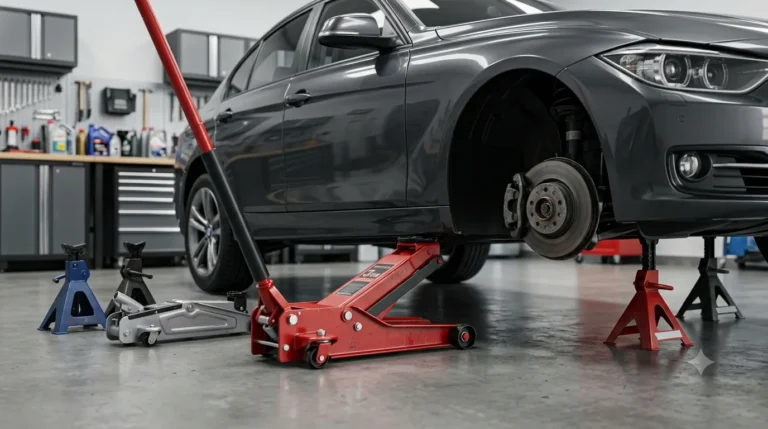
If you regularly maintain your vehicle at home, a properly rated set of jack stands is one of the most important pieces of garage equipment you can own. A floor jack is used to raise the vehicle, while jack stands provide mechanical support after the vehicle has been lifted.
The best jack stands for your garage should match your vehicle’s weight, provide an appropriate height range, use a secure locking mechanism, and have a stable base. You also need to use them with the vehicle manufacturer’s designated support points and on a suitable surface.
In this guide, we’ll compare reliable jack stands for DIY maintenance, including budget-friendly options and adjustable steel stands. We’ll also cover the floor jacks that pair with them and explain what to look for when choosing lifting equipment for routine vehicle maintenance.
Quick Picks: Best Jack Stands for DIY Maintenance
| Product | Best For | Capacity | Height Range |
|---|---|---|---|
| Amazon Basics Steel Jack Auto Stands | Budget-conscious DIY maintenance | 3 ton per pair | Adjustable |
| Torin BIG RED T43202 | Everyday garage maintenance | 3 ton | 11-1/4 to 16-3/4 in |
| Torin BIG RED T83006 Floor Jack | SUVs and taller vehicles | 3 ton | 5-7/8 to 17-1/4 in standard |
| VEVOR 3 Ton Low Profile Floor Jack | Low-clearance versatility | 3 ton | 3-6/11 to 19-11/16 in |
| ARCAN 3-Ton Aluminum Low Profile Floor Jack | Low-clearance vehicles | 3 ton | 18 inches |
Always confirm the current manufacturer specifications and vehicle compatibility before purchasing or using lifting equipment.
Best Jack Stands and Floor Jacks for DIY Repairs
The right lifting equipment depends on your vehicle type, available ground clearance, lifting capacity, and the kind of DIY work you plan to do. Below, we break down our top picks to help you understand what each jack or jack stand does best, where it has limitations, and which type of driver or DIY mechanic should consider it.
1. Amazon Basics Steel Jack Auto Stands, 3 Ton — Best Budget Option
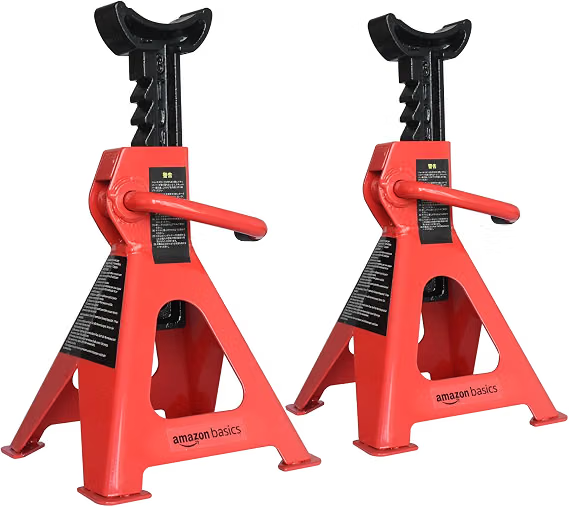
The Amazon Basics Steel Jack Auto Stands are a straightforward option for DIY vehicle owners who need mechanically locking support after lifting a vehicle.
The model identified in the supplied product information is designed with a 3-ton capacity for the pair and a self-locking ratchet design.
Key Features
- 3-ton capacity for the pair
- Self-locking ratchet mechanism
- Steel construction
- Adjustable height
- Designed as a pair
Pros
- Straightforward ratchet-style adjustment
- Steel construction
- Clear capacity rating
- Suitable for many routine DIY applications
- Budget-oriented design
Cons
- Basic design
- Height range should be checked against your vehicle
- Requires a separate floor jack
- Vehicle compatibility still needs to be confirmed
Best for: DIY owners who want a simple pair of jack stands for compatible passenger vehicles and routine maintenance.
Our Take:
The Amazon Basics stands make sense when you need basic mechanical support without paying for specialized features. Their value comes from their straightforward design rather than advanced functionality. Before purchasing, verify that their capacity and height range work with your vehicle.
2. Torin BIG RED T43202 3-Ton Jack Stands — Best for Everyday Garage Maintenance
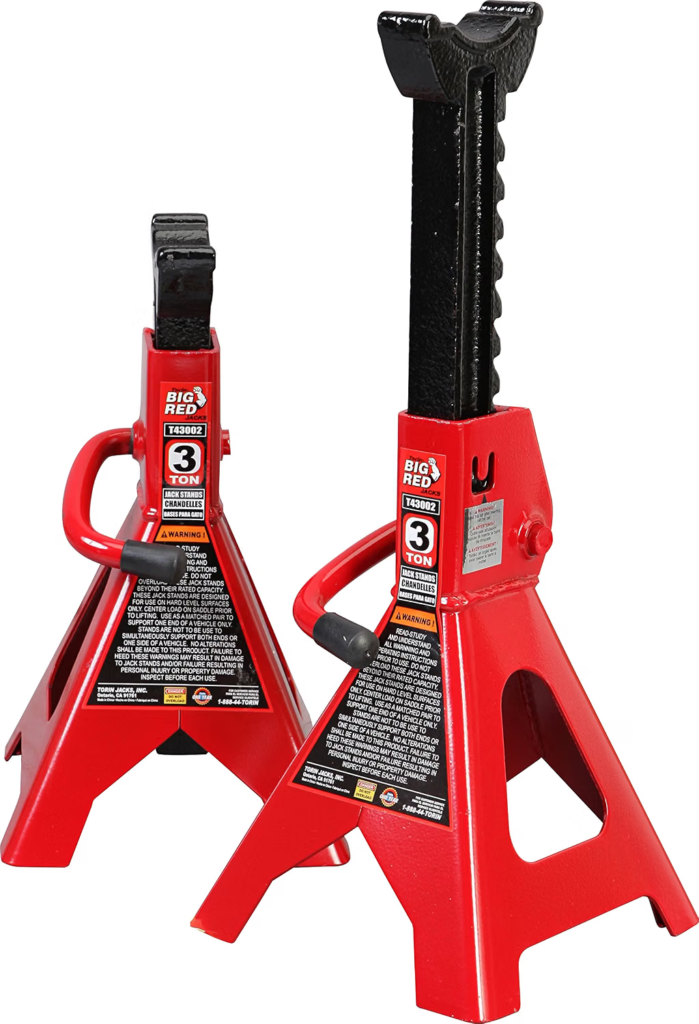
The Torin BIG RED T43202 is a 3-ton steel jack stand option for DIY owners who want adjustable mechanical support for routine vehicle maintenance.
The supplied product information identifies an adjustable height range of approximately 11-1/4 to 16-3/4 inches for the corresponding 3-ton configuration.
Key Features
- 3-ton rating
- Steel construction
- Adjustable height
- Ratchet-style height adjustment
- Designed for use as a pair
Pros
- Useful height range for many passenger vehicles
- Mechanical height adjustment
- Suitable for routine garage maintenance
- Established automotive lifting-equipment brand
Cons
- Not automatically suitable for every SUV or truck
- Requires a separate floor jack
- Vehicle support-point compatibility must be checked
- Not a substitute for correct lifting technique
Best for: DIY mechanics who primarily work on passenger cars and want adjustable steel jack stands for regular garage maintenance.
Our Take:
The T43202 is a practical choice when your vehicle falls within its capacity and height range. It provides the basic mechanical support needed after lifting without adding unnecessary complexity.
3. Torin BIG RED T83006 3-Ton Floor Jack — Best for SUVs and Taller Vehicles
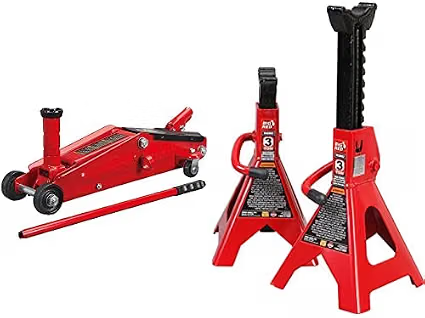
The Torin BIG RED T83006 is a floor jack rather than a jack stand, so it should be considered complementary equipment.
Torin’s documentation lists a 3-ton standard configuration with a lifting range from 5-7/8 to 17-1/4 inches. The manual also describes a separate SUV adapter configuration with different capacity and lift specifications.
Key Features
- 3-ton standard capacity
- 5-7/8 to 17-1/4-inch standard lifting range
- Hydraulic floor-jack design
- Overload bypass system
- Designed for automotive lifting applications
Pros
- Useful for home-garage lifting
- 3-ton standard capacity
- Higher lifting range than many compact jacks
- Useful for taller vehicles when specifications are appropriate
Cons
- Not a jack stand
- Not ideal for very low-clearance vehicles in standard configuration
- Requires more storage space than a compact emergency jack
- SUV adapter configuration has different specifications
Best for: Home garages that need a floor jack for taller vehicles and want to pair it with properly rated jack stands.
Our Take:
The T83006 is most useful when your garage needs a floor jack with more lifting range than a compact jack. Remember that the floor jack and jack stands perform different jobs: the jack lifts the vehicle, while the stands provide mechanical support.
4. VEVOR 3 Ton Low Profile Floor Jack — Best Low-Clearance Versatility
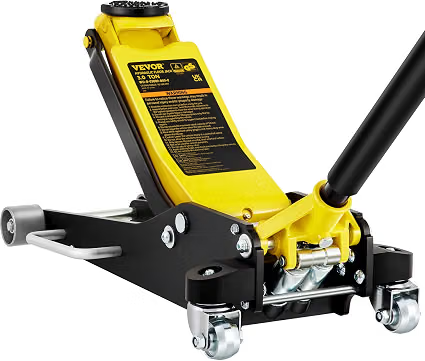
The VEVOR 3 Ton Low Profile Floor Jack combines a low minimum height with a 3-ton capacity. The referenced model uses aluminum-and-steel construction and a dual-pump hydraulic system.
The listed lifting range is approximately 3-6/11 to 19-11/16 inches.
Key Features
- 3-ton capacity
- Low-profile design
- Aluminum-and-steel construction on the referenced version
- Dual-pump hydraulic system
- Broad lifting range
Pros
- Low minimum lifting height
- High maximum lift
- 3-ton capacity
- Useful for different vehicle types
- Dual-pump design
Cons
- Larger than an emergency scissor jack
- More equipment than occasional tire-change users need
- Exact specifications vary by model
- Still requires properly positioned jack stands for under-vehicle work
Best for: DIY owners who want a floor jack that combines low clearance with a relatively high maximum lifting range.
Our Take:
The main advantage here is versatility. The low profile can help with lower vehicles, while the higher maximum lift can be useful for taller vehicles. Verify the exact model specifications before purchasing because VEVOR sells multiple floor-jack configurations.
5. ARCAN 3-Ton Aluminum Low Profile Floor Jack, Model A20019 — Best for Low-Clearance Vehicles
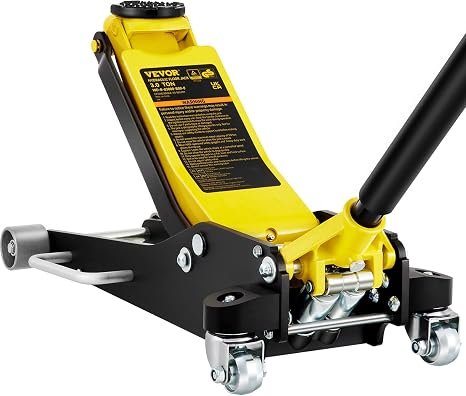
The Arcan XL20 is identified in the supplied draft as a low-profile floor jack intended for vehicles with limited ground clearance.
Because current primary-source specifications for the exact XL20 model were not sufficiently verified, confirm the current capacity, lift range, and model number before purchasing.
Pros
- Low-profile design
- Intended for vehicles with limited clearance
- Useful for lower vehicles
Cons
- Current exact specifications should be verified
- Capacity may limit vehicle compatibility
- Unnecessary for many standard-height vehicles
- Requires jack stands for under-vehicle work
Best for: Owners of low-clearance vehicles who verify that the current model’s specifications match their vehicle.
Our Take:
The Arcan XL20 is potentially useful when minimum ground clearance is the main problem. However, because exact current specifications need verification, check the manufacturer’s documentation and current product listing before making a purchase decision.
What Should You Look for in Jack Stands?
When choosing jack stands, focus on capacity, height range, locking mechanism, construction, and base stability. These factors determine whether a stand is appropriate for your vehicle and the type of maintenance you plan to perform.
1. Weight Capacity
Choose jack stands with a capacity appropriate for your vehicle and the way the vehicle will be supported.
Do not choose a stand based only on its advertised capacity. Check the vehicle manufacturer’s lifting instructions and the stand manufacturer’s specifications before use.
A higher capacity does not automatically make a jack stand safer if it is positioned incorrectly or used on an unsuitable surface.
2. Height Range
The jack stand needs to reach the manufacturer’s recommended support point while providing enough clearance for the work you need to perform.
Compare both the minimum and maximum height rather than looking only at capacity.
Low-profile floor jacks can be useful for vehicles with limited ground clearance, while taller equipment may be more appropriate for some SUVs and trucks.
3. Locking Mechanism
Jack stands commonly use ratchet-style mechanisms or locking pins to secure the selected height.
The locking mechanism should fully engage before the vehicle is lowered onto the stand. Inspect the mechanism before every use and follow the manufacturer’s instructions.
4. Construction
Steel is commonly used for jack stands because it provides a rigid structure and is suitable for garage use.
Aluminum equipment can reduce weight, which may make it easier to move around a garage, but material alone should not determine your purchase.
Capacity, height, locking system, stability, and vehicle compatibility are more important considerations.
5. Base Stability
A stable base helps keep the stand properly positioned during use.
However, even a wide base cannot compensate for an unsuitable surface. Jack stands should be used on a level, hard surface that can adequately support the equipment and vehicle.
Why Do You Need Both a Floor Jack and Jack Stands?
A floor jack and jack stands perform different jobs.
A floor jack lifts the vehicle. Jack stands are then positioned to provide mechanical support.
A hydraulic jack should not be treated as the sole support while you work underneath a vehicle. Once the vehicle is raised, properly rated jack stands should be positioned at the manufacturer’s designated support points and the vehicle lowered onto them according to the equipment and vehicle manufacturer’s instructions.
A typical setup is:
- Position the floor jack at the manufacturer’s designated lifting point.
- Raise the vehicle only as high as necessary.
- Position an appropriately rated matched pair of jack stands at the designated support points.
- Make sure the locking mechanisms are properly engaged.
- Slowly lower the vehicle onto the stands.
- Confirm the vehicle is stable before beginning work.
Never place any part of your body underneath a vehicle supported only by a floor jack.
How Do You Choose the Right Jack Stand Capacity?
Capacity should be based on the vehicle, the lifting arrangement, and the manufacturer’s instructions.
A 3-ton rating does not automatically mean a particular stand is appropriate for every vehicle weighing less than 6,000 pounds. You also need to consider how the vehicle is being supported and whether the stand’s height and support design are suitable.
Before purchasing, check:
- Vehicle weight information
- Manufacturer lifting instructions
- Jack stand capacity
- Minimum and maximum stand height
- Saddle or support design
- Working surface
- Whether the equipment is designed to be used as a pair
If you cannot determine whether a particular stand is appropriate for your vehicle, consult the vehicle manufacturer’s service information or a qualified professional.
What Makes a Jack Stand Safer to Use?
There is no single feature that makes one jack stand universally the safest.
A safer setup depends on selecting suitable equipment and using it correctly.
Look for:
- Appropriate rated capacity
- A functioning mechanical locking system
- Stable construction
- Suitable height range
- Undamaged components
- Compatibility with the vehicle’s support points
- A level, hard working surface
Inspect the equipment before every use. Do not use jack stands with bent components, cracks, damaged locking mechanisms, severe corrosion, or other visible defects.
Common Jack Stand Buying Mistakes
1. Choosing Capacity Without Checking Height
A jack stand can have sufficient capacity but still be unsuitable if it cannot reach the required support point.
2. Using One Stand Instead of a Matched Pair
When supporting one end of a vehicle, use an appropriately rated matched pair as directed by the vehicle and equipment manufacturer.
3. Buying Without Checking the Vehicle’s Lift Points
Vehicles have designated lifting points that vary by make and model. Check the owner’s manual before positioning a jack or jack stand.
4. Using Jack Stands on an Unsuitable Surface
Avoid soft ground, slopes, loose gravel, and unstable surfaces. Use a level, hard surface capable of supporting the equipment and vehicle.
5. Treating a Floor Jack as a Stand
A floor jack is designed for lifting. It should not be treated as the sole support while working underneath a vehicle.
How to Safely Lift and Support a Car at Home
Use this as general guidance, but follow your vehicle manufacturer’s lifting instructions when they differ.
- Park on a level, hard surface.
- Secure the vehicle.
- Find the manufacturer’s lifting points.
- Position the floor jack correctly.
- Raise the vehicle only as high as necessary.
- Position the jack stands.
- Engage the locking mechanisms completely.
- Lower the vehicle onto the stands slowly.
- Check stability before working underneath.
If the equipment, vehicle support points, or surface conditions are questionable, stop and consult the vehicle manufacturer’s service information or a qualified professional.
Best Jack Stands for Maintenance: Which Should You Choose?
For straightforward DIY maintenance, the Amazon Basics 3-ton steel jack stands are a budget-oriented option when their capacity and height range are appropriate for your vehicle.
The Torin BIG RED 3-ton stands are another option for owners who want adjustable steel stands for routine garage maintenance.
If you also need a floor jack, the Torin BIG RED T83006 is useful when greater lifting height is needed, while the VEVOR 3-ton low-profile jack offers a broader lifting range when low ground clearance is important.
The key is not simply choosing the highest-capacity or highest-rated equipment. Match the jack stands and floor jack to your vehicle, verify the current specifications, and follow the manufacturer’s lifting instructions.
Frequently Asked Questions
Are 3-Ton Jack Stands Enough for Most Cars?
Yes, 3-ton jack stands can be suitable for many passenger cars, but you should verify the vehicle’s requirements before use. Check the vehicle’s lifting instructions, the jack stand’s rated capacity, and its height range.
Can I Work Under a Car With Only a Floor Jack?
No, never work underneath a vehicle supported only by a floor jack. Use appropriately rated jack stands at the vehicle manufacturer’s designated support points before going underneath the vehicle.
How Many Jack Stands Do I Need?
For supporting one end of a vehicle, you generally need a properly rated matched pair of jack stands. Position both stands at the manufacturer’s designated support points and follow the vehicle and equipment manufacturer’s instructions.
Are Ratchet Jack Stands Safe?
Ratchet jack stands can be used when they are properly rated, undamaged, correctly positioned, and fully locked. Inspect the locking mechanism and stand before every use, and follow the manufacturer’s instructions.
What Size Jack Stands Do I Need for an SUV?
The right jack stand size for an SUV depends on its weight, required support height, and manufacturer-designated lifting points. Check the SUV’s lifting instructions and compare them with the jack stand’s capacity and height range before purchasing.
Are Low-Profile Floor Jacks Worth It?
Yes, low-profile floor jacks are particularly useful for sports cars, lowered vehicles, and cars with limited ground clearance. For a standard-height vehicle, a low-profile jack can still be useful but may not be necessary.
How Often Should I Inspect Jack Stands?
Inspect your jack stands before every use. Check for cracks, bent components, damaged locking mechanisms, severe corrosion, unstable bases, or other visible damage. Do not use a jack stand if it appears damaged or does not operate correctly.
Conclusion
The best jack stands for DIY maintenance are the ones that match your vehicle’s requirements, provide an appropriate height range, use a functioning mechanical locking system, and can be positioned correctly on a suitable surface.
For budget-conscious DIY owners, the Amazon Basics 3-ton steel jack stands are a straightforward option to consider. The Torin BIG RED 3-ton stands provide another option for routine garage maintenance. If you also need a floor jack, the Torin BIG RED T83006 is suited to applications where greater lifting height is useful, while the VEVOR 3-ton low-profile jack offers a broad lifting range for different vehicle clearances.
Whatever equipment you choose, verify the current specifications, follow the vehicle manufacturer’s lifting points, inspect the equipment before use, and never work underneath a vehicle supported only by a hydraulic jack.