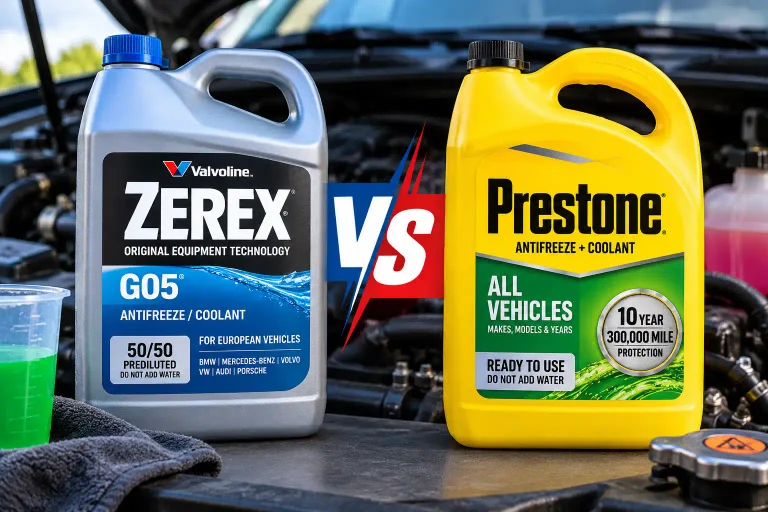
Zerex and Prestone both sell coolant products that can serve a vehicle well, but the brand name alone does not tell you which one belongs in your cooling system. The better choice is the specific formula that matches your vehicle manufacturer’s requirements, comes in the right concentration, and is available when you need it.
A Zerex formula aimed at a particular vehicle application may make the decision easier for one owner. A compatible Prestone formula may be more convenient for another. Neither brand has a universal performance advantage across every vehicle and product. Here is how to compare them without relying on coolant color or marketing claims alone.
Zerex vs Prestone: The Short Answer
Choose the coolant that meets the specification in your owner’s manual or service documentation. If products from both brands meet that requirement, compare their concentration, service guidance, availability, and total cost for the amount you need.
| Decision factor | Zerex | Prestone |
|---|---|---|
| Product selection | Offers multiple formulas, including application-focused products | Offers multiple formulas, including broad-application and vehicle-specific products |
| Compatibility | Depends on the exact product and vehicle requirement | Depends on the exact product and vehicle requirement |
| Ready-to-use or concentrate | Check the individual product label | Check the individual product label |
| Service interval | Follow the vehicle and product instructions | Follow the vehicle and product instructions |
| Best reason to choose | A specific formula matches the required application | A specific formula matches the requirement and suits your buying needs |
This is a comparison of how to select products, not a hands-on test. Performance can vary between formulas within either brand, and a brand-level comparison cannot establish which coolant will last longer in a particular engine.
What Coolant Performance Actually Means
Engine coolant does more than prevent freezing. A suitable coolant mixture also helps transfer heat and contains additives intended to protect cooling-system components against corrosion and deposits.
For a car owner, useful performance comes down to four questions:
- Is the formula appropriate for the vehicle? The additive package needs to suit the cooling system and the manufacturer’s specification.
- Is the concentration correct? Too much water or an incorrect mixture can compromise protection. More antifreeze is not automatically better; follow the specified mixture range.
- Is the system healthy? A good coolant cannot compensate for a leak, a failed thermostat, or a malfunctioning water pump.
- Is the fluid serviced on time? Additive protection can decline with use, even when coolant still looks clean.
When both candidates meet the same vehicle requirement, packaging differences may be more useful to compare than broad claims about cooling performance. There is no sound reason to expect a bottle from one brand to fix an overheating problem that has a mechanical cause.
Compatibility Matters More Than the Brand
Start with the exact coolant specification in your owner’s manual. Depending on the vehicle, that may be a manufacturer specification number, an approved fluid designation, or another stated requirement. Use the full vehicle details, including model year, engine, and trim where relevant, when checking a product’s application information.
Then compare that requirement with the exact bottle of Zerex or Prestone you intend to buy. Similar-looking containers and product names can represent different formulas or concentrations.
Meets a Specification vs. Manufacturer Approval
Product descriptions may use terms such as “meets,” “compatible with,” “recommended for,” or “approved.” These are not necessarily interchangeable.
A manufacturer approval is a claim that a product has received the relevant vehicle manufacturer’s approval. A statement that a product meets a specification or is recommended for an application may instead reflect the coolant maker’s assessment. Read the wording carefully and check the vehicle manufacturer’s requirements, especially if an explicit approval is specified.
If the label or product documentation does not clearly address your vehicle’s requirement, do not assume compatibility from the brand name. Ask the coolant manufacturer, a dealer, or a qualified repair shop before buying.
Coolant Chemistry and Color
You may encounter terms such as inorganic additive technology (IAT), organic acid technology (OAT), and hybrid organic acid technology (HOAT). These describe broad approaches to corrosion-inhibitor chemistry, but they do not replace a vehicle-specific specification. Formulas within a broad category can differ.
Color is even less useful as a compatibility test. Two coolants of the same color are not necessarily interchangeable, and different colors do not automatically establish incompatibility. Use the specification and the exact product documentation instead.
Zerex: When It Makes Sense
Zerex is worth considering when an individual Zerex product clearly addresses the coolant specification or application your vehicle requires. Its range includes formulas marketed for particular vehicle applications, which can make it easier to narrow the choice when the label matches your documentation.
The practical advantage is clarity, not proof that every Zerex product outperforms a competing formula. A product intended for one application may be the wrong choice for another vehicle in the same household.
Choose a Zerex product when:
- The exact formula matches the required specification or application.
- Its approval status satisfies your vehicle manufacturer’s instructions.
- The available concentration suits the job.
- You can obtain enough of the same suitable fluid for the service.
Consider another option when: The product information does not clearly match your vehicle, or a different verified product is easier to obtain in the quantity and concentration you need.
Prestone: When It Makes Sense
Prestone is worth considering when a specific Prestone formula matches your vehicle’s documented requirement and is convenient to purchase. Its range includes products marketed for broad applications as well as products aimed at particular applications.
A broad-application label can be useful when shopping, but it should not end the compatibility check. Compare the product’s precise claims with the vehicle manufacturer’s instructions. If the manual requires a particular approval, confirm that the bottle or current manufacturer documentation states it.
Choose a Prestone product when:
- The exact product addresses the required specification or application.
- Its documentation supports any approval your vehicle requires.
- The concentration and package size suit the work.
- It is a practical choice compared with other products that meet the same requirement.
Consider another option when: The application information is unclear, the required approval cannot be confirmed, or another suitable formula makes the decision more straightforward.
Concentrate vs. Prediluted Coolant
A compatible coolant is useful only if it is mixed correctly. Both brands sell products in forms that may differ by formula and package, so read the front and back labels before purchasing.
Prediluted coolant is ready to use at the concentration stated on the container. Do not add water unless the product instructions specifically direct you to do so. It is convenient for topping off or servicing a system when you want a prepared mixture.
Concentrate must be mixed according to the coolant and vehicle manufacturer’s directions. Many products use a 50/50 mixture, but confirm the recommended ratio for your vehicle and climate rather than treating that ratio as universal. Follow the instructions for water quality as well; use distilled or deionized water where specified.
Compare cost based on the amount of correctly mixed coolant you will actually have, not merely the price per bottle. A container of concentrate and an equally sized container of prediluted coolant do not provide the same amount of finished mixture.
After a cooling-system drain, residual liquid can remain in parts of the system. If the correct final concentration is uncertain, a qualified shop can check it with a tester appropriate for the coolant in use. Do not assume that adding a measured amount to an incompletely drained system automatically produces the intended ratio.
Can You Mix Zerex and Prestone Coolants?
Do not assume two coolants are suitable to mix just because they share a color or because both are sold by major brands. Check the exact formulas and the vehicle manufacturer’s guidance first.
A coolant maker may state that a product is compatible with certain existing coolants. That claim is specific to the product, and it does not automatically mean the resulting mixture retains either fluid’s original service interval or satisfies every vehicle manufacturer’s requirements.
If you do not know what is currently in the system, the safer long-term decision is to have the coolant identified where possible and discuss a replacement with a qualified shop. If changing formulas, follow the vehicle and product instructions for draining, flushing, filling, and bleeding. Simply adding a different fluid to an unknown mixture is not a reliable way to establish the correct chemistry.
What If the Coolant Is Low on the Road?
First, treat a low coolant level as a possible sign of a leak or another fault. If the engine is overheating, stop in a safe place, shut it off, and allow it to cool. Never open a hot pressurized cooling system. Seek roadside assistance if the vehicle continues to overheat or is losing coolant.
Once the system is cool, consult the owner’s manual for the correct top-off point and fluid. If the specified coolant is unavailable, follow the manual’s emergency guidance. Some manufacturers permit a temporary water top-off, but plain water can reduce freeze and corrosion protection and should not be treated as a permanent fix. Have the system inspected and the correct mixture restored promptly.
How to Choose and Maintain the Right Coolant
Use this checklist before your next purchase or service:
- Find the vehicle requirement. Check the owner’s manual and any applicable service information for the specified coolant and service procedure.
- Match the exact product. Review the label and current manufacturer documentation for the Zerex or Prestone formula, including approval wording where required.
- Choose the right form. Buy prediluted fluid for the stated ready-to-use mixture, or concentrate if you can mix and verify it correctly.
- Buy enough for the job. Check the vehicle’s cooling-system capacity and service procedure. A simple drain may not remove every bit of old fluid.
- Follow the applicable service interval. Use the vehicle manufacturer’s schedule and consider any shorter interval or conditions specified by the coolant maker. Do not assume a product’s advertised maximum applies to every vehicle or mixture.
- Check the system, not just the fluid. Repeated coolant loss, visible leaks, overheating, or contamination warrants diagnosis rather than repeated top-offs.
Coolant is hazardous to people and animals. Keep containers closed and clean up spills promptly. Never pour used coolant into a storm drain or onto the ground; use a local automotive-fluid recycling or hazardous-waste collection service that accepts it.
Frequently Asked Questions
Does Zerex or Prestone cool an engine better?
There is no reliable brand-wide winner. For normal operation, choose a coolant that meets the vehicle’s requirements and use it at the correct concentration. If the engine overheats with the proper fluid, the cooling system needs diagnosis rather than a brand change.
Can I use either brand in an electric or hybrid vehicle?
Only if the exact product meets the requirements for the system being serviced. An electric or hybrid vehicle may have separate cooling circuits with different fluid requirements. Check the vehicle documentation and obtain professional service if the procedure is unclear.
Can I switch brands at the next coolant service?
Yes, a switch can make sense if the new product meets the vehicle’s requirements and the service follows the applicable instructions. The important issue is the compatibility and condition of the resulting coolant, not whether the brand name changes.
Which Coolant Should You Buy?
Buy the Zerex or Prestone product that clearly matches your vehicle’s required specification and approval status. If both qualify, choose based on the right concentration, availability, and cost for the quantity you need.
If neither product’s documentation provides a clear match, use a fluid whose suitability can be confirmed. That decision is more valuable than choosing a familiar brand and hoping it works.