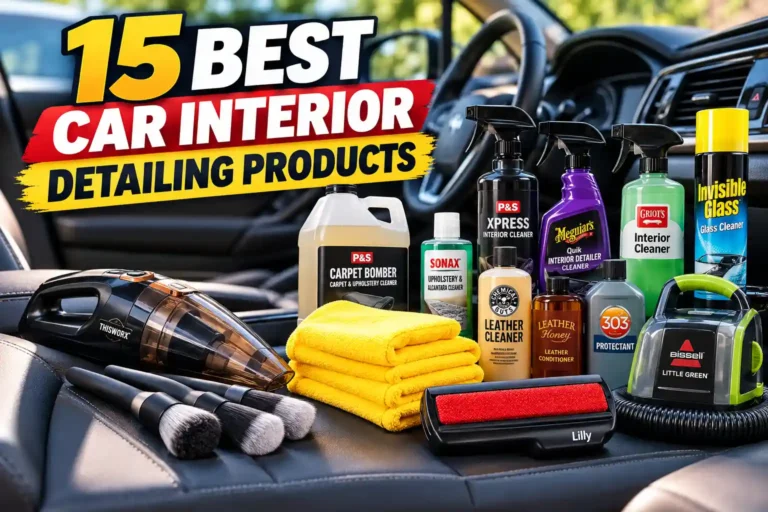
The best car interior detailing products help you solve a specific problem: oily trim, hazy glass, embedded pet hair, stained fabric, or dust in tight gaps. Buying several sprays with overlapping claims can cost more while leaving the actual problem untouched.
This guide brings together 15 cleaners, care products, towels, brushes, and machines that can form a practical interior kit. You do not need all 15. Start with a compatible cleaner, enough clean towels, a glass cleaner, and a way to remove dry debris, then add the specialty tools your vehicle actually needs.
These are research-based reviews, updated for 2026 using product information and material-care considerations. We did not conduct hands-on testing of these products, so the recommendations do not claim measured cleaning performance or a completed comparison test.
Quick Comparison: Best Car Interior Detailing Products
| Product | Best For | Category | Amazon |
|---|---|---|---|
| P&S Xpress Interior Cleaner, 16 oz | Best Core Interior Cleaner | Interior cleaner | Check Price on Amazon |
| Meguiar’s Quik Interior Detailer, 16 oz | Best for Quick Maintenance | Maintenance detailer | Check Price on Amazon |
| Griot’s Garage Interior Cleaner, 22 oz | Best Undressed Finish | Interior cleaner | Check Price on Amazon |
| P&S Carpet Bomber, 1 gallon | Best for Dirty Carpets | Fabric and carpet cleaner | Check Price on Amazon |
| SONAX Upholstery & Alcantara Cleaner, 250 mL | Best for Alcantara | Specialty textile cleaner | Check Price on Amazon |
| Chemical Guys Colorless & Odorless Leather Cleaner, 16 oz | Best Dedicated Leather Cleaning Step | Leather cleaner | Check Price on Amazon |
| Leather Honey Leather Conditioner, 8 oz | Best Optional Leather Conditioner | Leather conditioner | Check Price on Amazon |
| 303 Automotive Protectant, 16 oz | Best for Matte Trim Protection | Trim protectant | Check Price on Amazon |
| Invisible Glass 91164 Aerosol Glass Cleaner, 19 oz | Best for Interior Glass | Glass cleaner | Check Price on Amazon |
| The Rag Company Edgeless 365, 16 × 16 in, Gold 10-Pack | Best Everyday Microfiber Towels | Microfiber towels | Check Price on Amazon |
| Detail Factory TriGrip Ultra-Soft Detailing Brush Set, Gray | Best for Delicate Dusting | Detailing brushes | Check Price on Amazon |
| Lilly Brush Mini Pet Hair Detailer | Best for Embedded Pet Hair | Pet-hair tool | Check Price on Amazon |
| BISSELL Little Green Portable Cleaner, 1400B | Best for Textile Spot Extraction | Portable extractor | Check Price on Amazon |
| ThisWorx 12V Car Vacuum with 16 ft Cord | Best Plug-In Maintenance Vacuum | Dry vacuum | Check Price on Amazon |
| McCulloch MC1275 Canister Steam Cleaner | Best Steam Add-On for Deep Detailing | Steam cleaner | Check Price on Amazon |
Our Top Picks Car Interior Detailing Products
Our top picks cover the essential tasks of car interior detailing, from removing everyday grime to cleaning glass, treating upholstery, and removing embedded pet hair. Start with P&S Xpress Interior Cleaner, quality microfiber towels, and Invisible Glass, then add specialized products based on your vehicle’s materials and cleaning needs.
1. Best Core Interior Cleaner — P&S Xpress Interior Cleaner, 16 oz
Best for: Drivers building a practical kit for routine cleaning of compatible leather, vinyl, and plastic.
P&S Xpress is the bottle to start with when your dashboard, door panels, and seat surfaces need actual cleaning. The linked 16-ounce version is ready to use, so you can put it to work without calculating dilution ratios. Its intended finish is clean and natural rather than glossy.
That distinction matters on a dashboard: removing oily fingerprints is a different job from adding a dressing. Apply a small amount to a microfiber towel for open areas, then use a clean, soft brush where texture traps dirt. Wipe away the loosened soil before it dries.
Xpress makes a sensible foundation for an interior kit, but it does not replace every specialty product. Glass needs a glass cleaner, embedded carpet soil may need extraction, and delicate screens still require the vehicle manufacturer’s cleaning method. Treat the bottle as your general cleaner for approved surfaces, then add specialty products only where they solve a separate problem.
Key Features
- Ready-to-use 16-ounce spray simplifies occasional detailing.
- Designed to remove interior dirt, grease, and oil.
- Residue-free cleaning approach preserves a natural-looking finish.
- Suitable for compatible leather, vinyl, and plastic; patch-test first.
Pros
- One useful starting point for several common interior materials.
- No mixing equipment needed for the linked size.
- Works with towels and soft brushes for different shapes and textures.
Cons
- Cleaning does not provide a dedicated long-term UV-protection step.
- Not a substitute for material-specific screen or suede care.
- Small bottles are less convenient for frequent multi-vehicle work.
Buying Decision
Choose Xpress first if your interior is visibly dirty and you want a straightforward general cleaner. Add 303 after cleaning if compatible trim needs protection; buy Meguiar’s Quik Interior Detailer for lighter maintenance between deeper cleans.
2. Best for Quick Maintenance — Meguiar’s Quik Interior Detailer, 16 oz
Best for: Owners who regularly wipe down a mostly clean cabin.
Meguiar’s Quik Interior Detailer suits the five-minute clean: fingerprints on a console, light dust on door trim, and everyday marks that have not become heavy grime. Its spray-and-wipe format makes regular upkeep easy, which is often more useful than waiting for a large detailing session.
The formula includes sun-blocking agents and is intended to leave a non-greasy appearance and feel. That makes it appealing when you want a tidy, factory-style interior without a shiny dashboard. Use a lightly dampened towel and turn to a fresh section as it collects dirt.
Meguiar’s lists broad material compatibility, including certain displays. However, a vehicle’s instructions for its specific screen and coating take priority. Do not spray directly into buttons, seams, or electronics, and do not expect a quick detailer to handle the same soil load as a dedicated deep-cleaning process.
Key Features
- 16-ounce spray for convenient wipe-downs.
- Non-greasy finish helps retain the original interior appearance.
- Sun-blocking agents add a protection component to routine upkeep.
- Broad labeled interior compatibility, subject to vehicle-specific restrictions.
Pros
- Simple application encourages frequent maintenance.
- Combines light cleaning and some protection in one step.
- Good fit for cabins that do not need aggressive scrubbing.
Cons
- Heavy grime and fabric stains need a different process.
- Broad compatibility does not override delicate display-care instructions.
- Protection claims do not establish a fixed service life in every vehicle.
Buying Decision
Buy this if your cabin stays reasonably clean and convenience is the priority. For accumulated body oils or textured trim full of dirt, start with Xpress and reserve this for maintenance.
3. Best Undressed Finish — Griot’s Garage Interior Cleaner, 22 oz
Best for: Owners who want to remove grime without deliberately adding gloss or fragrance.
Griot’s Garage Interior Cleaner is a useful choice when “clean” should mean the original surface rather than a dressed appearance. Its dye-free, fragrance-free approach appeals to owners who dislike a strongly perfumed cabin and want to choose protection separately.
The 22-ounce spray bottle provides a convenient format for towels, brushes, and spot cleaning on approved interior materials. On textured plastic, work in small sections and wipe the lifted soil with a fresh towel. For compatible upholstery, avoid soaking the backing and check how the fabric dries before expanding the job.
A cleaner-only product gives you control over the final finish. You can leave approved trim undressed or add a separate protectant after it dries. That flexibility is valuable, although it means another step if sun exposure is your main concern.
Key Features
- 22-ounce bottle provides more product than many small maintenance sprays.
- Dye-free and fragrance-free formulation.
- Cleans without intentionally adding a glossy dressing.
- Useful across labeled interior surfaces when applied according to directions.
Pros
- Appealing for owners who prefer minimal added scent.
- Allows cleaning and protection to be selected independently.
- Practical bottle size for a full cabin clean.
Cons
- A separate protectant may still be needed.
- Fabric work requires moisture control and a drying check.
- Fragrance-free does not mean every odor source will disappear.
Buying Decision
Choose Griot’s if you prioritize a straightforward cleaning step and dislike added fragrance. Choose a maintenance detailer instead if you want light cleaning and a protection component in a single wipe-down.
4. Best for Dirty Carpets — P&S Carpet Bomber, 1 gallon
Best for: Frequent detailers cleaning soiled carpet, removable mats, and compatible upholstery.
P&S Carpet Bomber earns its place when ordinary interior spray is no longer enough for the footwell. It is a dedicated carpet and upholstery cleaner intended for soils such as grime and grease, with a concentrate format that makes more sense for repeated jobs than an occasional spill.
Dilute according to the current label and the condition of the material. Dry-vacuum first, apply a controlled amount, agitate with an appropriate fabric brush, and remove the suspended soil with towels or a suitable extraction process. Stronger mixing is not automatically better: excess product can make rinsing and drying harder.
The gallon size is its buying advantage and its main commitment. You need storage, a labeled working bottle, and a plan for removing moisture. It is a more focused purchase than a dashboard cleaner, so buy it for carpet work rather than expecting one concentrate to serve the entire cabin.
Key Features
- Dedicated carpet and upholstery cleaning formula.
- Concentrate format permits label-directed dilution.
- Gallon packaging supports repeated detailing sessions.
- Designed for heavier fabric soil, including oily grime.
Pros
- Useful step up for dirty mats and footwells.
- Bulk format can reduce the need for frequent small-bottle replacements.
- Pairs with controlled agitation and soil removal.
Cons
- Requires dilution and a separate working bottle.
- Poor rinsing or excessive application can leave residue.
- Not an all-purpose choice for screens, leather, or dashboards.
Buying Decision
Buy Carpet Bomber if you regularly tackle dirty textile interiors and can remove the loosened soil properly. For one small stain or a single annual detail, a smaller ready-to-use fabric cleaner is a simpler commitment.
5. Best for Alcantara — SONAX Upholstery & Alcantara Cleaner, 250 mL
Best for: Drivers with Alcantara or compatible microfiber upholstery who need a dedicated cleaning approach.
SONAX Upholstery & Alcantara Cleaner fills a specific gap: ordinary carpet-cleaning habits can be too wet or too aggressive for delicate microfiber surfaces. This foam cleaner is intended for upholstery and Alcantara, making it a more relevant starting point than a leather conditioner or a strong general-purpose degreaser.
Vacuum gently before applying product, then follow the label for foam application, working time, and removal. Keep moisture controlled and avoid vigorous scrubbing that distorts the pile. Finish only after the surface dries, using a suitable gentle method to restore the texture if needed.
The compact can is suited to steering-wheel sections, seat inserts, and smaller upholstered areas. It does not make every stain reversible: worn or matted fibers and permanent dye transfer may remain. Check the vehicle’s Alcantara instructions before treating a high-touch or delicate area.
Key Features
- 250 mL foam format for controlled specialty cleaning.
- Explicitly intended for Alcantara and upholstery.
- Targets material care without adding a leather-style dressing.
- Useful for small areas where careful application matters.
Pros
- More appropriate product category for Alcantara than leather conditioners.
- Compact format works for spot maintenance.
- Supports a low-moisture, gentle cleaning routine.
Cons
- Small packaging is less suitable for large carpet jobs.
- Cannot restore fibers that are physically worn away.
- Still requires a hidden-area test and careful moisture management.
Buying Decision
Choose SONAX when Alcantara is the reason you are shopping. For ordinary dirty floor mats, Carpet Bomber offers a more practical bulk format; keep that stronger carpet workflow away from delicate microfiber trim.
6. Best Dedicated Leather Cleaning Step — Chemical Guys Colorless & Odorless Leather Cleaner, 16 oz
Best for: Owners of compatible leather or leather-like seats who want cleaning separate from conditioning.
A dedicated leather cleaner is useful when a seat looks shiny because of accumulated body oils rather than its original finish. Chemical Guys Colorless & Odorless Leather Cleaner focuses on removing contamination before you decide whether a separate care product is needed.
The colorless, odorless formulation avoids deliberately adding dye or a fragrance treatment. Put a small amount on a towel or approved leather brush, clean a manageable section, and wipe away the lifted soil. Take extra care around perforations and seams so liquid does not collect underneath the surface.
The manufacturer lists compatibility with several natural and synthetic leather materials. That does not make it suitable for every finish: consult the seat-care instructions and patch-test. A cleaner will not recolor cracked bolsters, remove all dye transfer, or repair coating damage, so judge the result as cleaning rather than restoration.
Key Features
- 16-ounce spray bottle for controlled cleaning.
- Colorless and odorless formulation.
- Dedicated cleaning step before optional conditioning.
- Labeled for multiple leather and leather-like materials; confirm your finish.
Pros
- Keeps cleaning separate from the choice of final protection.
- Avoids deliberately adding a strong fragrance.
- Useful for manageable sections of seats and door inserts.
Cons
- No repair function for cracks or missing finish.
- Heavy dye transfer may require specialist assessment.
- Perforated seats demand careful application and wiping.
Buying Decision
Buy this if compatible leather seats need more attention than a maintenance wipe. Add conditioner only if the vehicle manufacturer allows it; synthetic upholstery does not automatically need leather conditioning.
7. Best Optional Leather Conditioner — Leather Honey Leather Conditioner, 8 oz
Best for: Owners of suitable leather that benefits from conditioning under the vehicle’s care instructions.
Leather Honey belongs in an optional care step, not the default shopping basket for every car. It is a leather conditioner intended to soften and protect appropriate leather after cleaning. Its fragrance-free, silicone-free formulation will appeal to owners who want to avoid a strongly scented dressing.
Apply a very thin layer and allow it to absorb according to the directions, then remove excess. More product can leave an undesirable feel or appearance, especially on coated automotive leather that absorbs little. Test for darkening before treating a complete seat.
Many modern seats have protective coatings, while other interiors use synthetic leather. Check what your manufacturer permits before buying. Leather Honey excludes suede, faux leather, and vinyl; it should also stay off pedals and other surfaces where a change in grip would matter. Conditioning cannot repair splits, missing color, or damaged seat coatings.
Key Features
- 8-ounce container for thin, controlled applications.
- Fragrance-free and silicone-free formulation.
- Intended for compatible genuine leather.
- Separate conditioning step lets you clean first and assess the material.
Pros
- Useful when suitable leather needs an approved conditioning treatment.
- Small applications can serve several areas.
- Does not require a fragranced interior finish.
Cons
- Not for suede, faux leather, or vinyl.
- May change color or feel; a patch test is essential.
- Absorption and benefit vary with automotive leather coatings.
Buying Decision
Buy Leather Honey only after confirming your leather can use it. If you have coated seats in good condition or synthetic upholstery, a compatible cleaner may be the more valuable purchase.
8. Best for Matte Trim Protection — 303 Automotive Protectant, 16 oz
Best for: Drivers who want UV protection on approved trim without a high-gloss dashboard.
303 Automotive Protectant is a finishing product for clean, compatible surfaces. Its appeal is the matte appearance: you can care for suitable vinyl, rubber, and plastic without deliberately turning a dashboard into a glossy reflector.
Clean the surface first and let it dry. Apply sparingly, then buff completely dry with a clean towel. The manufacturer specifically notes that the product does not air-dry, so a quick spray followed by walking away is the wrong workflow. Thorough buffing is part of obtaining the intended finish.
This is a targeted protection step rather than a universal coating. Keep it away from clear instrument plastics, screens, fabric, flooring, pedals, and other grip-sensitive areas. Its value is strongest in a sun-exposed vehicle with approved trim, not as an extra layer on everything you have just cleaned.
Key Features
- 16-ounce spray for compatible vinyl, rubber, and plastic.
- UV-protection formulation.
- Matte, non-greasy intended finish after correct buffing.
- Requires a clean, dry surface and complete wipe-drying.
Pros
- Offers a protection step separate from cleaning.
- Matte appearance suits many factory interiors.
- Useful for selected sun-exposed trim.
Cons
- Needs careful buffing; it does not simply air-dry.
- Not suitable for every plastic or interior surface.
- Does not remove the dirt underneath it.
Buying Decision
Choose 303 when you already have a cleaner and want to protect compatible trim. If you mostly need to remove grime, spend on a cleaner and good towels first.
9. Best for Interior Glass — Invisible Glass 91164 Aerosol Glass Cleaner, 19 oz
Best for: Drivers dealing with windshield haze and fingerprints on compatible interior glass.
Interior glass deserves its own product and towels. Invisible Glass 91164 is an ammonia-free aerosol cleaner with a foam format, useful for the oily film that makes a windshield look cloudy when sunlight hits it.
Inside the vehicle, spray onto a clean glass towel rather than flooding the windshield and nearby dashboard. Work one section at a time, then finish with a second dry towel. The final wipe is especially important when an apparent product streak is actually leftover soil or an overloaded cloth.
The formula is marketed as tint-safe, but the film installer’s care instructions still matter. This is a glass product, not permission to clean infotainment screens, anti-glare displays, or clear gauge covers. Give glass towels their own job so protectant and fabric-cleaner residue do not migrate onto the windshield.
Key Features
- 19-ounce aerosol foam format.
- Ammonia-free glass-cleaning formula.
- Labeled tint-safe for appropriate automotive glass applications.
- Works with a separate cleaning towel and dry finishing towel.
Pros
- Dedicated choice for interior windshield film.
- Foam can be applied to a towel for better control.
- Keeps glass work separate from greasy trim products.
Cons
- A dirty or contaminated towel can still leave streaks.
- Tint and specialized coatings may have additional restrictions.
- Aerosol overspray needs to be kept off surrounding electronics.
Buying Decision
Buy Invisible Glass if windshield haze is your main frustration. Pair it with dedicated clean towels before adding more general interior sprays; that combination makes the purchase more useful.
10. Best Everyday Microfiber Towels — The Rag Company Edgeless 365, 16 × 16 in, Gold 10-Pack
Best for: Owners who need enough clean towels to separate interior jobs.
Good towels change how effectively an interior cleaner works. The Rag Company’s Edgeless 365 pack gives you ten 16-by-16-inch towels, allowing you to swap away from a soiled section instead of spreading grime across the next panel.
The 365 GSM, 70/30 microfiber construction has an edgeless design and different pile lengths on its two sides. That gives you options for wiping and collecting light soil, although the right side still depends on the material and product. Fold each towel into quarters to create several fresh working faces.
This gold pack is one color, so keep separate labeled groups for glass, trim, and dirty tasks. A towel used with protectant should not become your windshield-finishing towel. Cleanliness matters more than a “soft” label: trapped grit can scratch, and fabric softener can interfere with microfiber performance.
Key Features
- Ten towels support a complete cabin workflow.
- 16-by-16-inch size folds into useful working sections.
- 365 GSM, 70/30 microfiber construction.
- Edgeless design with differing pile lengths across the two sides.
Pros
- More clean towel faces reduce repeated wiping with dirty cloth.
- Versatile size for trim and general cleaning.
- Reusable alternative to relying on disposable wipes.
Cons
- One-color packaging requires another way to separate jobs.
- Needs appropriate washing and storage.
- Does not guarantee scratch-free use when contaminated.
Buying Decision
Make this a priority purchase if you have only one or two old rags. A sensible cleaner plus enough clean towels is a stronger starter kit than several overlapping sprays used with contaminated cloth.
11. Best for Delicate Dusting — Detail Factory TriGrip Ultra-Soft Detailing Brush Set, Gray
Best for: Owners cleaning light dust from seams, vents, and delicate trim with controlled pressure.
The Detail Factory TriGrip Ultra-Soft set earns a place in a cabin kit because a towel cannot reach every seam. The soft brush heads help dislodge light dust from vent edges, trim joints, and textured details before you wipe or vacuum it away.
The triangular, rubberized grip is designed for comfortable control, and the metal-free construction avoids an exposed metal ferrule near trim. Those design choices are useful around awkward shapes, but they do not make every brushing technique harmless.
Start with a clean brush and light pressure. Piano-black panels can scratch if grit is dragged across them, regardless of bristle softness. These brushes are for careful detailing, not aggressive carpet agitation or grinding away sticky deposits; use the right cleaning product to loosen dirt before increasing force.
Key Features
- Ultra-soft bristles for light interior detailing.
- Triangular rubberized handles support a controlled grip.
- Metal-free construction reduces exposed hard hardware near trim.
- Brush-set format helps address different shapes and spaces.
Pros
- Reaches gaps that a folded towel may miss.
- Comfortable grip encourages careful handling.
- Useful companion to a towel or vacuum during dust removal.
Cons
- Too gentle for heavy carpet agitation.
- Contaminated bristles can still drag abrasive particles.
- Brushes must be cleaned and dried between dirty jobs.
Buying Decision
Choose this set for vents, seams, and careful dust removal. If your main problem is a stained floor mat, spend on a fabric cleaner and an appropriate upholstery brush instead.
12. Best for Embedded Pet Hair — Lilly Brush Mini Pet Hair Detailer
Best for: Drivers whose carpet holds medium-to-coarse or wiry pet hair after vacuuming.
Lilly Brush Mini Pet Hair Detailer tackles a problem a vacuum alone can leave behind: hair caught in the carpet pile. The reusable rubber blade helps gather suitable hair into small piles so suction can remove it more easily.
Use short, controlled strokes on a compatible dry textile. Start with loose debris removal, work the hair tool lightly across a small section, then vacuum the gathered strands. It is a useful addition for pet owners because the job is mechanical rather than another chemical treatment.
The manufacturer distinguishes hair types: this tool is best suited to medium-to-coarse or wiry hair, and it is not its preferred solution for fine, long, clingy undercoat. Results also depend on the fabric weave. Test a hidden area and avoid forceful scraping on delicate upholstery or glued headliners.
Key Features
- Reusable rubber blade gathers suitable trapped hair.
- Compact handheld format fits smaller carpet areas.
- Works as a preparation step before vacuum removal.
- Most relevant to medium-to-coarse or wiry pet hair.
Pros
- Addresses embedded hair rather than merely spraying odor.
- No disposable adhesive refills required.
- Easy to add to an existing vacuum routine.
Cons
- Not ideal for every pet-hair type, especially fine clingy undercoat.
- Can require repeated manual passes.
- Delicate textiles need a careful test and light pressure.
Buying Decision
Buy it if the remaining debris is coarse pet hair caught in carpet. If most of your debris is loose crumbs or your pet has fine clingy undercoat, a better-matched tool or vacuum workflow deserves priority.
13. Best for Textile Spot Extraction — BISSELL Little Green Portable Cleaner, 1400B
Best for: Families who need to spray, scrub, and suction suitable seat or carpet spots.
The BISSELL Little Green 1400B adds a capability that a spray bottle cannot provide: suctioning dirty cleaning liquid back out of a compatible textile. Its spray-and-extract process makes sense for localized carpet and upholstery spills when towel blotting is no longer enough.
The 48-ounce clean-water tank supports spot-cleaning sessions without the size of a full carpet machine. Dry-vacuum first, use only an approved formula, and make extra suction passes after applying solution. The aim is controlled cleaning and moisture removal, not saturating the seat foam.
Little Green is an extractor, not a boiler-powered steam cleaner. That matters when comparing it with the McCulloch below. It is also not a repair tool for permanent staining, and seats must dry fully before normal use. Empty and rinse the dirty-water system after each job so the machine does not become a source of odor.
Key Features
- Portable spray-and-suction cleaning process.
- 48-ounce clean-water tank.
- Suitable for localized cleaning on approved carpet and upholstery.
- Separate clean and recovered-water handling.
Pros
- Removes dirty liquid rather than leaving all soil in the textile.
- Practical for repeat family spills and small areas.
- Portable size suits car interiors and household spot jobs.
Cons
- Requires filling, cleanup, and drying time.
- Does not produce pressurized steam.
- Overwetting can leave moisture trapped beneath seat fabric.
Buying Decision
Choose Little Green when spills and dirty textile spots are your recurring problem. For dusty trim and ordinary weekly upkeep, a cleaner, towels, and dry vacuum are a more useful first purchase.
14. Best Plug-In Maintenance Vacuum — ThisWorx 12V Car Vacuum with 16 ft Cord
Best for: Drivers who want a compact vacuum stored in the car for routine crumbs and loose debris.
ThisWorx provides a simple way to deal with everyday dry mess without carrying a full garage vacuum outside. The linked 12V model uses a vehicle outlet and a 16-foot cord, so there is no rechargeable battery to keep topped up between outings.
Its attachments help direct suction into seat gaps and other small spaces, while the storage bag keeps the pieces together. That convenience is the reason to consider it: a compact tool available when a child drops crackers can prevent the mess from building up.
Set expectations around maintenance. Deeply embedded sand, extensive pet hair, and a neglected carpet can demand a more capable garage vacuum and manual agitation. Follow the vehicle’s outlet-power instructions, and keep the filter clean so airflow is not restricted. This is a dry-debris tool, not a wet extractor.
Key Features
- 12V vehicle-outlet power.
- 16-foot cord for moving around a typical cabin.
- Three included attachments for different small cleaning tasks.
- Storage bag helps keep the kit together.
Pros
- No cordless charging routine.
- Compact enough for convenient in-car storage.
- Useful for frequent small dry messes.
Cons
- Depends on a compatible, correctly powered vehicle outlet.
- Cord management adds a step.
- Not the best purchase for heavy debris removal or wet cleaning.
Buying Decision
Buy ThisWorx for convenient maintenance away from a household outlet. Choose a larger vacuum if your goal is a full deep clean of heavily soiled carpet rather than quick touch-ups.
15. Best Steam Add-On for Deep Detailing — McCulloch MC1275 Canister Steam Cleaner
Best for: Owners with outlet access who need to loosen grime on confirmed steam-safe interior surfaces.
The McCulloch MC1275 is a specialist addition after the basics are covered. It uses a 48-ounce boiler tank and comes with 18 accessories, giving you options for directing steam into suitable crevices and loosening stubborn grime before wiping it away.
The manufacturer lists about eight minutes of heating time and up to 45 minutes of steam. Those figures describe advertised operating conditions, not a guaranteed detailing pace. Its roughly 16-foot cord helps with positioning, but it requires household AC power rather than the car’s 12V outlet.
Steam is useful only when the material and method permit it. Keep concentrated heat and moisture away from displays, electrical openings, glued headliners, delicate coatings, and materials whose care instructions prohibit steam. This machine does not vacuum the loosened soil or extract water from seat cushions; towels or a separate extractor still do that work.
Key Features
- 48-ounce boiler tank and on-demand steam control.
- Manufacturer-rated runtime up to 45 minutes.
- 18 accessories for multiple cleaning jobs.
- Approximately 16-foot power cord; household AC outlet required.
Pros
- Adds heat-assisted cleaning for approved areas.
- Useful accessory range for car and household tasks.
- Can reduce reliance on stronger chemicals in suitable situations.
Cons
- Warm-up, cooling, and refill procedures take time.
- No dirty-water extraction function.
- Heat and moisture can damage incompatible interior materials.
Buying Decision
Buy MC1275 if routine cleaning leaves stubborn grime on surfaces confirmed safe for steam. If the main problem is a soaked or stained fabric seat, Little Green is the more directly useful machine.
Buying Guide: Build the Right Kit Before You Add More Products
Choose car interior detailing products based on your vehicle’s materials, cleaning needs, and budget. Start with a suitable interior cleaner, microfiber towels, glass cleaner, and a vacuum. Add specialized products for leather, carpets, Alcantara, or pet hair only when needed. Always check product compatibility and follow your vehicle manufacturer’s care instructions to avoid damaging interior surfaces.
Start With the Mess You Actually Have
Choose a general interior cleaner for dirty compatible trim, a maintenance detailer for light recurring marks, and a glass cleaner for windshield film. If the problem is carpet soil, shop for textile cleaning and soil removal. If it is embedded pet hair, a chemical cleaner alone is unlikely to solve it.
This prevents a common purchasing mistake: buying a protectant when the dashboard first needs cleaning. A shiny coating over dirt can change the appearance without removing the contamination. Likewise, an air freshener cannot extract a spill from the carpet backing.
Check the Material Before Choosing the Formula
Look at the vehicle’s care instructions before treating leather, synthetic leather, Alcantara, or coated trim. A product suitable for ordinary vinyl does not automatically suit a touchscreen. When the material is uncertain, begin with the gentlest approved process and a hidden-area test.
For leather seats, distinguish cleaning from conditioning. A compatible cleaner can remove surface grime, but many modern coated seats absorb little conditioner. Synthetic upholstery should not be treated as absorbent natural leather. Choose a conditioner because the material and manufacturer support it, not because every leather-care article includes one.
Decide Between a Ready-to-Use Bottle and a Concentrate
Ready-to-use products are convenient when you clean one car occasionally. A concentrate such as Carpet Bomber makes more sense when you repeatedly clean textile interiors and have labeled mixing bottles. Compare the usable amount at the directed dilution rather than the bottle volume alone.
Also budget for towels, applicators, and proper soil removal. A low purchase price loses its appeal if the formula needs equipment you do not own. Conversely, a larger pack of reusable towels can improve several cleaning jobs at once.
Choose a Machine Only When Its Function Matches Your Need
| Your main problem | Most useful starting point | What to add if necessary |
|---|---|---|
| Light dust and fingerprints | Maintenance detailer and clean microfiber | Soft brush for gaps |
| Oily or dirty compatible trim | Dedicated interior cleaner | Appropriate protectant after cleaning |
| Windshield haze | Glass cleaner and separate glass towels | Additional clean finishing towel |
| Loose crumbs and grit | Dry vacuum | Suitable attachments and agitation |
| Embedded coarse pet hair | Hair-release tool plus vacuum | A tool matched to your pet’s hair type |
| Soiled fabric spots | Textile cleaner and controlled removal | Extractor when appropriate |
| Grime on steam-safe surfaces | Normal cleaning first | Steamer for approved areas |
A dry vacuum collects debris. An extractor sprays solution and recovers dirty liquid. A steamer loosens contamination using heat and moisture. They solve different problems, so a steamer’s accessory count does not replace an extractor’s suction function.
Match the Purchase to How Often You Detail
For weekly maintenance, convenience matters: a small cleaner, a compact vacuum, and clean towels can keep the cabin manageable. For several vehicles, larger cleaner volumes and enough towels to rotate between jobs become more attractive. Frequent textile spills can justify an extractor, but a machine also brings storage, cleanup, and drying responsibilities.
Make the first purchase solve your biggest recurring frustration. If pet hair is the issue, prioritize removal tools. If every drive reveals windshield glare, prioritize glass care. Add an expensive machine only when your existing process leaves a problem that machine can realistically address.
How to Detail a Car Interior With These Products
- Remove clutter and inspect materials. Empty pockets and storage areas, take out removable mats, and check the vehicle’s cleaning restrictions. Avoid pulling or scrubbing damaged trim.
- Remove dry debris. Vacuum loose grit before wiping. Use a suitable pet-hair tool where necessary, then vacuum the gathered hair. Work gently around seams and seat hardware.
- Clean from the upper cabin downward. Dust approved areas with a soft brush, apply cleaner to a towel, and wipe compatible trim in small sections. Use separate cloths for heavily soiled areas.
- Treat seats and textiles selectively. Choose the cleaner for the actual material. Avoid excess liquid around seat perforations, switches, and sensors. For extraction, make extra suction passes and leave ample drying time.
- Protect only appropriate clean surfaces. Buff 303 dry where permitted. Use leather conditioner only where approved, and remove excess so it does not transfer onto clothing.
- Finish the glass. Keep glass cloths free of dressing residue. Clean one section, then buff with a dry towel under a different viewing angle to spot remaining haze.
- Clean and dry the tools. Empty vacuum debris, maintain filters, wash suitable towels without fabric softener, and clean the extractor’s dirty-water system. Store brushes and fabrics fully dry.
Use the vehicle’s screen-cleaning method separately. Keep sprayed liquids away from electronics, and never add a slippery finish to pedals, steering-wheel grips, or other control surfaces.
Conclusion
The best car interior detailing products depend on your vehicle’s materials and cleaning needs. Start with P&S Xpress Interior Cleaner, quality microfiber towels, Invisible Glass, and a suitable car vacuum for everyday maintenance.
For specific problems, consider SONAX for compatible Alcantara upholstery, Lilly Brush for embedded pet hair, or BISSELL Little Green for fabric spot extraction. Choose 303 Automotive Protectant when compatible trim needs additional protection.
You do not need all 15 products. Start with the essentials and add specialized tools only when necessary. Always follow your vehicle manufacturer’s care instructions to keep your interior clean without damaging delicate surfaces.
Frequently Asked Questions
What are the most important car interior detailing products for beginners?
A compatible general cleaner, clean microfiber towels, a glass cleaner, and a dry vacuum cover many routine tasks. Add tools for the materials and contamination in your own car rather than buying every product in a large kit.
Can one interior cleaner be used on every surface?
No product should be assumed compatible with every surface. Screens, clear gauge plastics, Alcantara, unfinished leather, and specialized coatings may need separate methods. Follow both the product label and the vehicle’s care instructions.
Should I clean or protect the dashboard first?
Clean it first and remove any residue. Apply a protectant only to compatible surfaces after they dry, using the amount and buffing method on the label. A protectant is not a replacement for removing grime.
Do modern leather seats always need conditioner?
No. The need depends on the leather, its coating, condition, and the vehicle manufacturer’s advice. Compatible cleaning may be sufficient for coated seats; synthetic upholstery should not automatically receive a natural-leather conditioner.
Is a steam cleaner better than a portable extractor?
Neither is universally better. Steam loosens contamination on approved surfaces, while an extractor removes cleaning liquid and suspended soil from suitable textiles. Choose the function your cleaning problem requires.
How can I keep interior glass from streaking?
Use glass cleaner with clean towels reserved for glass, avoid excess product, and finish with a dry towel. Residue from protectants, dirty cloths, or fabric softener can cause streaks even when the glass-cleaning formula is appropriate.
Will these products permanently remove odors?
Odor removal depends on finding and removing the source. A surface cleaner may help when contamination is accessible, but spills in padding, moisture leaks, or HVAC problems require the underlying issue to be addressed. Fragrance does not establish that the source is gone.