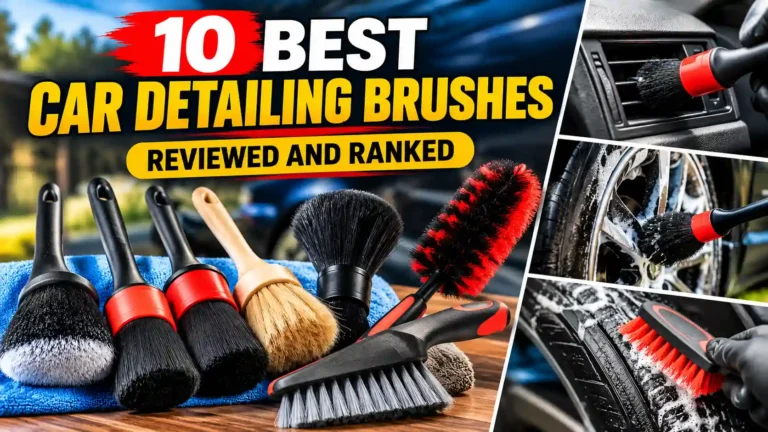
The best car detailing brushes help clean areas a wash mitt or folded towel cannot reach easily. The right brush for dusty dashboard seams is different from the one you need for tire rubber, wheel barrels, or textured upholstery. Choosing the correct bristles and shape matters more than buying the largest set.
For light cleaning around suitable scratch-prone interior trim, the Detail Factory TriGrip Ultra-Soft set is a strong starting choice. For more demanding agitation on durable surfaces, a dedicated boar-hair brush can fit the job. Tire, wheel, and upholstery brushes should have their own assignments rather than moving between every surface on the car.
This 2026 guide ranks ten verified brush products by documented construction, intended use, reach, and handling. These are research-based editorial reviews, not our own hands-on scratch, cleaning-speed, or durability tests. Each review includes features, pros, cons, and a clear buying decision.
Best Car Detailing Brushes: Quick Comparison Table
Use this detailing brush comparison to choose the surfaces you need to clean before comparing individual tools. A small set of correctly assigned brushes is more useful than one multipurpose brush carrying contamination around the car.
This article contains affiliate links. If you buy through them, we may earn a commission at no extra cost to you.
| # | Product | Best For / Category | Amazon |
|---|---|---|---|
| 1 | Detail Factory TriGrip Ultra-Soft Brush Set, Octane Ectoplasm | Best light-duty interior starting set | Check Price on Amazon |
| 2 | Detail Factory Boar Hair Short- and Long-Handle Combo | Best firmer two-handle option | Check Price on Amazon |
| 3 | Chemical Guys Boar’s Hair Detailing Brush | Best single round brush for assigned crevice work | Check Price on Amazon |
| 4 | Detail Dudes Three-Piece Detailing Brush Set | Best compact set for task separation | Check Price on Amazon |
| 5 | Mothers Detail Brushes, Two-Pack | Best narrow brush with a seam-cleaning tip | Check Price on Amazon |
| 6 | WORK STUFF Albino Detailing Brush, 30 mm | Best single soft synthetic alternative | Check Price on Amazon |
| 7 | Detail Factory Curveball XL, Gray | Best broad ultra-soft brush format | Check Price on Amazon |
| 8 | GYEON Q²M TireBrush | Best dedicated tire-rubber brush | Check Price on Amazon |
| 9 | Little EZ Detail Brush | Best narrow wheel-access brush | Check Price on Amazon |
| 10 | SONAX Textile & Leather Brush | Best dedicated upholstery and smooth-leather option | Check Price on Amazon |
10 Best Car Detailing Brushes Reviewed
These car detailing brush reviews explain what each tool adds to a kit and where its limitations affect the purchase. Use the Best for line to identify the appropriate task, then compare the handling and construction details.
1. Detail Factory TriGrip Ultra-Soft Set: Best Light-Duty Interior Starting Set
Best for: Gentle cleaning around compatible interior trim and other supported scratch-prone areas.
The TriGrip Ultra-Soft set is a strong starting point for owners whose main problem is light dust and dirt in delicate interior details. Detail Factory specifically positions these soft synthetic brushes for light-duty work, including suitable scratch-prone trim.
The triangular rubberized grip and balanced handle are useful handling details when making short, controlled movements. Metal-free construction reduces one contact risk, although the handle still should not be pressed against the finish. The linked variant is Octane Ectoplasm.
Use the set for a defined gentle-cleaning role. It is not the first purchase for scrubbing tire rubber or baked-on exterior grime. Check screen and trim care instructions even when a listing describes broad interior compatibility.
Key Features
- Ultra-soft synthetic bristles for light-duty work.
- Rubberized triangular grip area.
- Metal-free construction and chemical-resistant handle.
- Verified TriGrip set in the Octane Ectoplasm variant.
Pros
- A useful first set for controlled interior detail work.
- Grip design supports careful handling.
- Clearly distinct from a stiff tire or heavy-agitation brush.
Cons
- Limited agitation for more demanding contamination.
- Soft bristles can still carry grit.
- Sensitive screens and coatings need their own care approval.
Buying Decision
Choose TriGrip Ultra-Soft when gentle interior detailing is the main job. Add a separate firmer brush only where needed. If you mainly want broad surface coverage rather than precise crevice access, compare the Curveball XL.
2. Detail Factory Boar Hair Combo: Best Firmer Two-Handle Option
Best for: Supported durable surfaces needing more agitation and a choice of reach.
This combo provides short- and long-handle boar-hair brushes. The natural bristles are positioned for tougher work than Detail Factory’s Ultra-Soft range, making the set relevant to compatible exterior details and other durable areas.
Different handle lengths let you choose closer control or additional reach. The metal-free construction and non-slip grip are practical features, but they do not make every surface suitable for firm brushing. Keep contact controlled and use a compatible cleaner.
Assign the brushes before the first dirty job. A tool used around wheels or greasy exterior components should stay out of the cabin. That separation is more useful than buying a combo and using both brushes interchangeably everywhere.
Key Features
- Boar-hair bristles for firmer agitation.
- Short- and long-handle combo.
- Metal-free construction.
- Textured grip and chemical-resistant plastic construction.
Pros
- Two reach options within one product listing.
- Useful complement to an ultra-soft brush.
- Appropriate candidate for supported durable exterior details.
Cons
- Not the default choice for piano-black trim or delicate displays.
- Two brushes still need clear task assignments.
- Heavy contamination requires suitable cleaner and residue removal.
Buying Decision
Choose this combo when you need firmer detail brushes and will use both handle formats. Choose the Ultra-Soft set for delicate light-duty tasks. Keep separate tools for wheel contamination and interior cleaning.
3. Chemical Guys Boar’s Hair Brush: Best Single Round Crevice Brush
Best for: Buyers who need one round brush for a specific approved interior or exterior assignment.
The Chemical Guys Boar’s Hair Detailing Brush is a straightforward single-tool purchase for crevices, grilles, and other supported details. It is useful when you know the task and do not need another large kit.
Its plastic handle and ferrule avoid an exposed metal band around the bristles. The listing identifies compatible cleaner-assisted and dry-cleaning applications, but choose the method according to the surface. Broad marketing is not a reason to scrub every glossy or coated panel.
Buy it for one zone and keep it there. If you intend to clean both exterior recesses and interior controls, purchase or assign separate brushes. A single brush is convenient only when it does not create contamination transfer.
Key Features
- Single round boar-hair detailing brush.
- Plastic handle and ferrule.
- Manufacturer identifies crevice and detail-cleaning applications.
- Can be paired with an appropriate cleaner for supported work.
Pros
- Simple purchase when one assigned brush is enough.
- Round head reaches around small details.
- Avoids buying unused tools in a large set.
Cons
- One brush cannot remain dedicated to several dirty zones simultaneously.
- Not a universal soft-brush solution for delicate finishes.
- Does not replace wiping or rinsing away loosened residue.
Buying Decision
Choose this brush when you have one clear cleaning assignment. Choose a multi-brush set if genuine task separation is the missing part of your kit. For especially delicate light-duty work, compare an ultra-soft synthetic option.
4. Detail Dudes Three-Piece Set: Best Compact Set for Task Separation
Best for: Owners who want a few assigned brushes for different compatible cleaning zones.
The Detail Dudes three-piece set gives you multiple round boar-hair brushes in one listing. Its practical value is the opportunity to separate duties instead of moving one contaminated brush between the wheels and cabin.
The listing identifies metal-free handles and bristles suitable for supported wet or dry detailing. Bristle softness changes with the product and use conditions; do not accept a blanket claim that all boar hair is softer than every synthetic brush.
Label or store the brushes by assignment. Keep the interior brush clean, use an exterior brush only on approved durable details, and isolate wheel-related work. If your main task is delicate display cleaning, a dedicated ultra-soft brush is the more focused purchase.
Key Features
- Three-piece boar-hair detailing-brush set.
- Metal-free handle design.
- Listing identifies wet and dry cleaning roles.
- Multiple tools allow separate task assignments.
Pros
- Useful foundation for a small organized kit.
- Reduces the need to share one brush across dirty zones.
- Round brush format suits accessible crevices.
Cons
- Quantity does not establish suitability for every surface.
- Brushes still need labeling and separate storage.
- Not a substitute for specialized tire, wheel-barrel, or ultra-soft tools.
Buying Decision
Choose the three-piece set if task separation is the main benefit you need. Assign each brush before use. Choose one specialized tool instead when a single difficult surface, such as tire rubber or upholstery, defines the job.
5. Mothers Detail Brushes: Best Narrow Brush with a Seam-Cleaning Tip
Best for: Approved narrow trim details and accessible seams where a small brush is easier to control.
Mothers Detail Brushes use a slim format with soft bristles and a rubber seam-cleaning tip. The two-pack makes sense when small detail access matters more than the large round heads found in many kits.
The manufacturer identifies trim and emblems among the intended tasks. The rubber tip is a useful second working end, but it still requires controlled pressure and material compatibility. Do not force it under seals, against delicate edges, or into areas that should not be disturbed.
This is a focused accessory rather than a complete interior brush set. Keep one brush for a defined clean task and the other for a separate compatible zone. The small head can be slow on broad panels, where a different format is more useful.
Key Features
- Two detail brushes in the linked listing.
- Slim cleaning format with soft bristles.
- Rubber seam-cleaning tip.
- Non-slip grip.
Pros
- Useful access around smaller details.
- Two working ends offer different contact shapes.
- Pair allows separate task assignments.
Cons
- Small head is inefficient on larger surfaces.
- Rubber tip can cause damage if forced into unsuitable areas.
- Not a tire-scrubbing or wheel-barrel tool.
Buying Decision
Choose Mothers when narrow detail access is the missing capability in your kit. Buy a round or broader brush for larger areas. Use the rubber tip only where its contact and pressure are appropriate.
6. WORK STUFF Albino 30 mm: Best Single Soft Synthetic Alternative
Best for: Buyers who want one soft synthetic brush for a defined compatible interior or light exterior task.
WORK STUFF Albino uses soft synthetic bristles and is positioned for gentle interior and light exterior detailing. The linked product is the 30 mm version, giving you a specific brush size rather than an unspecified mixed set.
The manufacturer emphasizes short, controlled movements and avoiding unnecessary pressure. That makes the brush a useful candidate when control matters more than scrubbing force. Check the cleaner and finish instructions before using it on a sensitive area.
A single brush can be easier to add to an established kit than another assortment. Its limitation is the same: once used on a dirtier exterior zone, it should not automatically become your clean interior tool. Choose its permanent role before the first use.
Key Features
- Soft synthetic Albino bristles.
- Verified 30 mm listing.
- Manufacturer identifies interior and light exterior applications.
- Handle intended for controlled detail work.
Pros
- Specific size helps make a deliberate purchase.
- Useful alternative to a boar-hair round brush.
- Fits a kit that needs one additional dedicated tool.
Cons
- Light-duty role limits tougher agitation.
- Still requires separate assignment and maintenance.
- Delicate finishes need compatibility checks despite soft bristles.
Buying Decision
Choose Albino 30 mm if you want one soft synthetic brush and its head size suits the task. Choose TriGrip if you prefer that grip format and a set. Choose a dedicated stiffer tool when rubber scrubbing is the actual requirement.
7. Detail Factory Curveball XL: Best Broad Ultra-Soft Brush Format
Best for: Supported larger interior or exterior areas where a narrow detail brush would be slow.
The Curveball XL pairs ultra-soft synthetic bristles with a larger brush format and full-hand grip. It addresses coverage rather than narrow access, making it a different purchase from another small round brush.
The gray listing includes a storage holder. That is useful for an organized drying and storage routine, provided the brush is cleaned and allowed to dry appropriately. A holder does not make wet or dirty bristles ready for the next delicate surface.
Choose it where the surface and cleaner support a broader soft-brush contact area. It will not reach every small recess, and light-duty bristles are not a replacement for a dedicated tire brush. Add it to solve a coverage problem rather than expecting one large head to handle the entire car.
Key Features
- Large-area ultra-soft synthetic brush.
- Full-hand ergonomic grip.
- Gray variant with a storage holder.
- Manufacturer identifies suitable interior and exterior use.
Pros
- Broad format reduces reliance on tiny brushes for larger areas.
- Full-hand grip offers a different handling style.
- Included holder supports organized storage.
Cons
- Large head is less useful in tight crevices.
- Ultra-soft bristles provide limited heavy-duty agitation.
- Requires the same cleanliness and surface checks as smaller brushes.
Buying Decision
Choose Curveball XL when larger compatible surfaces are the task your small brushes handle poorly. Keep a narrow brush for details. Choose a dedicated scrubbing tool if dirt removal requires more force than a soft brush should provide.
8. GYEON Q²M TireBrush: Best Dedicated Tire-Rubber Brush
Best for: Cleaning suitable tire rubber with an approved tire cleaner.
GYEON TireBrush uses stiff synthetic bristles for tire and rubber cleaning. That is its buying advantage and its main boundary: it is a rubber-cleaning tool, not an interior trim brush or a brush for the wheel’s painted face.
The chemical-resistant handle supports the intended cleaner-assisted workflow. Work on appropriate cool surfaces, keep contact on the tire, and follow the cleaner’s dwell and rinsing instructions. The brush agitates contamination; rinsing or other required removal finishes the cleaning stage.
Buy it as a separate tire tool and store it away from interior brushes. Stiffness is useful for its intended job, but using the same bristles on an adjacent wheel finish can turn a sensible purchase into a surface-care mistake.
Key Features
- Stiff synthetic bristles for tire rubber.
- Chemical-resistant handle.
- Dedicated tire-cleaning role.
- Grip designed for controlled handling during wet work.
Pros
- Adds a capability an ultra-soft detail brush lacks.
- Clearly defined tire assignment simplifies tool separation.
- Suitable candidate for an approved tire-cleaner routine.
Cons
- Not for paint, glossy trim, or wheel finishes.
- Does not remove the need to rinse away loosened residue.
- Bristle contact must stay within the supported rubber area.
Buying Decision
Choose TireBrush when tire rubber is the actual cleaning job. Add a separate wheel brush for the rims. Do not buy this tool as a universal exterior brush simply because the tire and wheel sit next to each other.
9. Little EZ Detail Brush: Best Narrow Wheel-Access Brush
Best for: Suitable wheel openings and tight exterior areas where a narrow cylindrical brush can reach safely.
The Little EZ Detail Brush uses nylon and Nylex bristles around a flexible vinyl-coated stem. Its narrow cylindrical layout helps reach areas that a short round detail brush cannot access easily.
Fit is the deciding factor. Check the actual wheel opening and clearance rather than forcing the head between a caliper and rim. Keep the protective stem coating and tip in good condition, and follow wheel and cleaner compatibility instructions.
Pull the brush out carefully to control spray-back. This tool will pick up wheel contamination and should remain dedicated to that role. It is not a substitute for a tire brush or an ultra-soft cabin brush.
Key Features
- Narrow cylindrical wheel-access format.
- Nylon and Nylex bristles.
- Flexible vinyl-coated stem.
- Intended for accessible tight exterior details and wheel-related work.
Pros
- Reaches areas small handheld round brushes may miss.
- Flexible stem supports access around suitable shapes.
- Useful addition for an appropriate wheel design.
Cons
- Fit depends on actual wheel and caliper clearance.
- Stem coating and tip need inspection for damage.
- Withdrawal can splash cleaner and dirty water.
Buying Decision
Choose Little EZ Detail if its format fits your wheel openings without force. Choose a smaller or different tool where clearance is tight. Keep it wheel-dedicated and replace it if protective contact surfaces become damaged.
10. SONAX Textile & Leather Brush: Best Upholstery-Focused Option
Best for: Approved textile and smooth-leather cleaning with a compatible product and gentle method.
SONAX Textile & Leather Brush is a dedicated interior tool for supported upholstery and smooth-leather work. Its brush face and shaped handle provide a different cleaning contact from a small round detail brush.
The manufacturer calls for a compatibility check in an inconspicuous area and controlled use with suitable cleaning products. Work within the upholstery maker’s care instructions, then remove loosened dirt and cleaner with the approved cloth method.
Do not assume every seat insert, leather finish, or suede-like material accepts the same agitation. If the surface is worn or its identity is uncertain, assess it before brushing. Keep this tool separate from tires, wheels, and greasy exterior parts.
Key Features
- Dedicated textile and smooth-leather cleaning role.
- Shaped handle for controlled contact.
- Supports approved wet or dry textile care.
- Manufacturer specifies material-compatibility checking.
Pros
- More focused upholstery purchase than another narrow round brush.
- Can work with an approved cleaning system.
- Encourages a separate interior-fabric tool assignment.
Cons
- Not universal approval for every upholstery or leather finish.
- Cleaner residue still needs appropriate removal.
- Excessive agitation can affect delicate or worn surfaces.
Buying Decision
Choose the SONAX brush for an approved upholstery or smooth-leather process. Confirm the material before purchase and use. Choose a smaller detail brush when access around trim, rather than seat-surface agitation, is the real problem.
Car Detailing Brush Buying Guide: Bristles, Reach, and Surface Safety
The best detailing brush purchase matches cleaning intensity, access, and surface compatibility. These checks help you build a useful kit without paying for tools that repeat the same role.
Match bristles to the finish
Choose an ultra-soft brush for approved light-duty sensitive areas and a firmer brush only where the substrate tolerates it. Natural and synthetic bristles cover many different constructions; one material label is not a complete softness specification.
Read the product’s intended use, inspect the actual brush, and test appropriately. If the bristles need heavy pressure to work, a better cleaner or a different approved tool may be the answer.
Choose head size for the actual opening
A narrow detail brush suits seams and small recesses. A broad soft brush suits larger supported areas. A cylindrical wheel brush needs enough clearance to enter and withdraw without forcing its core or tip against the finish.
Do not buy by length alone. Handle clearance, head width, and your ability to control contact all affect whether the brush fits the job.
Inspect ferrules, cores, and handles
Metal-free construction reduces one potential contact source, but plastic edges can still mark a surface. Coated wire stems need an intact coating and protected tip. Check these areas before use, especially after a tool has been bent or heavily used.
Replace a tool with exposed, sharp, or damaged contact points. A brush that was suitable when new can become unsuitable through wear.
Separate interior, exterior, tires, and wheels
Assign tools by contamination level and surface. Label handles or store them separately. A brush used for brake dust should not become a leather-cleaning brush simply because both applications appear on a broad product list.
Separate assignments also make kit size more meaningful. Three clearly assigned brushes can be more useful than ten tools shared randomly between every task.
Match the cleaner and moisture to the surface
Brush compatibility does not establish chemical compatibility. Use the correct cleaner and dilution, and follow the surface maker’s moisture limits. Avoid flooding switches, screen edges, vents, and other areas where liquid can travel into equipment.
Remove loosened dirt through the required wiping, vacuuming, or rinsing process. Brushing alone may only redistribute it.
How to Use and Maintain Car Detailing Brushes
Proper brush technique limits unnecessary pressure and keeps contamination from returning to the surface. Follow the brush, cleaner, and material instructions together rather than treating the brush as a complete cleaning system.
Inspect and prepare before contact
Check the bristles, handle, ferrule, and any protective core. Remove grit and confirm that the tool belongs to the correct cleaning zone. Work on cool exterior surfaces where required by the cleaner.
Use controlled agitation
Apply the approved cleaner and make gentle, manageable movements. Do not scrub sensitive surfaces because the brush is advertised as scratch-free. Increase cleaning intensity only through an approved method and a reasoned assessment.
Remove dirt and cleaner residue
Wipe, extract, vacuum, or rinse according to the process. Use fresh cloth faces so dirt leaves the surface instead of returning to it. Avoid blowing or pushing debris deeper into vents and switches.
Rinse, dry, and store by assignment
Clean the brush under its care instructions, rinse away chemical residue where required, and allow suitable drying before storage. Do not leave natural bristles or wooden handles soaking without approval. Keep wheel and interior tools separate even after cleaning.
conclusion
Start with Detail Factory TriGrip Ultra-Soft or WORK STUFF Albino when gentle detail work is your priority. Add a firmer Detail Factory boar-hair combo or a single Chemical Guys brush for supported tasks that need more agitation. Detail Dudes offers a compact set for separate assignments, while Mothers adds narrow access and a seam tip.
Choose Curveball XL for broad soft-brush coverage, GYEON TireBrush for tire rubber, Little EZ Detail for suitable wheel openings, and SONAX for an approved upholstery-cleaning process.
The best car detailing brushes of 2026 form a small, purposeful kit. Buy for the surfaces you actually clean, keep the tools separated, and use controlled pressure rather than relying on a scratch-free claim.
FAQs
These detailing brush FAQs address softness, surface compatibility, and maintenance. Use them to narrow the purchase, then check the exact surface and product instructions before cleaning.
Were these car detailing brushes hands-on tested?
No, this guide uses research-based reviews and editorial rankings. We compared documented construction, intended applications, handling, and verified listings. We have not performed controlled scratch or durability testing.
What is the best detailing brush for car interiors?
An ultra-soft synthetic brush is a useful starting choice for compatible light-duty details. The TriGrip set and WORK STUFF Albino fill that role here. Upholstery, heavy grime, and sensitive screens can require different approved tools or methods.
Are boar-hair brushes softer than synthetic brushes?
Not universally. Softness varies by bristle specification, construction, and use conditions. Compare the exact brush and intended task rather than assuming one material is always gentler.
Can a soft detailing brush scratch paint?
Yes, contaminated bristles, excessive pressure, or hard parts contacting the finish can cause damage. Keep the tool clean and use it only where the finish and process permit. A scratch-free marketing claim does not remove those risks.
Can I use the same brush for wheels and the dashboard?
Keep separate brushes for those tasks. Wheel contamination should not be transferred into the cabin. Task separation is one of the most useful reasons to buy more than one brush.
Can I use a tire brush on wheel rims?
Do not assume it is suitable. The GYEON TireBrush reviewed here is selected for rubber, not wheel finishes. Use a wheel-compatible tool for the rim and keep stiff tire bristles away from it.
Should I use detailing brushes wet or dry?
Use the method approved for the brush, contamination, and surface. Light dusting and cleaner-assisted agitation are different processes. Do not flood sensitive interior equipment or drag dry grit across a delicate finish.
How should I clean detailing brushes after use?
Follow the manufacturer’s care instructions and remove dirt and cleaner residue. Allow the brush to dry appropriately before storage. Replace it when bristles or protective contact parts become damaged.
Can I clean an infotainment screen with a detailing brush?
Only if the screen’s care instructions and the tool’s application support that method. Use very controlled contact and avoid liquid entering edges or controls. When the surface guidance specifies a cloth instead, follow that method.