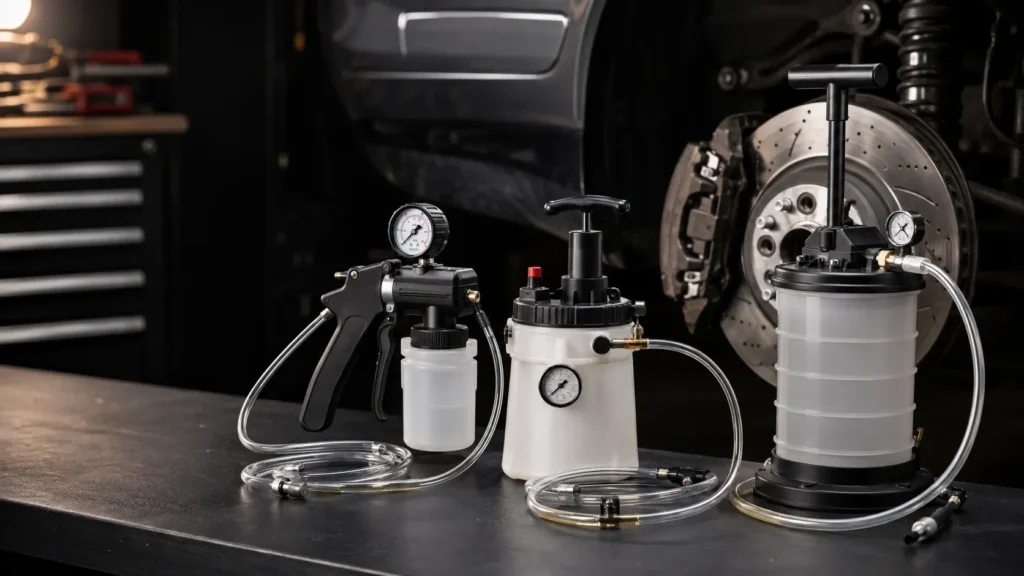
The best DIY brake bleeder kit lets you flush or bleed your brakes alone, without needing a second person at the pedal, using either a vacuum pump that pulls fluid through the lines or a pressure system that pushes it. Vacuum kits are generally gentler on ABS modules, while pressure-based kits push fluid through faster and handle tight European bleeder screws more effectively.
This guide covers the difference between vacuum and pressure bleeding, our top picks across price points and use cases, and how to choose the right type for your specific vehicle.
Before using any of these kits, our guide on how to bleed your car’s brakes walks through the correct wheel order and full bleeding procedure.
Quick Comparison: Best Brake Bleeder Kits at a Glance
These three brake bleeder kits cover different DIY needs, from a versatile professional-grade tool to dedicated pressure and high-capacity vacuum systems. The table below compares their bleeding method, primary use case, and overall positioning so you can quickly identify which kit best fits your brake service needs.
Here’s how our top brake bleeder kits compare at a glance:
| Rank | Product | Best For | Method | Buy Link |
|---|---|---|---|---|
| 1 | Mityvac MV8500 Silverline Elite | Best overall, professional-grade | Vacuum/pressure combo | Check Price |
| 2 | Motive Products 0100 | Best for European vehicles | Pressure | Check Price |
| 3 | FOUR UNCLES 3L Kit | Best for large-capacity one-person use | Vacuum | Check Price |
Our Top Brake Bleeder Kit Picks
We selected these brake bleeder kits based on their bleeding method, versatility, capacity, vehicle compatibility, and suitability for DIY brake service. Each option serves a different type of home mechanic, from occasional brake work to more frequent maintenance.
1. Mityvac MV8500 Silverline Elite
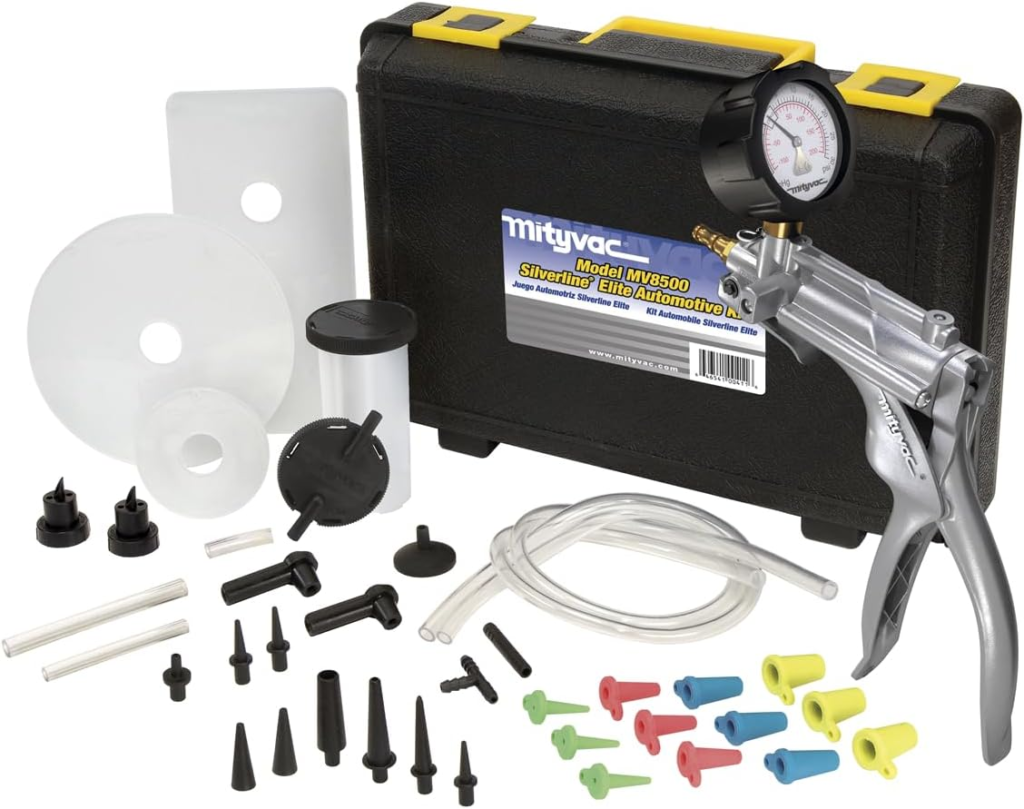
The Mityvac MV8500 Silverline Elite is a versatile vacuum and pressure testing tool for serious DIY mechanics.
It combines brake bleeding capability with broader automotive diagnostic functions.
Its durable construction makes it a strong choice for repeated garage use.
Pros
- Combines vacuum and pressure testing
- Durable zinc-aluminum construction
- Useful for multiple automotive applications
Cons
- More expensive than basic vacuum bleeders
- May offer more functionality than occasional users need
- Smaller reservoir requires monitoring
Review:
The Mityvac MV8500 stands out as the most versatile option in this lineup because it can handle both vacuum and pressure testing. For brake bleeding, it provides controlled suction while also being useful for other automotive diagnostic jobs. That added versatility makes it a better long-term investment for DIY mechanics who regularly work on their vehicles. If you only bleed brakes occasionally, however, a simpler kit may provide better value.
2. Motive Products 0100
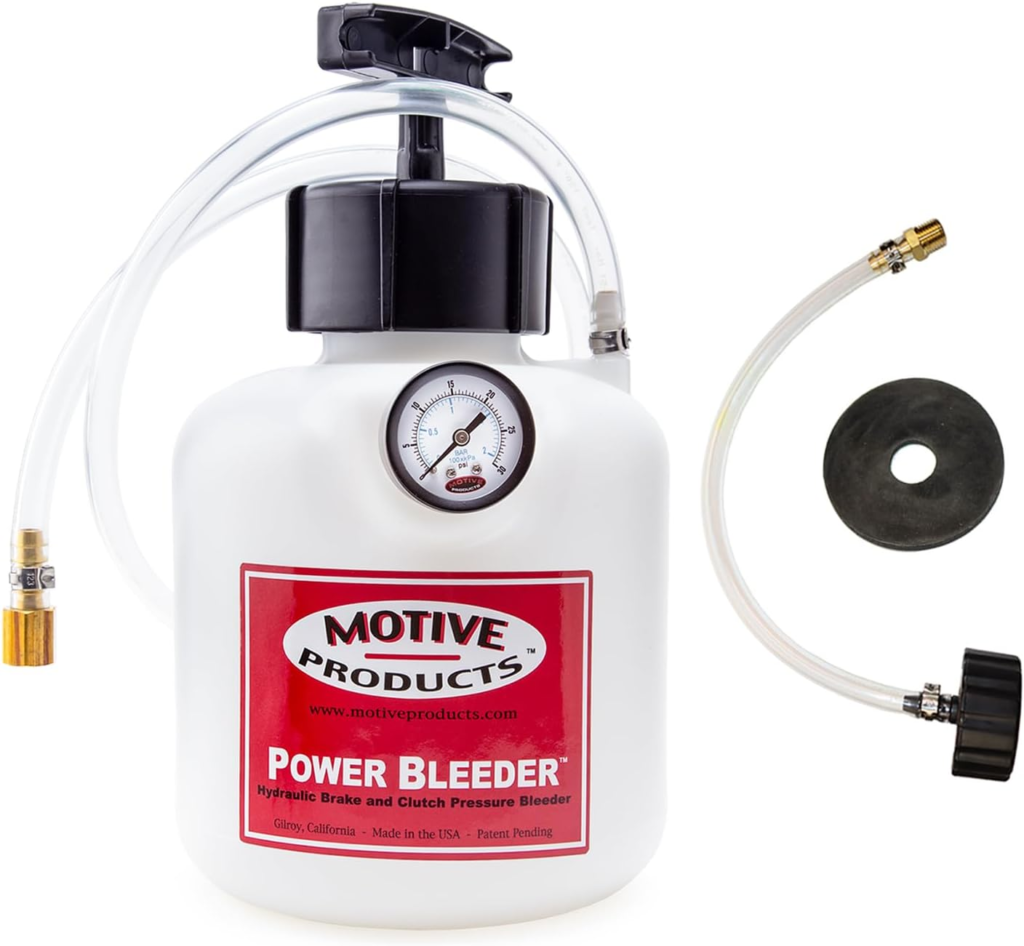
The Motive Products 0100 is a dedicated pressure brake bleeder designed for compatible European vehicles.
Its pressure-based system pushes fresh fluid through the brake system for efficient one-person bleeding.
It is particularly suited to DIY mechanics who frequently service European cars.
Pros
- Efficient pressure-based bleeding
- Designed for various European applications
- Convenient for one-person brake service
Cons
- Requires the correct reservoir adapter
- More expensive than basic vacuum kits
- Pressure must be controlled correctly
Review:
The Motive Products 0100 is a strong choice when pressure bleeding is your preferred method, particularly for compatible European vehicles. Its design eliminates the need for a second person to operate the brake pedal while you work at the bleeder screws. The pressure system can also make fluid changes efficient and consistent. Before purchasing, verify that the included adapter fits your vehicle’s master-cylinder reservoir.
3. FOUR UNCLES 3L Brake Bleeder Kit
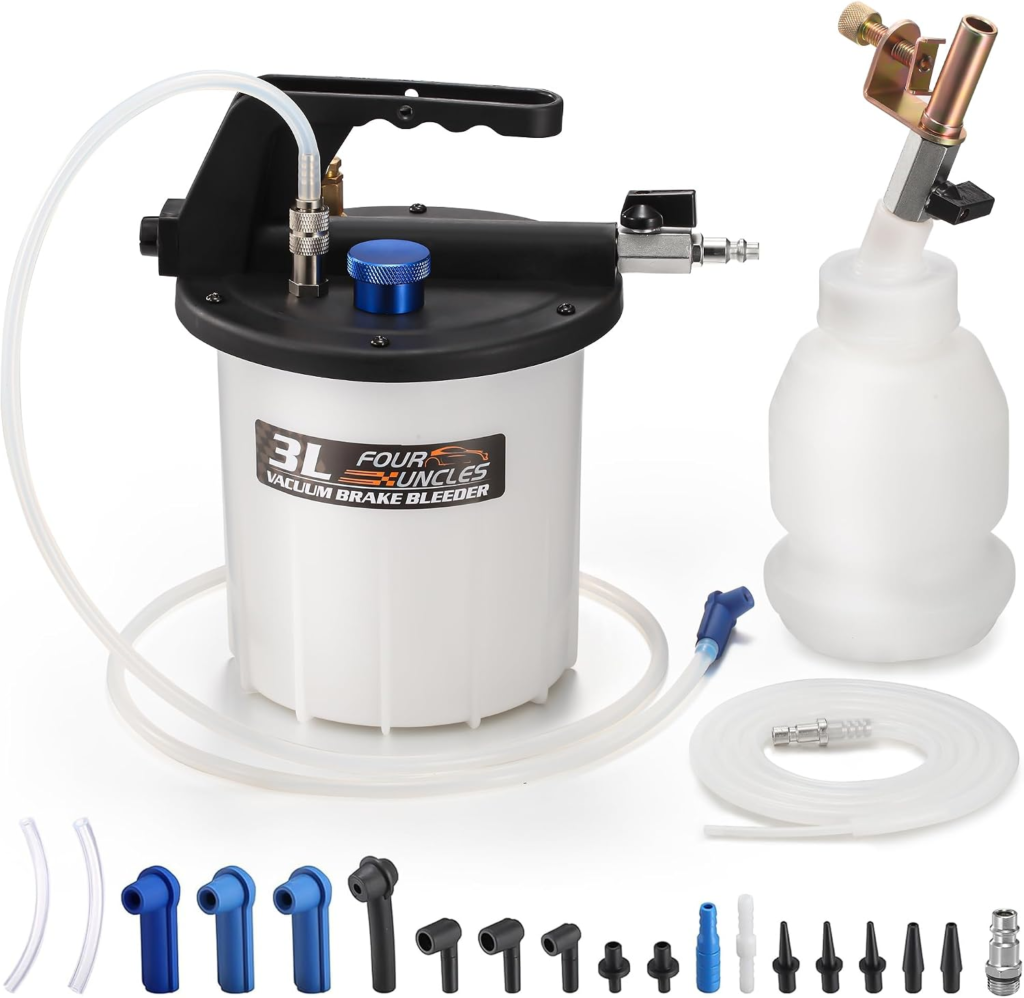
The FOUR UNCLES 3L kit is designed for DIY mechanics who want a high-capacity solution for complete brake fluid changes.
Its large collection reservoir provides plenty of capacity for longer brake bleeding jobs.
The included refill bottle and multiple adapters make it convenient for one-person use.
Pros
- Large 3-liter collection reservoir
- Includes 1-liter refill bottle
- Comes with 18 adapters
Cons
- Primarily focused on brake service
- Adapter compatibility should be checked
- Larger setup may be unnecessary for occasional use
Review:
The FOUR UNCLES kit is a practical choice for drivers who prefer to complete a full brake flush in one session. Its 3-liter collection capacity reduces the need to stop and empty the container, while the refill bottle helps maintain the master-cylinder fluid level during bleeding. The 18 included adapters also give it broad application potential. For occasional DIY brake work, its larger capacity may be more than necessary, but it makes sense for full-system flushes.
Vacuum vs. Pressure Bleeding: Which Method Should You Choose?
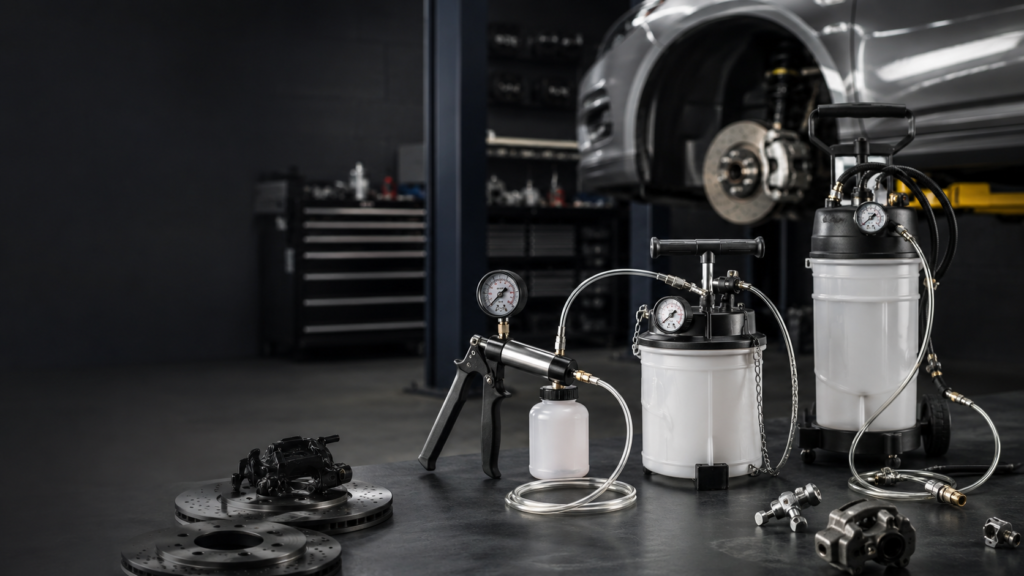
Vacuum and pressure bleeders both let you bleed brakes without a second person, but they move fluid in opposite directions. Vacuum kits pull fluid through the bleeder screw, while pressure kits push fresh fluid through the system from the master cylinder.
The table below highlights the key differences to help you choose the right method for your vehicle and DIY needs.
| Feature | Vacuum Bleeding | Pressure Bleeding |
|---|---|---|
| How it works | Pulls brake fluid and air out through the bleeder screw | Pushes brake fluid from the master cylinder through the brake lines |
| Best for | DIY users and occasional brake bleeding | Faster bleeding and frequent brake service |
| ABS systems | Generally gentle and suitable for many ABS-equipped vehicles | Works well when used at the correct pressure |
| Stubborn bleeder screws | May struggle with restrictive or partially seized fittings | Often handles tight fittings more effectively |
| Main advantage | Simple, affordable, and easy for one-person use | Faster fluid movement and efficient flushing |
| Potential drawback | Can draw small air bubbles around the bleeder screw threads | Requires correct pressure and a secure reservoir adapter |
| Ideal choice | Budget-conscious home mechanics | Enthusiasts and mechanics who want faster bleeding |
Does a Vacuum Bleeder Work on ABS-Equipped Vehicles?
Yes, vacuum bleeders generally work well on ABS-equipped vehicles since the gentle suction method doesn’t risk forcing air or fluid backward into the ABS module the way an improperly used pressure system theoretically could. Most kits marketed for one-person use, including several picks above, specifically note ABS compatibility as part of their adapter selection.
That said, some ABS systems with trapped air deep in the modulator require a scan tool-driven ABS bleed procedure that goes beyond what a standard vacuum or pressure kit alone can achieve. Checking your vehicle’s specific service manual for any special ABS bleeding requirement before relying solely on a standard kit avoids an incomplete bleed in these specific cases.
How Much Should You Expect to Spend on a Brake Bleeder Kit?
Budget-friendly vacuum kits with a hand pump and basic gauge typically start around $30 to $50, sufficient for occasional home use on standard, non-European vehicles. Mid-range kits with larger reservoirs and broader adapter selections, like the FOUR UNCLES options, generally run $40 to $80.
Premium professional-grade tools like the Mityvac MV8500 or dedicated pressure systems like the Motive Products 0100 typically cost $100 to $150, reflecting their broader functionality and more durable construction. For a driver who only bleeds brakes occasionally, a mid-range vacuum kit usually provides the best balance of capability and cost.
What Mistakes Should You Avoid When Using a Brake Bleeder Kit?
A few common mistakes account for most frustrating or incomplete bleeding results with these kits.
- Letting the master cylinder reservoir run dry – whether using vacuum or pressure, running the reservoir empty mid-bleed draws new air back into the system, undoing your progress.
- Over-tightening bleeder screws when reinstalling – this can strip threads or damage the screw, leading to a leak that’s more expensive to fix than the bleed itself.
- Skipping the correct wheel order – bleeding out of sequence, rather than starting with the wheel farthest from the master cylinder, can leave air trapped even after a thorough effort.
- Ignoring air bubbles introduced by the tool itself – some vacuum bleeders draw tiny bubbles in around the valve threads during suction, which is a normal quirk rather than a sign of a failed bleed; watching for a steady fluid stream rather than isolated bubbles avoids misdiagnosing a successful bleed as incomplete.
Avoiding these specific mistakes, more than the choice between vacuum and pressure methods, is usually what separates a clean, successful bleed from a frustrating repeat attempt.
Conclusion
Choosing the best DIY brake bleeder kit comes down to your vehicle, bleeding method, and how often you perform brake maintenance. Vacuum bleeders are simple, affordable, and convenient for one-person brake jobs, while pressure bleeders can provide faster and more consistent fluid movement. The Mityvac MV8500 is the most versatile option for serious DIY mechanics, the Motive Products 0100 is a strong choice for compatible European vehicles, and the FOUR UNCLES 3L kit offers useful capacity for complete brake fluid flushes. Before buying, always verify adapter compatibility and follow your vehicle manufacturer’s recommended bleeding procedure. A properly selected brake bleeder can make routine brake fluid maintenance easier, cleaner, and more manageable at home.
Frequently Asked Questions
What is the best DIY brake bleeder kit?
The Mityvac MV8500 Silverline Elite is a strong overall choice for DIY mechanics because it combines vacuum and pressure testing in one tool. For European vehicles, the Motive Products 0100 offers a dedicated pressure-bleeding solution, while the FOUR UNCLES 3L kit is useful for high-capacity brake fluid flushing.
Is a vacuum or pressure brake bleeder better?
Neither method is universally better. Vacuum bleeders are generally simpler and convenient for occasional one-person brake bleeding, while pressure bleeders can move fluid more efficiently and provide a controlled way to flush the system. The better choice depends on your vehicle and preferred bleeding method.
Can you bleed ABS brakes with a vacuum bleeder?
In many vehicles, a vacuum bleeder can be used for routine brake bleeding on ABS-equipped systems. However, some vehicles require a specific ABS bleeding procedure or scan-tool activation when air has entered the ABS hydraulic control unit. Always check the vehicle manufacturer’s service instructions before bleeding an ABS system.
Can one person bleed brakes with a brake bleeder kit?
Yes. Vacuum and pressure brake bleeder kits are designed to make one-person brake bleeding possible. A vacuum kit pulls fluid through the bleeder screw, while a pressure kit pushes fluid through the brake system from the master-cylinder reservoir.
What pressure should I use with a pressure brake bleeder?
The correct pressure depends on the specific brake bleeder, vehicle, and manufacturer’s instructions. Do not assume that a single pressure setting is safe for every vehicle. Always follow the pressure limit specified by the bleeder-kit manufacturer and the vehicle’s service documentation.
How often should brake fluid be changed?
Brake fluid replacement intervals vary by vehicle manufacturer, brake-fluid type, driving conditions, and climate. Instead of applying one universal interval to every car, check your owner’s manual or factory service schedule for the recommended replacement interval.
Why does my brake bleeder keep showing air bubbles?
Small bubbles can sometimes appear around the bleeder screw threads when using a vacuum bleeder. This does not necessarily mean there is still air inside the brake system. Check the hose connection, bleeder screw, and collection setup, and follow the manufacturer’s recommended bleeding procedure.
Do brake bleeder kits work on all cars?
No single brake bleeder kit fits every vehicle. Master-cylinder reservoir adapters and bleeder fittings can vary between makes and models. Check the kit’s adapter compatibility with your specific vehicle before purchasing, particularly when choosing a pressure bleeder.