The best OBD2 scanner for home diagnostics helps you read and clear trouble codes, monitor live engine data, and, on more advanced models, perform bidirectional tests and service resets without visiting a repair shop just to identify a problem. For most DIYers, the right scanner depends on the type of work you plan to do, from checking a check-engine light to testing components, accessing ABS or airbag systems, or completing common maintenance resets. Basic code readers are affordable and simple, while full-system bidirectional scanners provide much deeper diagnostic control. Bluetooth adapters can also turn your phone into a capable diagnostic display, while standalone scanners offer a dedicated, no-phone-needed experience.
In this guide: we compare five of the best OBD2 scanners for home use, covering different budgets, features, and skill levels. You’ll also learn which features matter most and how to choose a scanner that fits your vehicle and DIY repair needs.
What Should You Look for in an OBD2 Scanner?
A handful of features separate a genuinely useful scanner from one that only reads basic codes.
- Live data streaming – shows real-time parameters like engine RPM, coolant temperature, and fuel system status, which helps you diagnose intermittent issues that a stored code alone won’t explain.
- Bidirectional capability – lets the scanner send commands to the vehicle’s computer, not just read from it, enabling tests like activating the AC compressor or cycling a solenoid to confirm a component is working.
- System coverage – basic scanners only read engine codes, while full-system scanners also cover ABS, airbag, transmission, and other modules.
- Service resets – features like oil life reset, electronic parking brake reset, and steering angle sensor calibration, useful after common DIY maintenance jobs.
- Vehicle coverage and updates – confirm the scanner supports your specific make and model, and check whether software updates are free or require a subscription.
Matching the scanner’s capability to what you actually plan to do with it, rather than buying the most expensive option available, gets you the most practical value for home diagnostics.
Quick Comparison: Best OBD2 Scanners at a Glance
The table below makes it easy to compare the top OBD2 scanners by their intended use, key diagnostic capabilities, and overall value. Use it to quickly narrow down which scanner best matches your vehicle and DIY diagnostic needs.
Compare the options below to find the right OBD2 scanner for your home garage.
| Rank | Product | Best For | Key Capability | Buy Link |
|---|---|---|---|---|
| 1 | TOPDON TopScan Lite | Best overall for DIYers | Bi-directional, AI repair assistant | Check Price |
| 2 | OBDLink MX+ | Best for live data & Bluetooth apps | 4x data sample rate, hacker-proof security | Check Price |
| 3 | Foxwell NT301 | Best simple standalone reader | Dedicated handheld, no phone needed | Check Price |
| 4 | CGSULIT SC530 | Best for advanced resets | 30+ special functions, ABS bleeding | Check Price |
| 5 | Autel MaxiCOM MK808S | Best professional-grade option | 3,000+ active tests, 200+ brand coverage | Check Price |
Detailed Reviews of the Best OBD2 Scanners
These five OBD2 scanners cover different needs, from simple code reading to advanced bidirectional diagnostics. The reviews below highlight the main strengths, limitations, and ideal use case for each model.
1. Best Overall for DIYers: TOPDON TopScan Lite
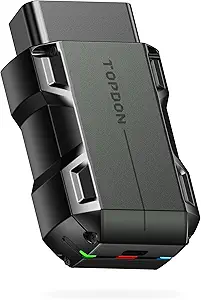
The TOPDON TopScan Lite is a compact Bluetooth OBD2 scanner designed for DIYers who want more than basic code reading. It combines full-system diagnostics, bidirectional testing, service resets, and an AI repair assistant in a phone-based setup.
Pros:
- Full-system diagnostics
- Bidirectional testing
- AI repair assistant
- 8 service resets
- iOS and Android support
Cons:
- Requires a smartphone or tablet
- Some features may be unnecessary for basic users
Review:
The TOPDON TopScan Lite offers an impressive combination of advanced features and affordability. It supports full-system diagnostics, eight one-tap resets, bidirectional testing, and an AI repair assistant. For DIYers who want more than basic code reading without spending heavily on a professional scanner, it is a strong all-around choice.
2. Best for Live Data and Bluetooth Apps: OBDLink MX+
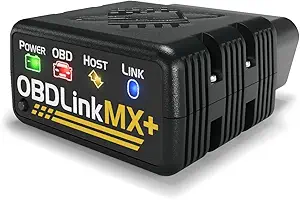
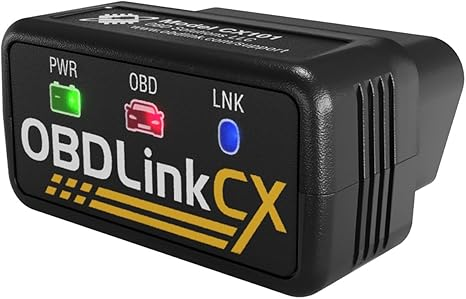
The OBDLink MX+ is a Bluetooth diagnostic adapter that turns a compatible smartphone or tablet into an OBD2 diagnostic tool, making it particularly useful for drivers who prioritize live data and app-based diagnostics.
Pros:
- Excellent live data performance
- Bluetooth connectivity
- High data sample rate
- GM-LAN and Ford MS-CAN support
- Compact design
Cons:
- Requires a phone or tablet
- Depends on compatible apps
Review:
The OBDLink MX+ is ideal for users who prefer phone-based diagnostics. Its high data sample rate and support for GM-LAN and Ford MS-CAN networks make it particularly useful for monitoring live parameters and accessing additional vehicle information beyond basic OBD2 codes.
3. Best Simple Standalone Reader: Foxwell NT301
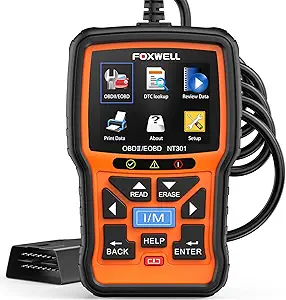
The Foxwell NT301 is a straightforward handheld OBD2 scanner with its own color display, making it a good choice for drivers who want basic diagnostics without relying on a smartphone or mobile app.
Pros:
- Standalone operation
- No phone required
- Color display
- Simple controls
- Beginner-friendly
Cons:
- Limited compared with advanced scanners
- Better suited to basic diagnostics
Review:
The Foxwell NT301 is a good fit for drivers who want a simple scanner without phone pairing or app setup. Its 2.8-inch color screen and straightforward controls make it useful for reading codes and viewing live data without the complexity of advanced diagnostic equipment.
4. Best for Advanced Resets: CGSULIT SC530
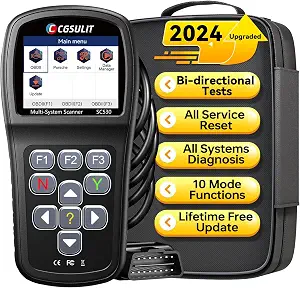
The CGSULIT SC530 is aimed at DIYers who perform more involved repairs and need advanced functions such as ABS bleeding, battery registration, injector coding, and bidirectional component testing.
Pros:
- Bidirectional testing
- Full-system diagnostics
- 30+ special functions
- ABS bleeding
- Battery registration
- Injector coding
Cons:
- More advanced than basic readers
- Functions vary by vehicle
Review:
The CGSULIT SC530 is designed for DIYers who perform repairs requiring more than code reading. Features such as ABS bleeding, battery registration, injector coding, and bidirectional testing make it useful for brake, battery, and electronic system work.
5. Best Professional-Grade Option: Autel MaxiCOM MK808S
The Autel MaxiCOM MK808S is the most advanced option in this lineup, offering professional-grade diagnostic capability for serious DIYers and enthusiasts who work on multiple vehicles.
Pros:
- 3,000+ active tests
- 28+ service resets
- 200+ brand coverage
- Full bidirectional capability
- Professional-grade features
Cons:
- More than casual users may need
- Higher-end option for home use
Review:
The Autel MaxiCOM MK808S offers more than 3,000 active tests, 28+ service resets, and coverage for more than 200 brands. Its bidirectional capability makes it useful for actively testing vehicle components, while its advanced functions give serious DIYers room to handle increasingly complex repairs.
Do You Need a Standalone Scanner or a Bluetooth Adapter?
Standalone scanners like the Foxwell NT301 include their own screen and interface, making them ready to use immediately without any app setup or phone dependency. Bluetooth adapters like the OBDLink MX+ rely on a paired phone or tablet app, which typically offers a larger, more detailed display and easier software updates, but adds a dependency on your device staying charged and the app staying compatible with your phone’s operating system.
Neither approach is objectively better, and the right choice comes down to whether you’d rather have a dedicated tool that just works or prefer the larger display and frequent feature updates that come with an app-based system.
What’s the Difference Between a Basic Code Reader and a Bidirectional Scanner?
Basic code readers focus on finding and clearing trouble codes, while bidirectional scanners provide additional control for testing vehicle components and performing advanced diagnostics.
The main difference is how much control the scanner gives you: a basic code reader mainly reads faults, while a bidirectional scanner can also send commands to the vehicle and test components.
| Feature | Basic Code Reader | Bidirectional Scanner |
|---|---|---|
| Read trouble codes | Yes | Yes |
| Clear check engine light | Yes | Yes |
| Live data | Basic or limited | More advanced |
| Send commands to vehicle | No | Yes |
| Active component testing | No | Yes |
| Test solenoids/actuators | No | Yes |
| ABS pump testing | No | Yes |
| Best for | Basic check-engine-light diagnosis | Advanced DIY diagnostics and repairs |
| Service resets | Limited | Often available |
| Typical user | Casual DIYer | Serious DIYer or enthusiast |
Conclusion
Choosing the best OBD2 scanner for home diagnostics depends on how much control you need over your vehicle. For basic check-engine-light diagnostics, a simple standalone reader such as the Foxwell NT301 can be enough. DIYers who want live data, broader system coverage, and bidirectional testing should consider options such as the TOPDON TopScan Lite or CGSULIT SC530. The OBDLink MX+ is a strong choice if you prefer Bluetooth connectivity and phone-based live data, while the Autel MaxiCOM MK808S offers the most advanced capabilities for serious DIYers.
Before buying, check vehicle compatibility, supported diagnostic systems, service functions, and update costs. The best scanner is not necessarily the most expensive one it is the model that provides the diagnostic features you will actually use.
Frequently Asked Questions
What is the best OBD2 scanner for home use?
The TOPDON TopScan Lite is the best overall choice for many DIYers because it combines full-system diagnostics, bidirectional testing, service resets, and an AI repair assistant. For basic code reading, a simpler scanner such as the Foxwell NT301 may be sufficient.
What can an OBD2 scanner diagnose?
An OBD2 scanner can read and clear diagnostic trouble codes and display live vehicle data. More advanced scanners can also access systems such as ABS, airbags, transmission, and other control modules, depending on the scanner and vehicle.
Do all OBD2 scanners work with every car?
No. OBD2 scanners can connect to compatible vehicles, but diagnostic coverage and advanced functions vary by make and model. Before buying, check the scanner’s vehicle compatibility and supported functions for your specific car.
Is a Bluetooth OBD2 scanner better than a handheld scanner?
Neither is universally better. Bluetooth scanners use a smartphone or tablet as the display and can provide a convenient app-based experience, while handheld scanners have their own screen and do not depend on a phone. The better option depends on your preferred setup.
What is bidirectional testing on an OBD2 scanner?
Bidirectional testing allows a scanner to send commands to a vehicle’s control modules and observe the response. This can help DIYers test components such as solenoids, actuators, or other systems instead of only reading stored trouble codes.
Can an OBD2 scanner clear a check engine light?
Yes, compatible OBD2 scanners can generally clear diagnostic trouble codes and turn off the check engine light. However, clearing the code does not repair the underlying problem, so the warning light may return if the fault remains.
Do OBD2 scanners require a subscription?
It depends on the scanner and manufacturer. Some models provide free updates, while others may require a subscription after an included update period. Check the specific model’s update policy before purchasing to understand the long-term cost.
Are expensive OBD2 scanners worth it for DIYers?
An expensive scanner is worthwhile when you need advanced functions such as bidirectional testing, full-system diagnostics, coding, or service resets. If you only need to read basic engine codes, a less expensive scanner may provide better value.
Can an OBD2 scanner tell me exactly what is wrong with my car?
Not always. A trouble code identifies a detected fault or affected system, but it does not necessarily identify the exact failed component. Live data, additional testing, and bidirectional functions can help narrow down the actual cause.
What should I check before buying an OBD2 scanner?
Check five key areas: vehicle compatibility, diagnostic system coverage, live data capability, bidirectional or service functions, and software update costs. Choosing based on the repairs you actually perform will help you avoid paying for features you do not need.