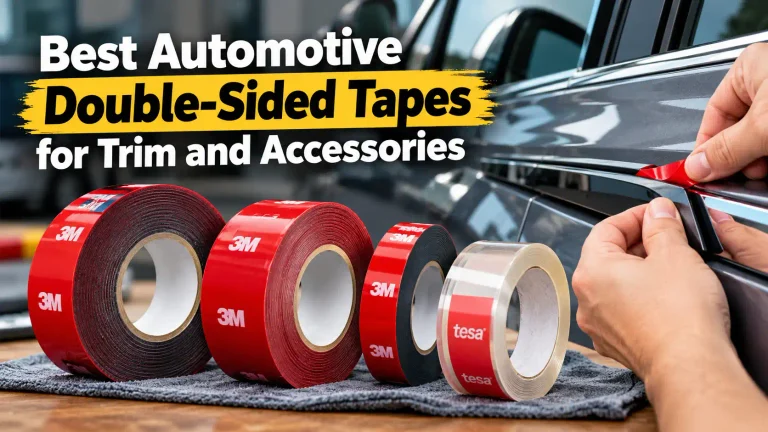
The best automotive double-sided tape matches the trim’s material, the vehicle surface, and the shape of the joint. A strong roll can still fail when it is placed over old adhesive, glossy dressing residue, or a warped piece that keeps pulling the edge away.
This guide compares four distinct tape options: an automotive molding roll, a workshop attachment tape, narrow industrial acrylic foam, and thin transparent PET film. Each serves a different buying need, so the goal is choosing the right construction rather than stacking several tapes together.
Quick Product Comparison: Best Automotive Double-Sided Tapes for Trim and Accessories
| Product | Best For / Category | Amazon |
|---|---|---|
| 3M Super Strength Molding Tape 03614, 1/2 in × 15 ft | Best Starting Point for Typical Molding and Emblems | Check Price on Amazon |
| 3M Automotive Acrylic Plus Attachment Tape 06382, 1/2 in × 20 yd | Best Workshop Automotive Attachment Roll | Check Price on Amazon |
| 3M VHB 5952 Tape, TapeCase-Converted, 1/4 in × 5 yd | Best Narrow Industrial Foam Option | Check Price on Amazon |
| tesa 4965 Original Double-Sided PET Film Tape, 1/2 in × 36 yd | Best Thin Transparent Film for Flat Parts | Check Price on Amazon |
Our Top Picks: Best Automotive Double-Sided Tapes for Trim and Accessories
1. Best Starting Point for Typical Molding and Emblems — 3M Super Strength Molding Tape 03614, 1/2 in × 15 ft
Best for: Owners reattaching suitable lightweight moldings, trim, and emblems designed for adhesive attachment.
3M 03614 is the most straightforward starting point in this guide because its stated purpose directly matches automotive moldings, trim, and emblems. The linked roll is half an inch wide and 15 feet long, a useful format for a limited repair without purchasing a large workshop roll.
Its acrylic foam construction provides conformability between suitable mating surfaces. That can help with modest surface differences, but it does not fill arbitrary gaps or compensate for a bent molding that keeps pulling away. Dry-fit the part and inspect how much of its backing actually contacts the vehicle.
Remove old adhesive and contamination using methods appropriate to the paint and trim, then follow 3M’s preparation and application directions. Firm pressure is part of creating contact. Avoid treating initial stick as proof that the assembly is ready for washing, road airflow, or other service loads.
Buy 03614 for the stated trim role. It is less relevant when you need a very thin invisible bond or a tape selected for a specific low-energy plastic. Existing clips or fasteners should be restored where the part requires them; tape is not automatically a replacement.
Key Features
- Half-inch-wide, 15-foot linked roll.
- Manufacturer-designed for vehicle moldings, trim, and emblems.
- Acrylic foam construction with conformability.
- Approximately 1.14 mm nominal thickness in the manufacturer data.
- Suitable painted and unpainted automotive surfaces under the specified process.
Pros
- Clear automotive application rather than a generic mounting claim.
- Manageable roll for limited trim work.
- Foam helps accommodate modest mating-surface differences.
- No liquid mixing or cartridge dispenser required.
Cons
- Foam thickness can be visible on small flush-fitting pieces.
- Cannot overcome persistent spring-back or severe gaps.
- Material preparation and bond-build time still matter.
- Permanent attachment can make later removal difficult.
Buying Decision
Choose 03614 first for suitable adhesive-mounted moldings or emblems. Choose thin tesa 4965 for genuinely flat, close-fitting light parts, or a specified automotive attachment system when material selection is more demanding.
2. Best Workshop Automotive Attachment Roll — 3M Automotive Acrylic Plus Attachment Tape 06382, 1/2 in × 20 yd
Best for: Experienced installers who need a larger roll selected for suitable automotive parts and paint systems.
3M 06382 has a specific automotive attachment design rather than simply a heavy-duty household mounting label. Its two adhesive sides are engineered for different mating roles: the manufacturer identifies one for automotive paint systems and the other for suitable metal and plastic parts.
That detail makes orientation part of the process. Follow the technical instructions for which side meets each substrate instead of assuming every double-sided tape is symmetrical. The nominal 1.12 mm black acrylic foam accommodates modest mismatch while preserving a defined bond line.
The manufacturer specifies a half-inch-by-20-yard roll for this product number, and the linked listing sells a roll. Confirm the exact dimensions and package before buying. This larger supply is attractive for repeated installation, but unnecessary volume can be a poor first purchase for one small emblem.
Choose 06382 when the substrates and attachment procedure call for it. Unsupported low-energy plastics, contaminated surfaces, or parts under persistent peel stress still require assessment. Buying a professional attachment tape does not remove the need to restore the mechanical features the part was designed to use.
Key Features
- Automotive attachment tape with two application-specific adhesive sides.
- Manufacturer-defined half-inch-by-20-yard roll format.
- Black acrylic foam, nominally 1.12 mm thick.
- Designed for appropriate automotive paint, metal, and plastic mating surfaces.
- Application orientation and any required preparation are part of selection.
Pros
- Specific automotive parts-and-paint bonding purpose.
- Larger roll suits repeated trim installations.
- Foam construction can accommodate modest surface mismatch.
- Technical guidance helps define the mating-surface process.
Cons
- More supply and storage commitment than a short retail roll.
- Correct orientation must be followed.
- Not automatic approval for every plastic or accessory.
- May require additional surface treatment under the selected process.
Buying Decision
Buy 06382 if you have repeated suitable attachment work and will follow its technical procedure. Choose the smaller 03614 roll for a limited ordinary molding repair when that product is appropriate.
3. Best Narrow Industrial Foam Option — 3M VHB 5952 Tape, TapeCase-Converted, 1/4 in × 5 yd
Best for: Installers needing a narrow conformable foam bond after checking the actual substrate and load.
3M VHB 5952 is an industrial acrylic foam tape with modified acrylic adhesive. The linked TapeCase-converted roll is a quarter of an inch wide and five yards long, making it relevant to narrow bonding lands where a wider strip would be impractical.
3M’s nominal tape thickness is 45 mil, approximately 1.1 mm. The foam can improve contact between slightly mismatched suitable surfaces, while the adhesive is designed for a range of metals, plastics, and paints, including many powder-coated surfaces. That is a material-selection starting point, not approval for every painted dashboard or exterior accessory.
The narrow width makes available bond area especially important. A strong tape still needs enough contact and a load arrangement that does not continually peel its edge. Do not convert a general load rating or stainless-steel test into a guaranteed capacity on textured plastic.
This is the most technical selection here for a buyer wanting a narrow foam format. Confirm the converter, product number, width, storage condition, and seller. Choose it after checking the engineering fit, not because the VHB name is assumed to replace bolts, clips, or screws on any part.
Key Features
- VHB 5952 modified-acrylic adhesive and foam construction.
- Quarter-inch-by-five-yard linked converted roll.
- Nominal 45-mil, approximately 1.1 mm, tape thickness.
- Conformability supports modest surface mismatch.
- Manufacturer lists a range of suitable paints, metals, and plastics.
Pros
- Narrow format fits limited-width bonding lands.
- Foam can support more contact than thin film on modest mismatch.
- Defined tape number allows technical-data checking.
- Useful industrial option for a properly assessed accessory bond.
Cons
- Narrow width limits the available bond area.
- Industrial compatibility is not a universal automotive fitment claim.
- Converted rolls require checking the actual source and dimensions.
- Not a blanket substitute for required mechanical retention.
Buying Decision
Choose this narrow 5952 roll when its foam thickness, substrate support, and available contact area fit the job. Choose an automotive molding tape for a conventional trim repair or thin film for a truly flush mating surface.
4. Best Thin Transparent Film for Flat Parts — tesa 4965 Original Double-Sided PET Film Tape, 1/2 in × 36 yd
Best for: Light, close-fitting accessory or decorative-part bonds on supported smooth surfaces.
tesa 4965 differs from the foam tapes above: it uses a transparent PET film backing with acrylic adhesive. The linked roll is half an inch wide and 36 yards long, with a listed thickness of approximately 0.205 mm.
That thin profile is useful when a foam layer would create an unwanted stand-off. It is also the limitation. A film tape needs close-fitting mating surfaces and does not bridge the same mismatch as a conformable foam. Flat decorative pieces can be a better match than a curved molding with gaps behind it.
tesa publishes industrial material and environmental data for the 4965 family. Do not turn a short-term high-temperature laboratory rating into approval for every hot cabin, plastic backing, or sustained load. The complete part, coating, and joint have to suit the actual environment.
Choose the verified original tape and confirm the supplied variant, since the product family has evolved. This is an industrial film option relevant to suitably assessed accessories, not the default for all exterior trim. Its long roll also makes more sense for repeated small jobs than a single tiny bond.
Key Features
- Transparent PET film backing with acrylic adhesive.
- Half-inch-by-36-yard linked original roll.
- Approximately 0.205 mm listed thickness.
- Thin bond line for close-fitting suitable surfaces.
- Industrial technical data supports substrate and environmental assessment.
Pros
- Low profile where foam would raise the part noticeably.
- Transparent construction can reduce visible edge contrast.
- Long roll suits repeated small flat-part work.
- Defined product family allows technical-data comparison.
Cons
- Minimal gap accommodation compared with foam tape.
- Not a universal exterior-molding recommendation.
- Long roll is more than an occasional user may need.
- Family variants and temperature data must be checked carefully.
Buying Decision
Buy tesa 4965 for a supported flat, close-fitting light accessory bond where a thin transparent line matters. Choose acrylic foam for an appropriately assessed molding with modest mismatch; fix distorted parts rather than trying to bridge their gaps with film.
Buying Guide: Select Tape by the Joint, Not the Brand Alone
Choose Foam or Film Before Choosing Width
Choose an appropriate foam tape when the joint needs modest conformability. A thickness around 1.1 mm can help with small mismatches but also creates a visible stand-off on some small pieces. Dry-fit the part to see how it sits before ordering.
Choose thin film when the mating surfaces are flat, smooth, and close-fitting. tesa 4965’s low profile is useful there, but it cannot fill a recessed mounting area that originally used foam. Match the original specified construction or an approved replacement rather than selecting solely by appearance.
Identify Both Mating Surfaces
Paint, bare metal, ABS, polypropylene, rubber, textured plastic, and coated film present different bonding conditions. “Plastic” is not a precise compatibility description. Low-energy plastics may need another tape family or a specified adhesion-promotion procedure.
Vehicle paint and an accessory’s backing both matter. A tape that bonds one well can fail at the other. For wraps, PPF, repainted panels, or special coatings, confirm the attachment and removal method with the relevant manufacturer or installer.
Match Width to Actual Contact Area
Measure the usable bonding land on the back of the trim. Wider tape helps only when the added width contacts both surfaces; a strip crossing a recess may add little useful area. Narrow tape can fit neatly but may provide too little area for the required load.
Do not stack tape to improvise the missing thickness of a distorted part. It changes the joint and can create weak interfaces. Replace damaged trim or use the specified attachment material when the part does not seat correctly.
Consider Peel, Vibration, and Weather
An accessory’s weight is not its only load. A curved molding can spring outward, and an exterior piece can see airflow, movement, water, and temperature changes. A persistent force lifting one edge is different from a flat part resting in shear.
General load claims from a listing do not establish capacity on a specific vehicle surface. Choose the system for the real joint and environment, keeping required fasteners. For demanding installations, use the manufacturer’s application guidance or an installer who can assess the attachment.
Check Temperature at Installation
Application temperature and service-temperature resistance are different specifications. Tape that tolerates a hot environment after a proper bond may not adhere well when installed cold. Follow the selected tape’s installation range and conditioning instructions.
Bring parts and the tape to the specified conditions rather than applying uncontrolled heat to paint or plastic. Do not assume warming the surface makes a contaminated substrate suitable. Preparation still comes first.
Buy Enough Tape and the Right Supporting Materials
Calculate the lengths needed and allow for careful cutting, without buying a workshop-size roll by habit. A short 03614 roll can be a more useful first purchase than a long industrial roll when the application is ordinary suitable trim.
Also plan paint-compatible adhesive removal, cleaning materials, alignment marks, and any specified promoter. Promoters are not universal cleaners, and unrelated chemicals can affect the surface. Choose a reputable supply source, especially for converted tape, and verify storage and shelf-life guidance.
How to Attach Suitable Car Trim With Double-Sided Tape
- Confirm the attachment method. Check the vehicle or accessory instructions and identify any clips, screws, or other retention that must remain.
- Dry-fit the piece. Ensure it sits correctly without persistent spring-back and has enough usable bonding area. Mark alignment with a suitable removable method.
- Remove old tape carefully. Use the approved method for the paint and part. Avoid blades, aggressive solvents, or heat that the surface does not permit.
- Clean and dry both surfaces. Remove dirt, oils, waxes, dressings, and other contamination using the selected system’s instructions. Confirm compatibility before using a cleaner on delicate trim.
- Apply any required surface treatment. Use only the specified promoter and allow its instructed preparation time. Do not add it simply because another tape installation used it.
- Cut and position the tape correctly. Keep fingers off the adhesive, use the required orientation for asymmetric systems, and avoid stacking layers or leaving unsupported strips.
- Align and apply firm even pressure. Follow the specified pressure and method. A casually placed piece may have less contact than it appears to have.
- Allow the stated bond-build period. Avoid washing, stressing, or subjecting the assembly to service conditions until the installation instructions permit it.
- Inspect the finished attachment. Confirm edges remain seated and mechanical retention is intact. Reassess lifting rather than pressing a failing edge down repeatedly.
This sequence does not replace tape-specific instructions. Side orientation, cleaning, promotion, application temperature, pressure, and waiting periods vary with the product and substrates.
Common Tape Problems and What They Mean
The Part Sticks Initially, Then Lifts
Check for spring-back, inadequate contact area, wrong application temperature, insufficient conditioning, and contamination. A stronger-sounding roll may not fix the root cause. Remove and reassess the assembly rather than relying on repeated pressing.
Tape Adheres to the Paint but Not the Trim
The backing material may be difficult to bond or contaminated with molding residues or dressing. Check the exact substrate and tape system. Generic approval for “plastic” is not enough.
A Thin Tape Does Not Reach the Panel
The joint may require the original foam thickness or another specified geometry. Film tape cannot bridge an air gap. Do not add random layers to make the piece touch.
Removal Leaves Residue or Damages the Finish
Permanent tape is not promised to be residue-free or paint-safe to remove under every condition. Repainted, aged, wrapped, or weakened surfaces need particular care. Use the approved removal method and stop if the finish begins to lift or change.
Conclusion: Which Automotive Double-Sided Tape Should You Buy?
Choose 3M 03614 Super Strength Molding Tape for a suitable ordinary molding, trim, or emblem job. Choose 3M 06382 Acrylic Plus for repeated automotive attachment work with the correct substrate and orientation procedure.
Choose the narrow VHB 5952 converted roll when that foam system and width fit an assessed joint. Choose tesa 4965 film for a supported flat light-part bond that needs a thin transparent line.
Make the joint the deciding factor. Correct material support, enough contact area, preparation, pressure, and conditioning are more useful than buying the tape with the boldest strength claim.
Frequently Asked Questions
What is the best double-sided tape for car trim?
3M 03614 is our research-based starting choice for suitable moldings, trim, and emblems because it is designed for that role. The part’s substrate, geometry, and original attachment method still determine suitability.
Is every 3M VHB tape the same?
No. The family includes different adhesives, thicknesses, colors, and constructions for different substrates and uses. Select the exact tape number rather than relying on the VHB name alone.
Can I attach a spoiler with double-sided tape alone?
Follow the spoiler manufacturer’s installation method. Tape may be supplemental or specified within an engineered attachment, but a general trim-tape recommendation does not establish that tape alone is suitable. Restore any required mechanical retention.
Does thicker tape always hold better?
No. Thickness affects conformity and fit, while hold also depends on substrate, contact area, adhesive type, and load direction. Too much thickness can create unwanted stand-off or stress.
How long should I wait before washing the car?
Follow the selected tape and accessory installation instructions for conditioning before washing or loading. Initial stick is not proof of the final bond. Temperature and the actual joint can affect bond development.
Should I use adhesion promoter on every plastic part?
No. Use it only when specified for the exact tape and substrate. It is not a universal substitute for cleaning, and an unsuitable chemical can affect the part or finish.
Can automotive tape be removed without paint damage?
Removal without damage cannot be guaranteed. Paint condition, repaint quality, aging, film, tape, and removal technique all matter. Use the approved method and test carefully where appropriate.
Why does tape not stick to my dashboard?
Texture, low-energy plastic, coatings, dressing residue, or an unsuitable load can prevent a reliable bond. Check the accessory’s approved mounting method and keep it clear of airbag zones. Do not solve an incompatible surface by simply stacking more tape.