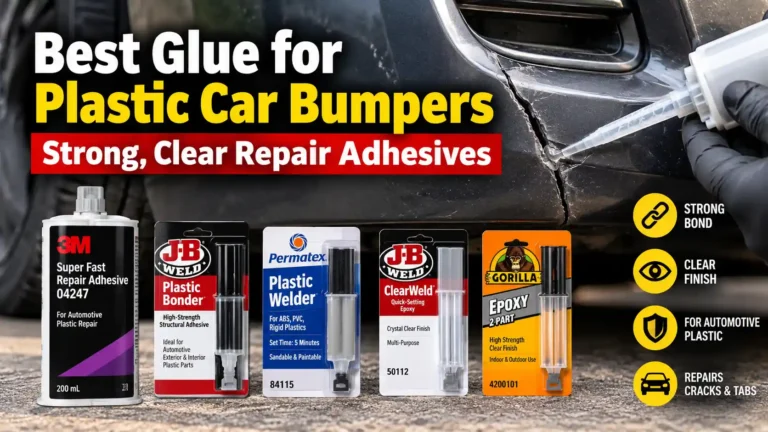
Choosing the best glue for plastic car bumpers depends on the bumper material and the type of damage. For professional repairs, 3M Super Fast Repair Adhesive 04247 is our top overall pick. J-B Weld Plastic Bonder 50139 is a practical DIY option for compatible plastics, while J-B Weld ClearWeld 50112 suits small repairs where a clear finish is important.
Before buying, check the plastic identification code on the back of your bumper. Materials such as polypropylene (PP), polyethylene (PE), and TPO may require a specialized adhesive system or plastic welding. This guide compares five bumper repair adhesives to help you choose the right option for your needs.
Quick Comparison: Best 5 Glue for Plastic Car Bumpers
Compare these five plastic car bumper adhesives by their best use, cure color, and material limitations. Check your bumper’s plastic type before choosing a product to ensure a suitable repair.
| Product | Best For | Cure Color | Important Limitation | Amazon |
|---|---|---|---|---|
| 3M Super Fast Repair Adhesive 04247 | Best Overall / Professional Repair | Clear | Low-energy plastics may need adhesion promoter | Check Price on Amazon |
| J-B Weld Plastic Bonder 50139 | Best DIY Automotive Plastic Adhesive | Black | Not for polypropylene or polyethylene | Check Price on Amazon |
| Permatex Plastic Welder 84115 | Best for ABS and Rigid Plastic | Off-white | Not for polypropylene or polyethylene | Check Price on Amazon |
| J-B Weld ClearWeld 50112 | Best Clear DIY Epoxy | Clear | General-purpose epoxy; check bumper plastic first | Check Price on Amazon |
| Gorilla 2 Part Epoxy 4200101 | Best Clear General-Purpose Alternative | Clear | Better for compatible rigid plastics than flexible PP bumpers | Check Price on Amazon |
Our Top 5 Glues for Plastic Car Bumpers
Choosing the best glue for a plastic car bumper depends on the bumper material, damage type, and desired finish. Our top five picks include automotive repair adhesives and clear epoxies for compatible plastics. Before choosing a product, check the molded identification code on the back of your bumper.
Common bumper plastic codes include PP, PP/EPDM, TPO, TEO, PE, ABS, PC/ABS, PUR, and SMC. Polypropylene (PP), polyethylene (PE), and TPO can be difficult to bond with standard epoxies, so they may require a compatible adhesive system, an adhesion promoter, or plastic welding. Compare each product’s material compatibility and manufacturer instructions before starting your repair.
1. 3M Super Fast Repair Adhesive 04247 — Best Overall
3M Super Fast Repair Adhesive 04247 is the most purpose-built bumper repair adhesive in this guide.
It is a two-part urethane adhesive made for repairing automotive plastic parts. 3M lists it for rebuilding, reshaping, bonding, and repairing plastic components, including broken mounting tabs and brackets.
The adhesive cures clear and has strong gap-filling ability, which is useful when a crack has a small missing section or when you need to rebuild a broken tab.
It also sets very quickly. That is useful in a professional repair environment, but it means you need to prepare the part before mixing the adhesive.
The biggest advantage is compatibility with a wider range of automotive plastics when the correct repair process is followed. For low-surface-energy plastics, 3M recommends using its polyolefin adhesion promoter.
That matters because many modern bumper covers use polypropylene or similar plastic that ordinary epoxy does not bond well.
This is not the simplest DIY product. The 200 ml cartridge is designed to work with a suitable applicator and mixing nozzle, so the total setup costs more than a small hardware-store syringe.
Best for: Serious bumper repairs, broken mounting tabs, missing plastic sections, and professional-quality work.
Pros:
- Designed for automotive plastic repair
- Cures clear
- Strong gap-filling ability
- Can rebuild broken tabs
- Works on many plastic types
- Can be sanded after curing
- Can be painted
- Suitable for exterior automotive parts
- Works with a polyolefin adhesion promoter for difficult bumper plastics
Cons:
- More expensive than small DIY epoxy syringes
- Requires a compatible cartridge applicator
- Very fast working time
- Low-energy plastic may still need adhesion promoter
- More preparation is required for the best result
Buying Decision:
Choose 3M 04247 if you want the most complete repair system in this guide and you are repairing an actual bumper cover rather than a small interior plastic part.
It is especially useful when the bumper material is difficult to bond or when the repair involves a broken tab, larger crack, or missing section.
For a simple cosmetic crack on an easy-to-bond rigid plastic, a small syringe adhesive may be cheaper and easier.
2. J-B Weld Plastic Bonder 50139 — Best DIY Automotive Plastic Adhesive
J-B Weld Plastic Bonder 50139 is a popular choice for automotive plastic repairs because it combines high strength with a simple dual-syringe package.
It is a two-part urethane adhesive and gap filler with a listed tensile strength of 3,770 PSI.
J-B Weld markets Plastic Bonder for automotive work, body panels, composites, plastic trim, and other repairs where the adhesive needs to fill a small gap as well as bond two pieces.
The black cure color also works well when the repair is on the back side of a black bumper cover or trim panel.
One important limitation is easy to miss: J-B Weld states that Plastic Bonder is not for polypropylene or polyethylene.
That matters because many bumper covers use polypropylene-based plastic.
Before using it on a bumper, look for the molded plastic code. If you see PP, PP/EPDM, PE, or a similar material, do not choose this product just because the package says it works on plastic.
For compatible thermoplastics, composites, fiberglass, PVC, and other supported materials, it is a strong and easy-to-use DIY option.
Best for: DIY bumper, body-panel, trim, and plastic repairs on compatible materials.
Pros:
- Strong 3,770 PSI bond
- Two-part urethane formula
- Good gap filling
- Made for automotive applications
- Convenient dual syringe
- Sets quickly
- Can be sanded
- Water resistant
- Black cure color blends with many hidden bumper repairs
Cons:
- Does not bond polypropylene
- Does not bond polyethylene
- Black finish is visible on an exposed repair
- Not a true clear adhesive
- Plastic identification is important before use
Buying Decision:
Choose J-B Weld Plastic Bonder if you want a strong DIY adhesive for a compatible bumper, trim panel, grille, or body-panel repair.
Do not buy it for a PP or PE bumper.
If your bumper is polypropylene, use a repair system made for polyolefin plastic or consider plastic welding instead.
3. Permatex Plastic Welder 84115 — Best for ABS and Rigid Plastic
Permatex Plastic Welder 84115 is a two-part structural adhesive made for bonding several rigid plastics and automotive materials.
Permatex lists it for ABS, fiberglass, PVC, vinyl, acrylic, SMC, styrene, glass, and other rigid materials.
The adhesive has a listed strength of up to 3,500 PSI and fills gaps up to about 0.125 inch.
That makes it useful for a crack where the two bumper edges do not meet perfectly.
It also works quickly. The adhesive has a short working time and reaches fixture strength in roughly 10 minutes.
The main limitation is the same problem found with several plastic epoxies: Permatex clearly states that Plastic Welder does not bond polyethylene or polypropylene.
If your bumper cover has a PP or PE marking, this is not the right adhesive.
The cured color is off-white, so it is usually better for a hidden repair on the back of a bumper than for an exposed crack that will not be painted.
Best for: ABS, fiberglass, SMC, PVC, and other compatible rigid plastic repairs.
Pros:
- Structural plastic adhesive
- Up to 3,500 PSI strength
- Good gap filling
- Fast set time
- Water resistant
- Good chemical resistance
- Works on ABS and fiberglass
- Useful for automotive trim and rigid plastic
Cons:
- Does not bond polypropylene
- Does not bond polyethylene
- Cures off-white
- Short working time
- Better for rigid plastic than highly flexible bumper material
Buying Decision:
Choose Permatex Plastic Welder if you have confirmed that the damaged part is ABS, fiberglass, SMC, PVC, or another listed compatible material.
It is a good choice for older rigid bumper components, trim pieces, spoilers, brackets, and other hard plastic parts.
For a flexible PP bumper cover, use a different repair system.
4. J-B Weld ClearWeld 50112 — Best Clear DIY Epoxy
J-B Weld ClearWeld 50112 is a better fit when the repair will remain visible and you want the adhesive to cure clear.
It is a two-part quick-setting epoxy supplied in a dual syringe.
ClearWeld bonds a wide range of materials, including many plastics, fiberglass, glass, metal, ceramic, and other hard surfaces.
Its main advantage for a visible repair is the transparent cured finish. A black or cream adhesive can make a small crack look worse if the repaired area is not going to be sanded and painted.
ClearWeld is also simple to use for small repairs. Dispense equal parts, mix them thoroughly, apply the epoxy, position the pieces, and allow the repair to cure.
However, ClearWeld is a general-purpose epoxy rather than a dedicated flexible bumper-repair system.
That distinction is important.
If the bumper flexes heavily or is made from polypropylene, polyethylene, or another hard-to-bond material, a clear general-purpose epoxy should not be your first choice.
It makes more sense for small cracks and rigid plastic parts where you have confirmed material compatibility.
Best for: Small visible repairs where a clear cured adhesive is important.
Pros:
- Cures clear
- Strong two-part epoxy
- Easy dual-syringe application
- Fast setting
- Works on many materials
- Water resistant
- Good for small cracks and broken plastic pieces
- Cleaner appearance than black or cream adhesive
Cons:
- Not designed specifically for flexible bumper covers
- Material compatibility needs to be checked
- May be too rigid for a highly flexible repair
- Not the best choice for PP or PE bumper covers
- Large structural cracks need a stronger repair method
Buying Decision:
Choose J-B Weld ClearWeld when you need a clear bond on a small compatible plastic repair.
It is useful for visible plastic pieces, trim, lenses, small brackets, and rigid bumper components where you do not want a dark adhesive line.
For a large bumper crack or PP/TPO bumper cover, use an automotive plastic repair system instead.
5. Gorilla 2 Part Epoxy 4200101 — Best Clear General-Purpose Alternative
Gorilla 2 Part Epoxy is another clear adhesive that works well when you need a neat-looking bond on compatible plastic.
The two-part epoxy comes in a syringe that dispenses resin and hardener at the same time.
It has a five-minute set time and cures clear.
The formula is also water resistant and can fill small gaps between uneven surfaces.
For car repairs, it is most useful on rigid plastic trim, brackets, interior pieces, and other parts that do not flex as much as a bumper cover.
It can also work for a small bumper repair when the plastic is compatible and the damaged area does not move much.
The limitation is that this is a general-purpose epoxy, not a bumper-specific urethane repair system.
Bumpers flex during parking impacts, temperature changes, and normal driving. A repair adhesive needs to tolerate that movement.
For that reason, Gorilla Epoxy is better treated as a clear repair option for compatible rigid plastic rather than a universal solution for every plastic bumper.
Best for: Small clear repairs on rigid plastic parts and low-flex areas.
Pros:
- Cures clear
- Easy dual-syringe design
- Five-minute set time
- Water resistant
- Good gap filling
- Strong general-purpose bond
- Useful on several materials
- Affordable for small repairs
Cons:
- Not designed specifically for car bumpers
- Less suitable for flexible repairs
- Plastic compatibility must be checked
- Not the first choice for PP or TPO
- Large structural cracks need a more complete repair method
Buying Decision:
Choose Gorilla 2 Part Epoxy when you need a clear, inexpensive adhesive for a small compatible plastic part.
It is a useful alternative to ClearWeld for trim and rigid plastic repairs.
For a large flexible bumper crack, 3M’s automotive plastic repair system is the better direction.
Which Glue Should You Use for a Plastic Car Bumper?
Start with the plastic code, not the brand of glue.
If you are working on a professional bumper repair or a difficult low-energy plastic, 3M Super Fast Repair Adhesive 04247 is the most complete option in this guide when used with the correct preparation and adhesion promoter.
For a compatible automotive plastic that is not PP or PE, J-B Weld Plastic Bonder 50139 is easier and cheaper for DIY use.
Choose Permatex Plastic Welder 84115 for ABS, fiberglass, SMC, PVC, and other listed rigid materials.
If the main concern is keeping the repair clear, J-B Weld ClearWeld 50112 or Gorilla 2 Part Epoxy can work on small compatible rigid plastic repairs.
Do not choose an adhesive based only on strength numbers.
A 3,000+ PSI epoxy that does not stick to your bumper plastic is less useful than a lower-strength system that is designed for that material.
Best Bumper Glue by Repair Type
| Repair | Better Adhesive Type | Product From This Guide |
|---|---|---|
| Professional bumper crack | Automotive urethane plastic repair | 3M Super Fast Repair Adhesive |
| Broken bumper tab | Fast automotive repair urethane | 3M Super Fast Repair Adhesive |
| Compatible black plastic repair | Automotive plastic bonder | J-B Weld Plastic Bonder |
| ABS bumper or rigid plastic | Structural plastic epoxy | Permatex Plastic Welder |
| Small visible clear repair | Clear epoxy | J-B Weld ClearWeld |
| Rigid trim or bracket | Clear general-purpose epoxy | Gorilla 2 Part Epoxy |
| PP or TPO bumper | Polyolefin-compatible system | 3M system with correct promoter or approved bumper repair system |
How to Identify the Plastic in Your Car Bumper
Look behind the bumper cover.
Manufacturers often mold the plastic type directly into the inside surface.
You may see a recycling symbol or letters such as:
PP or PP/EPDM
Polypropylene is common in modern bumper covers because it is light and flexible.
The problem is that PP is difficult to glue with normal epoxy.
If your bumper says PP or PP/EPDM, choose a repair system that specifically supports polyolefin plastic.
TPO or TEO
TPO and TEO are also common in flexible exterior automotive parts.
These materials can be difficult to bond and may require an adhesion promoter or a repair product made for low-surface-energy plastic.
ABS
ABS is easier to bond with many plastic epoxies.
Products such as Permatex Plastic Welder, Loctite plastic epoxy, and several J-B Weld formulas are commonly designed for ABS and similar rigid materials.
SMC or Fiberglass
These materials are usually easier to repair with structural epoxy or automotive body-repair adhesive.
No Plastic Marking
If you cannot identify the material, check the vehicle repair manual or the bumper manufacturer’s information before choosing glue.
Guessing is risky because a repair can look strong while the vehicle is parked and fail when the bumper flexes.
Is Clear Glue Better for a Car Bumper?
Not automatically.
Clear glue is useful when the repair remains visible and you do not plan to paint the area.
However, cure color does not tell you whether an adhesive is right for the plastic.
A black automotive urethane that matches the bumper material is a better repair than a clear epoxy that cannot form a reliable bond.
For an exposed hairline crack on a compatible rigid plastic, clear epoxy can give you a cleaner appearance.
For a structural bumper repair, plastic compatibility and flexibility matter more than color.
Epoxy vs. Urethane for Plastic Bumper Repair
Both can work, but they behave differently.
Epoxy
Two-part epoxy usually cures into a hard bond.
It works well on many rigid plastics, fiberglass, metal, and other materials.
Epoxy is often easy to buy and comes in small dual syringes.
The downside is that some epoxy becomes too rigid for a flexible bumper, and many formulas do not bond PP or PE.
Urethane
Two-part urethane repair adhesives are often a better match for automotive plastic because they can offer more flexibility.
Products such as 3M Super Fast Repair Adhesive and J-B Weld Plastic Bonder use urethane chemistry.
The exact plastic compatibility still matters.
A urethane label does not mean every product bonds every bumper material.
Can You Glue a Polypropylene Bumper?
Yes, but you need the right system.
Polypropylene has low surface energy, which makes many normal glues and epoxies pull away from the surface.
A successful repair may require:
- Correct sanding and surface preparation
- A polyolefin adhesion promoter
- A compatible two-part repair adhesive
- Reinforcement behind the crack
- Plastic welding for some damage
3M specifically recommends a polyolefin adhesion promoter with its Super Fast Repair Adhesive when working on low-surface-energy plastics.
If your bumper says PP, do not assume Permatex Plastic Welder, J-B Weld Plastic Bonder, or a normal clear epoxy will work.
When Is Plastic Welding Better Than Glue?
Plastic welding can be a better option for a long crack in a flexible thermoplastic bumper.
The process melts compatible plastic into the damaged area instead of depending only on adhesive.
It can work especially well on PP and TPO when the correct welding material and technique are used.
Glue may be easier for:
- Broken tabs
- Small edge cracks
- Brackets
- Small missing sections
- Repairs where welding access is limited
Plastic welding may be better for:
- Long bumper-cover cracks
- Flexible PP or TPO
- Cracks that move when the bumper flexes
- Repairs where matching filler plastic is available
Some professional repairs use both welding and adhesive reinforcement.
How to Glue a Cracked Plastic Bumper
Start by removing dirt, wax, grease, and road film from the repair area.
If possible, remove the bumper cover so you can work from the back. Reinforcing the back usually produces a cleaner visible finish.
Identify the plastic before choosing the adhesive.
Next, align the crack and check whether the edges fit together correctly.
Sand the repair area according to the adhesive manufacturer’s instructions. Many systems need a rough surface for better mechanical grip.
If the plastic requires an adhesion promoter, apply the correct promoter and allow it to dry as directed.
Mix the two-part adhesive thoroughly.
Apply it to the back of the crack first. For a larger repair, reinforce the area with the repair material recommended by the adhesive manufacturer.
Hold or clamp the bumper in its correct shape until the adhesive reaches handling strength.
Allow the repair to cure fully before reinstalling or flexing the bumper.
If the front side needs refinishing, sand and paint only after the adhesive has cured and only when the product is designed to be sanded and painted.
Common Bumper Glue Mistakes
Buying Glue Before Checking the Plastic
This is the biggest mistake.
A product may say “plastic adhesive” but still exclude PP and PE.
Always check the bumper code first.
Gluing Over Paint, Wax, or Dirt
Adhesive should bond to properly prepared material, not a layer of old wax or dirty paint.
Follow the manufacturer’s cleaning and sanding instructions.
Using Too Much Hardener or Resin
Two-part adhesives need the correct mix ratio.
A dual syringe makes this easier, but the two parts still need to be mixed thoroughly.
Moving the Repair Too Soon
Set time and full cure time are not the same.
An adhesive may feel hard after 10 minutes but still need much longer before the repair reaches full strength.
Repairing Only the Front of the Crack
For many bumper cracks, the strongest repair is made from the back where reinforcement can be added without affecting the visible surface.
Expecting Glue to Fix Major Structural Damage
A bumper cover is not the same as the impact bar and crash structure behind it.
If the reinforcement bar, absorber, sensors, mounting structure, or safety components are damaged, adhesive alone is not a complete repair.
Can You Repair a Bumper Without Removing It?
Small cracks and broken tabs may be accessible without completely removing the bumper.
However, removing the bumper cover often makes the repair easier.
You can clean and sand the back properly, align the crack, add reinforcement, and keep the visible side cleaner.
For a tiny edge repair, working with the bumper installed may be possible.
For a long crack or broken mounting point, access from behind usually produces a better result.
How Strong Does Bumper Glue Need to Be?
Tensile strength is useful, but it is not the only number that matters.
A bumper adhesive also needs:
- Good plastic compatibility
- Enough flexibility for bumper movement
- Resistance to water
- Resistance to temperature changes
- Good gap filling
- Proper surface preparation
- Enough cure time
A high PSI number cannot compensate for poor adhesion to the bumper material.
This is why product compatibility should come before advertised strength.
Final Verdict
The best glue for plastic car bumpers depends on the plastic type, damage, and required finish. In this guide, 3M Super Fast Repair Adhesive 04247 is the top overall choice for automotive plastic repairs, including cracks and broken mounting tabs. J-B Weld Plastic Bonder 50139 is a practical DIY option for compatible materials, while Permatex Plastic Welder 84115 suits certain rigid plastics. For small repairs requiring a clear finish, J-B Weld ClearWeld and Gorilla 2 Part Epoxy may work on compatible surfaces.
Before buying, check the bumper’s molded plastic code. Polypropylene (PP), polyethylene (PE), and TPO often require specialized repair systems or plastic welding. Always follow the adhesive manufacturer’s preparation and curing instructions. Choosing an adhesive that matches the material is more important than relying on advertised strength alone.
FAQs
What is the best glue for plastic car bumpers?
3M Super Fast Repair Adhesive 04247 is the top overall choice in this guide for automotive plastic repairs. It supports crack and tab repairs and can be used with the appropriate adhesion promoter on compatible low-surface-energy plastics.
What is the best clear glue for a plastic bumper?
J-B Weld ClearWeld 50112 is a suitable option for small repairs on compatible rigid plastics when a clear finish matters. For flexible bumper covers, confirm material compatibility before applying any adhesive.
Will J-B Weld Plastic Bonder work on a car bumper?
Yes, J-B Weld Plastic Bonder 50139 can repair compatible automotive plastics. However, it is not suitable for polypropylene or polyethylene, so check the bumper’s plastic identification code first.
Can you glue a polypropylene (PP) car bumper?
Yes, but you need an adhesive system specifically designed for polypropylene or other compatible polyolefins. An adhesion promoter or plastic welding may be necessary, depending on the damage and repair system.
Is epoxy or urethane better for plastic bumper repair?
Urethane repair adhesives can be better suited to many automotive plastic repairs, while epoxy works well on compatible rigid plastics. The best choice depends on the bumper material, flexibility, and manufacturer’s instructions.
Can you repair a cracked plastic bumper without replacing it?
Small cracks, broken tabs, and minor damage can often be repaired with a suitable automotive plastic adhesive. Severely distorted bumpers, large missing sections, or damage to underlying safety components may require professional assessment or replacement.
How long does plastic bumper glue take to cure?
Curing time varies by adhesive, temperature, and application conditions. Follow the manufacturer’s instructions for handling strength and full cure time, and avoid flexing or reinstalling the bumper before the repair is ready.