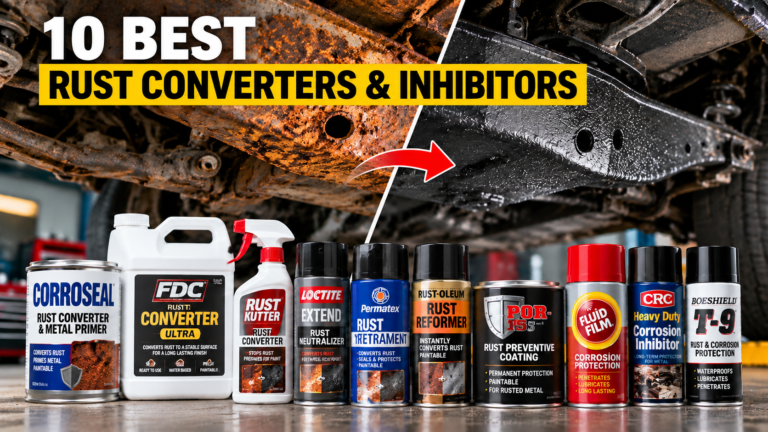
The best rust converters and inhibitors of 2026 solve different problems. A converter treats suitable existing rust before finishing. An inhibitor leaves protection that helps limit further corrosive exposure. Buying the wrong type can leave you with oily metal that will not accept paint—or a paint-preparation coating where you actually needed a renewable maintenance film.
This guide compares ten verified products for automotive repairs and appropriate metal-maintenance jobs. You will find brushable converters, aerosol rust treatments, a hard barrier coating, and protective films, with the preparation requirements and limitations that determine whether each purchase makes sense.
Our recommendations are based on manufacturer information, application instructions, and verified product listings. These are research-based editorial choices; we have not performed a hands-on durability or salt-spray comparison.
Best Rust Converters and Inhibitors: Quick Comparison
Use this comparison to choose a protection strategy before comparing individual products. A converter and an inhibitor can both be useful purchases, but they are not interchangeable stages in every repair.
This article contains affiliate links. If you buy through them, we may earn a commission at no extra cost to you.
| Product | Best For / Category | Amazon |
|---|---|---|
| Corroseal Rust Converter & Metal Primer, 1 Gallon | Best Brushable Converter and Primer | Check Price on Amazon |
| FDC Rust Converter Ultra, 1 Gallon | Best Gallon Option for Multiple Projects | Check Price on Amazon |
| Rust Kutter Rust Converter, 1 Quart with Sprayer | Best Trigger-Bottle Converter for Small Jobs | Check Price on Amazon |
| Loctite Extend Rust Neutralizer, 10.2 oz Aerosol | Best Aerosol for Localized Paint Preparation | Check Price on Amazon |
| Permatex Rust Treatment 81849, 10.25 oz Aerosol | Best Black Polymer Treatment for Repair Prep | Check Price on Amazon |
| Rust-Oleum Rust Reformer 248658, Black Aerosol | Best Convenient Rust-to-Paint Treatment | Check Price on Amazon |
| POR-15 Rust Preventive Coating 45404, Semi-Gloss Black, 1 Quart | Best Hard Barrier Coating | Check Price on Amazon |
| Fluid Film Corrosion Protection, 11.75 oz Aerosol | Best Renewable Lanolin-Based Inhibitor | Check Price on Amazon |
| CRC Heavy Duty Corrosion Inhibitor 06026, 10 wt oz | Best Protective Film for Metal Hardware | Check Price on Amazon |
| Boeshield T-9 Rust & Corrosion Protection, 12 oz Aerosol | Best Dry Wax Film for Selected Components | Check Price on Amazon |
Top 10 Rust Converters and Inhibitors Reviewed
These rust-treatment reviews explain what each product does, the preparation it requires, and the buyer it suits. Choose the treatment role first, then use the features, pros, cons, and buying decision to confirm the purchase.
1. Best Brushable Converter and Primer: Corroseal Rust Converter & Metal Primer, 1 Gallon
Best for: DIY owners treating substantial areas of sound, rusty iron or steel before a compatible finish.
Corroseal combines rust conversion with a water-based metal primer, making it a practical starting point for a larger restoration project. Its gallon format suits work spread across brackets, metal panels, and other accessible rusty surfaces where a brush gives better control than an aerosol.
The useful distinction is preparation. You still need to remove loose scale, flaking paint, oil, and contamination. Corroseal treats the rust that remains attached to the metal; it does not rebuild a panel that has thinned or perforated. Brush, roller, and spray application options give you flexibility, but the manufacturer’s coverage and film instructions should guide how much you apply.
Water cleanup makes the workflow convenient, especially when several pieces need treatment. For exposed automotive metal, plan the finishing system before buying. A converter-primer is one stage of the repair, and the next coating must be compatible with the treated surface.
Key Features
- Water-based rust converter and latex metal primer in one product.
- One-gallon container for multiple components or larger treatment areas.
- Brush, roller, or spray application options for different access needs.
- Soap-and-water cleanup simplifies handling of application tools.
Pros
- A useful combination of conversion and priming when the remaining rust is firmly attached.
- Brush application helps control product placement around edges and small hardware.
- The larger container reduces reliance on several aerosol cans during an extended project.
Cons
- Loose scale and grease still require removal before treatment.
- A gallon can be more than a small spot repair needs.
- Exterior finishing and topcoat compatibility require planning; conversion alone does not guarantee long-term protection.
Buying Decision
Choose Corroseal when you want a brushable conversion-and-primer step for a sizable project. For one small exposed patch, Rust Kutter’s trigger bottle or a suitable aerosol is easier to handle. Buy the compatible finishing materials at the same time so treated metal does not become an unfinished job.
2. Best Gallon Option for Multiple Projects: FDC Rust Converter Ultra, 1 Gallon
Best for: Buyers with several rusty steel items to treat and enough space to prepare and finish them properly.
FDC Rust Converter Ultra is another gallon-size option aimed at converting existing rust into a coating that can support further finishing. Its main buying appeal is project scale: one purchase can serve a collection of automotive parts, tools, and other suitable metal items.
The manufacturer describes conversion to an inert coating that helps seal out moisture. Treat that as a product function, not permission to coat dirty or crumbling metal. Aggressive rust that lifts in sheets needs mechanical removal, and surface contamination can prevent a useful bond even when the product reaches the rust underneath.
Before choosing FDC, check its application and painting directions against your intended repair. Budget for suitable applicators and preparation materials rather than comparing the container price alone. A gallon is good value only when the amount and workflow match the job.
Key Features
- One-gallon rust converter intended for existing rust on suitable metal.
- Manufacturer-described conversion to an inert protective coating.
- A larger format suited to treating several pieces in one maintenance cycle.
- Can be considered for automotive components and other appropriate metal projects.
Pros
- Convenient for owners restoring several parts rather than one isolated blemish.
- Provides a conversion option without committing to a small aerosol format.
- Useful when you want a consistent treatment across multiple compatible projects.
Cons
- The gallon package requires appropriate application tools and storage.
- Preparation remains necessary despite simplified application marketing.
- Coverage varies with surface texture, rust condition, and required film thickness.
Buying Decision
Buy FDC when your project list justifies a gallon and you are prepared to follow its finishing instructions. Choose Corroseal if its expressly combined converter-and-primer system better fits your paint plan. Neither should be selected as a substitute for removing loose corrosion.
3. Best Trigger-Bottle Converter for Small Jobs: Rust Kutter Rust Converter, 1 Quart with Sprayer
Best for: Owners treating accessible rusty spots who can rinse and dry the metal before repainting.
Rust Kutter puts conversion treatment in a quart bottle with a sprayer, making it convenient for a smaller restoration task. A trigger bottle gives you a portable application format without the volume commitment of a gallon.
Its finishing sequence is the deciding factor. The manufacturer’s procedure includes removing loose material, applying the product, allowing it to dry, then rinsing and drying before repainting. That makes Rust Kutter a sensible option for accessible parts where runoff can be controlled. It is less convenient inside a closed cavity that cannot be rinsed and dried properly.
Rust must be present for the intended treatment. Do not use the bottle as a universal primer for every clean or painted surface. Mask nearby finishes, keep overspray controlled, and check the label for compatibility before treating assembled parts.
Key Features
- Quart-size bottle with a sprayer for localized application.
- Rust conversion treatment for suitable rusty metal.
- A preparation sequence that includes rinsing before repainting.
- A manageable package for spot repairs and removable parts.
Pros
- Easy to dedicate to a smaller project without buying a gallon.
- Trigger application is convenient on exposed brackets and other accessible metal.
- The rinse-and-dry step creates a clear transition to the finishing stage.
Cons
- Rinsing makes the process awkward in sealed cavities or moisture traps.
- It is not a leave-on rustproofing oil or a universal clean-metal primer.
- Runoff and overspray need control around adjacent finishes and components.
Buying Decision
Choose Rust Kutter for exposed rusty metal that you can rinse and dry thoroughly. If the work area cannot accommodate rinsing, choose a treatment whose own instructions suit that situation. For maintenance inside a suitable cavity, a compatible inhibitor may fit the job better than a converter.
4. Best Aerosol for Localized Paint Preparation: Loctite Extend Rust Neutralizer, 10.2 oz Aerosol
Best for: Small rusted iron or steel areas that need a paintable treatment without mixing or brush cleanup.
Loctite Extend Rust Neutralizer is a practical aerosol choice when the repair area is small and accessible. The product is intended to convert rust on iron and steel into a black polymer coating that can be painted according to the manufacturer’s directions.
The can format helps with narrow edges and irregular shapes, but it also makes masking more important. Aerosol drift can reach surrounding paint, trim, and mechanical parts. Remove loose rust and contamination before spraying, then apply the coating as directed instead of flooding the surface to hide orange patches.
Plan your paint system carefully. A surface that feels dry is not automatically ready for every topcoat. Check the label’s coating compatibility and timing, and give the treatment the prescribed drying conditions before painting.
Key Features
- 10.2-ounce aerosol package for localized treatment.
- Designed to neutralize rust on suitable iron and steel.
- Forms a black polymer coating intended for compatible painting.
- Spray application avoids a separate brush for small jobs.
Pros
- Convenient when the amount of rust does not justify a gallon.
- Aerosol application can reach contours that take longer to brush.
- A paintable coating gives the repair a defined next step.
Cons
- Overspray requires masking and controlled application.
- Spraying does not eliminate cleaning or loose-rust removal.
- Topcoat selection and drying time must follow the product instructions.
Buying Decision
Choose Loctite Extend for a small, well-prepared iron or steel repair where an aerosol is convenient. Use a brushable gallon product when coverage is extensive. If your goal is a renewable protective film rather than paint preparation, select an inhibitor instead.
5. Best Black Polymer Treatment for Repair Prep: Permatex Rust Treatment 81849, 10.25 oz Aerosol
Best for: DIY repair work that calls for a paintable rust-treatment coating and a confirmed compatible finishing system.
Permatex Rust Treatment forms a black polymer coating over properly prepared rusted metal. The manufacturer describes the product as encapsulating old rust and creating a paintable surface, so it belongs in a repair workflow rather than a routine spray-and-forget maintenance routine.
Its compatibility information includes body filler and fiberglass repair work, which makes it worth considering when planning an automotive repair. That does not mean you can combine it with any filler in any order. Follow both the treatment directions and the repair-material instructions so the layers work together.
The 10.25-ounce aerosol is convenient for localized areas. Clean the metal, remove material that is no longer firmly attached, and protect surrounding surfaces before spraying. If the metal has lost strength, a black coating can improve appearance without correcting the underlying failure.
Key Features
- Aerosol rust treatment that produces a black polymer coating.
- Paintable surface when prepared and coated according to directions.
- Manufacturer-described suitability within body filler and fiberglass repair applications.
- 10.25-ounce format suited to localized treatment.
Pros
- Convenient format for preparing a small automotive repair area.
- Combines rust treatment with a surface intended for subsequent finishing.
- Relevant compatibility information helps buyers plan the repair system.
Cons
- Filler and topcoat compatibility still require checking the complete application sequence.
- A dark finish can conceal remaining damage, so inspect before coating.
- Aerosol application needs ventilation, masking, and the label’s handling precautions.
Buying Decision
Buy Permatex when its specified repair compatibility matches the materials you plan to use. Choose a maintenance inhibitor for components you intend to keep accessible and periodically recoat. Repair weak metal before applying either type.
6. Best Convenient Rust-to-Paint Treatment: Rust-Oleum Rust Reformer 248658, Black Aerosol
Best for: Owners who want a straightforward aerosol conversion step on small, sound rusty metal surfaces.
Rust-Oleum Rust Reformer is an approachable choice for a small repair that will receive a compatible finish. It converts rust into a black paintable surface, giving you a defined treatment stage before the final coating.
The aerosol format and any-angle spray feature are useful on oddly positioned parts. That convenience does not make the product an underbody coating or a repair for perforated steel. Start with a clean surface, remove loose corrosion, and apply the required coats without trying to bridge gaps or heavy scale.
Rust Reformer is worth buying when the workflow is simple and the remaining metal is solid. Allow the instructed drying period before topcoating, and check that the chosen paint can be used over this treatment. A quick change in color is not proof that the entire rust problem is solved.
Key Features
- Rust conversion treatment with a black finish.
- Aerosol application for small and irregular surfaces.
- Any-angle spray design supports application around accessible contours.
- Intended to provide a paintable treated surface under the specified instructions.
Pros
- Easy format to keep on hand for an appropriate small repair.
- Useful for accessible shapes that are inconvenient to coat from one direction.
- Supports a clear conversion-then-finishing workflow.
Cons
- Not a replacement for removing flaky scale or repairing perforation.
- Does not provide the cushioning or impact resistance of a dedicated undercoating.
- Painting too soon or using an incompatible topcoat can compromise the result.
Buying Decision
Choose Rust Reformer for a modest rusty-metal project where aerosol conversion and subsequent painting make sense. Choose Corroseal for larger brushable work, or a renewable inhibitor when ongoing maintenance is the real objective.
7. Best Hard Barrier Coating: POR-15 Rust Preventive Coating 45404, Semi-Gloss Black, 1 Quart
Best for: Owners prepared to complete a dedicated cleaning, preparation, and coating system on suitable metal.
POR-15 Rust Preventive Coating is a hard barrier coating rather than a rust converter. That distinction matters: you are choosing a surface-protection system, not a liquid that simply neutralizes visible rust and ends the job.
The manufacturer’s process uses Cleaner Degreaser and Metal Prep before coating, with the specified washing and thorough drying steps. The coating cures through moisture exposure, but that does not mean it should be applied to wet metal. Follow the preparation, thin-coat, and recoating instructions closely.
This listing is the semi-gloss black quart variant. It makes sense for buyers who want a durable coated finish and accept the additional preparation effort. Areas exposed to ultraviolet light need a compatible topcoat, so factor that finishing stage into the cost and schedule.
Key Features
- One-quart semi-gloss black rust preventive coating.
- Cures to a hard, nonporous barrier under the prescribed application conditions.
- Part of a manufacturer-defined cleaning and metal-preparation system.
- Requires a compatible topcoat in UV-exposed applications.
Pros
- A strong option when a hard coating is the desired final protection strategy.
- The defined preparation system helps organize a complete restoration workflow.
- Quart size is more manageable than a gallon for selected components.
Cons
- Preparation products and an exposed-area topcoat can add to the purchase cost.
- Timing, surface condition, and application thickness require care.
- A hard coating is less convenient to renew than a soft maintenance film.
Buying Decision
Choose POR-15 when you can commit to its complete preparation and coating process. Buy the required preparation materials and any UV topcoat with it. Choose Fluid Film when you prefer a maintained soft film and do not need a painted finish.
8. Best Renewable Lanolin-Based Inhibitor: Fluid Film Corrosion Protection, 11.75 oz Aerosol
Best for: Owners maintaining suitable metal areas with an inspectable, periodically renewed protective film.
Fluid Film is a lanolin-based corrosion inhibitor that leaves a soft protective film. It does not turn existing rust into a paintable primer, and it does not cure into a hard cosmetic finish. Its appeal is maintenance: suitable treated surfaces can be inspected and protection renewed as needed.
That makes it a practical choice when your priority is reducing moisture exposure on accessible compatible components. Clean away loose corrosion and contamination, follow the application guidance, and inspect high-exposure areas after washing, wet weather, and winter driving.
The soft film also creates tradeoffs. It can collect dirt, and future painting requires the treatment to be removed appropriately. Check material compatibility before spraying near rubber or other nonmetal parts; a broad automotive label does not authorize coating every component beneath a car.
Key Features
- Lanolin-based corrosion-inhibiting formulation.
- 11.75-ounce aerosol for localized maintenance work.
- Leaves a soft protective film rather than a hard paint coating.
- Suitable for inspection and renewal under the manufacturer’s use guidance.
Pros
- A useful option for owners who prefer recurring maintenance over a hard finish.
- Soft protection can be renewed when inspection shows exposed areas.
- Aerosol format is convenient for treating selected accessible components.
Cons
- The film can attract dirt and requires periodic inspection.
- It is not a rust converter, paint primer, or structural repair.
- Material compatibility and future paint preparation need attention.
Buying Decision
Buy Fluid Film for suitable metal that you can inspect and maintain. Choose POR-15 for a prepared hard-coating project, or Boeshield T-9 when a thinner dry wax film better suits the application. Do not select a soft inhibitor immediately before painting.
9. Best Protective Film for Metal Hardware: CRC Heavy Duty Corrosion Inhibitor 06026, 10 wt oz
Best for: Targeted corrosion protection on compatible metal hardware and components exposed to moisture.
CRC Heavy Duty Corrosion Inhibitor leaves a flexible dark amber protective film. Its useful role is targeted prevention on appropriate metal components rather than converting visible rust or producing a body-color repair finish.
The film is designed to protect against corrosive exposure, including moisture and salt-related conditions. For automotive work, that makes it worth considering for selected hardware where the manufacturer’s instructions and the vehicle’s component restrictions allow use. Do not extend that recommendation to friction surfaces, electrical connectors, or hot parts without explicit compatibility guidance.
The amber appearance is a practical buying detail. On visible hardware it may be noticeable, and on parts that need painting later it becomes another preparation task. Choose it because the film suits the component, not because the words “heavy duty” imply every automotive surface can be treated.
Key Features
- 10-weight-ounce aerosol corrosion inhibitor.
- Forms a flexible dark amber protective film.
- Intended to protect suitable metal against corrosive exposure.
- Useful for targeted component and hardware maintenance.
Pros
- A practical prevention option when a visible protective film is acceptable.
- Flexible film suits a different maintenance approach from a hard painted coating.
- Aerosol packaging allows localized application without buying a larger system.
Cons
- Amber film can be noticeable on exposed parts.
- Does not convert rust or remove existing corrosion.
- Film removal may be needed before painting or other finishing work.
Buying Decision
Choose CRC for compatible hardware where an amber protective film is an acceptable tradeoff. For a drier wax film, consider Boeshield T-9. If you need a paintable rust-treatment layer, move to one of the converter or repair-prep options instead.
10. Best Dry Wax Film for Selected Components: Boeshield T-9 Rust & Corrosion Protection, 12 oz Aerosol
Best for: Owners protecting compatible metal components where a thin waxy film is preferable to a softer wet coating.
Boeshield T-9 combines a carrier that evaporates with a paraffin-based protective film. After the specified drying period, the waxy coating gives it a different feel from a soft lanolin treatment such as Fluid Film.
That makes it a useful candidate for selected automotive hardware and other suitable metal components where you want corrosion protection without a thick hard-painted layer. Application weight affects the film left behind, so use the manufacturer’s directions rather than assuming one heavy pass is always better.
T-9 is an inhibitor, not a converter or a stone-chip coating. Clean and inspect the metal first, allow the carrier to evaporate as directed, and review treated areas as exposure demands. Parts subjected to constant abrasion or harsh washing may need a different protection system.
Key Features
- 12-ounce aerosol rust and corrosion inhibitor.
- Paraffin-based protective film left after the carrier evaporates.
- Thin-film application suited to appropriate metal components.
- Application guidance distinguishes lighter and heavier protective films.
Pros
- A useful alternative when a dry waxy residue better suits the part.
- Convenient for selected hardware without installing a full paint system.
- Protection can be reassessed and renewed as conditions require.
Cons
- Does not convert existing rust into a paintable layer.
- Thin wax protection is not a substitute for impact-resistant undercoating.
- Drying and maintenance depend on the application and exposure.
Buying Decision
Choose T-9 for compatible components where a thin wax film fits your maintenance plan. Choose Fluid Film when a renewable soft lanolin film is preferable. For metal that needs painting, prepare and treat it with a suitable paint-compatible system instead.
Rust Converter and Inhibitor Buying Guide
The right rust treatment is the one that matches the metal, preparation you can complete, and protection you can maintain. These buying criteria help you avoid paying for a product that creates extra work or conflicts with your intended finish.
Inspect the metal before choosing a coating
Look for loose scale, holes, swelling seams, and thinning metal. Treating a cosmetic spot on a sound bracket is different from dealing with corrosion near suspension mounts or other safety-critical parts. If strength is uncertain, have the component assessed before covering the damage with any product.
Decide whether the next step is paint or maintenance
If you intend to paint, select a treatment whose instructions support your primer and topcoat. If the goal is recurring corrosion prevention on suitable components, a renewable film may be more practical. Buying an oily inhibitor immediately before a paint job creates a cleanup problem rather than a shortcut.
Match preparation to your workspace
Rust Kutter’s rinse-and-dry sequence is easier on a removable part than inside a closed cavity. A dedicated hard-coating system requires space for cleaning, metal preparation, drying, and controlled coating. Choose a process you can actually complete, including runoff control and ventilation where required.
Compare complete project cost
Include degreaser, abrasives, masking materials, applicators, protective equipment, and compatible finishing products. A gallon may be sensible for several parts, while a small aerosol can be the more useful purchase for one patch. Do not compare container size without considering required coats and surface texture.
Choose a residue and finish you can live with
Soft films can collect dirt, amber coatings may remain visible, and hard black coatings may need an additional finish. For a visible restoration part, appearance and paint compatibility deserve more weight. On selected hidden components, inspectability and ease of renewal may matter more.
Plan maintenance around exposure
Winter salt, washing, abrasion, and moisture traps change how protection wears. Follow the product’s guidance and inspect treated areas rather than adopting one blanket yearly schedule. Reapply maintained films when their condition calls for it, and investigate new rust instead of spraying over it automatically.
Rust Converters vs. Rust Inhibitors: What Should You Buy?
Choosing a rust converter or inhibitor starts with the condition of the metal and the finish you want. Existing corrosion, surface strength, paint compatibility, and future access all matter more than whether a can promises heavy-duty protection.
Rust converters treat suitable existing rust
A converter reacts with rust on the types of metal specified by its manufacturer. It is useful when firmly attached corrosion remains after preparation and the product fits your painting plan. Remove loose rust, flaking coatings, grease, and debris first; conversion does not make unstable material a reliable base.
Rust inhibitors provide ongoing protection
An inhibitor helps reduce corrosive exposure by leaving a protective film. Soft lanolin treatments, wax films, and flexible protective coatings have different residue and maintenance characteristics. They do not automatically create a paintable surface, and some need removal before a future repair.
Hard coatings and rust removers have separate roles
A hard barrier coating such as POR-15 depends on its own preparation system. A rust remover dissolves or removes corrosion rather than leaving the same kind of conversion layer. None of these products replaces lost metal or restores the strength of a perforated component.
How We Chose the Best Rust Converters and Inhibitors
We compared rust treatments by their intended function, supported preparation requirements, application format, finish, and maintenance burden. Each ranking identifies a suitable use case rather than claiming that one formula wins every rust problem.
- Product role: conversion, repair preparation, hard coating, or maintained protective film.
- Metal and finish compatibility stated in the product guidance.
- Cleaning, rinsing, drying, and topcoat requirements that affect the complete job.
- Package size and application method appropriate to small or larger projects.
- Residue, appearance, future paint preparation, and renewal needs.
- Exact Amazon product identity and variant, checked for this October 2026 update.
How to Apply Rust Treatments Without Wasting the Product
Effective rust conversion and corrosion inhibition depend on preparation and the correct sequence. Use these steps as a planning checklist, then follow the selected product’s instructions for application, rinsing, curing, and finishing.
1. Make the work area accessible
Remove covers or components only when you can do so safely and reinstall them correctly. If working beneath a vehicle, use properly rated lifting equipment and supports on a suitable surface; never work under a vehicle held only by a jack. Identify prohibited spray areas before starting.
2. Remove contamination and unstable material
Clean off grease and grime using an appropriate method. Remove loose rust and flaking coatings until the remaining surface meets the treatment instructions. If cleaning reveals a hole or serious loss of thickness, pause the coating job and address the repair.
3. Apply the chosen treatment as directed
Mask surrounding finishes and protect brake friction surfaces, tires, belts, hot exhaust parts, sensors, and other components that must remain untreated. Maintain ventilation and use the protective equipment required by the label. Apply the prescribed film instead of assuming a thicker coating always protects better.
4. Complete the finishing or drying sequence
Some converters require rinsing; others follow a different process. Hard coatings have their own preparation and recoating requirements. Allow the instructed drying or curing conditions, then use only compatible subsequent coatings. Do not improvise a converter–oil–paint stack unless the manufacturers support it.
5. Inspect after the vehicle returns to service
Watch edges, seams, and areas exposed to wash water or road spray. A coating that looks good on day one can still fail where preparation was incomplete. Inspect maintained films for exposed metal and renew them according to their condition and product guidance.
Final Buying Decision: Which Rust Treatment Is Right for You?
For larger rusty-metal projects that will receive a compatible finish, start with Corroseal or compare FDC’s gallon treatment. Rust Kutter makes sense for smaller accessible areas where rinsing is practical. Loctite, Permatex, and Rust-Oleum offer aerosol options when controlled spray application fits the repair.
Choose POR-15 when you want a hard barrier coating and can complete the full preparation system. Choose Fluid Film for renewable lanolin-based maintenance, CRC for suitable hardware where a flexible amber film is acceptable, or Boeshield T-9 when a thin wax film better fits the component.
The strongest buying decision is to match the treatment to the job before placing an order. Confirm the metal is sound, select compatible finishing materials, and purchase the preparation supplies needed to complete the process.
FAQs About Rust Converters and Inhibitors
What is the difference between a rust converter and a rust inhibitor?
A rust converter treats suitable existing corrosion, while an inhibitor leaves protection that helps limit further corrosive exposure. Their surfaces and finishing requirements differ. Choose according to whether you are preparing a repair for paint or maintaining metal with a protective film.
Can I apply a rust converter without removing rust first?
You usually need to remove loose rust and scale before applying a converter. Firmly attached rust may remain where the selected product permits it. Grease, dirt, and unstable old coatings can interfere with treatment and adhesion.
Can rust converters be used on aluminum?
Do not assume an iron-and-steel rust converter is suitable for aluminum. Aluminum corrodes differently, and compatibility depends on the formulation and manufacturer’s instructions. Use a treatment and finishing system specifically approved for the metal involved.
Can I paint over Fluid Film or another oily inhibitor?
Do not apply paint directly over a protective film unless the complete coating system expressly supports it. Many inhibitors must be removed before painting. Follow the inhibitor-removal and paint-preparation directions to avoid adhesion problems.
Is POR-15 a rust converter?
POR-15 Rust Preventive Coating is a hard barrier coating, not a conventional rust converter. Its manufacturer specifies a cleaning and metal-preparation process. Applying it correctly involves more than brushing it over dirty rust.
Will a rust treatment repair a hole in a car panel?
No rust converter or inhibitor restores missing metal. Perforation and loss of strength require appropriate repair or replacement. Have corrosion near safety-critical components assessed before applying a coating that could hide the damage.
How often should I reapply a corrosion inhibitor?
Reapplication depends on the formulation, treated component, and exposure. Inspect after harsh weather, abrasive conditions, and washing rather than relying on a universal interval. Renew the protection when the product guidance and film condition indicate it is needed.
Can I combine several rust treatments for stronger protection?
Combine products only when the manufacturers support the sequence. A soft inhibitor can prevent paint adhesion, and incompatible chemical layers can create problems. A complete approved system is a better purchase than several unrelated products stacked together.