A good foam cannon makes it easier to spread car-wash solution across your vehicle before a careful rinse and contact wash. A poorly matched one can produce watery foam, waste shampoo, or require a fitting you did not know you needed. The difference often comes down to your pressure washer’s flow rate, the cannon’s internal jet, and the connection on your spray gun.The best foam cannons for pressure washers suit different setups. Some emphasize adjustable spray patterns and serviceable components. Others simplify filling, automate mixing, or connect directly to a particular brand’s original equipment. Paying more only makes sense when those features improve your washing routine.
This October 2026 guide compares 12 options, explains who each one suits, and shows what to check before ordering. The recommendations are based on published product information and compatibility guidance, rather than claimed hands-on testing.
What Does a Pressure Washer Foam Cannon Do?
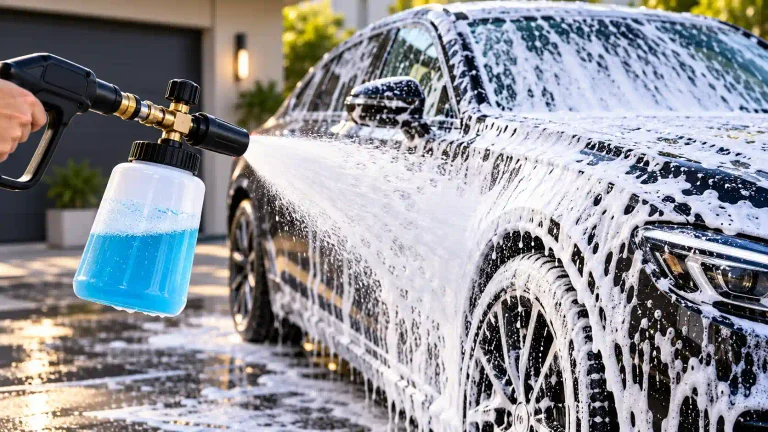
A foam cannon combines pressurized water, detergent solution, and air to distribute foamy cleaner over a vehicle. It typically connects to a pressure washer gun or wand, with a control for detergent delivery and an adjustable spray pattern.
The foam gives an appropriate cleaner time to work on contamination before rinsing. However, a thick white coating does not prove that the paint is clean. Road film and bonded contaminants can remain, and most regular washes still need careful contact cleaning.
A foam cannon also differs from a garden-hose foam gun. A hose-powered gun uses household water pressure; the cannons and pressure-washer foam attachments in this guide require a compatible pressure washer. They are not interchangeable purchases.
How We Chose These Foam Cannons
We compared manufacturer product pages, available manuals, package descriptions, and an exact Amazon listing where product identity could be established. The awards describe the use case each design appears best suited to; they are editorial recommendations, not laboratory performance rankings.
Our selection focused on:
- Connection compatibility: the fitting supplied and any model-specific restrictions.
- Operating requirements: published pressure, flow, temperature, and jet guidance.
- Adjustment: control over detergent delivery, fan width, and orientation.
- Bottle usability: opening size, stability, capacity, and measurement visibility.
- Maintenance: replaceable components and useful care instructions.
- Purchase practicality: whether the package includes accessories a buyer actually needs.
We did not rank these by foam photographs or assume that maximum advertised PSI predicts cleaning results. Product revisions and bundled accessories can differ between sellers, so confirm the exact version before checkout.
This article contains affiliate links. If you buy through them, we may earn a commission at no extra cost to you.
Product Comparison: 12 Foam Cannons at a Glance
Use this table to identify the right type of purchase before reading the individual reviews. Product links use specific Amazon ASINs where a matching listing was identifiable. The MTM Hydro wide-mouth version still requires ASIN confirmation.
| Product | Best For / Category | Amazon |
|---|---|---|
| MJJC Foam Cannon PRO V3.0 | Overall for Enthusiasts | Check Price on Amazon |
| MTM Hydro PF22.2 Wide Mouth Foam Cannon | for Serviceable Construction | Check Price on Amazon |
| Griot’s Garage THE BOSS Foam Cannon | for Automatic Mixing | Check Price on Amazon |
| Griot’s Garage Brilliant Finish Foam Cannon | for Manual-Mix Electric Washer Setups | Check Price on Amazon |
| McKillans Wide Mouth Foam Cannon | for Easy Filling | Check Price on Amazon |
| Adam’s Polishes Premium Foam Cannon | for Spray Orientation Control | Check Price on Amazon |
| Chemical Guys TORQ Big Mouth Max Release Foam Cannon | for a Chemical Guys Wash Setup | Check Price on Amazon |
| Active Premium Pressure Washer Foam Cannon 1000ml | for Multiple Jet Options | Check Price on Amazon |
| MJJC Foam Cannon S V3.0 | Alternative to the PRO V3.0 | Check Price on Amazon |
| Tool Daily 1-Liter Foam Cannon with 5 Nozzle Tips | Entry-Level Kit | Check Price on Amazon |
| Kärcher FJ 6 Foam Nozzle | for Compatible Kärcher K-Series Washers | Check Price on Amazon |
| Sun Joe SPX-FC34-PRO Foam Cannon | for Compatible Sun Joe SPX Setups | Check Price on Amazon |
The 12 Best Foam Cannons for Pressure Washers, Reviewed
Choose based on your existing equipment and how you prefer to wash. A useful bottle and the correct jet usually matter more than an impressive foam photo.
1. Best Overall for Enthusiasts — MJJC Foam Cannon PRO V3.0
Best for: Regular DIY detailers who want multiple orifice options and a larger bottle.
The MJJC PRO V3.0 is our overall enthusiast pick because its bottle design and included jets address two practical concerns: handling the cannon and matching it to the washer. MJJC specifies a bottle volume of up to 1.2 liters, a grooved grip, and an anti-leak cap.
The current quick-connect package lists a 1.25 mm installed orifice plus 1.1 mm and 1.35 mm alternatives. That gives you adjustment options without immediately buying another jet. However, MJJC restricts this model to cold-water machines. Select the connector and jet using its compatibility guidance before ordering.
Key Features
- Up to 1.2-liter bottle with a grip groove.
- 1.25 mm installed jet; 1.1 mm and 1.35 mm listed as spares.
- A 1/4-inch quick-connect version is available.
Pros
- Several included jet sizes for setup adjustment.
- Bottle design prioritizes handling and filling.
Cons
- Not intended for hot-water pressure washers.
- The correct fitting still depends on your gun or wand.
Buying Decision
Choose the PRO V3.0 if you expect to fine-tune your setup. For simpler routine washing, compare its added features with the S V3.0 before spending more.
2. Best for Serviceable Construction — MTM Hydro PF22.2 Wide Mouth Foam Cannon
Best for: Frequent washers who value a documented, maintainable foam cannon.
The MTM Hydro PF22.2 earns its place through practical construction and adjustable controls. The current wide-mouth package lists a nickel-plated brass body, a standing bottle, and a chemical adjustment knob with clicking positions. Its nozzle supports vertical and horizontal application.
MTM includes a 1.25 mm installed orifice and a 1.1 mm spare in the listed kit. The manufacturer also supplies care instructions and an exploded view, useful when identifying components. Check the plug profile carefully: some residential washers require MTM’s separately sold low-profile quick-connect plug.
Key Features
- Nickel-plated brass cannon body.
- Wide-mouth standing bottle and adjustable spray orientation.
- Two jet sizes and a fitting pack in the listed package.
Pros
- Clicking control helps identify chemical settings.
- Published component documentation supports maintenance.
Cons
- Certain residential couplers need a different plug.
- Older packages may have a different bottle.
Buying Decision
Choose the PF22.2 when maintenance and repeatable adjustment matter. Verify the wide-mouth package contents rather than assuming every PF22.2 listing includes the same accessories.
3. Best for Automatic Mixing — Griot’s Garage THE BOSS Foam Cannon
Best for: Owners who want to use compatible foaming concentrates without routine bottle premixing.
THE BOSS Foam Cannon has a meaningful difference from most picks here: its Auto-Mix system. With the appropriate metering tip and compatible concentrate, it handles dilution during dispensing. That can make a regular wash routine more convenient than measuring a new bottle mixture each time.
Griot’s specifies a stainless steel manifold, a 33.8-ounce reservoir, and adjustable chemical and spray controls. Auto-Mix is a system you must configure, however. Follow the product-specific metering guidance; do not assume one tip or setting provides the right dilution for every shampoo.
Key Features
- Auto-Mix system with metering-tip selection.
- Stainless steel manifold and 33.8-ounce reservoir.
- Vented cap and adjustable foam and spray controls.
Pros
- Reduces premixing steps with compatible products.
- Useful for a consistent branded wash routine.
Cons
- Requires the appropriate metering setup.
- Automatic mixing does not make all concentrates interchangeable.
Buying Decision
Choose THE BOSS if you plan to use its compatible foaming system regularly. Pick Brilliant Finish if you prefer manually preparing your own solution.
4. Best for Manual-Mix Electric Washer Setups — Griot’s Garage Brilliant Finish Foam Cannon
Best for: DIY owners who want to prepare their own dilution and have a washer meeting the published operating requirements.
Brilliant Finish is the more straightforward manual-mix alternative to THE BOSS. Its 33.8-ounce reservoir holds your prepared solution, while a dial and adjustable nozzle control dispensing. The manufacturer specifies an electroplated aluminum manifold.
The manual lists a 1.1 mm installed jet and a 1.25 mm alternative. It also gives pressure, flow, and cleaning-unit requirements, so compatibility involves more than choosing a fitting. This is a useful candidate for an electric washer, provided you check those requirements against its actual operating output.
Key Features
- 33.8-ounce reservoir for premixed solution.
- 1.1 mm installed jet with a 1.25 mm alternative.
- Dual-thread cap for compatible replacement bottles.
Pros
- Manual mixing keeps your recipe easy to record.
- Published jet guidance helps with washer matching.
Cons
- Does not offer THE BOSS Auto-Mix feature.
- You must confirm all operating requirements.
Buying Decision
Choose Brilliant Finish for a measured, repeatable manual-mix routine. It is a better fit than THE BOSS when automatic dilution is not something you need.
5. Best for Easy Filling — McKillans Wide Mouth Foam Cannon
Best for: Home washers who prioritize a stable bottle and uncomplicated controls.
The McKillans Wide Mouth Foam Cannon focuses on everyday handling. Its broad opening makes adding water and shampoo less awkward, while the wider base is designed to reduce tipping. A translucent bottle lets you monitor the remaining solution.
The top knob controls chemical output, and the nozzle adjusts stream width. McKillans lists a maximum pressure of 4,000 PSI and maximum flow of 2.5 GPM. That flow limit matters: a washer can fit the connector while exceeding the cannon’s stated operating ceiling.
Key Features
- Wide-mouth, translucent bottle with a broad base.
- Adjustable chemical output and spray width.
- Manufacturer limits: 4,000 PSI maximum and 2.5 GPM maximum.
Pros
- Convenient access for filling and rinsing the bottle.
- Visible solution level during use.
Cons
- Not the right match for output above its flow limit.
- Cannon-only and gun bundles have different contents.
Buying Decision
Choose McKillans if filling convenience is your priority and your washer meets its limits. Compare the cannon-only listing with bundles before buying accessories you already own.
6. Best for Spray Orientation Control — Adam’s Polishes Premium Foam Cannon
Best for: Owners who want to change fan orientation while working around a vehicle.
Adam’s Premium Foam Cannon combines a wide-mouth, 35-ounce canister with a wide base and 360-degree fan adjustment. Switching between vertical and horizontal spray can help you position the fan for doors, hoods, and other panel shapes without constantly changing your grip.
Adam’s lists a 1.25 mm orifice and operating ranges of 870–3,190 PSI and 1.3–5.3 GPM. Treat the pressure and flow specifications together. Its 1/4-inch attachment is convenient, but it does not remove the need to verify the connection on your existing sprayer.
Key Features
- 35-ounce wide-mouth canister.
- 360-degree fan adjustment.
- 1.25 mm orifice and 1/4-inch attachment.
Pros
- Orientation adjustment supports varied panel coverage.
- Wide base helps when setting down the filled bottle.
Cons
- Washer output must meet both published ranges.
- Premium cannon and snub-nose bundles are different purchases.
Buying Decision
Choose Adam’s if adjustable fan orientation is a feature you will use. Check the exact package before paying for a gun or shampoo bundle.
7. Best for a Chemical Guys Wash Setup — Chemical Guys TORQ Big Mouth Max Release Foam Cannon
Best for: Owners building a wash routine around Chemical Guys products and a compatible washer.
The TORQ Big Mouth Max Release Foam Cannon pairs a 34-ounce canister with a wide filling opening and an adjustable foam stream. It is a practical candidate if you already use Chemical Guys shampoo and want to follow the brand’s published setup instructions.
Chemical Guys lists 800–3,500 PSI compatibility and a minimum flow of 1.4 GPM, with 2.0 GPM recommended. A washer’s advertised peak PSI alone does not establish a good match. Compare its operating flow before choosing this cannon over a model suited to a lower-flow machine.
Key Features
- 34-ounce wide-opening canister.
- Adjustable foam output and spray stream.
- Standard quick-connect attachment.
Pros
- Wide opening makes routine mixing convenient.
- Published pressure and flow guidance supports selection.
Cons
- A low-flow washer may fall below its requirement.
- A cannon bundle may include shampoo you do not need.
Buying Decision
Choose Big Mouth when your washer meets its flow requirements and you prefer the Chemical Guys routine. Do not confuse it with the garden-hose Foam Blaster.
8. Best for Multiple Jet Options — Active Premium Pressure Washer Foam Cannon 1000ml
Best for: Owners who want to configure a cannon for different compatible washer outputs.
The Active Premium Foam Cannon is worth considering for its configuration options and available replacement components. The current product page lists a 1,000 ml bottle, a 1/4-inch quick connector, and a 1.25 mm installed nozzle. Active also lists several included orifice sizes in its compatibility guidance.
The published limits include 3,000 PSI maximum pressure, 4 GPM maximum flow, and 104°F maximum water temperature. Use the manual to choose a jet, and check that an Amazon listing matches the current version rather than an older package.
Key Features
- Approximately 33.8-ounce, wide-mouth bottle.
- 1.25 mm installed nozzle with additional listed jet options.
- Replacement nozzle and pickup components are available.
Pros
- Several setup options for compatible machines.
- Parts availability is useful for ongoing maintenance.
Cons
- Package revisions can change included components.
- Temperature and output limits still apply.
Buying Decision
Choose Active if jet selection and replaceable parts matter to your setup. Confirm the current package and manual before assuming a particular spare nozzle is included.
9. Best Alternative to the PRO V3.0 — MJJC Foam Cannon S V3.0
Best for: Owners who want MJJC spray adjustment without needing the PRO model’s particular bottle and spare-jet package.
The S V3.0 gives buyers another MJJC option with 360-degree spray control and a revised bottle, cap, and pickup tube. These features make it worth comparing with the PRO V3.0 rather than automatically choosing the newer-looking or higher-priced listing.
The current quick-connect package lists a 1.25 mm installed orifice and a 1.1 mm spare. Like the PRO model, it is intended for cold-water pressure washers. Compare the actual package contents and connector; the two models should not be treated as identical just because both carry a V3 name.
Key Features
- 360-degree spray adjustment.
- Revised bottle, cap, and pickup design.
- 1.25 mm installed jet and 1.1 mm spare listed.
Pros
- A distinct alternative within the MJJC range.
- Selectable connector versions for different setups.
Cons
- Not intended for hot-water machines.
- Does not list the same spare-jet package as PRO V3.0.
Buying Decision
Choose S V3.0 when its adjustments and listed accessories cover your needs. Compare delivered cost and fitting choice rather than assuming it always costs less.
10. Best Entry-Level Kit — Tool Daily 1-Liter Foam Cannon with 5 Nozzle Tips
Best for: First-time buyers who want a basic cannon and separate pressure washer nozzle tips.
The Tool Daily kit is a straightforward starting point: a 1-liter bottle, a 1/4-inch quick-connect plug, adjustable chemical delivery, and five separate nozzle tips. The verified listing specifies a working pressure of 1,000–3,000 PSI.
The extra tips are pressure washer spray nozzles, not replacement foam-cannon orifices. That distinction matters when trying to improve weak foam. You still need a compatible pressure washer and the correct fitting; this attachment does not connect directly to a garden hose or faucet.
Key Features
- 1-liter bottle and 1/4-inch quick-connect plug.
- Adjustable foam level and spray pattern.
- Five separate pressure washer nozzle tips.
Pros
- Simple package for trying a foam prewash.
- Extra rinse tips may help complete a basic setup.
Cons
- Not suitable above the listed 3,000 PSI range.
- Narrow spray tips require care around vehicle surfaces.
Buying Decision
Choose Tool Daily for a basic first setup when the current price is attractive. Select a vehicle-appropriate rinse tip; the narrowest nozzle is not the best car-washing choice.
11. Best for Compatible Kärcher K-Series Washers — Kärcher FJ 6 Foam Nozzle
Best for: Owners of compatible US-market Kärcher K1–K5 electric pressure washers.
The FJ 6 is a pressure-washer foam attachment designed around Kärcher’s K-series connection. Its approximately 20-ounce container, detergent dial, and adjustable jet make it a convenient option when retaining the original compatible gun.
Compatibility is the reason to choose it, and also its main restriction. Kärcher’s US page excludes K1700–K2300 machines and gas pressure washers. Some older guns require Adapter M. Check the exact model instead of assuming every yellow Kärcher pressure washer uses the same connection.
Key Features
- Approximately 20-ounce detergent container.
- Adjustable dosing dial and jet.
- Connection for listed Kärcher K1–K5 electric models.
Pros
- Convenient match for the specified original equipment.
- Compact bottle for smaller washing tasks.
Cons
- Not compatible with US K1700–K2300 models or gas washers.
- Smaller reservoir may need more frequent refilling.
Buying Decision
Choose FJ 6 for a confirmed compatible K-series gun. If you own a K1700-style machine, consider a correctly matched quick-connect cannon instead.
12. Best for Compatible Sun Joe SPX Setups — Sun Joe SPX-FC34-PRO Foam Cannon
Best for: Sun Joe owners seeking a 34-ounce quick-connect foam attachment.
The SPX-FC34-PRO offers a marked 34-ounce bottle, a detergent-control dial, and a nozzle that adjusts between a concentrated stream and wider fan. The measurement markings help you repeat a bottle mixture without estimating by eye.
Sun Joe’s guide lists compatible SPX families, including specific qualifications for some series. It is important to distinguish this PRO quick-connect model from other FC34 versions and adapter packages. Match your existing wand connection and exact washer model before purchasing.
Key Features
- 34-ounce bottle with measurement markings.
- 1/4-inch quick-connect attachment.
- Adjustable detergent delivery and spray pattern.
Pros
- Marked bottle supports consistent mixing.
- Manufacturer publishes model-family compatibility guidance.
Cons
- Compatibility is not universal across every SPX model.
- Similar FC34 names can refer to different packages.
Buying Decision
Choose SPX-FC34-PRO if the manual confirms your setup. Verify the PRO model and connector in the listing rather than buying on the Sun Joe name alone.
Quick Comparison: Which Design Fits Your Routine?
The most useful differences are how you mix detergent, handle the bottle, and connect the attachment.
| Your priority | Shortlist | What to verify |
|---|---|---|
| Automatic dilution | Griot’s Garage THE BOSS | Correct metering tip and compatible concentrate |
| Multiple included jets | MJJC PRO V3.0 or Active Premium | Current package contents and manual jet selection |
| Manual mixing with published electric-washer guidance | Griot’s Garage Brilliant Finish | Actual operating output and installed jet |
| Wide-mouth filling | McKillans, Adam’s Premium, or MTM PF22.2 Wide Mouth | Bottle version and pressure/flow limits |
| First cannon plus rinse tips | Tool Daily 1-Liter Kit | Working pressure and suitable rinse nozzle |
| Retaining a compatible Kärcher K-series gun | Kärcher FJ 6 | Exact K-series model and any required adapter |
| Existing Sun Joe quick-connect setup | SPX-FC34-PRO | Exact PRO version and model compatibility |
Buying Guide: How to Choose a Foam Cannon for Your Pressure Washer
Check the Gun Connection Before the Brand Name
The cannon usually attaches to the outlet of your pressure washer gun or wand. A 1/4-inch quick-connect plug is common, but proprietary connections and differing plug profiles exist. Check the actual outlet rather than assuming a washer brand guarantees compatibility.
An M22 connection elsewhere in the system may be the hose-to-gun fitting. It is not automatically the connection needed at the foam cannon. Buying a new short gun can introduce additional adapter requirements, so compare the complete connection path before replacing equipment.
Compare Operating PSI and GPM
PSI measures pressure; GPM measures water flow. Both matter when matching accessories. Use the washer’s operating specifications where available, and check whether the advertised maximum pressure and flow occur under different conditions.
For example, Adam’s publishes both a pressure range and a flow range for its Premium cannon. McKillans separately lists maximum pressure and maximum flow. A machine can satisfy one condition and fail the other.
Do not buy a high-output gas washer simply to chase thicker foam. First determine whether your existing machine meets the attachment’s requirements and whether the correct jet is installed.
Select the Orifice for Your Particular Setup
The orifice is the small internal water jet, not the outer fan nozzle. Common listed sizes include 1.1 mm and 1.25 mm, but the right choice depends on the cannon and the washer.
A smaller jet is sometimes recommended for a lower-output machine. That does not make it a universal upgrade: extra restriction can be inappropriate for another setup. Follow the manufacturer’s selection guidance, and stop using a combination that causes unusual pulsing or repeated cycling.
Distinguish an orifice spare from a kit’s separate rinse nozzles. Changing a 25-degree rinse tip does not change the foam cannon’s internal jet.
Choose Manual Mixing or Automatic Mixing
Most cannons use detergent that you mix with water in the reservoir. This approach works well when you want to record and repeat your own recipe.
An automatic system, such as THE BOSS, uses a configured metering arrangement with compatible concentrates. It can reduce preparation steps, but it still needs the right settings. Do not fill a manual-mix cannon with undiluted shampoo simply because another design supports automatic dilution.
The bottle dilution is also not necessarily the final concentration reaching the paint. The cannon introduces additional water during spraying, and delivery varies with the setup. Follow the shampoo’s specific foam-cannon directions.
Consider Bottle Handling and Maintenance
A wide opening makes filling and cleaning easier. A broad base helps when placing the detached bottle on the ground, while visible markings help repeat a mixture. Larger capacity is useful only if you need the extra solution; a full bottle also adds weight.
Look beyond initial foam output. Replaceable seals, pickup tubes, jets, and mesh components can make maintenance easier. A cannon with documented parts may be a more practical long-term purchase than one you cannot service.
Match the Shampoo to the Job
Choose a product suitable for both your equipment and the vehicle surface. A maintenance shampoo and a stronger prewash cleaner serve different purposes, even when both foam well.
For waxed, sealed, or ceramic-coated paint, check the cleaner’s dilution and compatibility instructions. Avoid assuming that a pH description alone establishes suitability for every finish, material, or concentration. More shampoo can increase consumption without solving a fitting, flow, or filter problem.
How to Use a Foam Cannon Without Wasting Shampoo
Start with the product labels and equipment manuals. Different cleaners specify different application surfaces, dilution, and dwell times.
- Park in the shade and let the panels cool. Prepare the washer according to its instructions.
- Confirm the fitting is secure and the jet matches the manufacturer’s guidance. Depressurize before changing attachments or components.
- Prepare the recommended mixture, usually adding water before shampoo to limit bubbles during filling. Configure Auto-Mix separately when applicable.
- Follow the cleaner’s instruction on whether to apply to dry paint or pre-rinse first. Remove heavy loose contamination as directed.
- Adjust detergent output and fan width for even coverage. Avoid repeatedly coating the same area just to build a thicker layer.
- Allow only the specified dwell time and rinse before the cleaner dries. Use a suitable vehicle-cleaning nozzle and distance according to the washer and vehicle guidance.
- Complete a careful contact wash if dirt or road film remains, then rinse and dry with clean equipment.
- Flush the bottle and cannon with clean water after use until detergent is cleared. Store according to the manual, including protection from freezing.
Why Is My Foam Cannon Producing Watery Foam?
Watery output can result from the mixture, washer compatibility, a blocked component, or an air leak. Replace parts only after checking the basics.
| Symptom | Possible cause | First check |
|---|---|---|
| Thin foam from the first use | Unsuitable shampoo, incorrect mix, or mismatched jet | Label dilution and manufacturer setup guidance |
| Foam becomes weaker over time | Detergent residue in the pickup path or foaming mesh | Flush and service according to the manual |
| Soap draw stops when the bottle tilts | Pickup tube no longer submerged | Tube position and remaining solution |
| Liquid leaks around the bottle | Loose cap, damaged seal, or incorrect assembly | Cap alignment and seal condition |
| Washer pulses with the cannon attached | Restricted flow or incompatible setup | Installed jet, water supply, and washer guidance |
Water hardness and the shampoo formulation can also affect appearance. Change one variable at a time so you can tell whether a new mixture or hardware adjustment helped. A stable, usable foam layer is a better goal than using extra concentrate to imitate a video.
Conclusion: Which Foam Cannon Should You Buy?
The MJJC PRO V3.0 is our overall enthusiast choice for its bottle features and listed spare jets. The MTM PF22.2 Wide Mouth deserves consideration when component documentation and adjustable controls are priorities. THE BOSS is the more distinctive option if automatic mixing fits your routine.
For a first purchase, compare the Tool Daily kit with your existing nozzle collection and current budget. Kärcher and Sun Joe owners should check their exact equipment before choosing a branded attachment.
Start with compatibility, then choose the bottle and mixing method you will enjoy using. A correctly matched cannon, appropriate shampoo, and careful wash technique are more useful than the thickest possible foam.
FAQs About Foam Cannons for Pressure Washers
What is the best foam cannon for an electric pressure washer?
The best choice is one that matches your electric washer’s operating pressure, flow, and gun connection. MJJC models with the correct jet and Griot’s Brilliant Finish are useful candidates to compare. An electric motor alone does not establish compatibility.
Will a foam cannon work with any pressure washer?
No. The fitting, operating output, temperature limits, and installed jet must suit the cannon. Model-specific attachments such as Kärcher FJ 6 have additional restrictions, while a quick-connect cannon may still require a different plug or adapter.
Can I use a foam cannon without a pressure washer?
The pressure-washer attachments in this guide require a compatible pressure washer. For a standard garden hose, choose a hose-powered foam gun. Buying a hose adapter does not make these two types function the same way.
Is a 1.1 mm orifice better than a 1.25 mm orifice?
Neither is universally better. The appropriate diameter depends on the cannon’s design and the washer’s output. Follow the model-specific selection instructions rather than fitting the smallest available jet to every machine.
How much car shampoo should I put in the bottle?
Use the shampoo manufacturer’s foam-cannon dilution instructions. Concentrations vary, so there is no single ounce-per-bottle recipe that suits every product. Start with the specified mixture and record adjustments instead of adding extra shampoo automatically.
Does thicker foam clean a car better?
Not necessarily. Cleaning depends on the chemistry, concentration, dwell time, contamination, and rinsing process. Foam appearance alone does not establish how much dirt has been removed or whether a contact wash is still needed.
Can a foam cannon replace hand washing?
Usually not for a complete maintenance wash. An appropriate prewash can help remove some contamination before contact, but remaining road film may need careful washing. Do not assume paint is clean because the foam rinsed away.
Are foam cannons safe for ceramic-coated cars?
The attachment itself does not determine chemical compatibility. Use a cleaner approved for the coating and other exposed surfaces at the specified dilution. Follow dwell-time instructions and prevent the solution from drying.
How often should I clean a foam cannon?
Flush detergent out after each use and follow the manufacturer’s service schedule. If foam output drops, inspect the pickup path and serviceable mesh rather than compensating with increasingly concentrated shampoo. Disconnect and depressurize before maintenance.