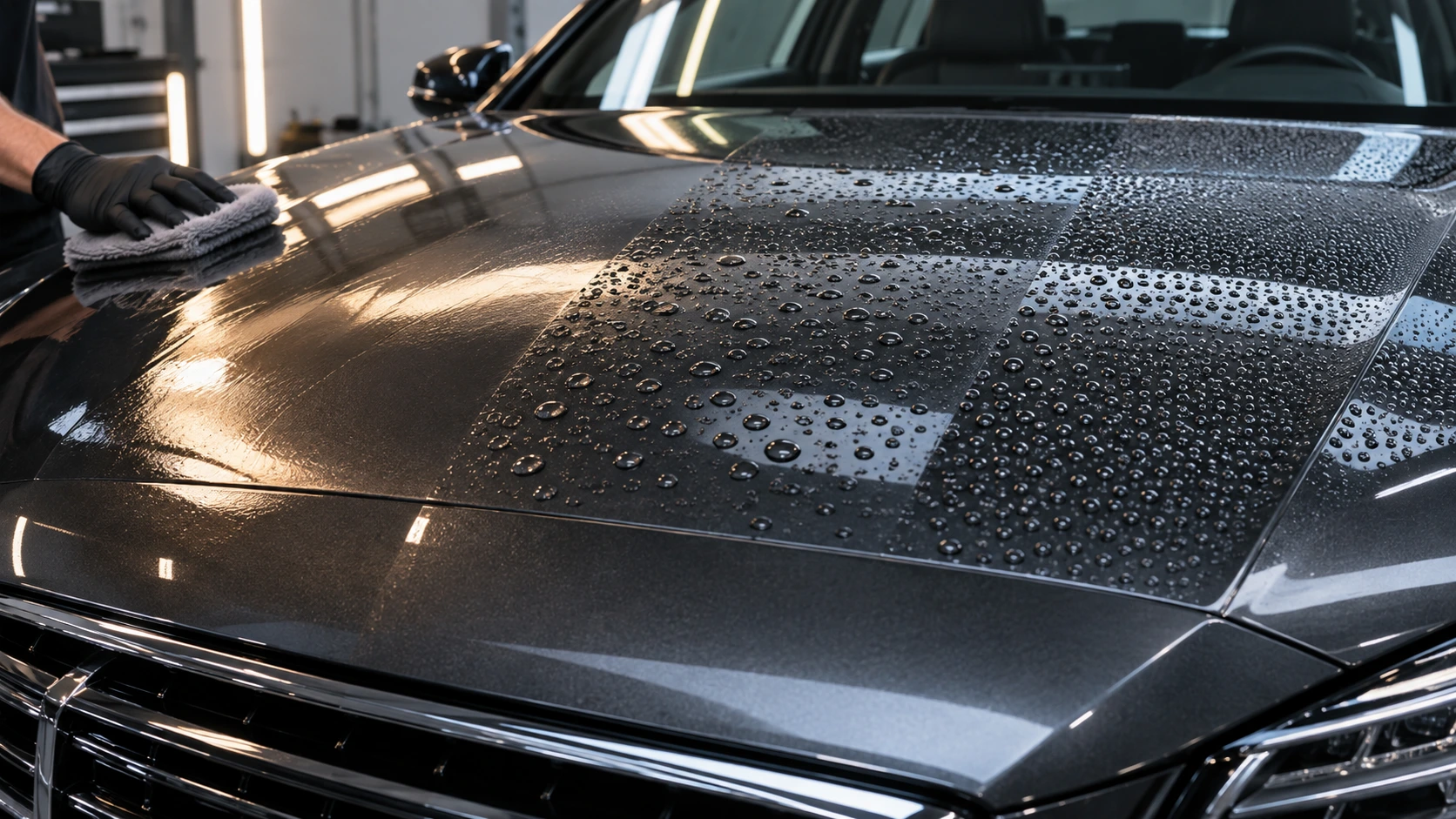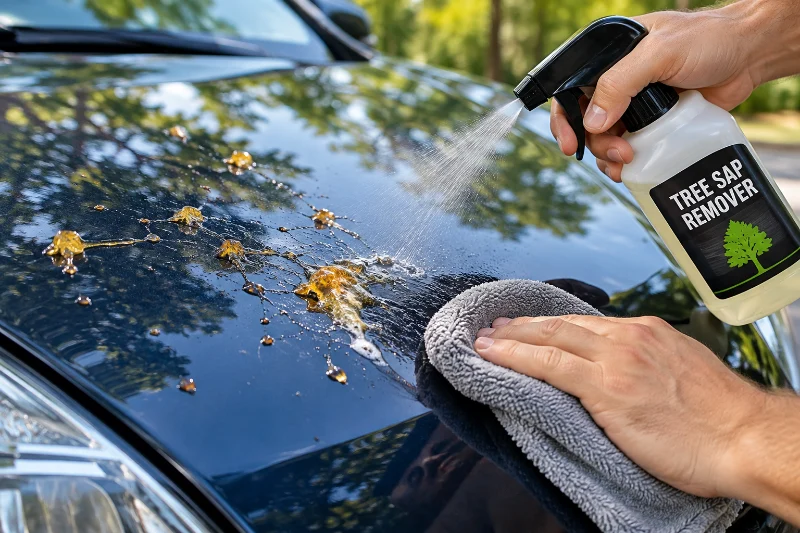
Bug splatter should not stay on car paint longer than necessary. Once insect residue dries and bakes onto the front bumper, mirrors, hood, headlights, or windshield, normal car shampoo may not remove it without repeated wiping.
That extra rubbing is the problem.
A good bug remover softens or breaks down insect residue before you touch the paint. The goal is to reduce scrubbing, not replace proper washing technique.
For most drivers, 3D Bug Remover is the best all-around option because it is made specifically for bug residue, works on paint, PPF, glass, chrome, plastic, and other exterior surfaces, and can be used as a spot cleaner or pre-wash. Meguiar’s Heavy Duty Bug & Tar Remover is easier when you want a clinging aerosol foam, while Gtechniq W8 Bug Remover is the better fit for a ceramic-coated car because the manufacturer specifically lists it as coating safe.
If tar and sap are a bigger problem than insects, Stoner Tarminator is the stronger specialist product. For professional or frequent use, P&S Bug Off and McKee’s 37 Road Kill Bug Remover offer larger-volume or concentrated options.
How We Reviewed These Bug Removers
This guide uses current manufacturer instructions, surface compatibility, formula type, application method, product availability, and recent independent hands-on comparisons where available.
Car Care Guy did not run a controlled laboratory test on all 12 products for this draft. Where a product has not been independently tested under the same conditions as another product, we do not invent test times, cleaning percentages, or performance scores.
The most useful comparison is whether the product fits the job: fresh insects, baked-on residue, tar, sap, coated paint, large-volume professional use, or quick road-trip cleanup.
Best Bug Removers Comparison Table
| Product | Best For | Main Use | Amazon |
|---|---|---|---|
| 3D Bug Remover 16 oz | Best Overall | Bugs, residue, pre-wash | Check Price on Amazon |
| Meguiar’s Heavy Duty Bug & Tar Remover G180515 | Best Clinging Foam | Bugs and tar | Check Price on Amazon |
| Chemical Guys Bug & Tar Remover CWS_104_16SW | Best Concentrated Pre-Wash | Bugs, tar, road grime | Check Price on Amazon |
| Gtechniq W8 Bug Remover 500 ml | Best for Ceramic-Coated Cars | Bug residue | Check Price on Amazon |
| Mothers Speed Foaming Bug & Tar Remover 16719 | Best No-Drip Aerosol | Bugs, bird droppings, tar, sap | Check Price on Amazon |
| Adam’s Polishes Car Bug Remover 16 oz | Best for Road Trips | Bug splatter | Check Price on Amazon |
| McKee’s 37 Road Kill Bug Remover MK37-100 | Best Dilutable Formula | Bugs, road film, light tar | Check Price on Amazon |
| Stoner Car Care Tarminator 91154 10 oz | Best for Tar and Sap | Tar, sap, asphalt | Check Price on Amazon |
| P&S Bug Off Insect Remover 1 Gallon | Best for Frequent Use | Heavy bug buildup | Check Price on Amazon |
| SONAX Insect Remover 500 ml | Best for Paint and Glass | Dried insect residue | Check Price on Amazon |
| Turtle Wax Bug & Tar Remover T-520A 16 oz | Best Budget Pick | Bugs, tar, tree sap | Check Price on Amazon |
| BugSlide 16 oz Shop Kit | Best Waterless Touch-Up Kit | Bugs and light surface dirt | Check Price on Amazon |
Our Top 12 Bug Removers for Cars
The products below are not identical.
Some are dedicated insect removers. Some also attack tar and tree sap. Others are designed as concentrated pre-wash cleaners or waterless detailing products.
That difference matters.
A solvent-heavy tar remover may be unnecessary for fresh insects on a ceramic-coated bumper. A mild coating-safe bug remover may take longer on old asphalt or sticky sap.
Choose the product around the contamination, not only the brand.
1. 3D Bug Remover 16 oz — Best Overall\
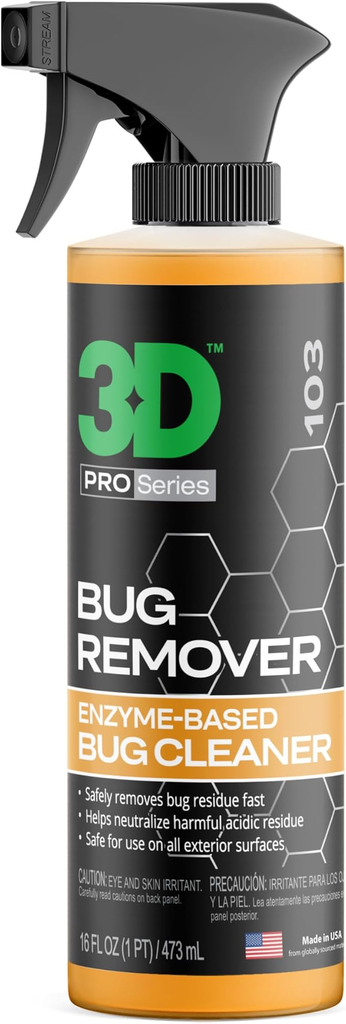
3D Bug Remover is a dedicated exterior cleaner made for insect residue and similar organic contamination.
3D lists it as safe for paint, paint protection film, glass, plastic, rubber, chrome, metal, and other exterior surfaces. That broad surface compatibility is useful because bug splatter rarely stays on one material. A highway drive can leave residue across the bumper, grille, headlights, mirror caps, windshield, and hood.
The product can be used straight from the bottle or diluted for lighter cleaning.
For normal spot treatment, spray the affected area, allow roughly 30 to 45 seconds of dwell time, then wipe gently with a clean microfiber towel. It can also be used as a pre-wash and rinsed away before normal contact washing.
3D states that the formula is safe over wax, sealants, and ceramic coatings. That makes it easier to use on a regularly protected vehicle without reaching immediately for a stronger solvent.
Recent Amazon market data also shows this remains one of the most widely purchased dedicated bug removers in the category.
Best for: Drivers who want one bug remover that works across most exterior surfaces.
Pros:
- Dedicated bug-removal formula
- Safe on paint and clear coat
- Safe on PPF
- Works on glass, plastic, rubber, chrome, and metal
- Can be used as a spot cleaner
- Can be used as a pre-wash
- Can be diluted
- Compatible with common paint-protection products
- Made in the USA
Cons:
- Costs more than basic supermarket bug sprays
- Heavy baked-on residue may need a second application
- Still requires careful towel technique
- Tar-heavy contamination may be better handled by a dedicated solvent
Buying Decision:
Choose 3D Bug Remover if you want the simplest all-around answer for normal insect buildup.
It is especially useful for a protected daily driver because it gives you a dedicated bug cleaner without forcing you into a strong tar solvent every time you return from a highway trip.
2. Meguiar’s Heavy Duty Bug & Tar Remover G180515 — Best Clinging Foam
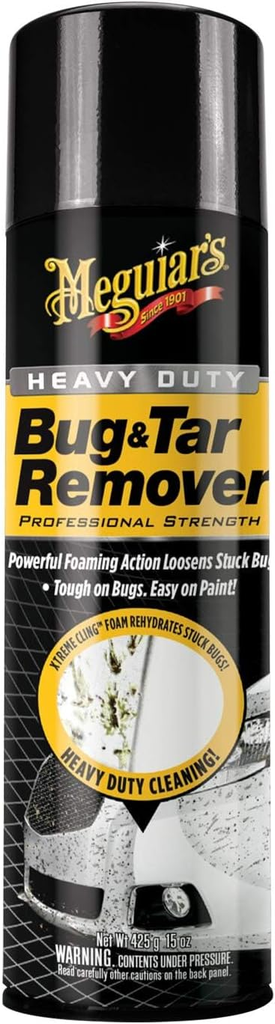
Meguiar’s Heavy Duty Bug & Tar Remover uses an aerosol foam rather than a thin trigger spray.
The main benefit is dwell time.
Meguiar’s Xtreme Cling formula is designed to remain on vertical panels while it rehydrates dried insect residue and softens tar.
That is useful on front bumpers, grilles, mirror caps, headlights, and lower rocker panels where a normal liquid may run down the surface before it has enough time to work.
Meguiar’s lists the product as clear-coat safe and suitable for paint, glass, plastic, and other common exterior surfaces.
It works well as a pre-wash treatment. Spray it onto the affected area on a cool surface, let the foam work, then continue with your normal wash.
The aerosol can is convenient, but it does not offer the same cost-per-use as a large concentrate.
Best for: Dried bugs on vertical panels where longer dwell time helps.
Pros:
- Thick clinging foam
- Made for bugs and tar
- Clear-coat safe
- Works on paint, glass, and plastic
- Useful before a normal wash
- Good coverage on vertical panels
- Simple aerosol application
- Easy to keep in a detailing cabinet
Cons:
- Aerosol can runs out faster than bulk liquid
- Not the cheapest option per application
- Heavy tar may need a stronger solvent
- Overspray needs control around surrounding areas
Buying Decision:
Choose Meguiar’s if dried insects keep sticking to the bumper and grille and you want a product that stays in place while it works.
It is one of the easiest choices for drivers who prefer a spray-on foam instead of mixing concentrate.
3. Chemical Guys Bug & Tar Remover CWS_104_16SW — Best Concentrated Pre-Wash
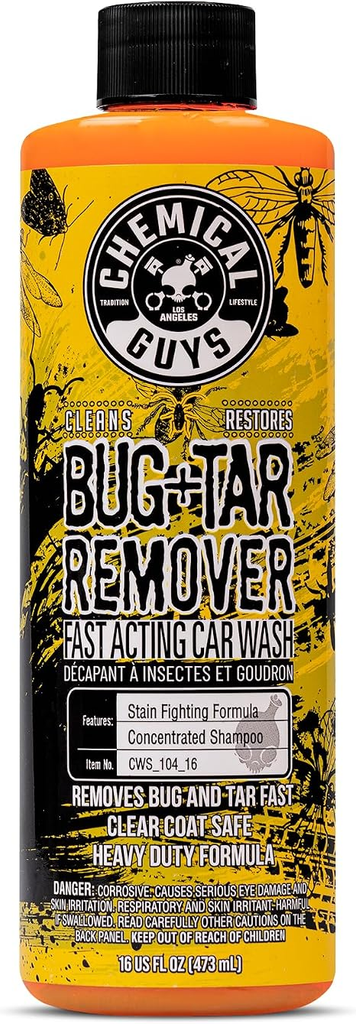
Chemical Guys Bug & Tar Remover is more flexible than a typical ready-to-use bug spray.
It can be diluted in a spray bottle, added directly to a wash bucket, or mixed with another car shampoo to increase cleaning strength.
Chemical Guys currently recommends a 6:1 dilution when using it as a direct spray treatment.
For a wash bucket, the company recommends adding about 2 ounces.
The formula works on paint, glass, plastic, rubber, stainless steel, metal, and aluminum.
That makes it useful for a front end covered with bugs plus road film rather than one isolated splatter.
Because it is concentrated, this is a better choice for someone who washes frequently and does not mind mixing the product before use.
Best for: Frequent washers who want a concentrate that can be used several ways.
Pros:
- Concentrated formula
- Can be diluted for spray use
- Can be added to a wash bucket
- Can boost normal car shampoo
- Works on many exterior surfaces
- Good for bugs, tar, and road grime
- Better value than some ready-to-use sprays
- Useful before contact washing
Cons:
- Requires dilution for some uses
- More preparation than a ready-to-use bottle
- Stronger cleaning may reduce some wax protection
- Should not be allowed to dry on the vehicle
Buying Decision:
Choose Chemical Guys Bug & Tar Remover if you want a product that can become part of your normal wash process.
It makes more sense for frequent detailing than buying small aerosol cans repeatedly.
4. Gtechniq W8 Bug Remover 500 ml — Best for Ceramic-Coated Cars
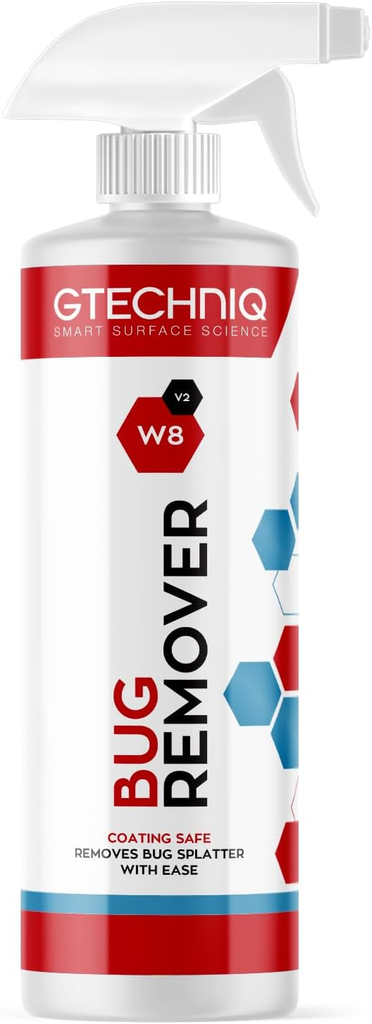
Gtechniq W8 is aimed at drivers who want to remove insects without compromising an existing ceramic coating.
Gtechniq specifically states that W8 is coating safe and designed to break down bug residue without stripping protective coatings.
It is also listed as safe for clear coat, plastic trim, plastic surfaces, and glass.
The formula is biodegradable and pH neutral.
For normal use, Gtechniq recommends applying it to a cool surface, allowing roughly three to five minutes of dwell time, and rinsing before the product dries.
That longer dwell period gives the cleaner time to soften dried insect residue without requiring aggressive wiping.
If the residue remains, repeat the treatment or use gentle microfiber agitation.
Best for: Ceramic-coated vehicles and drivers who want a pH-neutral insect cleaner.
Pros:
- Ceramic-coating safe
- pH neutral
- Biodegradable
- Safe on paint
- Safe on plastic trim
- Works on glass
- Long dwell time reduces the need for hard scrubbing
- Good fit for premium detailing routines
Cons:
- More expensive than budget bug removers
- Requires rinsing
- Three-to-five-minute dwell is slower than quick wipe products
- Not designed as the main product for heavy asphalt or tar
Buying Decision:
Choose Gtechniq W8 if your car has a ceramic coating and protecting that coating matters more than using the strongest possible solvent.
It is a focused insect remover rather than an all-purpose tar and adhesive cleaner.
5. Mothers Speed Foaming Bug & Tar Remover 16719 — Best No-Drip Aerosol
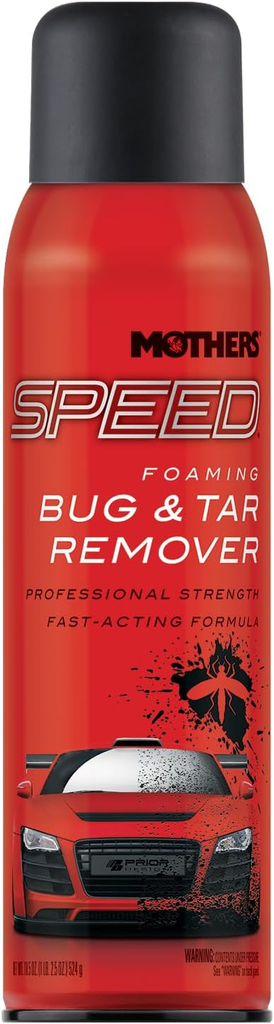
Mothers Speed Foaming Bug & Tar Remover uses a no-drip aerosol foam designed to stay on the contaminated area.
Mothers lists it for insect splatter, bird droppings, road grime, tar, sap, and other exterior deposits.
It can be used on paint, chrome, glass, metal, plastic, acrylic, vinyl wrap, and clear paint protection film.
The foam format is especially useful around grilles, vents, louvers, mirror housings, and other shapes where a trigger spray runs away quickly.
Mothers says it can be used as a spot cleaner or pre-wash treatment.
That gives it more flexibility than a product meant only to be used during a full wash.
Best for: Grilles, bumpers, vents, and other areas where a clinging foam is easier to control.
Pros:
- No-drip foam
- Works on bugs and bird droppings
- Also targets tar and sap
- Safe on PPF
- Safe on vinyl wrap
- Works on paint, glass, chrome, metal, and plastic
- Useful for spot cleaning
- Useful as a pre-wash
Cons:
- Aerosol is less economical than gallon concentrate
- Stronger formula than necessary for fresh light splatter
- Can needs to be stored properly
- Heavy tar may still require repeated treatment
Buying Decision:
Choose Mothers Speed if your front grille and bumper collect most of the insects and you want foam that stays where you spray it.
Its broad surface list also makes it useful on vehicles with wrap or PPF.
6. Adam’s Polishes Car Bug Remover 16 oz — Best for Road Trips
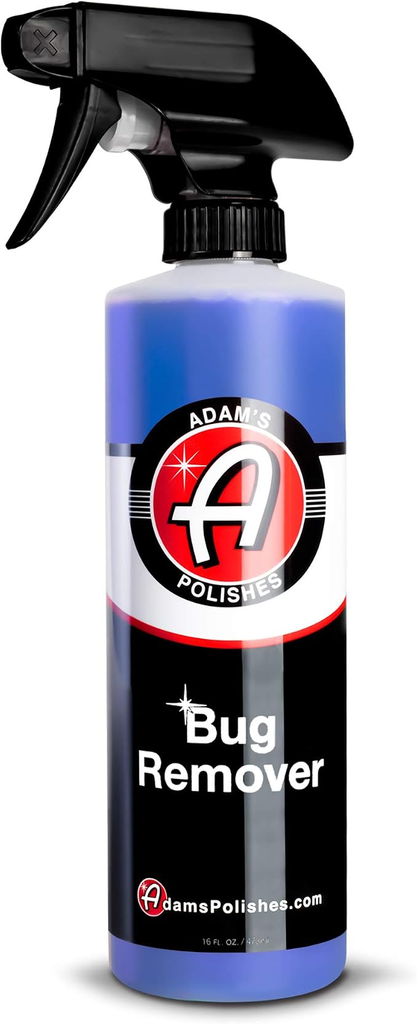
Adam’s Bug Remover is made for fast treatment of insect residue after highway driving.
The product is intended to dissolve bug splatter on paint, glass, bumpers, plastic, rubber, chrome, metal, headlights, and other common exterior surfaces.
That broad compatibility is useful when you return from a road trip with bugs across the entire front of the car.
The 16-ounce trigger bottle is also easy to carry in a trunk detailing kit.
Apply it before the residue spends days baking in direct sun.
Fresh insect residue is easier to remove than old residue that has dried through several heat cycles.
Best for: Drivers who travel often and want a ready-to-use bottle for post-trip cleanup.
Pros:
- Ready to use
- Works on many exterior surfaces
- Good for front bumpers and mirrors
- Suitable for glass and headlights
- Compact 16-ounce bottle
- Easy to keep in a trunk kit
- Designed specifically around bug residue
- Useful before a normal wash
Cons:
- Smaller bottle than professional concentrates
- Frequent users may go through it quickly
- Strong baked-on deposits can need a second pass
- Not as specialized for tar as Tarminator
Buying Decision:
Choose Adam’s if most of your bug problems come from highway or road-trip driving.
It is easy to keep in the garage or trunk and does not require mixing before use.
7. McKee’s 37 Road Kill Bug Remover MK37-100 — Best Dilutable Formula
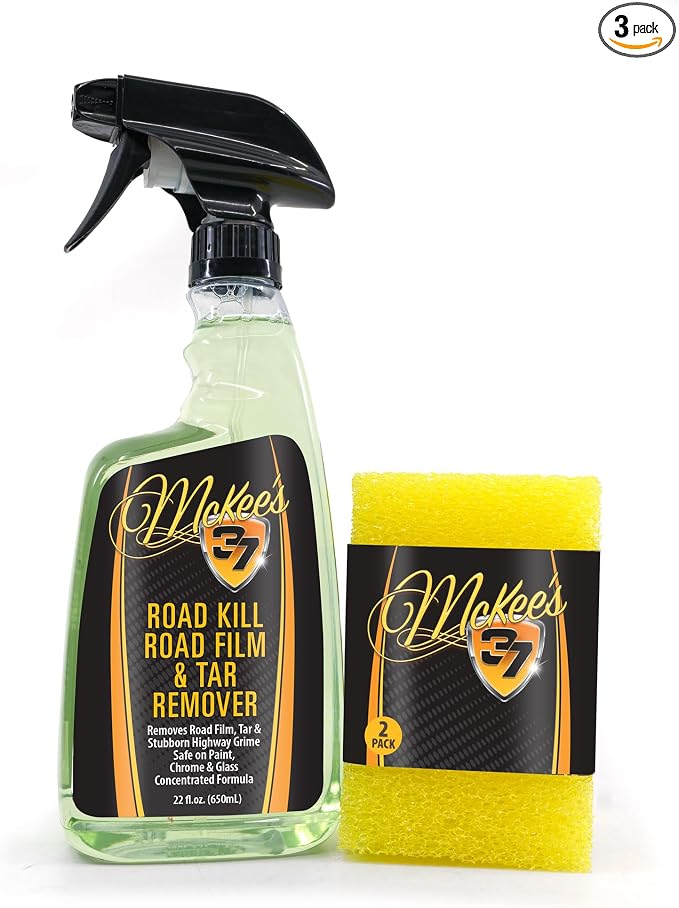
McKee’s 37 Road Kill Bug Remover is designed for insects, road film, and fresh tar.
The formula can be used full strength or diluted 1:1 with water for routine bug removal on well-maintained vehicles.
That gives you more control over cleaning strength than a fixed ready-to-use spray.
McKee’s lists it as safe on paint, glass, chrome, and plastic trim.
For normal bug residue, spray the product onto a cool surface, allow about 30 seconds of dwell time, then wipe gently with a microfiber towel.
It can also be added to a wash bucket when the whole vehicle needs extra cleaning power.
Best for: Drivers who want a concentrated bug remover that can be adjusted for the job.
Pros:
- Can be diluted 1:1
- Safe on paint
- Works on glass
- Works on chrome and plastic trim
- Targets bugs and road film
- Can help with fresh tar
- Can be added to wash solution
- Good value when diluted
Cons:
- Requires mixing for diluted use
- Stronger contamination may need full-strength application
- Not as convenient as aerosol foam
- Old hardened tar is better handled by a dedicated tar solvent
Buying Decision:
Choose McKee’s 37 if you want to control the strength of your cleaner instead of using the same concentration for every job.
It is especially useful in bug-heavy areas where front-end cleaning is part of your normal wash routine.
8. Stoner Car Care Tarminator 91154 10 oz — Best for Tar and Sap
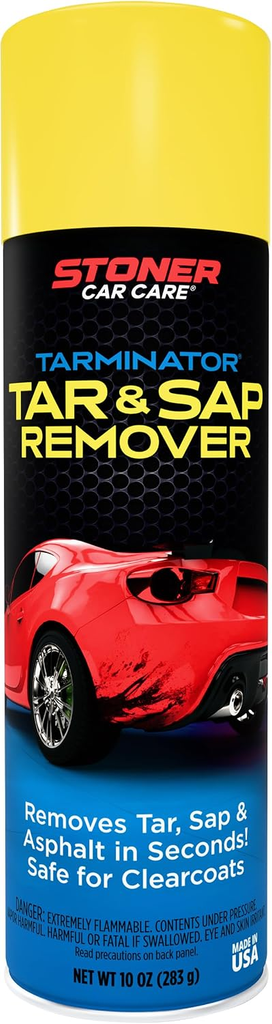
Tarminator is not the first product I would buy for normal fresh insect splatter.
It is here because road trips often leave a combination of bugs, tar, asphalt, grease, and tree sap, and Tarminator is stronger on petroleum-based contamination than many mild bug cleaners.
Stoner lists it as safe on automotive paint, clear coat, chrome, and several exterior surfaces when used as directed.
The aerosol solvent acts quickly and is intended to dissolve tar and sap with minimal rubbing.
That makes it a useful second bottle if a dedicated bug remover cleans the insect residue but leaves black tar spots on the lower doors and rocker panels.
Use it on a cool surface and follow the dwell and wipe instructions rather than allowing the solvent to sit for an extended period.
Best for: Tar, asphalt, tree sap, and oily road contamination.
Pros:
- Fast solvent action
- Excellent fit for tar
- Useful on tree sap
- Works on asphalt residue
- Clear-coat safe when used correctly
- Easy aerosol application
- Helps avoid aggressive scraping
- Good companion to a normal bug remover
Cons:
- More solvent-heavy than a dedicated insect cleaner
- Not the first choice for coating maintenance
- Stronger than necessary for fresh bugs
- Needs controlled application around sensitive surfaces
Buying Decision:
Choose Tarminator if your “bug remover” problem also includes black tar spots, road asphalt, or sticky sap.
For insects only, 3D, Meguiar’s, Gtechniq, or Adam’s is the better starting point.
9. P&S Bug Off Insect Remover 1 Gallon — Best for Frequent Use
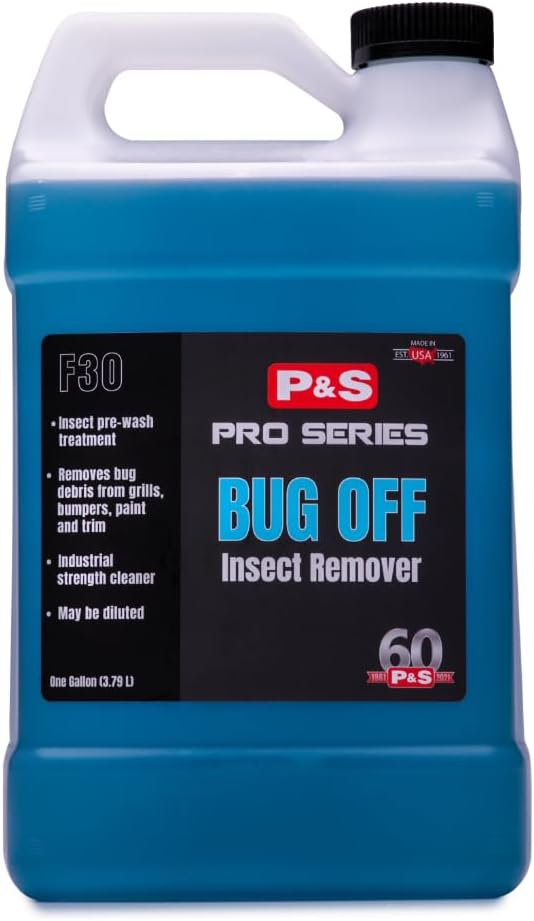
P&S Bug Off is aimed at professional detailing and frequent front-end cleaning.
The formula is designed to break down heavy insect buildup on grilles and bumpers before the vehicle is washed.
The one-gallon format is the main reason to choose it.
If you clean one personal car a few times each summer, a gallon is unnecessary. If you maintain several cars, a fleet, rideshare vehicles, or customer cars, the larger bottle is easier to justify.
P&S recommends applying Bug Off before washing and rinsing away the loosened residue.
This is a work product rather than a small bottle designed to live in the glove box.
Best for: Detailers, multi-car households, fleets, and drivers dealing with insects constantly.
Pros:
- One-gallon size
- Designed for heavy insect buildup
- Good for bumpers and grilles
- Made for pre-wash use
- Practical for professional detailing
- Better cost per ounce for frequent use
- Unscented
- Straightforward wash-process integration
Cons:
- Too much product for occasional users
- Large bottle is less convenient to store
- Needs a separate spray bottle for easy application
- Best used as part of a wash rather than quick roadside cleanup
Buying Decision:
Choose P&S Bug Off if you use bug remover often enough that buying small bottles no longer makes sense.
For one personal vehicle, the 16-ounce options in this guide are more convenient.
10. SONAX Insect Remover 500 ml — Best for Paint and Glass
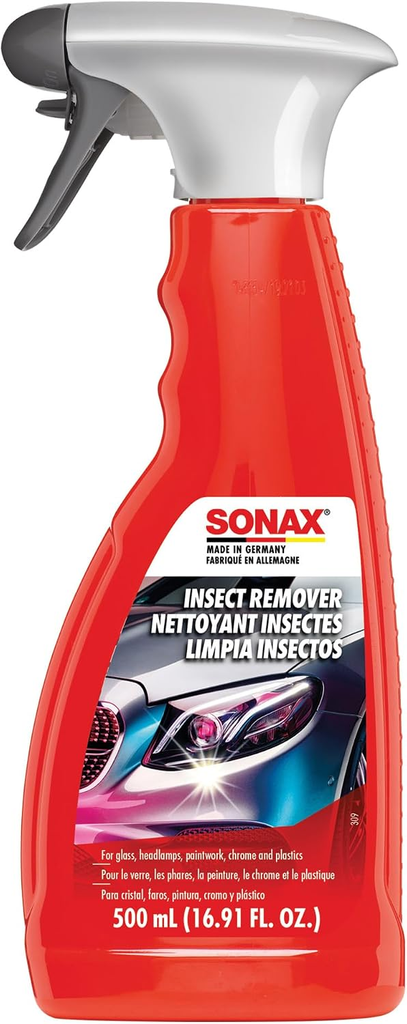
SONAX Insect Remover is a dedicated spray for dried insect residue on exterior surfaces.
SONAX lists the product for paint, glass, chrome, and plastic.
That makes it useful across the whole front of the car, especially the windshield, headlights, grille surround, mirrors, and painted bumper.
The spray is designed to loosen dried organic residue before normal washing.
Use it on a cool surface and do not let the cleaner dry.
For an older dried splatter, give the product time to soften the deposit instead of immediately rubbing harder.
Best for: Drivers who want a dedicated bug cleaner for paint, glass, chrome, and plastic.
Pros:
- Dedicated insect-removal formula
- Works on paint
- Useful on glass
- Safe for chrome and plastic
- 500 ml trigger bottle
- Good pre-wash option
- Reduces the need for hard scrubbing
- Simple application
Cons:
- Less focused on tar than dual-purpose removers
- Not the cheapest bottle in the group
- Requires rinsing as part of normal use
- Availability can vary by seller
Buying Decision:
Choose SONAX if you want a straightforward dedicated insect remover without needing tar-focused solvent strength.
It is a sensible choice when the windshield and painted front end are the main problem areas.
11. Turtle Wax Bug & Tar Remover T-520A 16 oz — Best Budget Pick
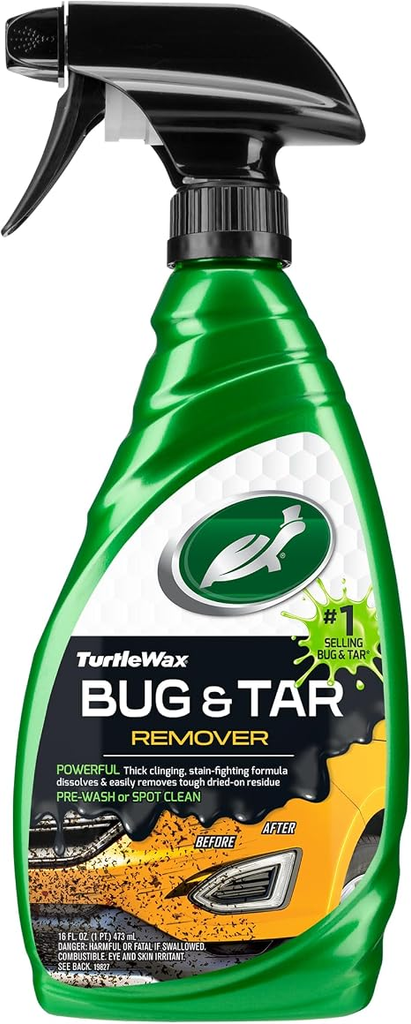
Turtle Wax Bug & Tar Remover is a long-running budget option for bugs, tar, tree sap, and road grime.
The ready-to-use trigger bottle is simple and does not require dilution.
It also leaves some gloss behind rather than acting only as a bare cleaner.
For someone who needs bug remover a few times per year and does not want to buy a premium detailing formula, that simplicity is the main appeal.
It works best as a spot cleaner on normal contamination.
Old tar and heavily baked insect residue may need more dwell time or repeat treatment.
Best for: Occasional DIY use at a lower purchase price.
Pros:
- Affordable
- Ready to use
- Works on bugs
- Also targets tar and tree sap
- Easy trigger application
- Good for occasional cleaning
- Compact bottle
- Widely known product
Cons:
- Less specialized than premium bug-only formulas
- May need repeat treatment on old deposits
- Not the best gallon-value option for frequent users
- Drivers with ceramic coatings may prefer a coating-specific cleaner
Buying Decision:
Choose Turtle Wax if you need a basic bug-and-tar spray for occasional summer cleanup and want to keep cost low.
For heavy bug seasons or a coated vehicle, one of the more specialized options is easier to justify.
12. BugSlide 16 oz Shop Kit — Best Waterless Touch-Up Kit
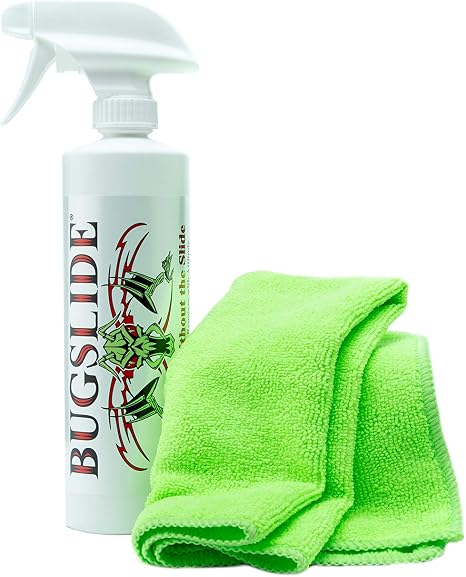
BugSlide is different from most products on this list.
It is a waterless detailer and bug remover rather than a pre-wash chemical that needs to be rinsed away.
The 16-ounce Shop Kit includes the cleaner and a microfiber towel.
BugSlide lists the formula for glass, fiberglass, Plexiglas, chrome, stainless steel, aluminum, vinyl, and other non-porous surfaces.
It contains no wax, petroleum, silicone, or Teflon and leaves a slick protective finish after cleaning.
This format is useful for motorcycles, road trips, show cars, RVs, and quick bug removal when you do not have access to a hose.
The limitation is dirt level.
Do not use a waterless wipe method over a heavily dusty or gritty front end. If sand and road dirt are mixed with the bug residue, rinse first.
Best for: Quick bug removal when a hose is not available.
Pros:
- Waterless use
- Includes microfiber towel
- Works on many non-porous surfaces
- Useful for travel
- Good for motorcycles and RVs
- Leaves a slick finish
- No wax or petroleum
- Convenient complete kit
Cons:
- Expensive compared with simple trigger sprays
- Not ideal for a gritty or heavily dirty vehicle
- Requires careful towel technique
- Heavy baked-on bugs may need repeat application
Buying Decision:
Choose BugSlide if you need to remove fresh bug residue away from home and cannot complete a full wash.
It is more useful as a travel and touch-up product than as the strongest deep-cleaning bug remover.
Which Bug Remover Should You Buy?
Start with what is stuck to the car.
For normal insect residue on paint, PPF, glass, and trim, 3D Bug Remover gives you the broadest all-around use.
Choose Meguiar’s Heavy Duty Bug & Tar Remover if you want an aerosol foam that stays on vertical surfaces.
For a ceramic-coated vehicle, Gtechniq W8 is the easiest choice because it is specifically designed to be coating safe.
Chemical Guys Bug & Tar Remover and McKee’s 37 Road Kill Bug Remover make more sense if you prefer concentrated products that can become part of your normal wash process.
Choose Stoner Tarminator when the contamination is mainly tar, asphalt, or tree sap rather than insects.
For frequent professional use, P&S Bug Off gives you a gallon-size product.
If you need a product for travel without a hose, BugSlide has the more useful waterless format.
Best Bug Remover by Use Case
| Situation | Better Product Type | Product From This Guide |
|---|---|---|
| Normal bugs across front end | Multi-surface bug remover | 3D Bug Remover |
| Dried bugs on bumper | Clinging foam | Meguiar’s Heavy Duty Bug & Tar |
| Concentrated pre-wash | Dilutable bug/tar cleaner | Chemical Guys Bug & Tar Remover |
| Ceramic-coated car | Coating-safe bug remover | Gtechniq W8 |
| Grille and vents | No-drip aerosol foam | Mothers Speed |
| Road-trip cleanup | Ready-to-use trigger spray | Adam’s Bug Remover |
| Frequent seasonal bugs | Dilutable cleaner | McKee’s 37 Road Kill |
| Tar and tree sap | Solvent remover | Stoner Tarminator |
| Detailing shop or fleet | Gallon bug remover | P&S Bug Off |
| Paint and windshield | Dedicated insect spray | SONAX Insect Remover |
| Budget purchase | Ready-to-use bug/tar spray | Turtle Wax T-520A |
| No hose available | Waterless bug remover | BugSlide |
Bug Remover vs. Tar Remover: What Is the Difference?
Bug residue and road tar are different contaminants.
Bug Residue
Insect remains are organic.
They contain proteins and other material that dry onto the paint and become harder to remove with time and heat.
A dedicated bug remover focuses on softening or breaking down that residue so you do not need to scrub the clear coat.
Tar
Road tar and asphalt are petroleum-based.
They usually respond better to solvents.
A product such as Stoner Tarminator is designed more around dissolving this type of contamination.
Some products try to handle both.
Meguiar’s, Chemical Guys, Mothers, and Turtle Wax all sell formulas aimed at bugs and tar in one product.
For light contamination, that is convenient.
For thick black tar dots, a dedicated solvent normally works faster.
Why You Should Remove Bug Splatter Quickly
The longer insect residue sits, the harder it becomes to remove.
Heat from the sun and engine area can dry the material onto:
- Clear coat
- Plastic bumper trim
- Headlights
- PPF
- Windshields
- Mirror caps
- Chrome
- Grilles
The main practical reason to remove bugs quickly is that fresh residue needs less chemical dwell time and less physical wiping.
That reduces the chance of creating wash marks.
Do not wait until the entire front bumper is covered before cleaning it.
A short post-road-trip cleanup is easier than removing several weeks of baked-on residue.
How to Use Bug Remover Without Scratching Paint
Start with a cool vehicle.
Do not spray bug remover onto a hot hood or bumper in direct sunlight unless the manufacturer specifically says it is safe.
If the car is also dusty or gritty, rinse it first.
That step matters because bug remover may soften insects, but it does not make sand safe to drag across paint.
Spray the product generously enough to wet the residue.
Allow the recommended dwell time.
Do not let the product dry.
For a pre-wash product, rinse it away before normal contact washing.
For a wipe-off product, use a clean, soft microfiber towel and light pressure.
If the bug does not come off, apply more cleaner and allow another dwell period.
Do not keep pressing harder.
The chemical should do most of the work.
Should You Use a Bug Sponge?
A bug sponge can help, but the material and technique matter.
A rough kitchen sponge is not appropriate for automotive paint.
Use a bug sponge made for vehicle finishes and soak it thoroughly before contact.
Even then, the safest order is:
- Soften the residue with bug remover.
- Rinse away loose material.
- Wash normally.
- Use gentle mechanical help only on what remains.
Do not attack dry bug residue with an abrasive pad.
Can Bug Remover Damage Wax or Sealant?
Some can reduce existing protection.
Strong cleaning products, alkaline formulas, and solvents can weaken:
- Natural wax
- Spray wax
- Polymer sealant
- Some topper products
This is not always a major problem if you plan to reapply protection after washing.
If preserving an existing ceramic coating is important, choose a product that specifically states it is coating safe, such as Gtechniq W8 or 3D Bug Remover.
For waxed paint, using a diluted cleaner when the manufacturer allows it can help reduce unnecessary stripping.
Is Bug Remover Safe for Ceramic Coatings?
It depends on the product.
Do not assume every bug-and-tar chemical is coating safe.
Gtechniq specifically lists W8 as coating safe.
3D also states that its Bug Remover is safe over ceramic coatings, waxes, and sealants.
A strong solvent tar remover should be used only where needed rather than covering the entire coated panel unnecessarily.
When in doubt, check the coating manufacturer’s maintenance guidance.
Is Bug Remover Safe for PPF?
Several products in this guide are specifically listed for paint protection film.
3D lists Bug Remover as PPF safe.
Mothers Speed Foaming Bug & Tar Remover also lists clear PPF among its compatible surfaces.
For another product, check the manufacturer rather than assuming clear coat compatibility automatically means PPF compatibility.
Film can respond differently to strong solvents.
Can You Use Bug Remover on a Windshield?
Many bug removers can be used on exterior automotive glass.
Products in this guide that list glass use include:
- 3D Bug Remover
- Meguiar’s Heavy Duty Bug & Tar Remover
- Chemical Guys Bug & Tar Remover
- Gtechniq W8
- Mothers Speed
- Adam’s Bug Remover
- McKee’s 37 Road Kill
- SONAX Insect Remover
After cleaning, rinse or wipe the windshield properly so no oily or chemical residue remains in the wiper path.
For bugs that occur constantly while driving, a summer windshield washer fluid designed for insect residue can also help, but it does not replace a full exterior bug remover for bumpers and paint.
Bug Remover for Matte Paint
Use more caution on matte paint and satin finishes.
Do not assume every bug-and-tar remover is suitable.
Matte paint cannot be polished like normal glossy clear coat if aggressive rubbing creates a shiny spot.
Check whether the product manufacturer specifically approves use on matte or satin finishes.
When compatibility is uncertain:
- Use the vehicle manufacturer’s approved cleaner
- Test in a small hidden area
- Avoid solvent-heavy tar removers unless approved
- Do not scrub
- Rinse thoroughly
The safest product for glossy clear coat is not automatically the safest choice for matte paint.
How Long Should Bug Remover Sit?
Follow the exact product directions.
Typical dwell times vary significantly.
3D lists roughly 30 to 45 seconds for normal use, with longer dwell in cooler conditions.
Gtechniq W8 recommends around three to five minutes.
McKee’s 37 recommends about 30 seconds for bug removal.
A clinging aerosol may remain active differently from a thin trigger spray.
The rule that applies to all of them is simple:
Do not let the cleaner dry on the surface.
If it starts drying, rinse or wipe it away and reapply if necessary.
Fresh Bugs vs. Baked-On Bugs
Fresh bug splatter is much easier to remove.
For fresh residue, a mild cleaner and short dwell period may be enough.
For baked-on residue:
- Work on a cool surface.
- Apply enough product to fully wet the deposit.
- Increase dwell time only within the manufacturer’s directions.
- Rinse.
- Repeat instead of scrubbing harder.
- Follow with a normal wash.
If a mark remains after the physical insect residue is gone, you may be looking at staining or etching rather than dirt.
More bug remover will not repair etched clear coat.
Common Bug-Removal Mistakes
Scrubbing Dry Bugs
Dry insect remains can act like abrasive dirt.
Soften them first.
Working on Hot Paint
Hot paint makes cleaners evaporate faster and can increase spotting or streaking.
Work in shade on cool panels.
Letting the Chemical Dry
More dwell time is not always better.
Follow the product instructions and rinse before the cleaner dries.
Reusing a Dirty Towel
Once the microfiber is carrying insect residue and road grit, turn to a clean side or replace it.
Using Tar Solvent Everywhere
Use strong solvent only where the tar exists.
There is no reason to coat the entire front end in a heavy tar solvent if the problem is normal insect splatter.
Ignoring the Existing Protection
A strong cleaner may reduce wax or sealant.
Reapply protection when necessary.
Do Bugs Really Damage Clear Coat?
The risk is not that every insect immediately burns through paint.
The bigger issue is prolonged contamination combined with heat and repeated drying.
Bug residue can leave staining or etching on the finish, especially when it remains through hot sun for extended periods.
There is also a mechanical risk.
Once the residue is hard, drivers often scrub aggressively to remove it, creating scratches that could have been avoided by softening the material first.
Removing bugs early addresses both problems.
How to Prevent Bugs From Sticking as Badly
No product can prevent all insect splatter.
A well-protected, smooth surface can make cleanup easier.
Useful protection options include:
- Synthetic paint sealant
- Ceramic spray
- True ceramic coating
- Paint protection film
- Glass sealant on the windshield
Keep the paint clean and protected before long highway trips.
On arrival, remove fresh bug residue before it has time to bake on.
That is more effective than searching for an extremely aggressive cleaner later.
FAQs
What is the best bug remover for a car?
3D Bug Remover is the best all-around choice in this guide because it is made specifically for insect residue, works across many exterior surfaces, and can be used as a spot cleaner or pre-wash.
What is the best bug remover for ceramic-coated cars?
Gtechniq W8 is specifically designed to be safe on ceramic coatings. 3D Bug Remover is another option whose manufacturer lists it as safe over ceramic protection.
What is the best bug and tar remover?
Meguiar’s Heavy Duty Bug & Tar Remover is a useful dual-purpose choice for normal bugs and tar. If the problem is mainly heavy tar or asphalt, Stoner Tarminator is the more specialized product.
What is the best bug remover for PPF?
3D Bug Remover and Mothers Speed Foaming Bug & Tar Remover are both listed by their manufacturers for use on paint protection film.
Can I use WD-40 to remove bugs from car paint?
A dedicated automotive bug remover is the better choice. It is designed around vehicle-surface compatibility and gives you clearer instructions for dwell, rinsing, and protection.
Can dish soap remove bugs from a car?
Car shampoo may remove fresh insects, but dried residue often needs more dwell time and targeted chemistry. Strong household detergent can also strip wax and is not necessary when dedicated automotive products are available.
Can I leave bug remover on overnight?
No. Bug removers are not designed to sit and dry on paint for hours. Follow the stated dwell time and remove or rinse the product as directed.
Should I wash the car after using bug remover?
For most pre-wash bug removers, yes. Follow with your normal wash to remove cleaner residue and loosened contamination. Some waterless products such as BugSlide are designed to wipe off without a full wash.
What removes old baked-on bugs?
Use a dedicated bug remover, give it the full recommended dwell time, rinse, and repeat. If a mark remains after the residue is gone, it may be paint etching that requires polishing rather than more cleaner.
Is bug remover safe on headlights?
Several products in this guide list plastic among their approved exterior surfaces. Check the exact manufacturer’s directions, especially for coated or aftermarket headlight lenses.
Does bug remover strip wax?
Strong bug removers can reduce wax or sealant. If keeping protection intact is important, use a product specifically listed as compatible with your existing protection and reapply wax when water behavior drops.
When should I remove bugs from my car?
As soon as practical. Fresh bug residue is easier to remove and requires less rubbing than material that has baked onto the surface for days.
Final Verdict
The best bug remover depends on what is stuck to the car and what protection is already on the paint.
For most drivers, 3D Bug Remover is the strongest all-around option in this guide because it covers the surfaces where bugs normally land, can be used as a spot cleaner or pre-wash, and is compatible with paint, PPF, wax, sealant, and ceramic protection.
Meguiar’s Heavy Duty Bug & Tar Remover is the better choice if you want clinging aerosol foam.
Chemical Guys Bug & Tar Remover and McKee’s 37 Road Kill Bug Remover make sense for frequent users who want concentrated formulas.
For ceramic-coated paint, Gtechniq W8 provides a more coating-focused approach.
Mothers Speed is useful around grilles and vents because the foam stays on vertical surfaces, while Adam’s Bug Remover is easy to keep around for road-trip cleanup.
Use Stoner Tarminator when tar, sap, or asphalt is the main problem rather than insects.
For professional or multi-vehicle use, P&S Bug Off gives you a gallon format.
SONAX, Turtle Wax, and BugSlide round out the list with dedicated insect cleaning, lower-cost spot treatment, and waterless road-trip cleanup.
Whichever product you use, the safest technique is the same: soften the residue, let the cleaner work, and use less physical pressure rather than more.