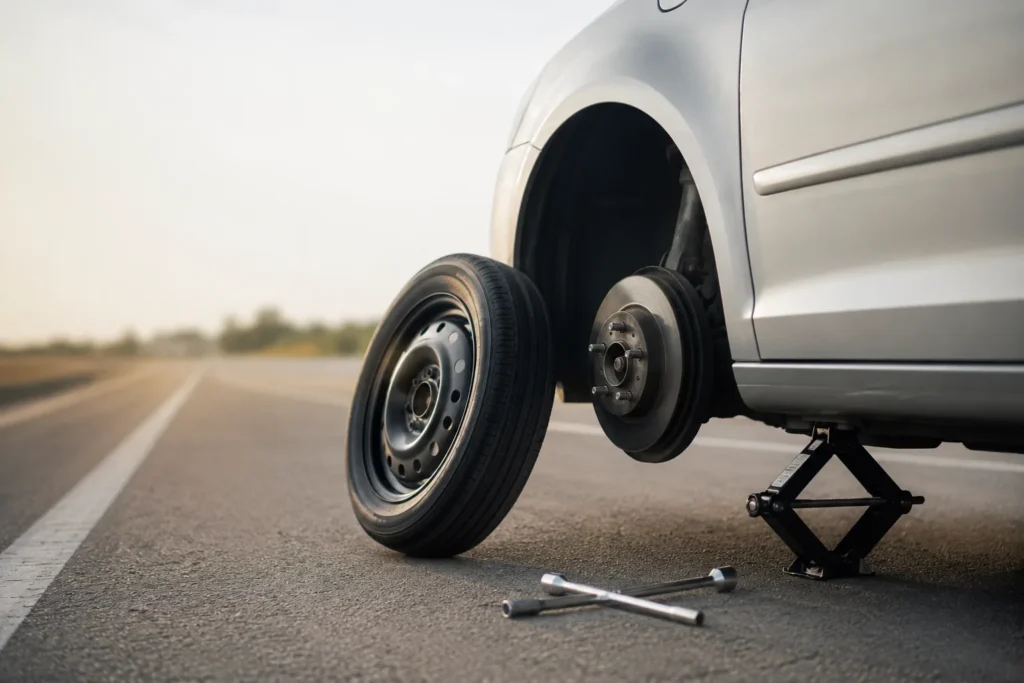
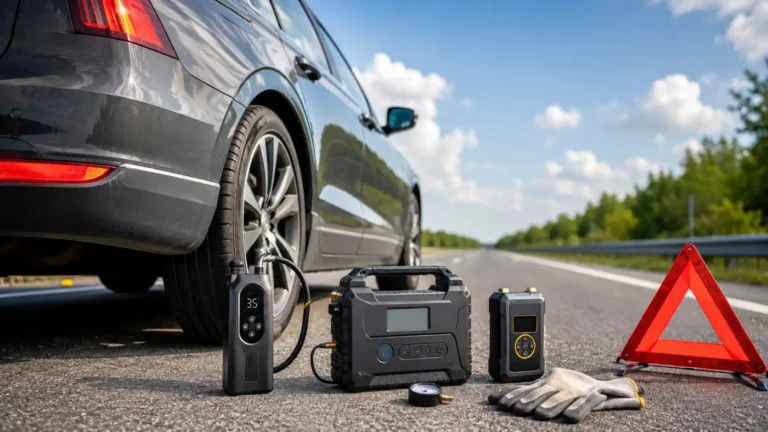
A portable tire inflator can turn a low-pressure warning from a roadside problem into a quick stop. The best models are easy to store, reach all four tires, show the current pressure clearly, and provide enough airflow for the type of vehicle you drive.
For most car owners, the Fanttik X8 APEX offers the easiest combination of cordless operation, compact size, auto shutoff, and useful emergency features. Drivers with larger SUV or truck tires should look more closely at the VIAIR 88P, while DEWALT and Milwaukee are stronger choices if you already own their battery systems.
This guide compares seven portable tire inflators based on power source, tire compatibility, inflation convenience, portability, and how practical they are to keep in a vehicle.
Best Portable Tire Inflators at a Glance
| Tire Inflator | Power Source | Auto Shutoff | Best For |
| Fanttik X8 APEX | Built-in rechargeable battery | Yes | Most drivers |
| VIAIR 88P | 12V vehicle battery clamps | No | SUVs, trucks, larger tires |
| DEWALT DCC020IB | 20V battery / 12V DC / 110V AC | Yes | Multiple power options |
| NOCO Boost Air AX65 | Rechargeable | Yes | Roadside emergency kit |
| Milwaukee M18 2848-20 | M18 battery | Yes | Fast inflation and M18 owners |
| AstroAI L7 | Built-in rechargeable battery | Yes | Compact budget cordless option |
| AstroAI AIRUN H | 12V vehicle outlet | Yes | Affordable trunk inflator |
How We Chose These Tire Inflators
We did not choose products based only on maximum PSI. A 150 PSI rating looks impressive on a product page, but it does not tell you how quickly the compressor can move air into a large tire.
For roadside use, we focused on:
- Inflation capability for the intended tire size
- Cordless versus vehicle-powered operation
- Automatic shutoff
- Hose and power-cable reach
- Portability and storage
- Built-in lighting
- Gauge convenience
- Battery requirements
- Manufacturer specifications
- Suitability for emergency rather than workshop use
We also cross-checked current manufacturer specifications and recent expert coverage rather than assuming that every popular Amazon inflator is suitable for the same vehicles. VIAIR, for example, specifically rates the 88P for tires up to 33 inches, while Milwaukee says its M18 inflator is optimized for passenger and light-truck tires.
1. Fanttik X8 APEX Tire Inflator — Best for Most Drivers
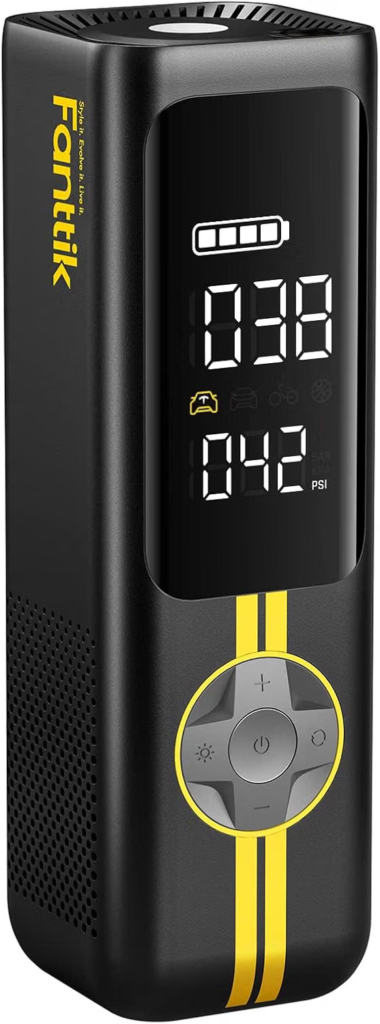
The Fanttik X8 APEX is one of the easiest inflators to keep in a daily-driven car because everything is self-contained. There is no 12V cable to route through the vehicle and no separate tool battery to buy.
The X8 APEX provides up to 150 PSI and approximately 32 L/min of airflow. Fanttik lists a rechargeable battery, automatic pressure presets, an LED light, and power-bank capability. Current manufacturer specifications put continuous runtime at up to 40 minutes under typical conditions.
For roadside use, the main advantage is convenience. Connect the hose, select the desired pressure, start inflation, and the compressor automatically stops when it reaches the preset value.
Best For
Sedans, crossovers, motorcycles, bicycles, and drivers who want a compact cordless inflator permanently stored in the vehicle.
Pros
- Completely cordless operation
- 150 PSI maximum pressure
- Automatic shutoff
- Digital pressure display
- Compact enough for easy vehicle storage
- Built-in LED light
- Can function as an emergency power bank
- Multiple preset inflation modes
Cons
- Internal battery needs to be kept charged
- Not the first choice for repeatedly inflating large truck tires
- Cordless battery performance can become a limitation during extended inflation jobs
Buying Decision
Choose the Fanttik X8 APEX if you drive a passenger car or crossover and want an inflator that is easy to grab and use without opening the hood or connecting a long power cable.
Its biggest roadside weakness is also the weakness of every rechargeable inflator: a dead battery makes the compressor useless. Check its charge periodically if it spends months sitting in your trunk.
2. VIAIR 88P Portable Compressor — Best for Trucks and SUVs
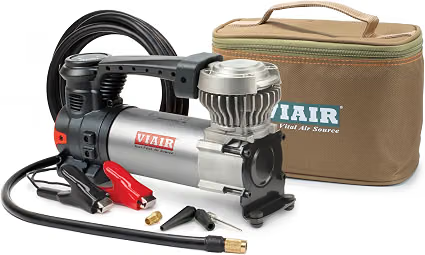
The VIAIR 88P approaches roadside inflation differently. Instead of relying on a small internal battery, it connects directly to the vehicle battery with clamps.
VIAIR rates the current 88P for tires up to 33 inches. It provides 1.97 CFM of airflow at 0 PSI, a maximum working pressure of 120 PSI, a 25-minute duty cycle at 30 PSI, a 10-foot power cord, and a 16-foot air hose.
That makes it particularly attractive for SUVs, pickups, off-road vehicles, and drivers who care more about dependable compressor performance than having the smallest possible device.
Best For
SUVs, pickups, off-road vehicles, and drivers with larger tires.
Pros
- Designed for tires up to 33 inches
- Direct vehicle-battery connection
- Stronger fit for larger tires than many miniature cordless pumps
- Long 16-foot air hose
- Solid brass twist-on tire chuck
- Includes a carrying bag
- LED work light
- No internal lithium battery to remember to charge
Cons
- No automatic shutoff on the standard 88P
- Requires opening the hood and attaching battery clamps
- Larger than pocket-style cordless inflators
- Compressor can become hot during extended operation
- Less convenient for a quick one- or two-PSI top-off
Buying Decision
Choose the VIAIR 88P if your roadside priority is dependable inflation for an SUV, pickup, or vehicle with larger tires.
For drivers who leave an inflator in the vehicle for months at a time, direct battery power also removes the concern that an internal rechargeable battery may be discharged when the compressor is finally needed.
If you prefer preset pressure and automatic shutoff, VIAIR now also sells a Digital EVC88P version with those features.
3. DEWALT DCC020IB 20V MAX Inflator — Best Multi-Power Inflator
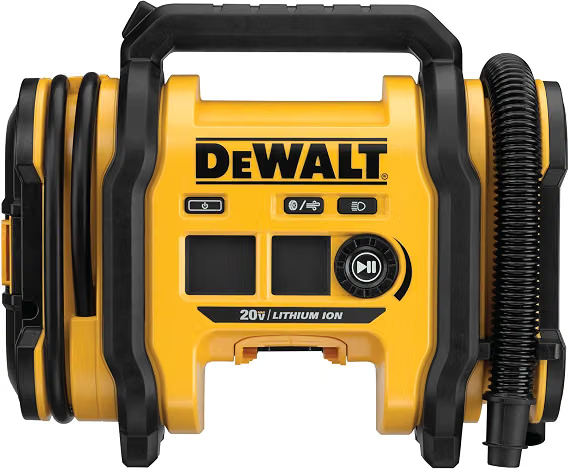
The DEWALT DCC020IB stands out because you are not limited to one power source.
DEWALT designed it to operate from a 20V MAX battery, a vehicle’s 12V DC supply, or 110V AC power. The high-pressure mode includes automatic shutoff, while a separate high-volume mode can inflate larger low-pressure items. It also has a built-in LED light and onboard accessory storage.
That flexibility is particularly useful for someone who wants one inflator for the garage, road trips, and other household inflation jobs.
There is one important purchasing detail: the DCC020IB is sold as a bare tool. DEWALT states that the battery, charger, and AC power adapter are sold separately, although the 12V DC power cord is included.
Best For
DEWALT 20V MAX owners and drivers who want both battery and vehicle-powered backup options.
Pros
- Three possible power sources
- Automatic shutoff
- Digital gauge
- High-pressure and high-volume modes
- Built-in LED light
- 12V DC cord included
- Onboard accessory storage
- Particularly convenient for existing DEWALT users
Cons
- Battery is not included
- Charger is not included
- AC adapter is sold separately
- Larger than handheld cordless pumps
- Less attractive value if you do not already own DEWALT batteries
Buying Decision
The DCC020IB is one of the more practical roadside choices if you already own DEWALT 20V MAX batteries.
A charged battery gives you cordless operation, while the included 12V connection provides an important backup if that battery is discharged. That redundancy is useful in an emergency kit.
If you do not own the DEWALT battery system, calculate the total cost of the inflator, battery, and charger before choosing it over a self-contained model.
4. NOCO Boost Air AX65 — Best Inflator and Jump Starter Combo
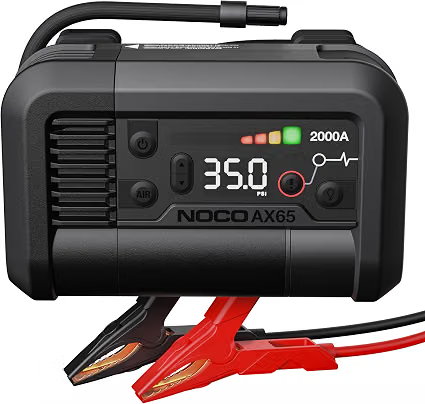
The NOCO Boost Air AX65 solves two common roadside problems with one device: a low tire and a dead battery.
It combines a 2,000-amp jump starter with a compressor rated for up to 100 PSI, 67 liters per minute of maximum airflow, and tires up to 35 inches. NOCO also specifies automatic shutoff, a digital pressure gauge, an IP55 rating with the ports closed, and a built-in flashlight.
NOCO states that the AX65 can support jump-starting gasoline engines up to 8.0 liters and diesel engines up to 6.0 liters.
Its advantage is not minimal size. It is emergency capability.
Best For
Drivers building a more complete roadside emergency kit and anyone who wants both tire inflation and jump-start capability.
Pros
- Tire inflator and jump starter in one device
- 67 L/min maximum airflow
- Designed for tires up to 35 inches
- Digital gauge
- Automatic shutoff
- Built-in flashlight
- IP55 rating with ports closed
- Eliminates the need to carry separate jump starter and inflator units
Cons
- Significantly more expensive than a basic tire inflator
- Heavier than compact handheld pumps
- Overkill if you already carry a quality jump starter
- More device than you need for occasional tire-pressure adjustments
Buying Decision
Buy the AX65 because you want a broader roadside tool, not simply because you need an air pump.
If you are assembling an emergency kit from scratch, combining a jump starter and capable tire inflator can save storage space and reduce the number of devices that need to be checked before a long trip.
If you already own a jump starter, a dedicated inflator such as the Fanttik or VIAIR will usually make more sense.
5. Milwaukee M18 2848-20 Inflator — Best for Fast Inflation
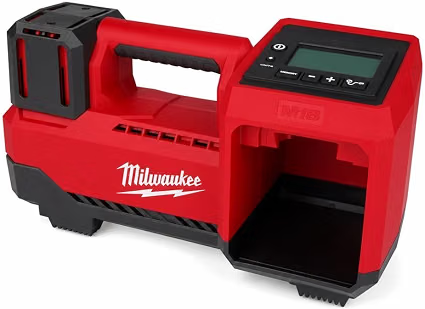
The Milwaukee M18 2848-20 is less interested in being glovebox-sized and more focused on moving air quickly.
Milwaukee rates the inflator to 150 PSI and says it can top off a 33-inch light-truck tire in under one minute under its specified test conditions. It is optimized for passenger cars and light trucks.
Its TrueFill system checks pressure, allows it to stabilize, and continues filling until the selected target is achieved. Automatic shutoff then stops inflation at the chosen pressure.
The unit also provides four pressure-memory slots, a 36-inch hose, brass Schrader chuck, and onboard accessory storage.
Best For
Milwaukee M18 owners, pickups, work vehicles, and drivers who prioritize inflation speed.
Pros
- Fast inflation
- Designed for passenger and light-truck tires
- 150 PSI maximum
- Automatic shutoff
- Pressure-checking system
- Four pressure memory presets
- Brass Schrader chuck
- Works with Milwaukee M18 batteries
- Five-year tool warranty
Cons
- Battery is not included with the bare tool
- Larger and heavier than handheld inflators
- Expensive if you need to buy into the M18 battery platform
- No 12V vehicle-power backup
Buying Decision
The Milwaukee M18 is an excellent fit if M18 batteries are already part of your tool collection.
For someone buying only a roadside compressor, however, the cost and size may be difficult to justify compared with a dedicated inflator.
There is also an important emergency consideration: unlike the DEWALT, the Milwaukee depends on its M18 battery. Keep a charged battery with the inflator if it lives in your vehicle.
6. AstroAI L7 Tire Inflator — Best Compact Budget Cordless Inflator
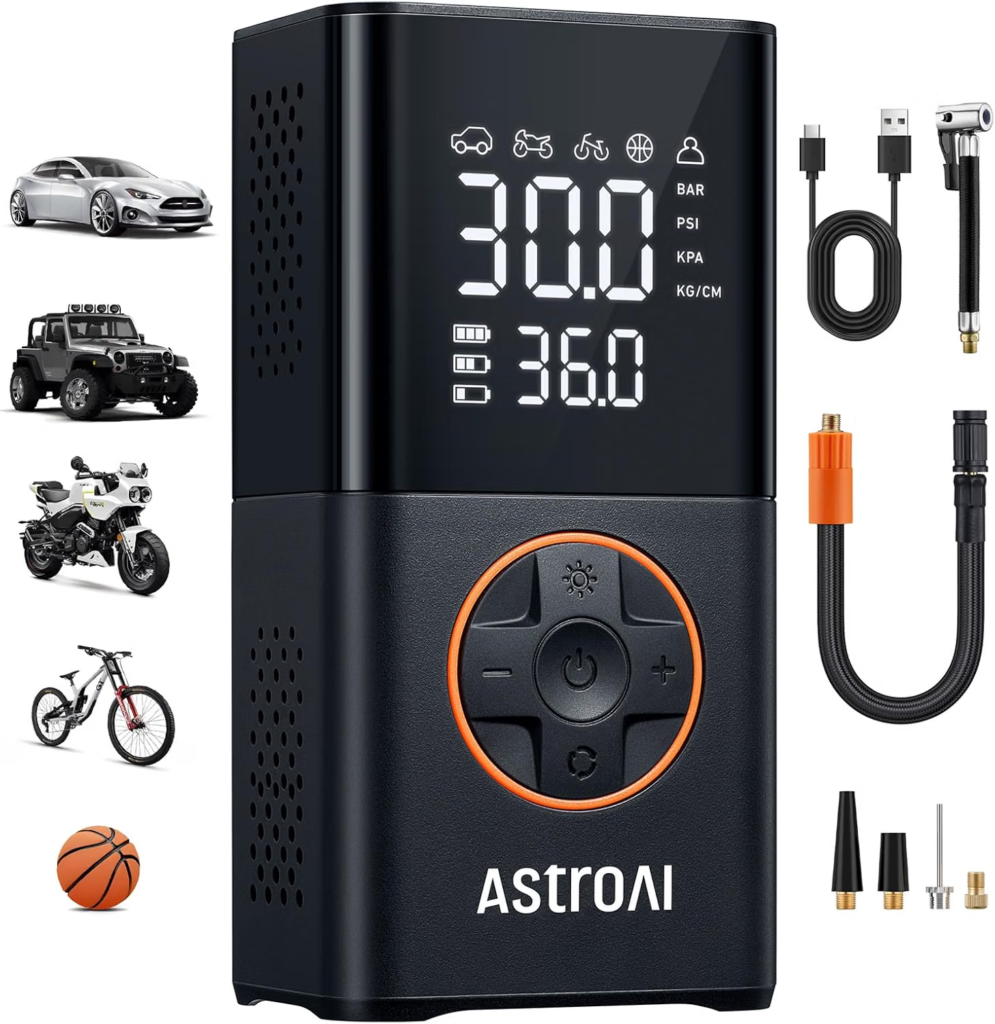
The AstroAI L7 is designed for buyers who like the portability of the Fanttik but do not necessarily need the same level of capacity.
AstroAI lists a 150 PSI maximum, approximately 17 L/min airflow, a built-in rechargeable battery, automatic shutoff, multiple inflation modes, and a digital pressure display. The inflator weighs under one pound, making it particularly easy to keep in a center console, trunk organizer, motorcycle luggage, or small emergency kit.
It also includes a multi-mode LED light and USB functionality.
Best For
Passenger-car top-offs, motorcycles, bicycles, compact emergency kits, and budget-conscious buyers.
Pros
- Very compact
- Lightweight
- Cordless operation
- 150 PSI maximum
- Automatic shutoff
- Multiple pressure presets
- Digital pressure display
- Built-in emergency light
- Easy to store in smaller vehicles
Cons
- Lower airflow than larger compressors
- Not ideal for routinely filling large truck tires
- Internal battery must be maintained
- Better suited to pressure corrections than repeated heavy-duty inflation
Buying Decision
Choose the AstroAI L7 if storage space and affordability matter more than maximum inflation speed.
It is especially attractive for keeping a small pump available for occasional low-pressure warnings. Drivers with pickups, large SUVs, or off-road tires should choose a higher-output compressor.
7. AstroAI AIRUN H 12V Tire Inflator — Best Budget 12V Option
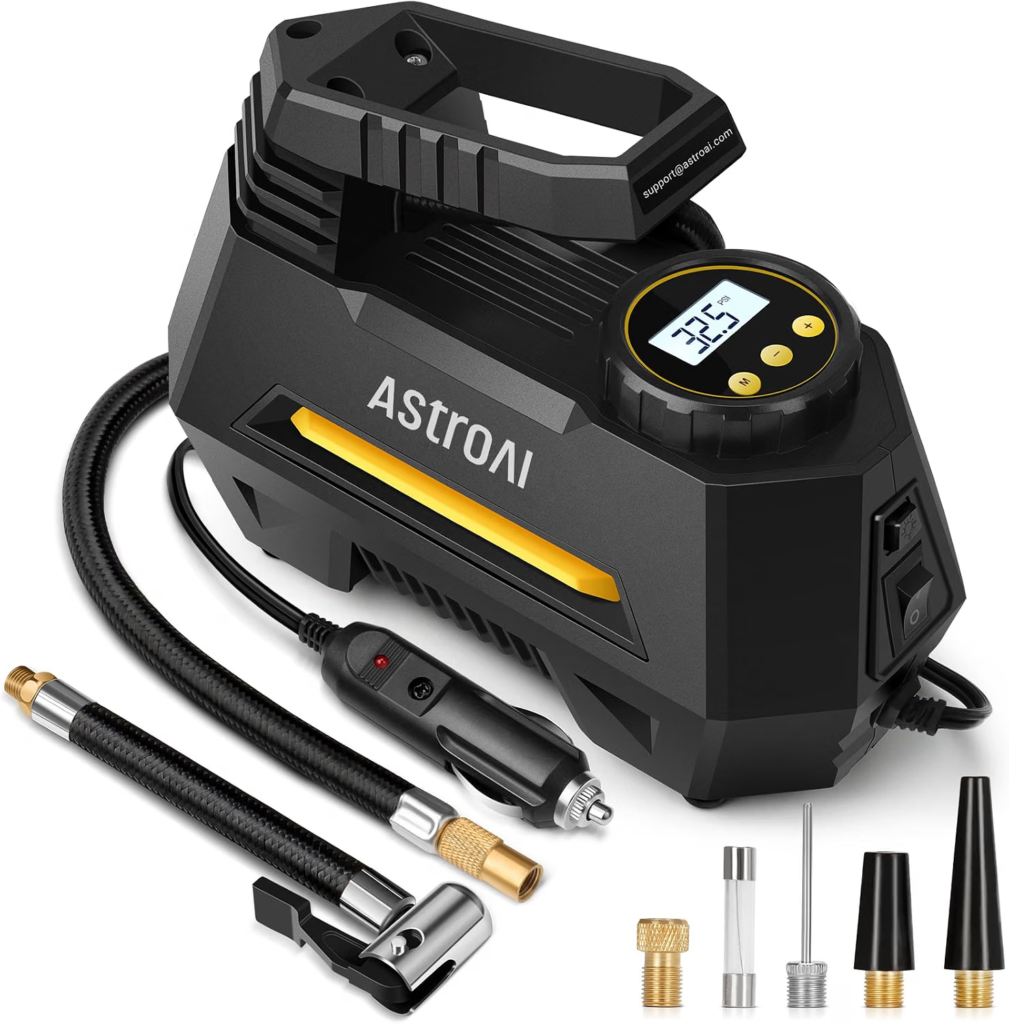
The AstroAI AIRUN H removes one of the biggest concerns associated with inexpensive cordless inflators: battery maintenance.
It plugs directly into the vehicle’s 12V outlet and provides a digital pressure gauge, preset inflation, automatic shutoff, LED lighting, and a 9.8-foot power cord. AstroAI positions it for passenger-car, motorcycle, and bicycle tires.
Because there is no rechargeable battery to maintain, you can store it in the trunk and power it from the vehicle when needed.
Best For
Drivers who want an inexpensive emergency inflator without worrying about keeping another battery charged.
Pros
- Affordable
- Uses vehicle 12V power
- Automatic shutoff
- Digital pressure gauge
- Built-in LED light
- 9.8-foot power cord
- Compact enough for trunk storage
- No internal battery to recharge
Cons
- Must remain connected to the vehicle
- Cable management is less convenient than cordless operation
- Not intended for heavy-duty large-tire inflation
- Less useful if the vehicle’s 12V electrical system is unavailable
Buying Decision
The AIRUN H makes sense if you want a basic compressor that spends most of its life in the trunk waiting for an occasional low-pressure warning.
It is less convenient than a cordless model, but eliminating battery-charge anxiety is a meaningful advantage for emergency equipment.
Which Portable Tire Inflator Should You Buy?
Choose based on your vehicle, power preference, and the features you actually need.
Best for a Normal Passenger Car
Choose the Fanttik X8 APEX if you want a compact cordless inflator for routine tire-pressure top-ups without cables or a separate tool battery.
Best for Larger SUVs and Pickups
Choose the VIAIR 88P if you need stronger compressor capability for larger tires. It connects directly to the vehicle battery for power.
Best for Power Redundancy
Choose the DEWALT DCC020IB if you want two power options. It can run from a compatible DEWALT battery or your vehicle’s 12V supply.
Best for Faster Inflation
Choose the Milwaukee M18 if inflation speed is a priority and you already own compatible M18 batteries.
Best for a Complete Roadside Kit
Choose the NOCO AX65 if you want an emergency device that combines tire inflation and jump-start capability.
Best Budget Cordless Option
Choose the AstroAI L7 if you want cordless convenience at a lower price and do not want to depend on a vehicle power cable.
Best Budget Option Without a Rechargeable Battery
Choose the AIRUN H if you prefer a direct power solution and want to avoid maintaining another rechargeable battery.
Cordless vs. 12V Tire Inflators for Roadside Use
Neither power type is automatically better.
Cordless Inflators
Cordless models are easier to use. You can walk directly to any tire without routing cables through an open door or connecting clamps under the hood.
They are especially useful for:
- Passenger cars
- Motorcycles
- Routine pressure adjustments
- Apartment parking
- People who prioritize compact storage
The disadvantage is battery maintenance. A cordless inflator that has spent six months untouched in the trunk may not have enough charge when you need it.
12V and Vehicle-Powered Inflators
Vehicle-powered compressors sacrifice some convenience but can be more dependable for long-term emergency storage.
They make sense for:
- Road-trip vehicles
- SUVs
- Pickup trucks
- Larger tires
- Drivers who do not want another battery to maintain
For roadside preparedness, a vehicle-powered backup can therefore be more valuable than cordless convenience.
What to Look for in a Portable Tire Inflator
Choosing a portable tire inflator is about more than comparing maximum PSI or advertised features. Consider your tire size, power source, hose and cable reach, automatic shutoff, and emergency-use features to find an inflator that fits the way you actually use your vehicle.
1. Match the Inflator to Your Tire Size
Do not choose a portable tire inflator based on maximum PSI alone. Most passenger tires operate well below the 100–150 PSI figures commonly advertised by portable compressors. For larger tires, airflow and compressor duty cycle become more important because the inflator needs to move a greater volume of air.
If you drive a pickup, large SUV, or off-road vehicle, check whether the manufacturer specifies a maximum compatible tire size.
2. Look for Automatic Shutoff
Automatic shutoff allows you to set your desired tire pressure and let the inflator stop automatically when that pressure is reached. This is especially useful at night or during roadside emergencies because you do not need to continuously monitor the pressure gauge.
3. Check the Power Source
Think about how the inflator will be powered after it has been stored in your vehicle for several months. Rechargeable models need to be checked and charged periodically, while tool-battery inflators require a compatible charged battery.
A 12V inflator depends on the vehicle’s electrical system, while direct-clamp compressors require access to the vehicle battery. There is no universally correct power system, so choose the option you are most likely to keep charged and ready.
4. Check Hose and Cable Reach
Hose and power-cable length can make a major difference in real-world usability. An inflator may have impressive specifications but still be frustrating to use if the hose cannot comfortably reach all four tires.
Pay particular attention to reach if you drive a:
- Long-wheelbase pickup
- Full-size SUV
- Van
- RV
Check both the air-hose length and the power-cable length before buying.
5. Consider a Built-In Light
A built-in light can be a useful feature when you need to connect the air hose to a tire valve in low-light conditions. For an inflator that will mainly be kept in your vehicle for roadside emergencies, integrated lighting can make nighttime tire inflation more convenient.
What PSI Should You Inflate Your Tires To?
Use the pressure specified by the vehicle manufacturer, not the maximum pressure printed on the tire sidewall.
NHTSA says the recommended pressure is normally shown on the Tire and Loading Information label around the driver’s door area or in the owner’s manual. Tire pressure should ideally be checked when the tires are cold.
For example, if your tire sidewall says 51 PSI maximum but your vehicle placard specifies 35 PSI cold, the vehicle’s 35 PSI specification is the pressure you should normally follow.
Do not assume that a higher pressure is better.
Can a Portable Tire Inflator Fix a Flat Tire?
No. A tire inflator adds air; it does not repair damage.
It can be useful if:
- A tire has gradually lost pressure
- Temperature changes triggered a low-pressure warning
- A very small puncture is leaking slowly enough for the tire to temporarily hold air
- You need to correct normal pressure loss
An inflator should not be treated as a solution for serious tire damage.
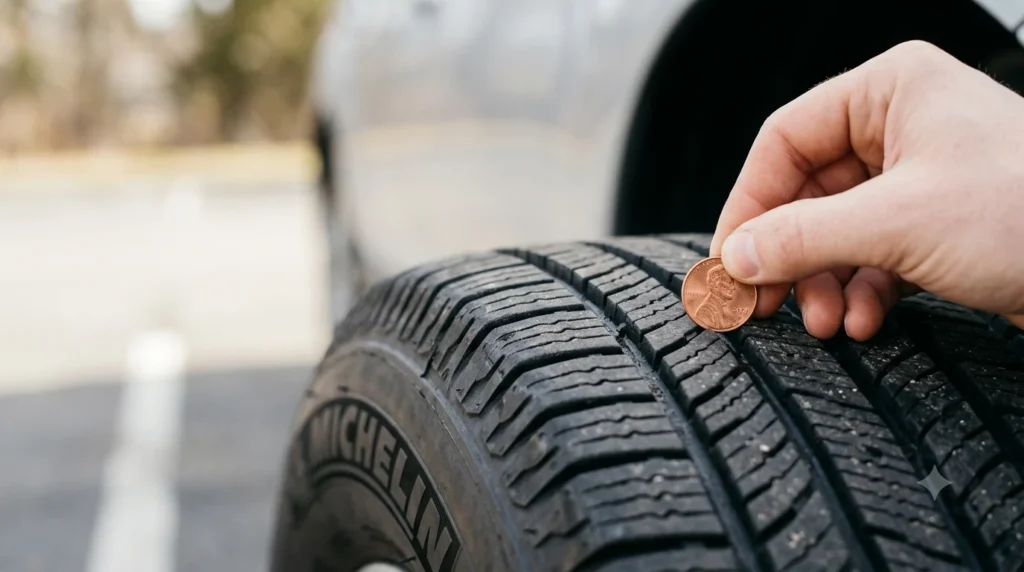
NHTSA recommends inspecting tires for punctures, bulges, cuts, cracks, scrapes, and other damage. If tire damage is present, the tire should be evaluated rather than simply reinflated and driven normally.
How to Use a Portable Tire Inflator on the Roadside
When it is safe to do so:
- Pull completely away from moving traffic.
- Turn on your hazard lights.
- Check the tire for obvious sidewall or tread damage.
- Find the manufacturer’s recommended tire pressure on the driver’s-door placard or owner’s manual.
- Connect the inflator securely to the valve stem.
- Set the required pressure if your inflator has an automatic preset.
- Start the compressor.
- Allow an auto-stop model to finish, or monitor the pressure manually.
- Remove the connector carefully because fittings may become hot.
- Recheck the tire for continued pressure loss before relying on it for normal driving.
If the tire rapidly loses pressure again, the problem needs repair rather than more air.
Frequently Asked Questions
Is it worth keeping a tire inflator in your car?
Yes, especially for low-pressure warnings, gradual air loss, road trips, and seasonal pressure changes. A compressor cannot repair tire damage, but it can prevent a minor pressure problem from immediately leaving you stranded.
Is a cordless tire inflator better for roadside emergencies?
Cordless inflators are usually easier to use, but only if the battery is charged. A 12V or direct-battery compressor can be a better long-term trunk tool because it does not depend on an internal rechargeable battery.
Is 150 PSI necessary for car tires?
Usually not. Passenger-car tire pressures are typically far below 150 PSI. Maximum PSI should not be the main buying criterion. Airflow, tire-size compatibility, duty cycle, power source, and auto shutoff are generally more useful comparison points.
Can a small portable inflator fill a completely flat tire?
Some can, provided the tire and bead are intact, but inflation will take considerably longer than a small top-off. Compact battery inflators are usually better at adding several PSI than repeatedly filling large tires from completely flat.
Should I leave a cordless tire inflator in my car?
You can keep one in your emergency kit, but inspect and recharge it periodically. Lithium batteries should also be stored according to the manufacturer’s temperature and charging guidance.
Should I inflate tires to the PSI printed on the sidewall?
No. NHTSA recommends using the vehicle manufacturer’s specified cold tire pressure shown on the vehicle placard or in the owner’s manual rather than using the maximum pressure printed on the tire as your target.
Final Thoughts
The best roadside tire inflator depends more on your vehicle and power preference than on which model advertises the highest PSI.
For most passenger-car owners, the Fanttik X8 APEX provides a useful balance of portability, automatic operation, and cordless convenience. The VIAIR 88P is a stronger fit when larger SUV or truck tires are involved. DEWALT provides the most useful power flexibility for drivers already using 20V MAX tools, while Milwaukee is particularly attractive to existing M18 owners who value faster inflation.
For a more complete roadside emergency solution, the NOCO Boost Air AX65 combines tire inflation and jump-starting in one unit. On a tighter budget, AstroAI’s L7 and AIRUN H cover the two most practical choices: compact cordless convenience or simple 12V reliability.
Whichever model you choose, keep it accessible, know your vehicle’s correct tire pressure, and check the inflator or its battery before a long road trip. A tire inflator is most valuable when it is ready before you actually need it.