Worn tire tread is one of those problems that develops so gradually most drivers never notice it happening. Then a rainy commute turns into a slide, and the tread depth suddenly matters a great deal.
The U.S. Department of Transportation recommends replacing tires once tread depth reaches 2/32 of an inch, and several states legally require it at that point. Checking your tread takes less than two minutes and needs nothing more than a coin or a small gauge.
This guide covers three reliable ways to check tread depth, what the results actually mean for safety, and how to spot uneven wear that might point to a bigger issue than the tires themselves.
Why Does Tire Tread Depth Actually Matter?
Tread channels water, snow, and debris away from the contact patch where the tire meets the road. As tread wears down, that channeling ability shrinks, which increases stopping distance and raises the risk of hydroplaning in wet conditions.
The difference isn’t small. A tire with worn tread can take significantly longer to stop on a wet road compared to one with healthy tread depth, since there’s less surface area actively gripping the pavement and more water being pushed ahead of the tire instead of channeled away.
How Do You Check Tire Tread Depth With a Penny?
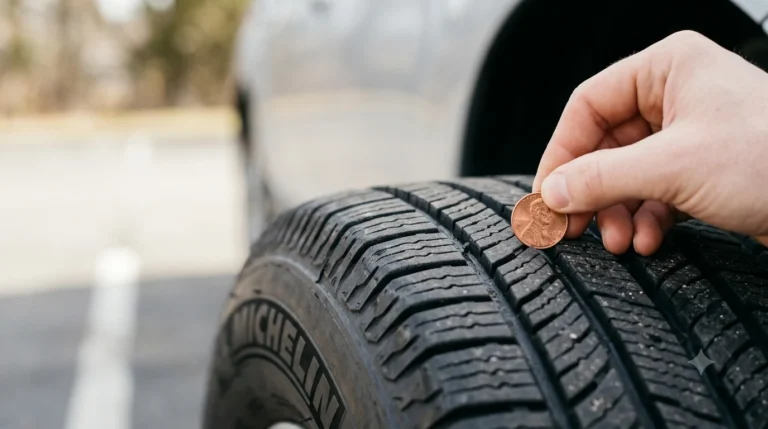
The penny test is the simplest method, and it requires nothing more than a coin already sitting in your pocket.
Insert a penny into one of the tread grooves with Lincoln’s head facing down into the tire. If part of his head disappears into the tread, you still have at least 2/32 of an inch remaining, the minimum legal depth in most states. If his entire head remains visible above the tread, the tire has worn past the safe threshold and needs replacing.
Check this at several points around the tire, not just one spot, since tread wear isn’t always even across the full circumference.
How Does the Quarter Test Different From the Penny Test?
The quarter test uses the same idea but sets a more conservative benchmark, useful for drivers who want extra margin before wet weather becomes a real risk.
Insert a quarter into the tread groove with Washington’s head facing down. If the tread covers part of his head, you have at least 4/32 of an inch remaining, generally considered the point where wet-weather traction starts to noticeably decline. If his entire head is visible, the tire is approaching the legal minimum and worth planning to replace soon, even if it technically still passes the penny test.
Many tire safety advocates recommend the quarter test as the more meaningful checkpoint, since 4/32 gives more of a safety buffer than waiting until the tire hits the legal limit.
How Do You Use a Tire Tread Depth Gauge?
A dedicated gauge offers a more precise reading than a coin test, and most cost very little.
For a digital gauge, turn it on, place the tip fully into the tread groove, and read the display. For a probe-style gauge, insert the probe into the lowest point of the groove, press the base flush against the tread, and record the marking on the scale. Checking the inner edge, center, and outer edge of the tire separately, then comparing the three readings, gives a more complete picture than a single measurement.
A meaningful difference between the inner, center, and outer readings on the same tire is itself useful information, since it often points to an alignment or inflation problem rather than simple age-related wear.
What Do Your Tread Depth Results Actually Mean?
Interpreting the number matters just as much as measuring it correctly.
- 6/32 of an inch or more: tread is in good condition for most driving conditions, including light rain
- 4/32 of an inch: still legal and functional, but wet-weather traction is measurably reduced compared to newer tread
- 2/32 of an inch: the legal minimum in most states, and the point where replacement is strongly recommended regardless of remaining appearance
- Below 2/32 of an inch: tire should be replaced immediately, since stopping distance and hydroplaning risk both increase substantially at this depth
New tires typically start around 10/32 to 11/32 of an inch, so tracking how far a tire has worn from that starting point over time gives a useful sense of how much life remains.
What Does Uneven Tire Wear Tell You?
Even tread wear across the whole tire is normal and expected. Uneven wear is a different story, and it often signals a mechanical issue rather than simple mileage.
Wear concentrated on the outer edges can point to underinflation, since a low tire flexes more at the shoulders and wears faster there. Wear concentrated in the center often points to overinflation, where the tire bulges slightly and puts more pressure on the middle of the tread. Wear that’s uneven from one side of the tire to the other, rather than symmetric, frequently points to a wheel alignment problem rather than an inflation issue.
If you notice a pattern like this during a tread check, it’s worth having a technician inspect the alignment and suspension rather than simply replacing the tires and expecting the new set to wear evenly.
How Often Should You Check Your Tire Tread Depth?
Checking tread depth once a month, or at minimum every time you rotate your tires, catches wear before it becomes a safety issue.
Drivers who put unusually high mileage on their vehicles, or who frequently drive in wet or snowy conditions, benefit from checking more often, since tread wears down faster under heavier use and harsher conditions. Pairing a tread check with a tire pressure check takes only a few extra minutes and gives a more complete picture of tire health in one sitting.
Common Mistakes People Make When Checking Tread Depth
A handful of avoidable habits lead to inaccurate readings or missed warning signs.
- Checking only one spot on the tire instead of multiple points around the circumference
- Assuming a tire that passes the penny test is automatically safe in all conditions, without considering the more conservative 4/32 benchmark
- Ignoring a noticeable difference between the inner, center, and outer tread depth on the same tire
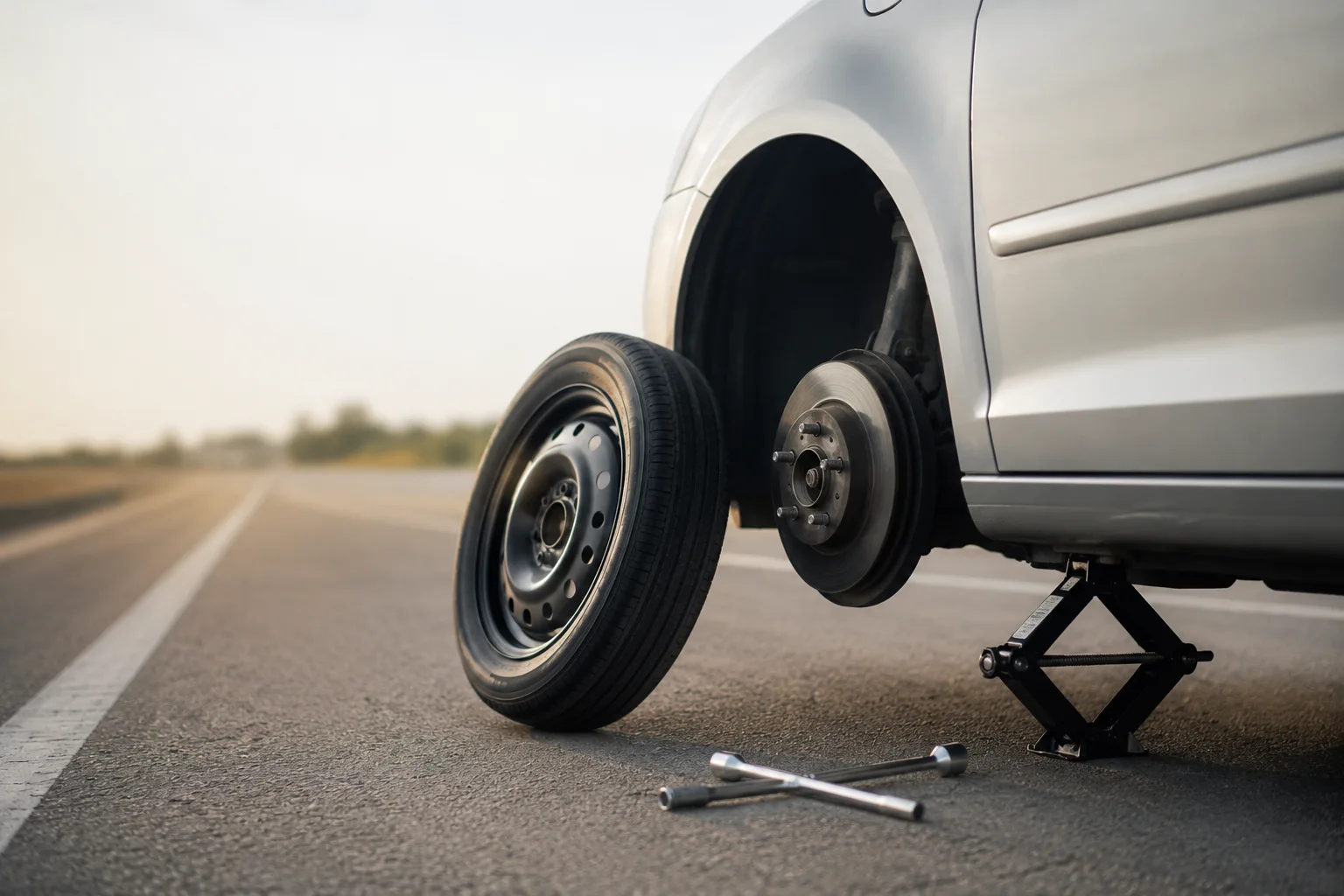
- Ignoring the tread on the spare tire entirely, which can be dangerously worn or dry-rotted without ever being used
- Waiting until a tire visibly looks worn rather than checking proactively on a regular schedule
Building tread checks into a routine, rather than doing them only when a problem seems obvious, is the difference between catching wear early and discovering it during a wet-weather emergency.
Conclusion
Knowing how to check tire tread depth with a penny, quarter, or tread depth gauge is one of the quickest ways to improve your vehicle’s safety. A simple inspection takes only a couple of minutes but can help you spot worn tires before they reduce traction, increase stopping distance, or raise the risk of hydroplaning.
Make tread depth checks part of your regular maintenance routine by inspecting all four tires and your spare at least once a month. If you notice uneven wear or your tread is approaching the replacement threshold, address the underlying issue and replace the tires when needed. Staying proactive helps you enjoy better handling, safer braking, and greater confidence every time you get behind the wheel.
Frequently Asked Questions
Is the penny test accurate enough, or should I use a tire tread depth gauge?
The penny test is accurate enough for a quick safety check because it tells you whether your tire has reached the legal minimum tread depth of 2/32 inch. However, a tire tread depth gauge provides an exact measurement, making it the better choice for monitoring wear over time, checking multiple tread locations, and planning tire replacement before traction becomes a safety concern.
What is the minimum legal tire tread depth?
In most U.S. states, the minimum legal tire tread depth is 2/32 inch, which is also the replacement recommendation from the U.S. Department of Transportation. While a tire may still be legal at this depth, many tire safety experts recommend replacing it sooner because wet-weather grip and braking performance begin to decline before reaching the legal limit.
What tread depth is considered unsafe for driving in rain?
A tread depth below 4/32 inch can significantly reduce wet-road traction and increase the risk of hydroplaning. Although 2/32 inch is the legal minimum in most states, replacing tires around 4/32 inch provides better braking performance and improved safety during heavy rain or standing water.
What tread depth is recommended for driving in snow?
For reliable winter traction, tires should generally have at least 6/32 inch of tread depth. Deeper tread helps channel snow and slush away from the contact patch, improving grip during acceleration, braking, and cornering. Tires with less than 6/32 inch may struggle to maintain traction on snowy or icy roads.
Can uneven tire tread wear be fixed without replacing the tires?
Uneven tread wear can sometimes be slowed by correcting the underlying cause, such as improper tire pressure, poor wheel alignment, or missed tire rotations. However, if the tread is already severely or unevenly worn, replacing the affected tires is usually the safest solution, even after the mechanical problem has been repaired.
How often should I check my tire tread depth?
Most drivers should check tire tread depth once a month and before long road trips. It’s also a good idea to inspect tread whenever you check tire pressure or rotate your tires. Regular inspections help identify excessive wear early and reduce the risk of poor traction, longer stopping distances, and unexpected tire replacement.
Should I check the tread depth on my spare tire?
Yes. Your spare tire should be inspected regularly, even if it has never been used. In addition to checking tread depth, examine the rubber for cracks, dry rot, or other signs of aging, since an older spare tire may no longer be safe in an emergency despite having deep tread.
How much does a tire tread depth gauge cost?
Most tire tread depth gauges are inexpensive and available at auto parts stores, tire shops, and online retailers. Basic manual gauges typically cost only a few dollars, while digital versions cost more but provide easier-to-read, highly accurate measurements for routine tire maintenance.
Is a tire tread depth gauge more accurate than the penny or quarter test?
Yes. A tire tread depth gauge is the most accurate way to measure tire tread because it provides an exact reading in 32nds of an inch or millimeters. Coin tests are useful for quick checks, but a gauge allows you to compare tread depth across different parts of the tire and detect uneven wear much earlier.
Why should I measure tread depth in more than one location?
You should measure tread depth at the inner edge, center, and outer edge of each tire because wear is not always uniform. Different readings across the tire can indicate issues such as underinflation, overinflation, or wheel alignment problems, helping you identify mechanical issues before they shorten tire life or affect vehicle safety.