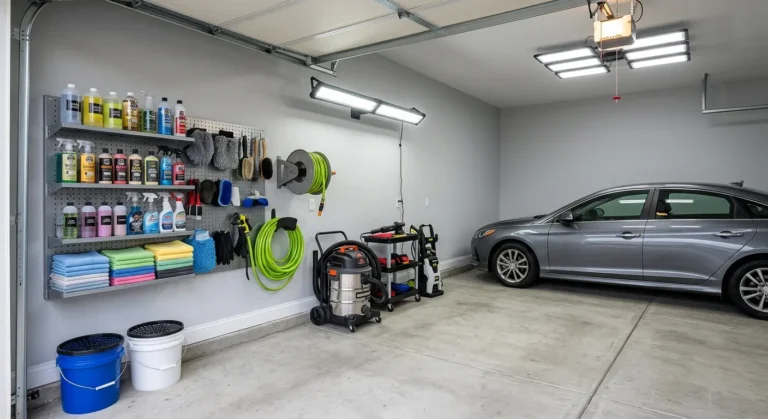
A home car detailing station does not need to be a professional-grade garage. For most vehicle owners, a practical setup needs four things: a suitable place to work, access to water and electricity, organized storage, and enough lighting to see what you are cleaning. The right setup makes routine washing and interior detailing faster because your tools, chemicals, towels, and equipment are ready to use instead of scattered around the garage or driveway.
This guide explains how to organize a home detailing station, what equipment is actually useful, how to handle water and runoff, how to store detailing chemicals, and how to build the setup gradually without buying equipment you do not need.
What Are the Core Components of a Home Detailing Station?
A functional home detailing station needs a suitable work area, water access, storage, lighting, and electrical power. You can start with the basics and add equipment as your detailing needs become more demanding.
The core components are:
- A suitable work surface: A garage floor or driveway can work, provided the area gives you enough room to walk around the vehicle and allows water to drain appropriately.
- Water access: An outdoor spigot and a quality hose are enough for basic washing. A pressure washer can be added later if you regularly use one.
- Electrical access: A nearby outlet is useful for a shop vacuum, polisher, blower, or other powered equipment.
- Storage: Shelving, cabinets, a rolling cart, or storage bins keep chemicals and tools organized.
- Lighting: Good lighting makes it easier to find missed dirt, residue, stains, and paint defects.
- Towel and tool organization: Separate storage for paint, wheel, tire, and interior tools reduces the chance of cross-contamination.
You do not need to purchase all of these items at once. A basic station can begin with a hose, wash supplies, towels, storage bins, and adequate lighting.
How Much Space Do You Need for a Home Detailing Station?
You generally need enough room to open the vehicle’s doors and walk around the vehicle safely without repeatedly moving equipment. A single garage bay or a driveway parking space can be sufficient for routine detailing if storage is kept compact.
The most important consideration is not having a large dedicated detailing room. It is keeping the area organized enough that equipment does not become an obstacle while you work.
For a garage, leave enough clearance around the vehicle for:
- Opening doors and the rear hatch or trunk.
- Moving a vacuum or rolling cart.
- Running an extension hose or power cord safely.
- Reaching wheels and lower body panels.
- Accessing shelves without leaning over the vehicle.
If space is limited, a rolling detailing cart or portable storage tote can keep frequently used supplies close to the vehicle without permanently occupying floor space.
What Water Setup Works Best for Car Detailing?
For basic detailing, an outdoor spigot connected to a quality hose is enough. A spray nozzle can provide better control over the rinse than an unrestricted hose, while a pressure washer is useful when you want a more powerful pre-rinse or plan to use a foam cannon.
The important point is that a pressure washer is an upgrade, not a requirement for building a useful detailing station.
A practical water setup can include:
- Outdoor water spigot.
- Quality garden hose.
- Adjustable spray nozzle.
- Hose reel or wall-mounted hose storage.
- Two wash buckets for traditional washing.
- Pressure washer if your cleaning routine justifies it.
- Foam cannon if you already use a compatible pressure washer.
- Water filtration equipment if hard-water spotting is a recurring problem.
If you use a pressure washer, choose equipment and accessories that are compatible with one another rather than focusing only on the highest available pressure. Automotive cleaning also depends on nozzle selection, working distance, flow rate, and technique.
A water filter can be useful in areas with hard water, but it is not essential for every home setup. If water spotting is not a recurring problem, the money may be better spent on towels, storage, or other equipment you will use more frequently.
How Should You Organize Detailing Tools and Chemicals?
The simplest organization system is to separate supplies by the surface they are intended to clean. Paint, wheels, tires, glass, and interior surfaces should not share every brush or towel simply because they look similar.
A practical storage system can use separate areas for:
Paint and Washing Supplies
Store items such as:
- Wash mitts.
- Drying towels.
- Wash soap.
- Buckets.
- Grit guards.
- Exterior detailing brushes.
Wheels and Tires
Keep wheel and tire tools separate from paint-contact tools.
This area can contain:
- Wheel brushes.
- Tire brushes.
- Wheel cleaner.
- Tire cleaner.
- Tire dressing applicators.
- Dedicated microfiber towels.
Interior Cleaning
Keep interior products together so you can quickly prepare for an interior-only cleaning session.
Useful items include:
- Interior cleaner.
- Glass cleaner.
- Interior brushes.
- Microfiber towels.
- Vacuum attachments.
- Upholstery or carpet products.
Paint Correction and Protection
If you use polishing or paint-protection products, store them separately from routine washing supplies.
This area may include:
- Polishing pads.
- Applicators.
- Compound.
- Polish.
- Wax.
- Sealant.
- Ceramic or spray coating products.
A rolling cart is particularly useful when you frequently move between a garage and driveway. A wall-mounted pegboard can also keep brushes and smaller tools visible while keeping them off the floor.
Should Wheel and Paint Tools Be Stored Separately?
Yes. Separate storage is a simple way to reduce the chance of transferring brake dust, abrasive dirt, or other contaminants from wheels and tires onto painted surfaces.
The separation does not need to be complicated. Different colored bins, clearly labeled containers, or separate shelves can be enough.
For example:
- Paint towels: Paint and glass only.
- Wheel towels: Wheels and tires only.
- Interior towels: Interior surfaces only.
- Wheel brushes: Never used on painted panels.
- Interior brushes: Kept away from wheel-cleaning chemicals.
This organization also makes it easier to identify which tools need cleaning or replacement after a particularly dirty job.
What Lighting Setup Is Best for Detailing?
Good lighting helps you see dirt, streaks, product residue, stains, and paint defects that may be difficult to notice under weak garage lighting. It is especially useful when working indoors or after daylight fades.
For general detailing, start with bright, evenly distributed lighting that illuminates the vehicle from multiple directions. Standard overhead lighting may leave areas of the vehicle in shadow, particularly around lower panels and the interior.
For paint inspection, directional lighting can be useful because changing the angle of illumination makes certain surface defects easier to identify.
A practical garage lighting setup can include:
- Bright overhead LED fixtures for general illumination.
- Additional wall or portable lights for darker areas.
- A portable inspection light for close-up paint inspection.
- Task lighting near the workbench or storage area.
You do not need professional detailing lights to maintain a vehicle. If your main goal is washing and interior cleaning, improving general illumination may provide more value than buying specialized inspection equipment.
What Electrical Setup Do You Need?
Electrical access becomes more important as you add powered equipment.
A basic station may only need one convenient outlet for a vacuum or blower. A more advanced setup may use several powered tools during the same session.
Common electrical equipment includes:
- Wet/dry vacuum.
- Corded or cordless polisher.
- Air blower.
- Electric pressure washer.
- Battery chargers.
- Portable work lights.
Keep power cords and connections away from standing water, and follow the electrical and safety instructions supplied with each device. If your garage lacks suitable electrical outlets, adding or modifying wiring should be handled according to applicable electrical requirements rather than improvised with overloaded circuits or unsafe connections.
Where Should You Store Detailing Chemicals?
Store detailing chemicals in a cool, dry, protected location and follow the storage instructions on each product’s label or Safety Data Sheet when available.
A garage cabinet or enclosed storage area is generally more practical than leaving bottles exposed to direct sunlight or extreme temperatures.
Organize chemicals by purpose rather than brand:
- Car wash soaps.
- Exterior cleaners.
- Wheel and tire cleaners.
- Interior cleaners.
- Glass cleaners.
- Paint cleaners.
- Polishes and compounds.
- Waxes and sealants.
- Specialty chemicals.
Keep bottles closed when they are not being used, and label any diluted product clearly. Do not assume that two products can safely be mixed just because they are both intended for automotive cleaning.
A simple inventory list can also prevent unnecessary duplicate purchases, especially when you have several similar cleaners or protection products.
Do You Need a Shop Vacuum for a Home Detailing Station?
A wet/dry vacuum is useful if interior detailing is a regular part of your routine, particularly when you clean carpets, floor mats, or heavily soiled interiors.
The important specification is not simply the size of the vacuum. Consider:
- Suction and airflow characteristics.
- Hose size and length.
- Crevice and upholstery attachments.
- Dust-bin or tank capacity.
- Cord length or battery runtime.
- Wet-pickup capability if you actually need it.
- Storage size.
A compact vacuum can be sufficient for occasional maintenance cleaning. A larger wet/dry vacuum makes more sense when you frequently clean heavily soiled vehicles or want greater capacity.
Do not buy a wet/dry vacuum solely because it is larger. Match the machine to how often you clean and the type of debris you normally encounter.
How Should You Handle Drainage and Wash-Water Runoff?
Runoff deserves attention when you build a home washing area because water leaving a driveway can carry dirt, detergents, automotive residues, and other pollutants toward storm drains.
The U.S. Environmental Protection Agency recommends practices such as using a permeable surface where appropriate, minimizing water use, using phosphate-free soaps, and preventing wash water from entering storm drains. EPA also notes that local requirements can apply to vehicle-washing wastewater.
This means a detailing station should not be designed simply around the most convenient place to connect a hose.
Before establishing a permanent wash area:
- Identify nearby storm drains.
- Check how your driveway or garage drains.
- Check local rules for residential vehicle washing.
- Avoid allowing dirty wash water to flow directly into a storm drain.
- Minimize water use when practical.
- Follow product disposal instructions for chemical solutions and contaminated water.
EPA specifically recommends commercial car washes as an option because these facilities are designed to manage wastewater, while its residential guidance also recommends reducing runoff when washing at home.
Do not assume that washing on grass is appropriate in every location. Local conditions, groundwater concerns, soil characteristics, and local regulations can affect what is acceptable.
Can You Build a Detailing Station in a Garage?
Yes. A garage can be an effective detailing workspace because it provides weather protection, storage space, electrical access, and more consistent lighting.
A garage-based station can be organized into three practical zones:
Vehicle zone: Keep enough open space for the car and for walking around it.
Cleaning zone: Store buckets, towels, brushes, vacuum equipment, and frequently used chemicals close to the vehicle.
Storage and work zone: Use shelves, cabinets, or a workbench for products and equipment that are not needed during every wash.
One advantage of a garage is that you can leave permanent storage and lighting installed rather than repeatedly assembling the same equipment before every detail.
The main limitation is drainage. A garage should not be treated as a wash bay simply because it has a concrete floor. If wash water cannot be appropriately collected or disposed of, exterior washing may be better handled elsewhere.
Can You Build a Detailing Station on a Driveway?
Yes. A driveway can work well for exterior washing when there is sufficient space, water access, and an appropriate way to manage runoff.
A driveway setup is especially practical when:
- You do not have a garage.
- You mainly wash during favorable weather.
- You want a portable setup.
- You have limited storage space.
- You prefer to keep chemicals and tools indoors.
A rolling cart, storage tote, or compact shelving unit can turn a driveway into a functional detailing area without permanently installing equipment.
The main disadvantage is exposure to weather. Direct sunlight can make exterior cleaning and drying more difficult, while rain and extreme temperatures can interrupt the work.
How Much Does It Cost to Build a Home Detailing Station?
There is no single cost that applies to every home detailing station because the equipment you already own can dramatically change the total investment.
Instead of buying a complete setup at once, divide your equipment into three stages.
| Setup level | What it can include | Best for |
|---|---|---|
| Basic | Hose, nozzle, buckets, wash mitts, towels, cleaners, storage bins, basic lighting | Routine washing and interior maintenance |
| Intermediate | Basic setup plus pressure washer, shop vacuum, better storage, additional lighting | Regular washing and deeper detailing |
| Advanced | Intermediate setup plus polisher, specialized lighting, water-treatment equipment, larger tool storage and specialty equipment | Enthusiast-level detailing |
Actual costs vary considerably by brand, equipment type, and what you already own, so fixed dollar amounts are less useful than deciding which capability you actually need.
For most beginners, the sensible approach is to build the station around the tasks you perform regularly rather than buying every detailing tool at once.
What Should You Buy First for a Home Detailing Station?
Start with equipment that improves the basic cleaning process rather than specialty tools.
A sensible progression is:
- Quality hose and nozzle
- Wash buckets and wash tools
- Good microfiber towels
- Dedicated storage
- Better lighting
- Interior vacuum
- Pressure washer
- Specialty detailing equipment
The order can change depending on your situation.
For example, someone who primarily cleans vehicle interiors may benefit more from a good vacuum than a pressure washer. Someone who already owns a vacuum and regularly washes multiple vehicles may benefit more from improving exterior washing equipment.
What Is the Most Common Mistake When Building a Detailing Station?
Buying too much equipment too early is one of the easiest ways to create an expensive but poorly organized detailing station.
A beginner may purchase a pressure washer, foam cannon, polisher, extractor, blower, multiple specialty cleaners, several brushes, and large amounts of microfiber towels before developing a consistent cleaning routine.
A better approach is to identify the tasks you perform most often and buy equipment that directly improves those tasks.
For example:
- Wash frequently → improve your water and washing setup.
- Clean interiors frequently → prioritize a vacuum and interior tools.
- Perform paint correction → invest in a suitable polisher and lighting.
- Work in a small garage → prioritize compact storage and a mobile cart.
- Deal with hard-water spotting → investigate water-management options.
The goal is a station that makes detailing easier, not a collection of equipment that spends most of its time unused.
How Can You Keep a Small Detailing Station Organized?
Small spaces work best when frequently used items are easy to reach and rarely used equipment is stored out of the way.
Use:
- Wall-mounted shelves.
- Pegboards.
- Stackable storage bins.
- Clearly labeled spray bottles.
- A rolling cart.
- Hose reels.
- Towel storage bins.
- Small parts organizers.
Keep chemicals upright and organized, and avoid placing heavy equipment where it can fall onto the vehicle or create a trip hazard.
A useful rule is to keep the products you use during almost every wash within easy reach and store specialty products elsewhere.
Frequently Asked Questions
Do I need a garage to set up a home detailing station?
No. A driveway can work for routine detailing if you have adequate space, water access, storage, and a suitable way to manage wash-water runoff. A garage mainly provides better weather protection, storage, and more consistent working conditions.
How much space do I need for a detailing station?
You need enough room to walk around the vehicle, open the doors, move your equipment, and work without creating trip hazards. One garage bay or a suitable driveway space can be enough for most home detailing.
Is a pressure washer necessary for car detailing?
No. A hose and suitable nozzle can handle basic car washing. A pressure washer becomes useful when you want more effective pre-rinsing, use compatible foam equipment, or regularly clean heavily soiled vehicles.
Is an electric or gas pressure washer better for a home detailing station?
For many home users, an electric pressure washer is a practical choice because it avoids fuel storage and engine maintenance and is easier to integrate into a residential setup. Gas pressure washers can provide substantially different performance characteristics, but their additional capability may not be necessary for routine vehicle washing.
Choose based on the manufacturer’s specifications, your water supply, intended use, noise tolerance, storage space, and local requirements rather than assuming more pressure is automatically better.
Do I need a dedicated shop vacuum?
Not necessarily. A suitable vacuum may be enough for occasional interior cleaning. A wet/dry vacuum becomes more useful when you frequently clean heavily soiled carpets, floor mats, or interiors and want a machine designed for both dry debris and appropriate wet-pickup tasks.
Should I store detailing chemicals in the garage?
A garage can be suitable if the products are stored according to their labels and manufacturer instructions and are protected from conditions that could damage the products. Check the product’s storage guidance rather than assuming every detailing chemical has the same temperature or storage requirements.
Can I wash my car in an apartment parking area?
That depends on the property’s rules and local wastewater requirements. Some shared parking areas restrict vehicle washing because of water use, runoff, or property-management rules. Check with the property manager before establishing a regular washing routine.
A portable detailing tote can still be useful if you need to transport your supplies to an approved wash location.
What should I prioritize if I have a small budget?
Prioritize the equipment that improves the work you actually perform. For most beginners, that means basic washing tools, quality towels, appropriate cleaners, organized storage, and adequate lighting before adding specialty equipment.
How should I store microfiber towels?
Separate towels according to their intended use and wash them according to the towel manufacturer’s care instructions. Keep paint-contact towels separate from wheel and tire towels so abrasive contamination is less likely to transfer to painted surfaces.
What Is the Best Way to Build a Home Detailing Station?
The best home detailing station is not necessarily the one with the most equipment. It is the setup that gives you convenient access to the tools you actually use while keeping chemicals organized, work areas safe, and wash water appropriately managed.
Start with a clean workspace, reliable water access, basic washing equipment, storage, and good lighting. Then add a vacuum, pressure washer, polisher, water-treatment equipment, or other specialty tools only when your detailing routine gives you a reason to use them.
That approach keeps the initial investment under control while creating a station that can grow with your skills and detailing needs.