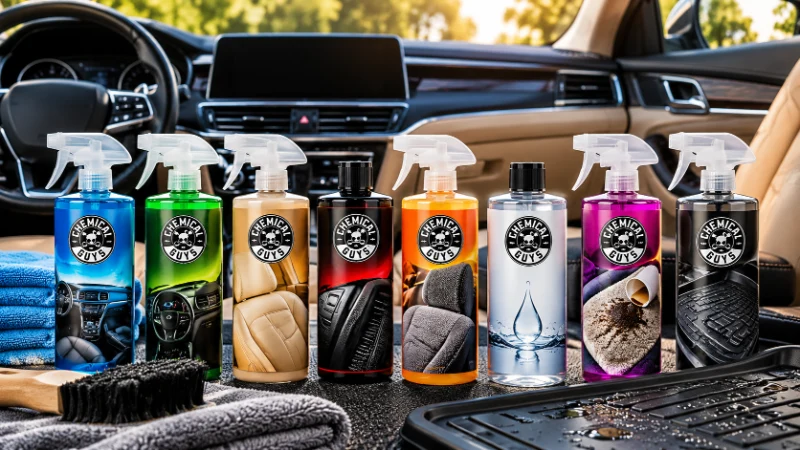
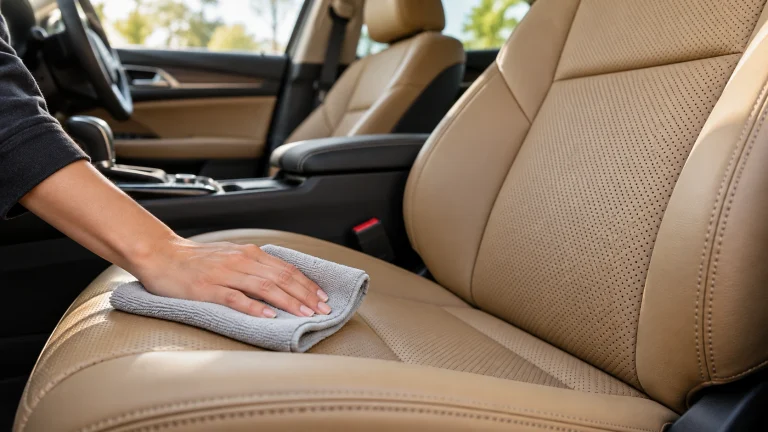
Body oils, food spills, and grit collect on car seats. The right product should remove that buildup without leaving a slippery seat or damaging the upholstery finish. Choosing gets confusing because “leather seats” can mean coated leather, uncoated leather, vinyl, synthetic leather, or a mix of materials. A cleaner, a conditioner, and a protective coating do different jobs, even when a bottle claims all three.
Quick recommendation: For a typical car with genuine leather seats, start with the Chemical Guys Leather Cleaner & Conditioner Kit. Its separate cleaner and conditioner let you remove grime before applying the second product. If your seats are perforated or ventilated, look at Chemical Guys VentRight and use very little liquid. For vinyl or synthetic leather, choose a cleaner labeled for those surfaces instead of a conditioner meant for genuine leather. Check the vehicle manual and test a hidden spot first.
Quick comparison: Best Leather Cleaner and Conditioner Products for Car Seats
| Product | Best for | Key specification | Check Price on Amazon |
|---|---|---|---|
| Chemical Guys Leather Cleaner & Conditioner Kit | Two-step care for genuine leather | Two 16 oz bottles | Check Price on Amazon |
| Lexol Leather Cleaner and Conditioner Kit | First-time two-step cleaning | Two 8 oz bottles and two sponges | Check Price on Amazon |
| Chemical Guys VentRight Leather Cleaner & Conditioner | Perforated and ventilated seats | 16 oz bottle | Check Price on Amazon |
| Leather Honey Leather Conditioner | Conditioning older genuine leather | 8 oz conditioner | Check Price on Amazon |
| Griot’s Garage Leather 3-in-1 Spray | Routine care across different leather finishes | 22 oz spray | Check Price on Amazon |
| 303 Leather 3-In-1 Complete Care | Finished leather and vinyl with one bottle | 16 fl oz spray | Check Price on Amazon |
| Weiman Leather Cleaner & Conditioner Spray | Smooth finished leather exposed to sun | 12 fl oz spray | Check Price on Amazon |
| Mothers VLR Vinyl-Leather-Rubber Care | Mixed-material cabins | 24 oz spray | Check Price on Amazon |
| Adam’s Polishes Leather & Interior Cleaner | Cleaning before separate protection | 16 oz cleaner | Check Price on Amazon |
| Leather Honey Leather Cleaner with UV Protection | Cleaning genuine and synthetic upholstery | 16 oz spray | Check Price on Amazon |
| Chemical Guys Sprayable Leather Cleaner & Conditioner in One | Fast upkeep on leather or synthetic leather | 16 oz spray | Check Price on Amazon |
| Bickmore Bick 4 Leather Conditioner | Smooth, light-colored genuine leather | 8 oz conditioner | Check Price on Amazon |
| Turtle Wax T-363A Leather Cleaner & Conditioner | Simple care for sealed leather | 16 fl oz bottle | Check Price on Amazon |
| Armor All Leather Care Gel | Controlled application on seat bolsters | 18 fl oz gel | Check Price on Amazon |
| Colourlock Leather Shield & Mild Cleaning Kit | Newer finished leather and dye-transfer prevention | 125 ml kit listing | Check Price on Amazon |
1. Chemical Guys Leather Cleaner & Conditioner Kit — Best for a complete two-step routine
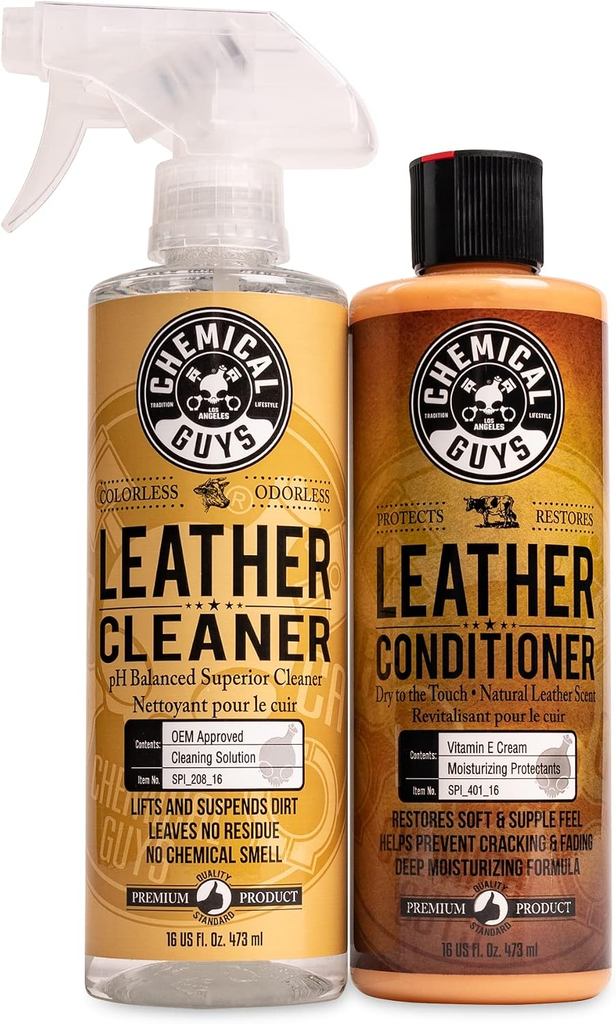
The kit contains separate 16 oz bottles of Leather Cleaner and Leather Conditioner. Clean the seat first, wipe away loosened dirt, then apply the conditioner as directed. Keeping the steps separate makes sense when the driver’s seat has body oils or grime that a quick combination spray may leave behind. The maker lists natural, synthetic, and sealed leather among its compatible surfaces; still check your seat maker’s instructions and test first.
It takes more time than a single spray and can leave excess product if you use too much conditioner. On vinyl or synthetic leather, the cleaning step is useful; a rich conditioner may offer little benefit. Choose this over Lexol if you want larger bottles; choose Lexol if the included sponges matter more.
Best for: Drivers who want one purchase for a separate cleaning and conditioning routine.
Pros: Dedicated cleaner removes grime before treatment; two full-size bottles.
Cons: Two applications take longer; applicators are not the reason to buy this kit.
Buying Decision: The most flexible overall choice for routine genuine-leather seat care.
2. Lexol Leather Cleaner and Conditioner Kit — Best for first-time leather care
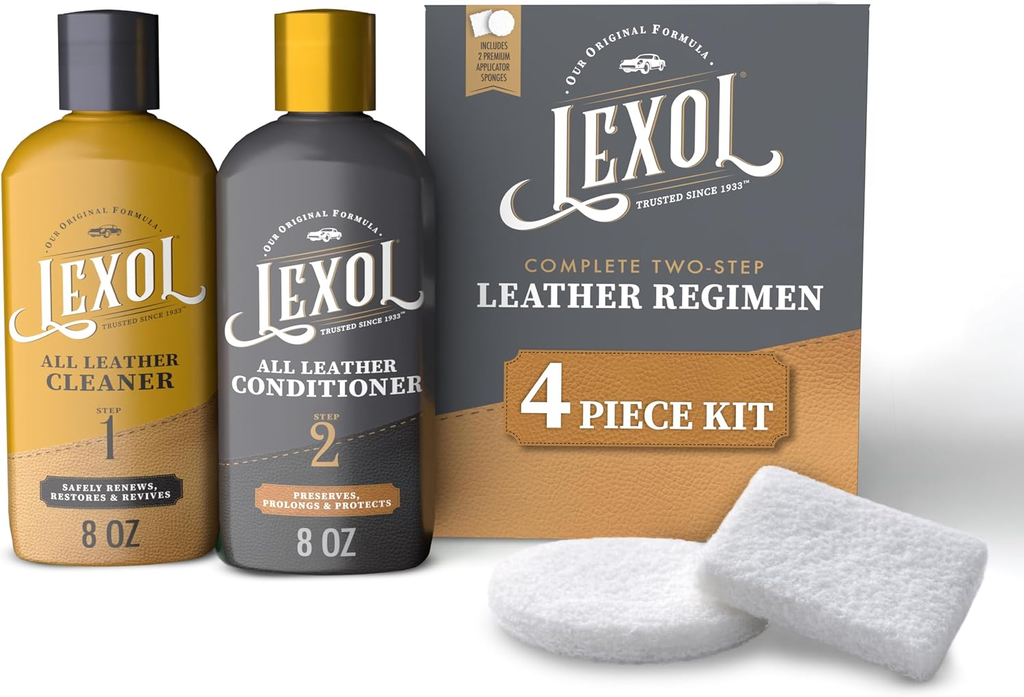
Lexol pairs an 8 oz cleaner and an 8 oz conditioner with two applicator sponges. That makes it practical when you have no cloths or dedicated leather products yet. Use the cleaner to lift ordinary soil, remove residue according to the label, and apply the conditioner to suitable genuine leather. The smaller bottles make more sense for one car than for cleaning several vehicles regularly.
Read the labels before using either liquid on an unusual finish, and keep the sponges clean so grit does not rub across the seat. The kit does not solve stained or peeling upholstery. Pick it over Chemical Guys when you want applicators in the package and do not need two 16 oz bottles.
Best for: A first leather-cleaning purchase for one car.
Pros: Separate products; two included application sponges.
Cons: Smaller bottles than the Chemical Guys kit; extra time for two steps.
Buying Decision: A straightforward starter kit when the seat material is confirmed as compatible leather.
3. Chemical Guys VentRight Leather Cleaner & Conditioner — Best for perforated seats
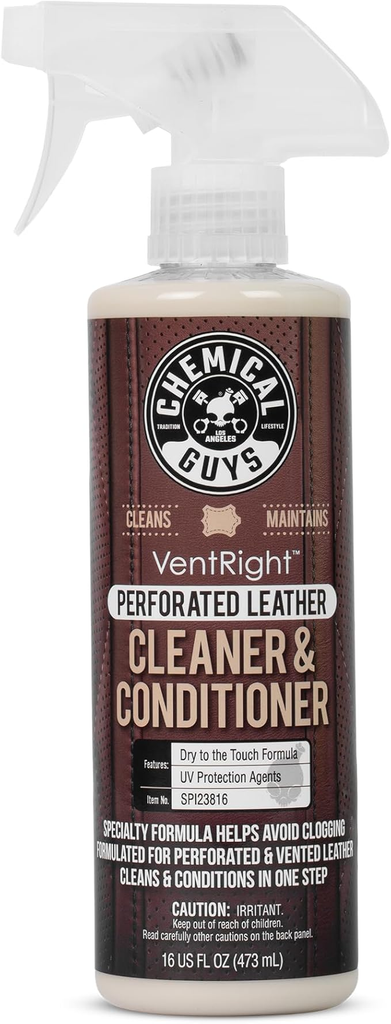
VentRight is sold as a 16 oz product for perforated and ventilated leather seats. Its intended use makes it a better fit for seats with small ventilation holes than a thick lotion or gel. Work sparingly with a soft cloth, follow the bottle directions, and keep liquid from pooling in the perforations. The goal is to clean the seating surface without soaking the foam, heating elements, or ventilation channels underneath.
The Amazon listing describes both cleaning and conditioning, while the maker describes the product as a perforated-leather cleaner. Check the current bottle if conditioning is important to your purchase. For solid leather panels with heavy buildup, the separate cleaner in the Chemical Guys kit offers more control.
Best for: Drivers with ventilated or perforated leather seat inserts.
Pros: Made for perforations; lighter application than a heavy cream.
Cons: Requires careful dosing; product descriptions differ on the conditioning claim.
Buying Decision: Choose it for perforated seats, applying lightly rather than trying to flood the holes clean.
4. Leather Honey Leather Conditioner — Best for older genuine leather
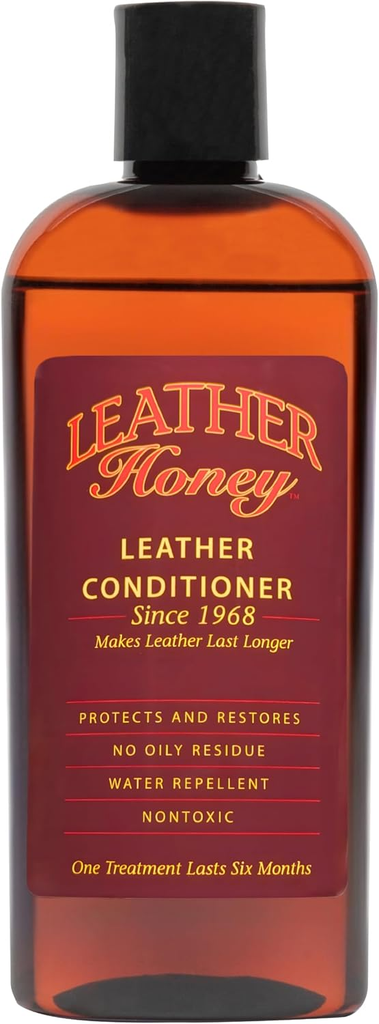
This 8 oz bottle is a conditioner, so clean dirty seats with a suitable cleaner first. Leather Honey recommends its conditioner for genuine leather and explicitly excludes suede, faux leather, and vinyl. It suits an older leather interior when the finish accepts conditioner and you have time to let the product absorb and wipe away any excess.
Modern automotive leather often has a protective topcoat. If a discreet test patch stays tacky or fails to absorb, do not coat the whole seat; use a suitable cleaner and protector instead. The product cannot repair cracks or worn pigment. Choose it over a light all-in-one spray when conditioning compatible genuine leather is the main task, rather than routine dust removal.
Best for: Clean, genuine leather that accepts a separate conditioner.
Pros: Dedicated conditioning product; small amount can be applied precisely.
Cons: No cleaning action; unsuitable for faux leather, vinyl, or suede.
Buying Decision: Buy only after confirming your seat finish tolerates conditioner.
5. Griot’s Garage Leather 3-in-1 Spray — Best for mixed leather finishes
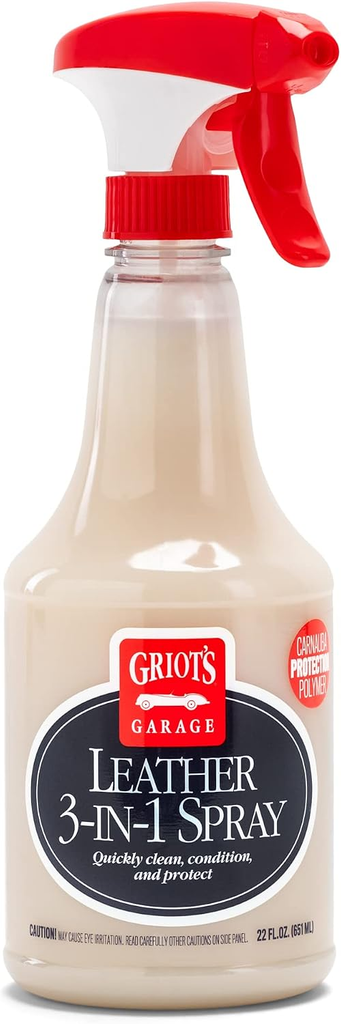
The 22 oz Leather 3-in-1 Spray cleans, preserves, and protects in one pass. Griot’s lists unfinished drum-dyed and aniline leather as well as finished, vinyl-coated leather as intended surfaces. That unusually broad stated compatibility helps when a vehicle has different leather finishes across seats and trim. Still spot-test absorbent leather: aniline can change appearance after treatment.
This is for regular cleaning and care, not deep extraction of dye transfer or ground-in soil. It leaves a leather scent, which may be a drawback in a fragrance-sensitive cabin. Choose it over a finished-leather-only spray if your owner’s manual identifies aniline or drum-dyed upholstery and permits this type of care.
Best for: Confirmed leather interiors with more than one finish type.
Pros: Manufacturer lists aniline and finished leather; large spray bottle.
Cons: Added leather scent; absorbent finishes demand a careful test.
Buying Decision: A practical all-in-one if its stated finish compatibility matches your seats.
6. 303 Leather 3-In-1 Complete Care — Best for finished leather and vinyl
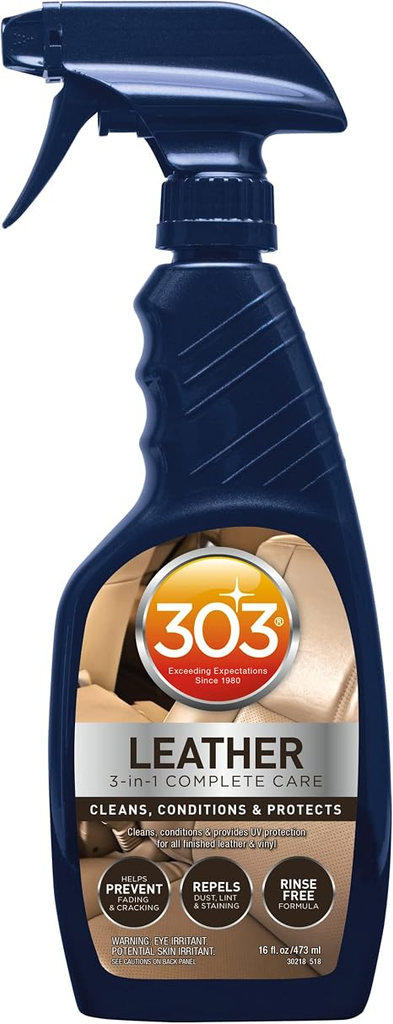
This 16 fl oz spray combines cleaning, conditioning, and protection for routine care of finished leather and vinyl. It makes sense when seats have coated leather center panels and vinyl elsewhere, and you want one bottle for both. The product is sold as a rinse-free formula; apply to a cloth and wipe any remaining film rather than leaving a wet seat.
An all-in-one product trades some cleaning control for speed. If the seat has thick body-oil buildup, use Adam’s dedicated cleaner before deciding whether you need protection. Avoid treating aniline or suede as finished leather merely because this bottle says “leather.”
Best for: Regular upkeep on finished leather and vinyl upholstery.
Pros: One bottle covers both listed surfaces; no separate rinse step.
Cons: Light cleaning is less suited to stubborn soil; finish identification still matters.
Buying Decision: Choose it when your seats need maintenance rather than a thorough restoration clean.
7. Weiman Leather Cleaner & Conditioner Spray — Best for smooth finished leather in sunny cars
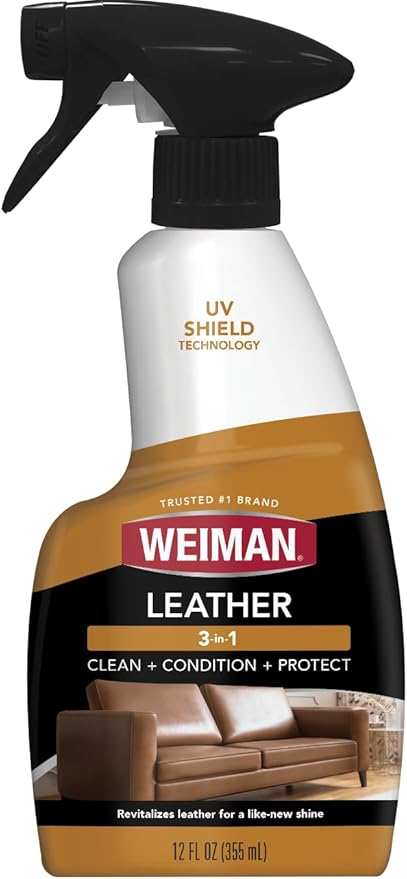
Weiman’s 12 fl oz spray cleans and conditions smooth finished leather and includes UV protection. Its directions say to spray onto a cloth and buff the leather. That gives better control near stitching and perforations than spraying a seat directly. The same bottle is suitable for compatible finished-leather accessories outside the car.
The manufacturer excludes suede, nubuck, unfinished leather, and Natuzzi-branded leather. The spray has a lemon scent, which some drivers will notice. It is a sensible choice over Leather Honey’s conditioner when you want everyday cleaning and UV-focused care in one bottle; buy a dedicated cleaner if the seats are heavily soiled.
Best for: Smooth finished-leather seats that need simple, regular care.
Pros: Cloth-first directions help limit overspray; UV protection is part of the formula.
Cons: Not for unfinished or napped leather; scented formula.
Buying Decision: A convenient finished-leather spray when the owner’s manual allows combination products.
8. Mothers VLR Vinyl-Leather-Rubber Care — Best for a mixed-material cabin
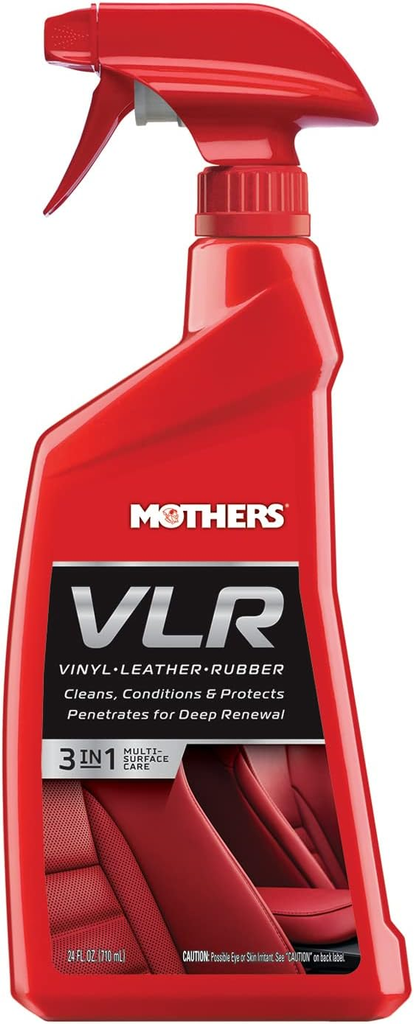
VLR stands for vinyl, leather, and rubber. The 24 oz product is useful in a cabin where the upholstery, door inserts, and rubber trim need attention during the same cleaning session. It cleans and conditions compatible surfaces without requiring separate bottles for each named material. Apply sparingly to a cloth so you can control where it lands.
Multi-surface convenience does not mean every part of the car is fair game: keep any dressing off pedals and any surface where slipperiness could matter. It is also a less targeted choice for neglected genuine leather than the separate Chemical Guys kit. Choose it over a leather-only product when vinyl and rubber make up much of the interior.
Best for: Cars with leather, vinyl, and rubber trim to maintain.
Pros: Covers three named material types; 24 oz bottle.
Cons: Less specialized for deep leather cleaning; avoid control surfaces that must stay grippy.
Buying Decision: Buy for material coverage, not for repairing damaged leather.
9. Adam’s Polishes Leather & Interior Cleaner — Best for cleaning before a separate protectant
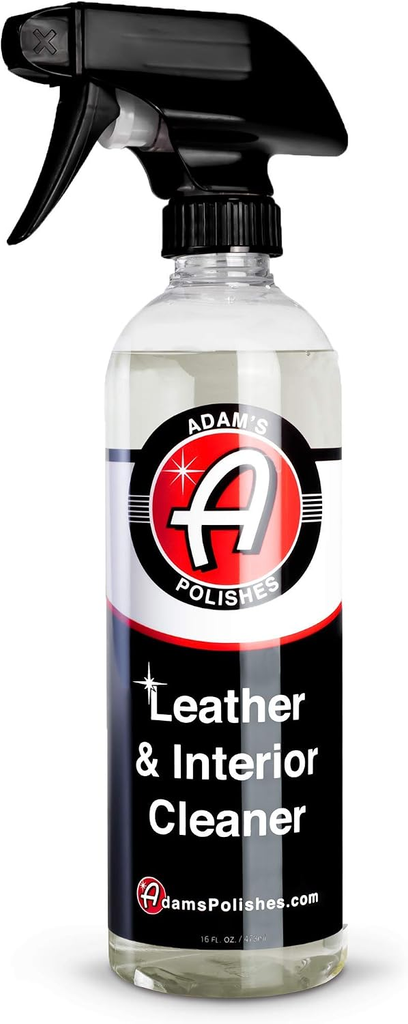
Adam’s 16 oz cleaner is intended for leather, vinyl, and textured interior plastics. It is a cleaner, not the brand’s separate leather conditioner. This makes it useful when the immediate problem is grime on the driver’s seat and you want to decide on a compatible conditioner or protectant only after the surface is clean. Work one small area at a time with a soft cloth or appropriate brush and remove loosened dirt.
Read the bottle directions and spot-test dyed leather. A dedicated cleaner can expose existing color loss that grime had hidden; it cannot replace missing dye. Compared with 303’s all-in-one, this gives more control over the cleaning stage but requires another purchase if protection is needed.
Best for: Grimy seats needing a dedicated cleaning step.
Pros: Also covers vinyl and textured plastic; leaves protection as a separate decision.
Cons: Does not condition or protect by itself; more work than one-step sprays.
Buying Decision: Pick this when removing soil is the priority and you want to choose the finish product separately.
10. Leather Honey Leather Cleaner with UV Protection — Best for cleaning genuine and synthetic seats
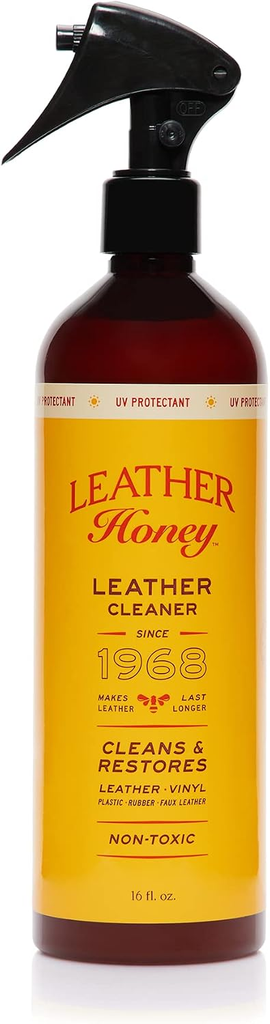
This is the 16 oz, ready-to-use spray version of Leather Honey Leather Cleaner with UV protectant. Unlike the brand’s leather conditioner, the cleaner is also listed for vinyl, plastic, rubber, and faux leather. It fits an owner who is unsure whether every panel labeled “leather interior” is actually genuine leather. Clean a small test area first and follow the bottle’s directions for removing residue.
UV protectant in a cleaner does not turn it into a conditioner. If the car has genuine leather that also needs conditioning, use a compatible separate product after cleaning. Choose this over Leather Honey Conditioner for synthetic seat panels; choose Adam’s cleaner when you specifically want a cleaning-only step before another protectant.
Best for: Routine cleaning when genuine and synthetic upholstery share a cabin.
Pros: Maker lists faux leather and vinyl as compatible; ready-to-use 16 oz spray.
Cons: No leather-conditioning step; test sensitive finishes before use.
Buying Decision: A useful cleaner for mixed upholstery, with conditioning decided separately.
11. Chemical Guys Sprayable Leather Cleaner & Conditioner in One — Best for quick seat upkeep
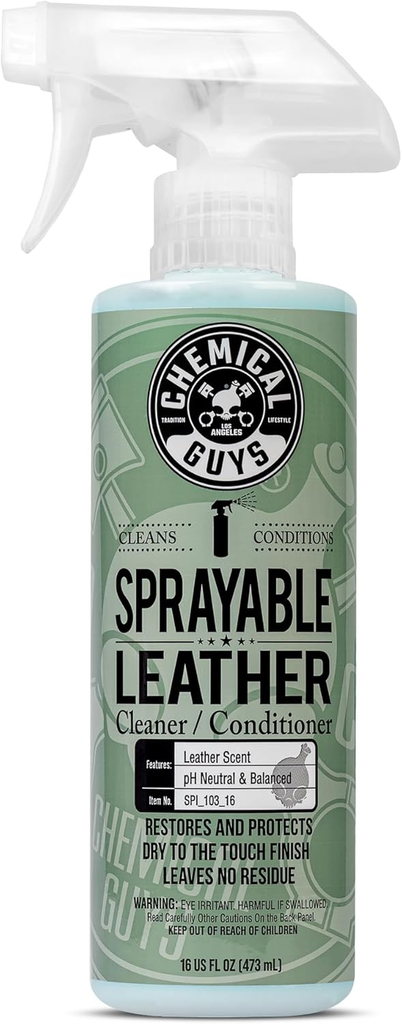
The 16 oz spray combines light cleaning and conditioning, saving a step on seats that are already maintained. The maker lists natural and synthetic leather uses. Apply to an applicator or cloth and wipe the surface evenly, especially around stitched panels. It works best when the task is fingerprints and light body oils, not layers of neglected grime.
For a dirty driver’s bolster, the two-bottle Chemical Guys kit is easier to use deliberately: remove soil first, then condition. Any combination spray can leave a film when overapplied, so buff away excess and check the seat feel before driving. Choose this bottle when time and storage space matter more than separate steps.
Best for: Fast maintenance between fuller cleans.
Pros: Single 16 oz bottle; maker includes synthetic leather in stated uses.
Cons: Less control over cleaning versus conditioning; not a fix for heavy soil.
Buying Decision: Buy for convenience on regularly maintained, compatible seats.
12. Bickmore Bick 4 Leather Conditioner — Best for light-colored genuine leather
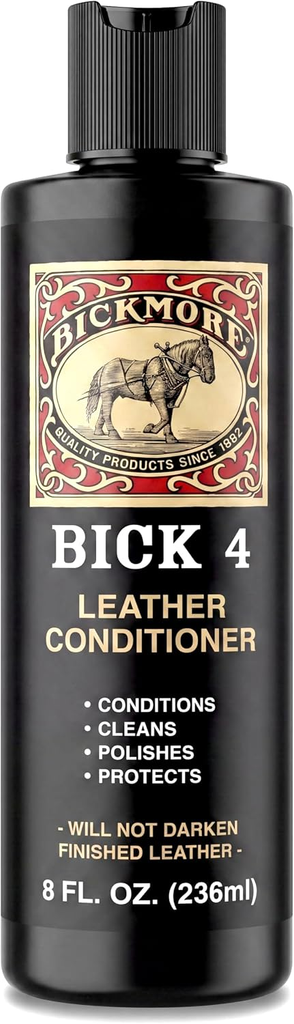
Bick 4 comes in an 8 oz bottle and is intended for smooth finished leather, including car interiors. Bickmore says the wax-free formula will not darken leather. That makes it worth considering when the seat is pale and a darker finish would be unacceptable. Clean a dirty seat first: Bickmore specifically advises a separate cleaner for very dirty leather.
Even with the maker’s no-darkening claim, test a hidden patch because older finishes can react differently. Bickmore excludes suede, rough-out, distressed, and napped leather. Pick it over Leather Honey when keeping the shade of smooth finished leather is the main concern; neither is a substitute for a proper cleaner.
Best for: Smooth, light-colored genuine leather after cleaning.
Pros: Maker states it will not darken leather; wax-free formula.
Cons: Separate cleaner needed for heavy dirt; excluded specialty finishes.
Buying Decision: A targeted conditioner for pale leather when a spot test confirms the finish stays consistent.
13. Turtle Wax T-363A Leather Cleaner & Conditioner — Best for basic sealed-leather care
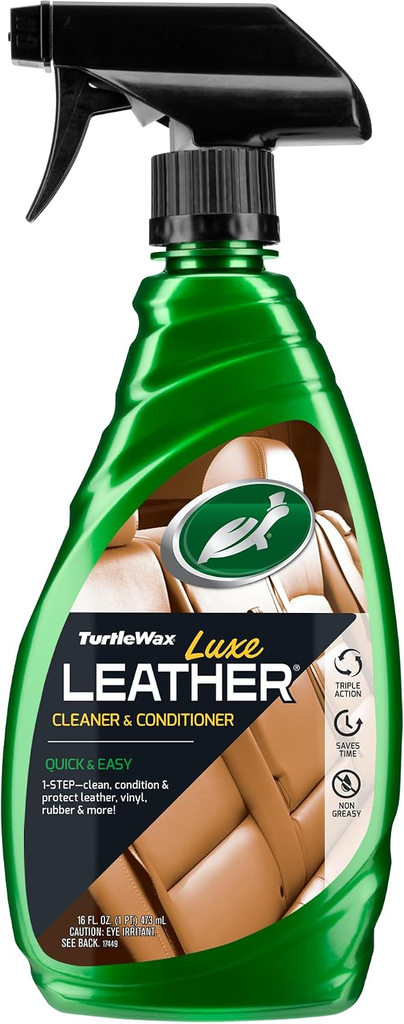
The Amazon listing identifies this exact T-363A cleaner and conditioner as a 16 fl oz product. It is a simple single-bottle option for drivers who want to wipe down ordinary leather seat dirt and follow with a dry buff. Check the current bottle’s directions and the car manual before using it on any seat with an unusual or absorbent finish.
Turtle Wax’s current Luxe Leather product is a different listing, so do not assume its label or instructions apply to T-363A. The available listing gives less finish-specific guidance than some other picks here. Choose Weiman for clearly labeled smooth finished leather, or the two-step kit when seats are substantially dirty; choose this if you specifically prefer the T-363A one-bottle format.
Best for: Routine upkeep when the T-363A label matches your seat finish.
Pros: Combined cleaner and conditioner; direct listing specifies the 16 fl oz size.
Cons: Verify current label for finish restrictions; less targeted than a dedicated cleaner.
Buying Decision: A basic one-bottle pick after checking the physical product’s compatibility directions.
14. Armor All Leather Care Gel — Best for controlled application on bolsters
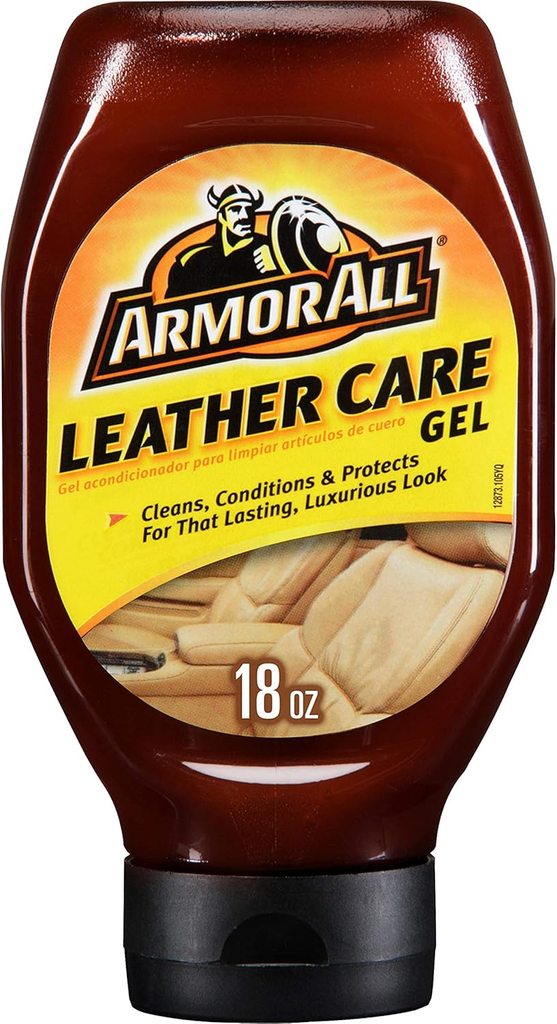
This 18 fl oz gel cleans, conditions, and protects leather. A gel on a cloth can be easier to keep on a side bolster or seatback than a freely sprayed liquid. Armor All says to spread it evenly and absorb excess moisture with a dry towel. It also says the product will not harm vinyl or rubber.
The maker excludes suede, buckskin, unfinished leather, and fabric and warns against use where slipperiness is hazardous. Do not use it on the steering wheel or pedals. It is also a poor match for perforated inserts where excess gel could lodge in holes; VentRight is the more suitable pick there.
Best for: Solid finished-leather panels and bolsters where application control matters.
Pros: Gel helps direct product onto a cloth; cleaner and protectant in one.
Cons: Excess needs thorough removal; unsuitable for perforations and grip-critical surfaces.
Buying Decision: Choose for solid leather sections, then wipe until the seat feels dry and secure.
15. Colourlock Leather Shield & Mild Cleaning Kit — Best for newer finished leather
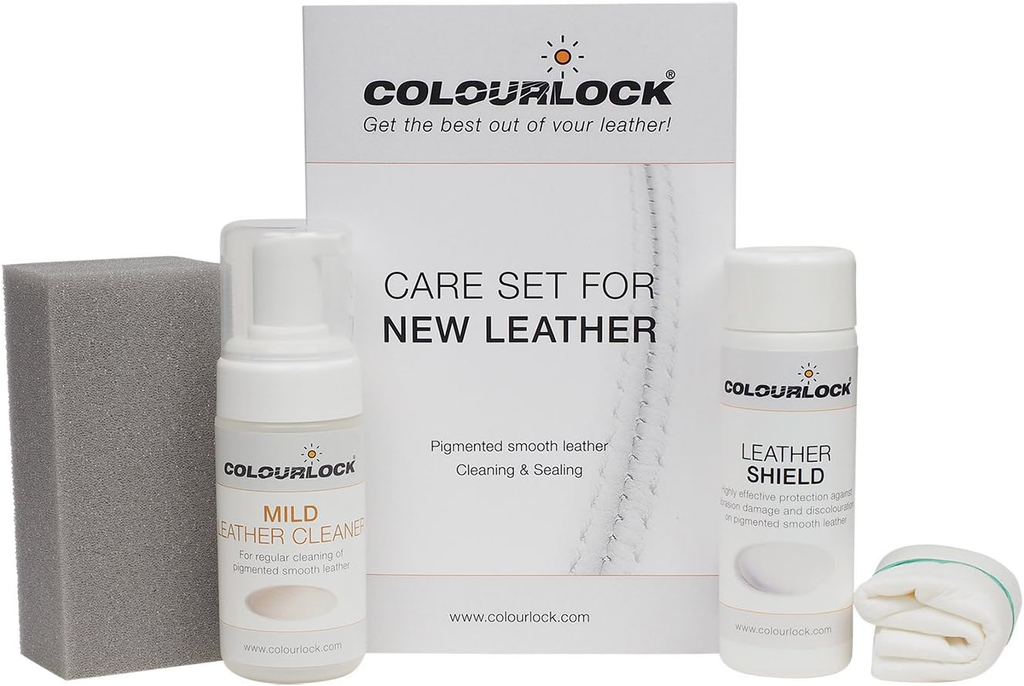
This Amazon listing is the 125 ml Leather Shield & Mild Cleaning Kit. It combines a mild cleaning step with a protective shield aimed at newer leather; the listing describes leather up to three years old. That suits a newer, pigmented leather seat where limiting rub wear and dye transfer matters more than applying a rich conditioner.
The shield is a protectant, not a leather conditioner. Confirm the bottle contents and your car’s finish before purchase, especially if you have absorbent aniline leather or suede. Availability may vary by seller. Compared with the Chemical Guys kit, this targets protection on newer finished seats rather than a general cleaning-and-conditioning routine.
Best for: Newer pigmented leather seats that need cleaning and surface protection.
Pros: Separate mild cleaner and protective step; specific new-leather use case.
Cons: Not a conditioning kit; small listed size and variable seller availability.
Buying Decision: Choose when preserving a newer finished seat is the goal and its kit contents match the listing.
Which should you buy?
For most genuine-leather interiors, buy the Chemical Guys Leather Cleaner & Conditioner Kit. The separate steps are easier to match to the seat’s condition: clean first and apply conditioner only when appropriate for that finish. If you are starting from scratch and want sponges included, choose Lexol. For perforated seats, choose VentRight and apply it sparingly. If the cabin mixes vinyl and leather, use Mothers VLR or the Leather Honey Cleaner; do not apply Leather Honey Conditioner to faux leather or vinyl.
| Your seat or task | Start here | Why |
|---|---|---|
| Grimy genuine leather | Chemical Guys two-bottle kit | Separates dirt removal from conditioning |
| Ventilated leather | Chemical Guys VentRight | Intended for perforated inserts |
| Older leather that accepts conditioner | Leather Honey Conditioner | Dedicated conditioning after cleaning |
| Light-colored smooth leather | Bickmore Bick 4 | Maker says it does not darken leather |
| Vinyl and leather in one cabin | Mothers VLR | Labeled for both materials and rubber |
| Newer finished leather | Colourlock kit | Mild cleaning plus a separate protective shield |
Safe use and common mistakes
- Vacuum grit and crumbs before wiping. Grit trapped in a cloth can scratch a finish.
- Test a hidden spot and let it dry before treating a visible panel. Stop if color transfers, the patch darkens, or the surface turns tacky.
- Put product on a cloth when practical. Avoid soaking seams, ventilation holes, switches, or heated-seat components.
- Follow the product label for dwell time and residue removal. Wipe off excess and allow the seat to dry before driving.
- Never put a slippery conditioner or dressing on pedals, steering wheels, or other controls. Do not try to fix peeling coating, cracks, or missing dye with a cleaner.
- Avoid using a genuine-leather conditioner on faux leather simply because the interior is advertised as “leather.” Use a cleaner approved for synthetic material instead.
FAQs
Do coated leather car seats need conditioner?
It depends on the car and the product. A topcoat may prevent a conditioner from absorbing. Clean first, check the owner’s manual, and test the conditioner on a hidden patch. If it sits on the surface or becomes sticky, remove it and use care intended for the coated finish.
Can I use these products on faux leather or vinyl?
Only when the product lists those materials. Mothers VLR, Adam’s Leather & Interior Cleaner, and Leather Honey Leather Cleaner are examples with stated synthetic-surface uses. Leather Honey Conditioner specifically excludes faux leather and vinyl.
How do I clean perforated or ventilated seats?
Vacuum loose debris, then use a lightly dampened cloth with a compatible product. Work gently and avoid pushing liquid through the holes. VentRight is the pick here designed for this type of seat.
Will leather cleaner remove blue-jean dye or repair cracks?
Routine cleaning may remove fresh surface transfer, but old dye marks and damaged finishes may need a leather specialist. A cleaner or conditioner cannot rebuild cracked coating or replace missing color.
Verdict
The Chemical Guys Leather Cleaner & Conditioner Kit is the best overall pick for a typical genuine-leather car interior because its two steps let you clean before deciding how much conditioner the seat needs. Lexol is the compact starter kit, VentRight suits perforated seats, Mothers VLR fits mixed interiors, and Colourlock makes more sense for newer finished leather that needs a protective shield. Check the seat material and product label before applying any of them.