
To disinfect leather car seats, first clean them using your vehicle manufacturer’s approved method. Then use a disinfectant only if its label permits the seat’s material and the automaker allows that type of treatment. Follow the product’s application directions and full wet contact time. If those requirements conflict, don’t use the product on the seat.
There is no universal disinfectant recipe that is safe for every automotive leather finish. A leather cleaner can remove dirt without disinfecting, while a household disinfectant can damage upholstery even when it kills germs. The safest approach starts with identifying the material and checking both sets of instructions, rather than choosing the strongest chemical available.
Cleaning and Disinfecting Are Different Tasks
Cleaning removes dirt, oils, and other material from a surface. Disinfecting uses a product with specific germ-killing claims under stated conditions. Cleaning helps reduce contamination, but it does not establish that a seat has been disinfected.
Leather cleaners, conditioners, and interior detailing wipes should not be treated as disinfectants unless their labels specifically support that use. Likewise, words such as “antibacterial” or “sanitizing” do not automatically mean a product is effective against the organism you are concerned about.
For a disinfectant, the claim depends on more than the active ingredient. The approved surface, application method, target organism, and required contact time all matter. A quick wipe followed by immediate drying may not meet those conditions.
Check Your Seat Material Before Choosing a Product
Start with the owner’s manual or the automaker’s upholstery-care instructions. Seats described as leather may combine leather seating panels with synthetic side bolsters, and different trim packages can require different care.
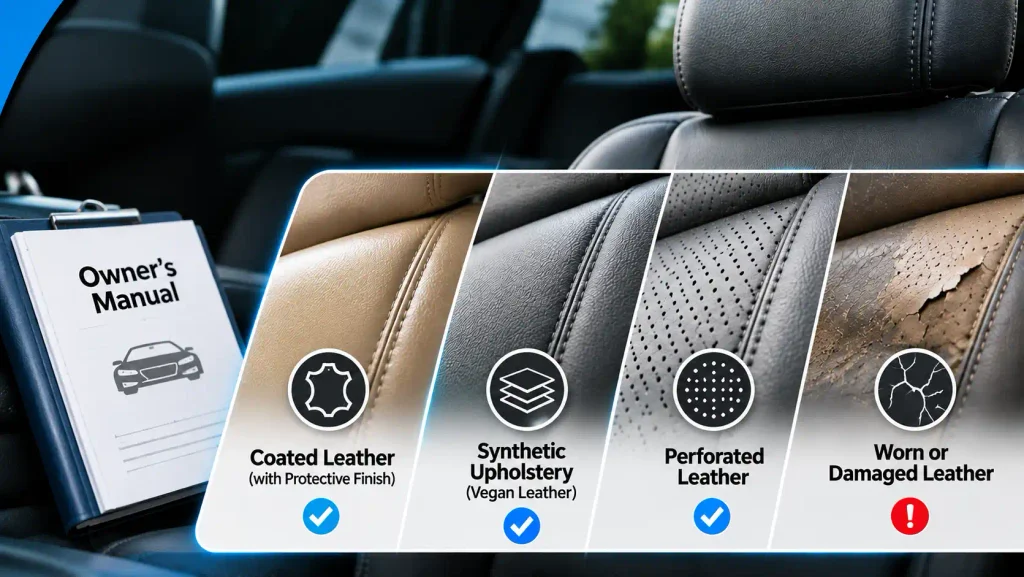
Coated leather and synthetic upholstery
Many automotive leather seats have a protective surface finish. That finish still needs protection from incompatible chemicals and excessive rubbing. Synthetic leather may look similar but have different care requirements, so don’t assume a product approved for one is approved for the other.
A disinfectant labeled for “hard, nonporous surfaces” is not automatically suitable for flexible leather upholstery. Look for explicit permission for the relevant upholstery material, alongside any vehicle-manufacturer restrictions.
Perforated, worn, or absorbent leather
Perforations, stitching, cracks, and damaged coatings complicate disinfection because liquid can reach places that cannot be treated or dried reliably. Keeping a seat visibly wet for a disinfectant’s required contact time may also conflict with instructions not to saturate the upholstery.
If water readily absorbs into the leather, the finish is peeling, or contamination has entered the cushion, stop before applying a general-purpose disinfectant. Ask the automaker or a qualified automotive upholstery specialist for an appropriate treatment. Surface wiping cannot establish that underlying foam has been disinfected.
What You Need
Gather only the supplies permitted by the seat-care instructions and the cleaning or disinfecting product labels. Having separate cloths ready helps prevent a dirty cloth from spreading contamination back onto a cleaned panel.
- A vacuum with a clean, soft upholstery attachment, for ordinary dry debris.
- Several clean, soft cloths, preferably colorfast microfiber.
- A manufacturer-approved leather or upholstery cleaner.
- A disinfectant explicitly suitable for the material and intended purpose, if an approved option is available.
- Protective gloves or other protection required by the product label.
- A timer for tracking contact time.
Do not mix cleaners or disinfectants. Park out of direct sunlight, let hot seats cool, and provide the ventilation required by the product instructions.
How to Disinfect Leather Car Seats Step by Step
The process must satisfy both upholstery-care limits and disinfectant directions. If you cannot meet the disinfectant’s instructions without violating the vehicle’s care requirements, choose another approved approach rather than shortening the contact time or soaking the seat.
1. Identify the contamination and any stop conditions
For ordinary contact contamination, begin with the cleaning steps below. Visible blood, vomit, feces, or other body fluids require additional precautions and a treatment appropriate to that contamination.
Do not vacuum body fluids or contaminated damp material. Keep people away from the affected area and seek professional guidance when contamination has soaked into seams, perforations, or cushioning. Mold growth and persistent dampness also call for investigation beyond a routine surface wipe.
2. Remove loose debris and clean the surface
For dry, ordinary dirt, gently vacuum crumbs and grit without dragging a hard nozzle across the leather. Pay attention to seat creases, but avoid pushing debris into perforations.
Apply the approved cleaner according to its directions. Where the instructions permit, applying it to a cloth rather than spraying the seat directly helps control moisture. Work gently in manageable sections and change cloths when they become dirty.
Remove cleaner residue as directed. Don’t leave a layer of cleaner beneath the disinfectant unless the product system specifically calls for it.
3. Confirm that the disinfectant is suitable
Read the disinfectant label for the exact surface permission, intended germ claim, preparation requirements, and wet contact time. In the United States, an EPA registration number identifies a registered disinfectant, but it does not by itself establish compatibility with leather seats.
Check the vehicle-care instructions for restrictions on the product or its ingredients. If the manual allows only mild cleaning and says nothing about disinfection, ask the manufacturer before experimenting.
Household disinfecting wipes deserve the same check. A familiar brand name is not enough because different wipes from the same brand can have different formulas and approved uses. Ordinary leather-care wipes may be useful for cleaning without providing disinfection.
4. Spot-test an inconspicuous area
If both sets of instructions allow the treatment, test a small hidden area first. Follow the intended application and drying directions, then inspect for color transfer, whitening, streaking, tackiness, or a change in sheen.
Stop if the cloth picks up dye or the finish changes. A successful spot test can reveal an immediate compatibility problem, but it does not guarantee that repeated treatment will be harmless.
5. Apply the disinfectant and meet its contact time
Treat a manageable section using the label’s application method. Keep that section visibly wet for the entire specified contact time, using a timer rather than guessing.
Do not automatically spray the whole seat or flood it to keep it wet. Avoid allowing liquid to collect around stitching, perforations, controls, or seat-mounted electrical components. If the required wetness cannot be maintained within the upholstery-care limits, the product is not a suitable choice for that application.
6. Finish as directed and allow the seat to dry
After the contact time, follow any required wiping, residue-removal, or rinsing instructions. Do not assume every disinfectant should be left on the surface, and don’t improvise a rinse that saturates the seat.
Allow the upholstery to dry fully before use. Do not accelerate drying with a heat gun, hair dryer, or seat heater unless the relevant instructions specifically permit it. Apply conditioner only if recommended for that upholstery and compatible with the completed treatment; conditioner does not replace disinfection.
Methods to Avoid Without Specific Approval
Strong chemicals and aggressive tools are not shortcuts around material compatibility. Avoid bleach, concentrated alcohol, peroxide, household surface sprays, abrasive pads, and steam unless the exact treatment is approved for your seats and used as directed.
Do not transfer a general alcohol concentration recommendation from another setting into a leather-care recipe. The active ingredient alone does not establish either finish safety or effective disinfection under your application conditions.
Homemade vinegar mixtures, essential oils, baking soda, and similar household remedies should not be presented as validated leather-seat disinfectants. Parking in the sun or warming the seats also does not provide a controlled, verified disinfection process.
If No Compatible Disinfectant Is Available
Clean the seats using the approved method rather than substituting an incompatible disinfectant. This is still useful care, but describe the result accurately as cleaning, not verified disinfection.
For a specific infectious exposure, contact the vehicle manufacturer and a professional experienced with automotive upholstery. Explain the material, contamination, and affected area. If contamination entered the cushioning, surface treatment alone may be inadequate, and professional assessment may identify a need for component replacement.
Conclusion
Safe leather-seat disinfection requires agreement between the vehicle’s care instructions and the disinfectant label. Clean first, confirm material compatibility, spot-test, and meet the full contact time without saturating the upholstery. When those conditions cannot all be met, use approved cleaning and seek qualified advice instead of risking permanent finish damage.
Frequently Asked Questions
Does a leather seat that smells clean need more treatment?
Smell cannot establish whether a leather seat has been disinfected. Fragrance can mask odors, and an odor-free surface is not proof of a germ-killing result. Base that assessment on the appropriate product and completed procedure, not scent.
Can a handheld UV wand disinfect leather car seats?
A handheld UV wand should not be assumed to disinfect an entire leather seat. Effectiveness depends on a validated dose and exposure conditions, while folds, seams, and shaded areas complicate coverage. UV devices can also present eye and skin hazards, so they are not a substitute for an approved upholstery-care process.
How often should leather car seats be disinfected?
There is no single disinfection schedule for every personal vehicle. Base additional treatment on an actual contamination concern, relevant health guidance, and the seat manufacturer’s limits. Routine dirt and body oils generally call for approved cleaning rather than automatically repeated disinfectant exposure.
What should I ask a detailer who offers leather-seat disinfection?
Ask for the exact product, its approved upholstery applications, the intended germ claim, and the required contact time. Also ask how the detailer will meet those directions without over-wetting your particular seats. A service described only as “sanitizing” does not explain what treatment or result is being offered.
Will a removable seat cover keep the leather underneath disinfected?
A removable cover does not guarantee that the leather underneath stays uncontaminated. Hands, gaps, and handling can transfer material around the cover. Use only covers compatible with the vehicle’s seat-mounted airbags and other seat functions, and clean them according to their own care instructions.