Checking transmission fluid starts with finding the procedure for your specific vehicle. Some automatic transmissions have a dipstick under the hood, while others use a check plug or an electronic service procedure. The engine may need to be running or off, and the fluid may need to be at a specified temperature.
Your owner’s manual is the best place to start. If your vehicle has a dipstick and the manufacturer provides an owner-accessible procedure, the steps below will help you take a reliable reading. If there is no dipstick or the instructions require lifting the car, a scan tool, or a specific fluid temperature, a qualified shop may be the safer choice.
What You Need Before Checking Transmission Fluid
For a typical dipstick-equipped automatic transmission, gather:
- The vehicle owner’s manual
- A clean, lint-free cloth or paper towel
- Gloves, if desired
- The manufacturer-specified transmission fluid, if a top-off is needed
- A clean funnel, if the vehicle is designed to be filled through the dipstick tube
Park on a flat, level surface away from traffic. Set the parking brake, and follow the manual’s instructions for the transmission selector position and engine state. Keep loose clothing, hair, hands, and tools away from belts, fans, and other moving or hot engine components.
Do not work underneath a vehicle supported only by a jack. A check-plug procedure may require the vehicle to be raised and kept level, which is a good reason to have a shop perform the check.
First, Confirm Which Transmission You Have
This guide primarily covers automatic transmissions with a dipstick. Transmission designs vary, and the check method is not interchangeable between them. Many rear-wheel-drive, all-wheel-drive, and four-wheel-drive vehicles also have a differential with its own fluid, covered in our guide on how to check and change differential fluid.
| Transmission or check method | What to look for | Best next step |
|---|---|---|
| Automatic with a dipstick | An identified transmission-fluid dipstick and a procedure in the manual | Follow the vehicle-specific temperature, engine, and selector instructions |
| Automatic without a dipstick | No owner-accessible dipstick, or a manual directing you to service information | Have a qualified shop check it using the specified procedure |
| Manual transmission | Typically a fill/check plug rather than an under-hood dipstick | Follow the service procedure or use a shop |
| CVT or dual-clutch transmission | Vehicle-specific service instructions and fluid requirements | Confirm the exact procedure and fluid specification before proceeding |
| Electric vehicle | Vehicle-specific drive-unit or gearbox service requirements | Consult the manufacturer’s instructions; do not assume an automatic-transmission procedure applies |
Some vehicles described as having a “sealed” transmission still have fluid that can be checked or serviced. The term does not mean you should look for a plug and open it yourself. The correct procedure can depend on fluid temperature, vehicle position, and specialized equipment.
How to Check Transmission Fluid With a Dipstick
Use these steps only if your manual identifies a dipstick and permits an owner check. If the manual differs from the general sequence below, follow the manual.
1. Bring the Fluid to the Specified Condition
Read the instructions before starting the engine. Your manufacturer may require the transmission to be at operating temperature, within a specified temperature range, or checked under a different condition.
Some dipsticks have separate cold and hot markings. Use the range specified for the actual fluid condition and the manufacturer’s procedure. Do not assume that a short drive, an idling engine, or a warm engine-temperature gauge confirms the transmission fluid is at the required temperature.
If the procedure requires an exact fluid temperature and you cannot measure it as instructed, arrange for a professional check rather than guessing.
2. Park on Level Ground and Set the Controls
Park on a level surface and set the parking brake. Place the selector in the position specified by the manual, commonly Park, but do not assume that applies to every vehicle.
Some manufacturers instruct you to move the selector through its positions before checking the level. If yours does, keep your foot on the brake and follow the specified sequence. Return the selector to the required position before opening the hood.
The manual should also say whether the engine needs to be running. Many automatic transmissions are checked with the engine running, but some are not. Checking under the wrong condition can produce a misleading reading.
3. Locate and Identify the Dipstick
Open the hood and find the transmission-fluid dipstick identified in your owner’s manual. Do not confuse it with the engine-oil dipstick. Handle colors and locations vary, so use the manual rather than color alone to identify it.
If you cannot positively identify the transmission dipstick, stop. Pulling the wrong dipstick will not tell you the transmission fluid level, and adding fluid to the wrong opening can cause damage.
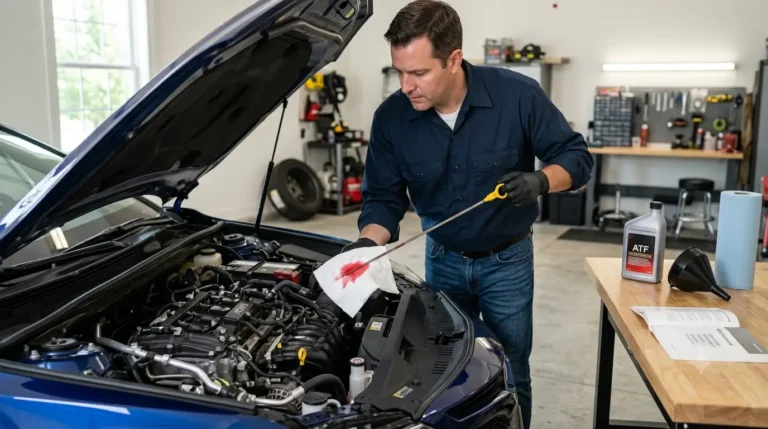
4. Wipe, Reinsert, and Read
With the engine and selector in the required state:
- Pull out the transmission dipstick carefully.
- Wipe it clean with a lint-free cloth.
- Reinsert it fully, following any instructions for the dipstick design.
- Pull it out again and read the fluid level against the appropriate markings.
- Repeat the reading if the fluid is smeared or difficult to see.
Read both sides if necessary, and look for a consistent fluid boundary rather than a streak left by the tube. A light-colored cloth can help you see the fluid, but the level must be read on the dipstick itself.
Keep clear of hot surfaces and moving parts throughout the check. If you are uncomfortable working near a running engine, have a technician do it.
5. Interpret the Reading
A level within the correct marked range generally does not need adjustment. Refit the dipstick fully and secure it as designed.
If the level is below the specified range, verify that you followed the temperature, engine-state, selector-position, and level-ground instructions. An incorrect setup can make a normal level appear low or high. If the reading remains low, inspect for signs of a leak and follow the manufacturer’s top-off instructions.
If the level is above the specified range, do not add fluid. Confirm the reading under the correct conditions. Persistent overfilling should be corrected using the manufacturer’s procedure, preferably by a qualified technician. Both insufficient and excessive fluid can cause operating problems.
How to Add Transmission Fluid Safely
Add fluid only after confirming that the level is low and that your vehicle’s manufacturer permits the top-off method you intend to use. Identify the exact fluid specification in the owner’s manual or manufacturer service information. Transmission fluids are not automatically interchangeable, even when containers use similar names.
If the manufacturer specifies filling through the dipstick tube, use a clean funnel that fits the tube. Add a small amount at a time, allow it to settle as directed, and repeat the complete level-check procedure. The marked range is the target, not the highest point you can reach.
Do not pour in an entire container based on a low-looking dipstick. The amount needed varies by vehicle and by how far the level is below the correct range. If the manual does not specify an owner top-off procedure, or if the proper fluid cannot be confirmed, stop and ask a qualified shop.
A low reading deserves attention beyond the immediate top-off. If the level falls again, or you see fluid collecting beneath the vehicle, have the source investigated. Topping off does not repair a leak.
What Transmission Fluid Appearance Can Tell You
A dipstick reading can reveal more than level, but color alone cannot establish whether fluid is good or bad. Fluid appearance varies by formulation, age, and contamination, so use it as a reason to investigate rather than as a diagnosis.
- Fluid that looks different from a fresh sample: Compare it with the manufacturer’s guidance and service history. A color change by itself does not prove a transmission failure.
- A burnt smell or very dark fluid: Have the vehicle assessed, especially if shifting has changed or the transmission has overheated.
- Milky-looking fluid: Possible contamination needs prompt professional attention. Do not assume the cause without an inspection.
- Visible particles or debris: Save the observation for a technician and avoid drawing conclusions from appearance alone.
Follow the manufacturer’s maintenance schedule for fluid service. A fluid-level check does not replace a scheduled fluid change or inspection.
Common Mistakes That Produce a Bad Reading
Checking at the Wrong Temperature
Fluid level changes with temperature. Reading the hot markings when the fluid has not reached the specified condition can lead to an unnecessary top-off. Use the temperature and range required by the vehicle manufacturer.
Assuming the Engine Must Always Be Running
A running-engine check is common for automatic transmissions, but it is not universal. The correct engine state and selector position are vehicle-specific. Check both before pulling the dipstick.
Checking on a Slope
A driveway incline can affect the reading. Move to a level surface, secure the vehicle, and repeat the procedure before deciding the level is low.
Using the Wrong Fluid
Do not choose fluid solely because the bottle says “automatic transmission fluid” or claims broad compatibility. Confirm that it meets the exact specification required for your vehicle. If you are unsure, do not add it.
Treating a Check Plug Like a Dipstick
A transmission without a dipstick may require a carefully controlled temperature and a level vehicle during the check. Opening an unidentified plug can release hot fluid or disturb the wrong component. Leave unfamiliar under-car procedures to a qualified shop.
When to Stop and Get Professional Help
Arrange an inspection if the correct procedure is unclear, the vehicle has no accessible dipstick, or the level cannot be verified without specialized equipment. A technician can also check a recurring low level or suspected leak.
Seek prompt help if you notice slipping, delayed engagement, unusual shifting, a transmission warning, or fluid leaking onto the ground. Do not assume adding fluid will fix those symptoms. If the vehicle is unsafe to drive or the manufacturer’s instructions tell you to stop, arrange a tow.
Frequently Asked Questions
Can I check transmission fluid when the engine is cold?
You can check it cold only if the manufacturer provides a cold-check procedure and explains how to use the result. Some cold markings are intended for a preliminary check rather than a final level setting. Follow the manual’s instructions.
How often should I check the level?
Follow the inspection intervals in your owner’s manual. Check sooner if you notice a possible leak or transmission symptoms, provided the manufacturer gives an owner-accessible method. Vehicles without a dipstick may need a shop inspection.
Does low transmission fluid always mean there is a leak?
No. An inaccurate reading or an incorrect previous fill can also make the level appear low. If a correctly checked level is low, however, a technician should investigate the cause, especially if it drops again after a top-off.
Can I check the fluid level right after driving?
Only if the manufacturer’s procedure calls for that condition. Recent driving does not necessarily put the fluid within a specified temperature range, and some checks require a measured temperature. Follow the vehicle-specific instructions.
Make the Check Fit Your Vehicle
Start with the owner’s manual, identify the correct dipstick or service method, and check the level only under the specified conditions. If the reading is in range, leave it alone. If it is low, confirm the reading and use only the specified fluid and fill procedure. For a check-plug transmission, recurring fluid loss, or uncertain instructions, a qualified shop is the better next step.