Checking differential fluid means locating the fill plug on the differential housing, confirming the fluid sits at the correct level, and inspecting its color and smell for signs it needs changing. This is a less familiar maintenance task for many drivers than an oil change, but it protects a component that’s just as critical to how the car drives.
This guide covers what a differential actually does, how to check the fluid, when a full change is necessary, how to do that change at home, and how driving habits affect how often this fluid needs attention.
What Does the Differential Actually Do?
The differential allows a vehicle’s wheels on the same axle to spin at different speeds while still receiving power, which is essential during turns since the outer wheel travels a longer distance than the inner wheel. Without this component, tires would scrub and wear unevenly every time the car turned a corner.
Rear-wheel-drive and all-wheel-drive vehicles have at least one differential, and some all-wheel-drive systems have two, one at each axle. Front-wheel-drive vehicles have this same function built into the transaxle rather than a separate differential unit, so this fluid check applies mainly to trucks, SUVs, and rear or all-wheel-drive cars.
Does Your Vehicle Even Have a Separate Differential?
Confirming whether your vehicle has a standalone differential is the first step, since front-wheel-drive cars typically don’t. The following vehicle types commonly have one or more:
- Rear-wheel-drive cars and trucks – almost always have a single rear differential.
- Four-wheel-drive trucks and SUVs – typically have both a front and rear differential.
- All-wheel-drive vehicles – often have a rear differential, and sometimes a front one too, depending on the drivetrain design.
- Front-wheel-drive cars – generally don’t have a separate differential, since that function is built into the transaxle.
Checking your owner’s manual or looking underneath the vehicle for a rounded housing near the rear axle confirms which category your car falls into.
How Do You Locate and Check the Differential Fluid Level?
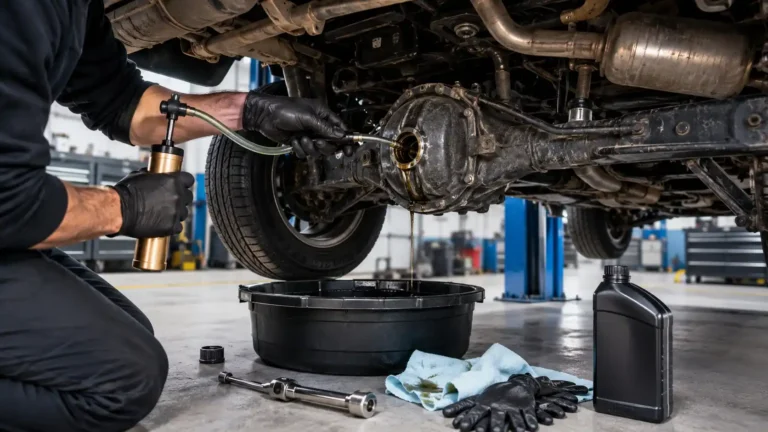
The differential fluid fill plug is located on the differential housing itself, usually accessible from underneath the vehicle. It’s typically a bolt with a square or hex recess, distinct from the drain plug that sits lower on the housing.
With the vehicle level, remove the fill plug and check whether fluid sits right at the bottom edge of the fill hole, which indicates a correct level. If fluid doesn’t reach the opening when you check, the level is low and needs topping off before you replace the plug.
How Do You Add Differential Fluid If the Level Is Low?
Adding fluid to a differential is a straightforward process once you have the fill plug removed and the correct fluid on hand.
- Remove the fill plug and confirm the current level is below the opening.
- Use a pump-style fluid dispenser or a squeeze bottle with a long nozzle, since the fill hole is usually positioned awkwardly.
- Add fluid slowly until it just begins to trickle back out of the fill hole, confirming the level is correct.
- Reinstall the fill plug and tighten it to the manufacturer’s specified torque.
- Wipe away any spilled fluid from the housing and surrounding area.
This process typically doesn’t require raising the vehicle high off the ground, though enough clearance to comfortably reach underneath makes the job considerably easier.
What Type of Differential Fluid Should You Use?
Differential fluid, often called gear oil, comes in different viscosities and formulations, and using the correct one matters for how well it protects the internal gears. Your owner’s manual specifies the exact type, typically labeled with a designation like 75W-90 or 80W-140.
Some differentials, particularly those with limited-slip designs, require a special friction modifier additive mixed into standard gear oil. Using standard gear oil without this additive in a limited-slip differential can cause chattering or jerking during turns, so confirming your differential’s specific requirement before adding fluid avoids this problem.
What Does Fluid Color and Smell Tell You About Differential Health?
Fresh gear oil is typically a light amber or honey color with a distinct sulfur-like smell that’s normal for this fluid type. As it ages, it gradually darkens toward brown or black, similar to how other automotive fluids change with heat exposure over time.
Metal particles or shavings visible in the fluid, beyond a very fine, barely noticeable residue, point to internal gear wear that a fluid change alone won’t fix. A strong burnt smell paired with dark, gritty fluid is a stronger indicator of significant wear and is worth having inspected by a mechanic rather than simply topping off or changing the fluid yourself.
How Often Should Differential Fluid Be Changed?
Most manufacturers recommend changing differential fluid somewhere between 30,000 and 60,000 miles under normal driving conditions, though this range varies significantly by vehicle and how the car is used. Checking your owner’s manual for the specific interval remains the most reliable approach, since some manufacturers rate their differentials for considerably longer intervals.
Several driving conditions shorten this interval meaningfully:
- Towing or hauling heavy loads regularly – generates more heat and stress inside the differential, accelerating fluid breakdown.
- Off-road or rough terrain driving – exposes the differential to more contamination risk and mechanical stress.
- Frequent hard acceleration or aggressive driving – increases heat and wear on the internal gears.
- Driving through water crossings – risks water contamination entering the differential housing, which requires an immediate fluid change regardless of mileage.
A vehicle used mainly for light commuting on paved roads can often comfortably reach the upper end of the recommended interval range.
How Do You Change Differential Fluid Completely?
A full fluid change involves both a drain and fill plug, and follows a similar principle to a full oil change though with different components.
- Warm up the vehicle briefly by driving it, which thins the fluid and helps it drain more completely.
- Position a drain pan underneath the differential and remove the drain plug, located at the lowest point of the housing.
- Let the old fluid drain completely, which can take longer than engine oil due to its thicker viscosity.
- Reinstall and torque the drain plug to the manufacturer’s specification.
- Remove the fill plug and add fresh fluid until it reaches the bottom of the fill hole.
- Reinstall the fill plug and dispose of the old fluid at a recycling center that accepts gear oil.
Gear oil’s thicker consistency means it drains more slowly than engine oil, so allowing extra time for this step results in a more complete fluid change.
Conclusion
Your vehicle’s differential works every time you accelerate, corner, or tow a load, yet its fluid is often overlooked until problems develop. Regularly checking the fluid level, monitoring its condition, and replacing it at the recommended service interval helps keep the gears properly lubricated, reduces heat and wear, and extends the life of one of the most important drivetrain components.
Whether you drive a rear-wheel-drive car, a four-wheel-drive truck, or an all-wheel-drive SUV, staying on top of differential fluid maintenance can prevent costly repairs and ensure smooth, reliable performance for years to come. When in doubt, always follow your owner’s manual for the correct gear oil specification and maintenance schedule to keep your differential operating at its best.
Frequently Asked Questions
How often should differential fluid be checked?
It’s a good idea to inspect the differential fluid level and condition every 30,000 miles (48,000 km) or during major maintenance services, even if your vehicle doesn’t require a fluid change yet. Vehicles used for towing, off-roading, or frequent heavy hauling should be checked more often because these conditions generate additional heat and wear.
What are the symptoms of low or bad differential fluid?
Low or contaminated differential fluid can cause several noticeable problems, including:
- Whining or humming noises from the axle
- Clunking sounds during acceleration or turning
- Vibration while driving
- Burning smell from overheated gear oil
- Visible differential fluid leaks
- Increased gear wear over time
Ignoring these warning signs can eventually lead to expensive differential repairs.
Can I drive with low differential fluid?
Driving with low differential fluid is not recommended. Insufficient lubrication increases friction between the gears, causing excessive heat and accelerated wear. While the vehicle may still drive normally for a short time, continued operation can result in severe differential damage or complete gear failure.
What type of differential fluid does my vehicle need?
The correct differential fluid depends on your vehicle’s manufacturer and differential design. Most vehicles use gear oil such as 75W-90 or 80W-140, while limited-slip differentials may also require a friction modifier additive. Always check your owner’s manual before adding or replacing differential fluid.
How can I tell if my differential fluid needs changing?
Differential fluid should be replaced if it appears dark, dirty, contains excessive metal particles, smells burnt, or has reached the manufacturer’s recommended service interval. Water contamination after deep water crossings also requires an immediate fluid change, regardless of mileage.
Can I change differential fluid myself?
Yes. If your differential has accessible drain and fill plugs, changing the fluid is a straightforward DIY maintenance job. You’ll need the correct gear oil, a fluid transfer pump, basic hand tools, and a drain pan. Always refill the differential to the proper level and tighten both plugs to the manufacturer’s torque specification.
Is differential fluid the same as transmission fluid?
No. Differential fluid (gear oil) and transmission fluid are different lubricants designed for different components. Gear oil is much thicker and formulated to handle the high-pressure contact between differential gears, while transmission fluid lubricates and operates the transmission’s internal components. They should never be used interchangeably.
How much does a differential fluid change cost?
A professional differential fluid service typically costs $80 to $150 per differential, depending on the vehicle, labor rates, and fluid type. DIY replacement usually costs $20 to $50 for gear oil and supplies, making it an affordable maintenance task for experienced home mechanics.