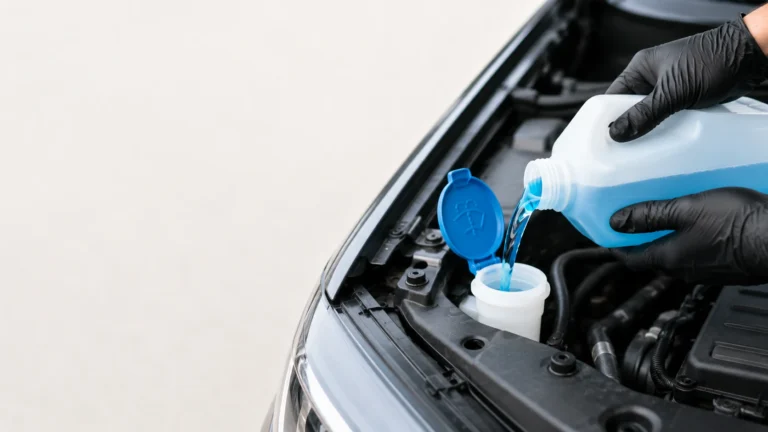
Windshield washer fluid is the blue (or sometimes orange or green) liquid that sprays onto your glass when you pull the washer lever. You check it by looking at the level in the reservoir under the hood, and you refill it by pouring fluid through a funnel up to the full mark. The whole job takes about five minutes and costs a few dollars.
Most people find out the tank is empty at the worst time. A truck kicks up mud, you pull the lever, and nothing comes out. This guide walks you through every part of the job: where the tank is, how to read the level, what fluid to buy, what to avoid, and what to do if the spray still doesn’t work after a refill.
How Do You Check and Refill Windshield Washer Fluid?
You check and refill windshield washer fluid in six steps: park on level ground, open the hood, find the reservoir with the spray icon, read the level, pour in fluid with a funnel to the full mark, and test the spray. No tools are needed besides a funnel and a jug of washer fluid.
- Park on level ground and turn the engine off.
- Open the hood and look for a cap with a windshield-and-spray icon.
- Read the level on the side of the tank, or dip a clean stick in if the tank is not see-through.
- Pour washer fluid through a funnel until the level reaches the full mark.
- Close the cap until it clicks, then wipe up any spills.
- Test the spray by pulling the washer lever and checking that both nozzles fire.
Where Is the Windshield Washer Fluid Reservoir?
The washer fluid reservoir is a plastic tank under the hood, usually near the front corner or along the back edge of the engine bay. Its cap is almost always marked with a windshield-and-spray icon, and many caps also say “Washer Fluid Only” in plain words.
Cars differ, so here are the most common spots:
- Front corner of the engine bay, behind the headlight, on many sedans and SUVs.
- Near the windshield, on the passenger or driver side of the firewall.
- Under a plastic cover, on some newer cars. Lift the cover to reach the cap.
If you can’t find it, the owner’s manual shows the reservoir in the “Maintenance” or “Under the Hood” section. You can also follow the thin black hoses that run from the windshield nozzles back toward the tank.
How to Tell It Apart From the Coolant Tank
The washer tank and the coolant overflow tank can look alike, but the caps are different. The coolant tank cap has a warning about hot pressure, and the tank often holds a green, pink, or orange liquid. The washer tank cap has the spray icon.
Pouring washer fluid into the coolant system can cause overheating, so check the icon before you pour. If you’re unsure, stop and read the cap label or the owner’s manual first.
How to Check the Washer Fluid Level
You check the washer fluid level by looking at the markings on the side of the reservoir. Most tanks are semi-clear plastic with a “full” line, so you can see the level without opening the cap. A tank that shows no fluid at all is empty.
Here are three quick ways to check:
- Look at the tank. If the plastic is see-through, find the liquid line and compare it with the “full” mark.
- Use the dashboard light. Many cars show a washer-fluid warning light when the level gets low. If it comes on, refill soon.
- Do a spray test. Pull the washer lever. If the pump hums but little or no fluid comes out, the tank is almost empty.
If the tank is dark or hidden, open the cap and slide a clean, thin stick or a dipstick-style rod down inside. The wet line shows the level.
When to check: look at the level every time you fill the fuel tank. It takes ten seconds and keeps you from running dry.
How to Refill Windshield Washer Fluid, Step by Step
You refill windshield washer fluid by opening the reservoir cap, pouring fluid in slowly through a funnel until it reaches the full mark, and closing the cap firmly. Gather a funnel, a jug of washer fluid, and a rag before you start.
Step 1: Park and Find the Reservoir
Park on level ground, turn the engine off, and open the hood. A level car gives you a true reading on the tank, and a cool engine keeps you safe near hot parts. Locate the cap with the spray icon and wipe dirt off the top so it doesn’t fall into the tank.
Step 2: Pour With a Funnel to the Full Mark
Open the cap and place a funnel in the neck. Pour the washer fluid in slowly and stop when the level reaches the “full” line. Pouring slowly lets air escape and prevents splashing onto the engine.
Some tanks have a mesh filter in the neck. If the fluid backs up in the funnel, pause for a few seconds and let it drain. Don’t overfill, because fluid can spill out as the car warms up.
Step 3: Cap, Close the Hood and Test the Spray
Press the cap down until it clicks and wipe any spilled fluid off plastic and paint. Close the hood, sit in the driver’s seat, and pull the washer lever. Both nozzles should spray a steady fan across the glass.
If the first spray is weak, hold the lever for a few seconds. The lines were empty, and they need a moment to fill with fluid again. If nothing sprays, jump to the troubleshooting section below.
What Type of Washer Fluid Should You Use?
Use windshield washer fluid made for your climate: a summer or all-season blend for warm weather and a winter de-icer for freezing weather. The right fluid cleans bugs and road film, and in winter it also stays liquid in the cold so it doesn’t freeze in the lines.
Summer Fluid vs. Winter De-Icer
Summer washer fluid is built to dissolve bugs, dirt, and bird droppings, but it can freeze when the temperature drops. Winter fluid, often called de-icer, contains more antifreeze and stays liquid at low temperatures. Many winter blends are rated to -20°F or lower, and the label tells you the exact rating.
If you live where it freezes, switch to winter fluid before the first cold snap. Frozen summer fluid can block the lines, the tank, or the nozzles and may crack the reservoir. The best time to switch is when the tank is nearly empty. Adding winter fluid to a half tank of summer blend works too, but the mix will freeze at a higher temperature than the label says.
In summer, a bug-remover formula cuts through insects on the glass faster than a basic blue fluid.
Ready-Mixed vs. Concentrate and Distilled Water
Ready-mixed washer fluid is poured straight from the jug into the tank. Concentrate is a stronger liquid that you dilute with distilled water, following the ratio on the label. Both work well when used correctly.
- Ready-mixed: the easiest choice. No measuring, and the freeze rating on the label is accurate.
- Concentrate: cheaper per gallon and lighter to store. Mix it in a clean jug first, then pour it in.
- Distilled water: the safest water to mix with concentrate because it has no minerals that leave scale in the lines and nozzles.
Skip tap water for mixing when you can. Minerals in hard water build up inside small nozzles over time and cause weak or uneven spray.
Can You Use Water or Coolant Instead of Washer Fluid?
You can use plain water in an emergency in warm weather, but you can’t use coolant at any time. Water doesn’t clean oily film and it freezes in cold weather. Coolant is made for the engine and makes a mess on the glass.
- Water: fine for a short time when it’s warm and you have nothing else. Ford says not to use it because it can freeze, clog the lines, and harm the reservoir and hoses. Other makers, like Hyundai, allow it in summer if fluid isn’t on hand. Switch back to real fluid as soon as you can.
- Coolant or antifreeze: never put it in the washer tank. Hyundai warns that sprayed coolant can badly limit your view through the windshield, and Honda notes that antifreeze can damage paint.
- Vinegar or dish soap mixes: skip these as well. Honda says a vinegar-and-water mix can damage the washer pump, and soap can leave streaks and foam on the glass.
Why Is Your Washer Fluid Not Spraying?
A washer that won’t spray after a refill usually has one of four problems: frozen fluid, clogged nozzles, a blown fuse, or a failed pump. You can sort out which one it is in a few minutes with simple checks.
- Frozen fluid. In cold weather, the fluid in the lines or tank may be ice. Park in a warm garage for a few hours, or run the heater and wait. Then switch to a winter fluid.
- Clogged nozzles. Dirt, wax, or old fluid residue can block the tiny holes. Gently clear each hole with a pin or a needle, then spray again.
- Blown fuse. If you hear nothing when you pull the lever, check the washer pump fuse. The fuse box diagram in the owner’s manual shows which one it is.
- Failed pump. If the fuse is good and the pump stays silent, the pump motor may have died and needs replacing.
Here is a simple test. Turn the ignition on and pull the lever. If you hear the pump humming but nothing comes out, the problem is a clog or a frozen line. If you hear nothing, the cause is the fuse or the pump itself.
How Often Should You Check and Refill Washer Fluid?
Check the washer fluid level every time you fill up the fuel tank, and refill it whenever it drops below the full mark. Most drivers use a few ounces per wash, so a tank can last weeks, but heavy bug season and winter road salt can empty it fast.
- Every fuel stop: quick look at the tank or the dashboard light.
- Before a long trip: top it off so you aren’t stuck with a dirty windshield.
- Before winter: switch to a winter-rated fluid.
- After salt or mud driving: expect to use more and check sooner.
Common Washer Fluid Mistakes
The most common washer fluid mistakes are using the wrong fluid for the season, pouring it into the wrong tank, and overfilling the reservoir. Each one is easy to avoid once you know about it.
- Using summer fluid in freezing weather. It can freeze and block the lines.
- Mixing up the tanks. Washer fluid in the coolant tank can lead to engine overheating.
- Diluting winter fluid with water. Extra water raises the freezing point.
- Using household cleaners. Dish soap, vinegar mixes, and window cleaner can foam, streak, or harm the pump and paint.
- Overfilling. The extra fluid spills onto the engine and stains the bay.
- Ignoring dirty glass. Fluid only rinses the surface. For a deeper clean, use an automotive glass cleaner on the outside of the windshield.
Frequently Asked Questions
Can I mix different brands or types of windshield washer fluid?
Yes, you can mix different brands of washer fluid, because they are all made from similar alcohol-based formulas. The freeze rating of the mix will fall somewhere between the two fluids, so the mix is only as cold-proof as the weaker one. Don’t mix summer fluid into winter fluid if freezing weather is coming.
Why is my windshield washer fluid not spraying even though the reservoir is full?
A full reservoir with no spray usually means frozen fluid, clogged nozzles, a blown pump fuse, or a failed pump. Listen for the pump when you pull the lever. A humming pump points to a clog or ice, while a silent pump points to the fuse or the pump motor.
Is windshield washer fluid the same as engine coolant?
No, washer fluid and engine coolant are two different liquids for two different jobs. Washer fluid cleans the glass and sits in a small plastic tank. Coolant keeps the engine from overheating and stays in a sealed system. Never swap them, because coolant on glass blocks your view and washer fluid in the cooling system can harm the engine.
How can I tell if my windshield washer fluid is winter-rated?
Check the label on the jug for a freeze rating, like -20°F, or for words like “de-icer” or “winter.” Summer blends often show no low-temperature rating at all. If the label doesn’t give a number, treat the fluid as unsafe for freezing weather.
Can I use vinegar or household glass cleaner instead of washer fluid?
No, it’s best to use real washer fluid. Vinegar mixes can damage the washer pump, according to Honda, and household glass cleaner can foam, streak, and clog the nozzles. Washer fluid is made for the pump, the lines, and your paint, and it costs only a few dollars.
What should I do if my windshield washer fluid reservoir is cracked?
If the washer fluid reservoir is cracked, replace it, because tape and glue rarely hold against vibration and fluid pressure. A cracked tank usually comes from frozen fluid, so switch to winter fluid when you replace it. Look for puddles under the front of the car and a tank that keeps going empty.
Conclusion
Checking and refilling windshield washer fluid is one of the simplest jobs on any car: find the spray-icon cap, read the level, fill to the full mark, and test the spray. Pick the right fluid for the season, keep it out of the coolant tank, and check the level at every fuel stop.
If the spray fails after a refill, work through the four causes in order: ice, clogs, fuse, and pump. With a clear windshield and a full tank, you’re ready for whatever the road throws at you.