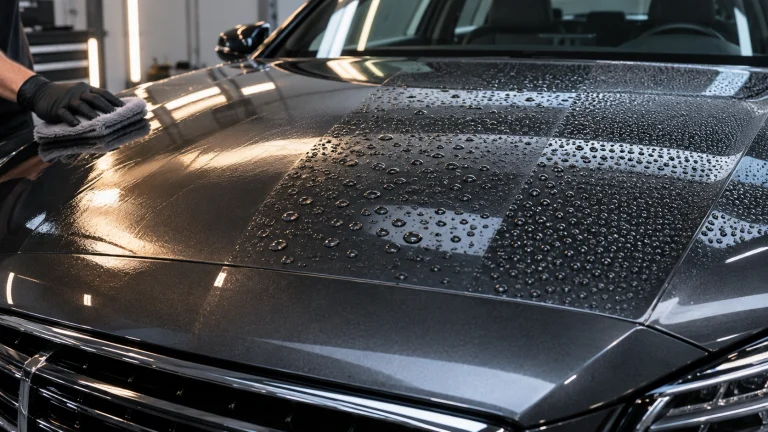
Wax, paint sealant, and ceramic coating all leave a protective layer on automotive paint. The useful difference is how long that layer lasts, how much preparation it needs, and how you maintain it. For most owners, a spray sealant is the easiest way to get months of protection. Wax suits people who enjoy frequent detailing; a true ceramic coating suits owners willing to spend more time or money on preparation for longer service.
None of these products repairs damaged clear coat or prevents rock chips. If stone impacts are your main concern, look at paint protection film (PPF).
Wax vs. sealant vs. ceramic coating at a glance
Start with the time and work you are willing to spend. Each option protects healthy paint, but the application and renewal schedule differ.
| Wax | Paint sealant | True ceramic coating | |
|---|---|---|---|
| Typical service interval | Reapply every few weeks to a few months | Reapply after several months | Product claims commonly span years; maintenance and conditions matter |
| Application | Spread or spray, then buff | Often spray and wipe; some liquids need buffing | Decontaminate, prep, apply in sections, level, and allow to cure |
| Best reason to choose it | You like a traditional wax finish and frequent detailing | You want easy protection with fewer applications | You want longer service and easier routine cleaning |
| Main trade-off | Frequent reapplication | Still needs periodic reapplication | More prep, more room for application error, higher total cost |
| Rock-chip protection | No | No | No |
| Product example | Meguiar’s Gold Class | Turtle Wax ICE Seal N Shine | CARPRO CQUARTZ UK 3.0 |
A sensible starting point: Try a sealant on a clean daily driver. You can judge how much you value longer protection before paying for paint correction and a coating. A garage-kept hobby car may be perfectly well served by wax. A coating becomes more compelling when you plan to keep an outdoor-parked car for years and can wash it properly.
Product labels overlap: a bottle sold as “wax” may contain synthetic polymers, and a “ceramic spray” is usually much closer to a spray sealant than to a small-bottle, curing coating. Compare the product’s instructions and stated service life, not just its name.
What each product does
The names describe different application methods and expected service intervals. Formulas vary, so the directions on the product you buy take priority over any category-wide rule.
Car wax
Traditional car wax blends natural waxes such as carnauba with other ingredients to leave a thin, sacrificial layer. It can add a pleasing finish and make fresh dirt easier to wash away. Its appeal is the quick application and easy refresh, especially on a car you already detail regularly.
Durability varies with the formula, weather, mileage, and washing. As a maintenance reference, Meguiar’s recommends waxing three or four times a year; this is not a fixed lifespan for every wax. A spray wax used as a drying aid may need more frequent use. Wax cannot restore peeling clear coat or remove scratches unless the particular product also contains cleaners or abrasives.
Paint sealant
A sealant uses synthetic protection chemistry and is usually chosen for longer intervals between applications. Some are spray-on, wipe-off products; others are liquid products with a set-up or cure period. Clean paint still matters, but full machine polishing is optional if you are happy with the paint’s current appearance.
For a concrete example, Turtle Wax describes ICE Seal N Shine as a spray sealant with up to six months of protection. “Up to” is a product claim, not a promise for a car parked outdoors and washed with harsh chemicals. Follow its panel-by-panel directions and avoid overapplying.
True ceramic coating
A true ceramic coating is applied to thoroughly prepared paint and cures into a thin, longer-lasting protective layer. It can resist common wash chemicals and make dirt easier to remove. It does not mean the car becomes self-cleaning or scratch-proof.
Coating lifespans vary widely. CARPRO lists 2–5 years for CQUARTZ UK 3.0, while Gtechniq states up to five years for Crystal Serum Light when properly applied and maintained. Those are manufacturer figures. Weather, mileage, prep, wash habits, and any guarantee conditions affect the result. The coating itself may still be present when road film or mineral deposits temporarily reduce beading.
How to choose for your car
The condition of the paint and where the car is parked matter more than its age alone. Use these situations to narrow the choice before buying a product.
| Your situation | Practical choice | Why |
|---|---|---|
| First time protecting a daily driver | Spray sealant | Fast application and easy renewal |
| Garage-kept weekend or show car | Wax or sealant | You can refresh the finish whenever you detail it |
| Outdoor-parked car you expect to keep for years | Sealant or coating | Choose by prep budget and how often you want to reapply |
| New car with dealership swirls | Inspect and correct the paint before coating | A coating will not hide existing defects |
| Older car with peeling clear coat | Repair the paint first | Protection cannot fix failed clear coat |
| Highway car with front-end stone chips | PPF on impact areas; optional sealant or coating elsewhere | A thin coating cannot absorb stone impacts |
If you’re deciding between a sealant and a coating, ask what you are paying for. A professional coating quote often includes washing, decontamination, polishing, panel preparation, application, and curing time. The paint correction may account for much of the bill. If you do not want that work, a well-applied sealant is a reasonable choice rather than a failed coating job.
What protection can and cannot do
These products help preserve a sound finish, but their benefits are often overstated. It helps to separate easier cleaning from physical damage prevention.
Dirt, chemicals, and bird droppings
All three act as sacrificial layers, but a coating generally tolerates routine cleaning chemicals better and lasts longer. No layer makes bird droppings or bug residue safe to leave on the paint. Remove them promptly with a suitable cleaner and a clean, soft towel; rubbing dry contamination can mar the surface.
Water beading and water spots
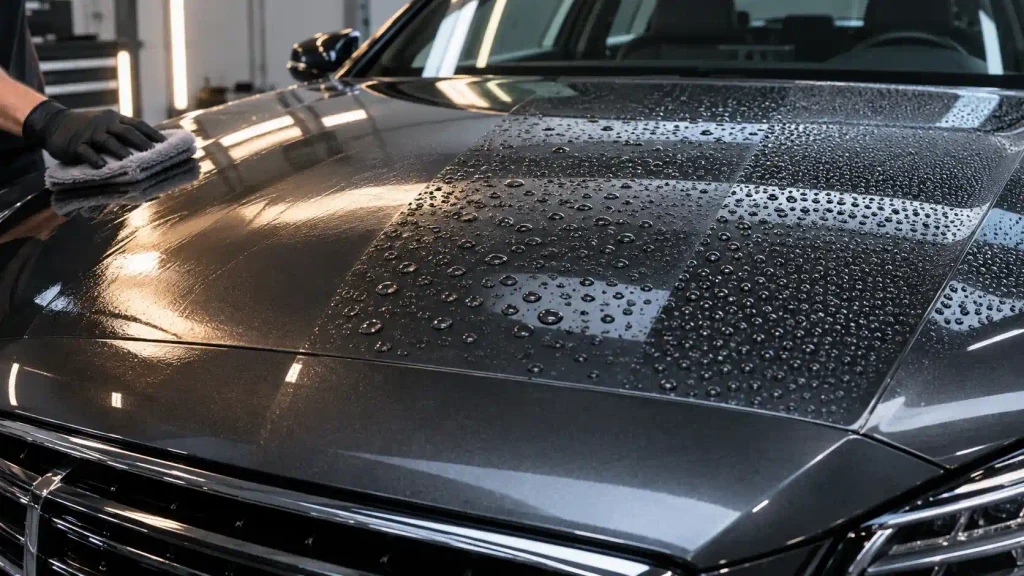
Strong beading looks good, but it is a poor stand-alone durability test. Road film can mask the water behavior of a coating, and a fresh topper can bead even if the original coating has weakened. Beads left to dry can also deposit minerals, so dry the car after washing and address hard-water spots promptly. Assess protection after a proper wash, not by one rain shower.
Gloss and scratches
Paint condition has more influence on gloss than the final protection product. Wax may give a different visual character from a sealant or coating, but none removes established swirls just by being applied. Coatings may reduce some very light wash marring under favorable conditions; they will not stop a key scratch, a brush wash, a door ding, or a rock chip. Good wash technique still matters.
UV and existing paint damage
Product makers describe varying UV and environmental benefits, but there is no reliable reason to choose solely from a broad “UV protection” claim. Choose based on the particular product, service interval, and your ability to maintain it. Once clear coat is peeling or failing, polish and protection cannot rebuild it.
Preparation and application: where results are won or lost
Clean paint gives any protection product a better starting point. A coating adds stricter surface preparation and curing requirements because application errors are harder to correct later.
For wax or sealant:
- Wash and rinse thoroughly; dry unless the label permits use on wet paint.
- Remove bonded contamination if the paint feels rough. Use a suitable clay or chemical decontaminant according to its instructions.
- Apply a thin, even layer to a small section. Follow the label for dwell, wiping, and cure time.
- Check the panel under good light for streaks and missed areas.
Polishing is optional when the finish is sound and you accept its existing swirls. More product does not produce a thicker useful layer; excess is usually just harder to remove.
For a true coating:
- Wash, chemically decontaminate, and clay only where necessary.
- Inspect under strong light. Polish defects you want removed before coating.
- Remove polishing oils with a panel wipe approved for that coating.
- Work in small sections on cool paint, out of direct sun. Apply and level within the product’s working window.
- Inspect from several angles for high spots; correct them before they cure.
- Keep the surface dry and avoid cleaners for the period specified by the manufacturer.
Do not use a universal cure rule. For example, CARPRO’s directions for CQUARTZ UK 3.0 advise at least one hour dry, preferably 24 hours, and no detergents or chemicals for five days. Gtechniq’s Crystal Serum Light instructions call for an indoor application and 12 hours indoors afterward. Follow the exact bottle you buy.
Can you coat over wax or sealant? Remove the old protection and prep the paint first; residue can interfere with coating adhesion. Wax or a compatible topper can be applied over a cured coating if its manufacturer permits it, but the topper may temporarily change the coating’s water behavior. Layering products is optional, not a substitute for washing.
Maintenance after application
Every option needs washing. The difference is how often you must renew the protective layer and how carefully you must handle a newly applied coating.
- Wash regularly. Pre-rinse grit, use clean wash media and an automotive shampoo appropriate for the protection, then dry with a clean towel. Avoid abrasive automated brushes.
- Deal with bonded contamination when needed. Iron fallout, tar, road film, and mineral deposits can build up on any protected surface. Choose a cleaner that is compatible with your wax, sealant, or coating.
- Refresh at the right time. Reapply wax or sealant when a clean surface becomes harder to wash and no longer behaves as expected. Before assuming a coating has failed, wash and decontaminate it according to the maker’s instructions.
- Keep the cure period in mind. A newly coated car may need several days without detergents, even if it can tolerate light moisture sooner. Follow its specific instructions.
Product examples
These are examples of the three application categories, not a claim that each is the best product for every paint. Check the current listing, package size, and compatibility before ordering.
| Type | Example | What to check |
|---|---|---|
| Paste wax | Meguiar’s Gold Class Carnauba Plus Premium Paste Wax | Time needed to apply and buff; regular refresh |
| Spray sealant | Turtle Wax ICE Seal N Shine | Spray-and-wipe directions; up-to-six-month claim |
| True coating | CARPRO CQUARTZ UK 3.0 kit | Authenticity, kit contents, prep, and cure instructions |
Common questions
These answers address the mix-ups that most often lead to a poor product choice or unnecessary prep work.
Is a ceramic spray the same as a ceramic coating?
Usually no. A spray marketed as “ceramic” can be a useful, easy-to-renew sealant, but the ingredient label alone does not make it a multi-year coating. Check its application method and claimed durability.
Should I polish a new car before coating it?
Inspect it first. New cars can arrive with swirls or water spots. Polish only the defects you want to remove, then perform the coating’s required panel prep. Coating a new car without machine polishing is possible when the paint is already in acceptable condition.
Does ceramic coating stop scratches or rock chips?
No. It may help with very light surface marring, but it is too thin to replace careful washing or PPF on high-impact areas.
Is wax better for dark paint?
Some owners prefer the look of a traditional wax on dark colors. The more noticeable improvement usually comes from removing swirls and haze first. Choose the product based on the finish you like and the reapplication schedule you will actually keep.
Is a coating maintenance-free?
No. It needs regular washing, prompt removal of contamination, and occasional decontamination when the surface becomes loaded. A long durability claim is not a promise that the car can go unwashed.
The practical choice
Choose wax if you enjoy detailing and want a finish you can refresh easily. Choose sealant if you want a simple routine and several months between applications. Choose ceramic coating if you are ready for careful preparation, cure time, and regular washing in exchange for longer-lasting protection. If the paint is already damaged or chips are your concern, deal with those problems before spending money on a coating.