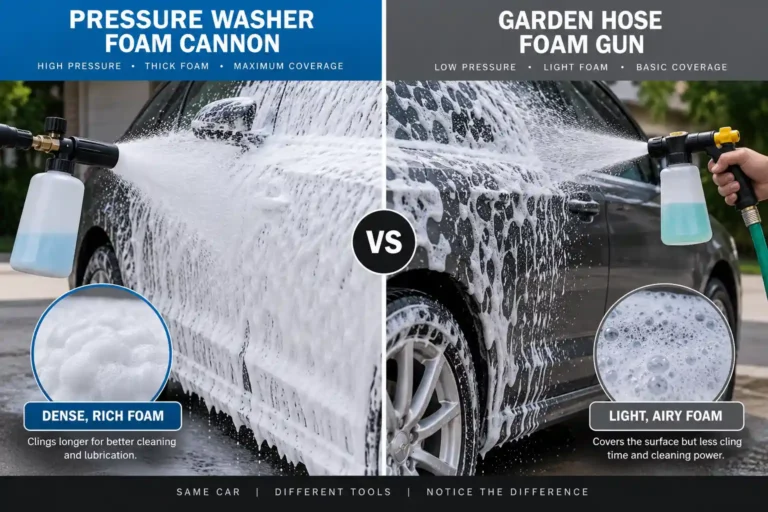
A foam cannon connects to a pressure washer, while a foam gun connects to a standard garden hose. Both apply car wash soap as foam before the contact wash, but a pressure-washer foam cannon generally produces denser, more consistent foam and gives you more control over coverage.
A foam gun is simpler because it does not require a pressure washer. It is a practical option for occasional car washing or for anyone who wants to add a foam pre-wash without buying additional equipment.
The better choice depends less on which tool produces the most foam and more on the equipment you already own, how often you wash your vehicle, and how much control you want over the pre-wash process.
Quick Comparison: Foam Cannon vs Foam Gun
| Factor | Foam Cannon | Foam Gun |
|---|---|---|
| Power source | Pressure washer | Standard garden hose |
| Foam output | Generally denser and more consistent | Generally lighter and wetter |
| Setup | Requires a compatible pressure washer and fitting | Connects directly to a garden hose |
| Coverage | Fast, even application across large panels | Simple coverage, generally with less foam density |
| Dwell potential | Usually better foam cling | Usually shorter dwell because the foam is wetter |
| Equipment cost | Higher if you need to buy a pressure washer | Lower if you already have a garden hose |
| Best for | Frequent washers and pressure-washer owners | Occasional users and simpler setups |
| Main limitation | Requires additional equipment | Less foam density and control than a pressure-washer setup |
What Is a Foam Cannon?
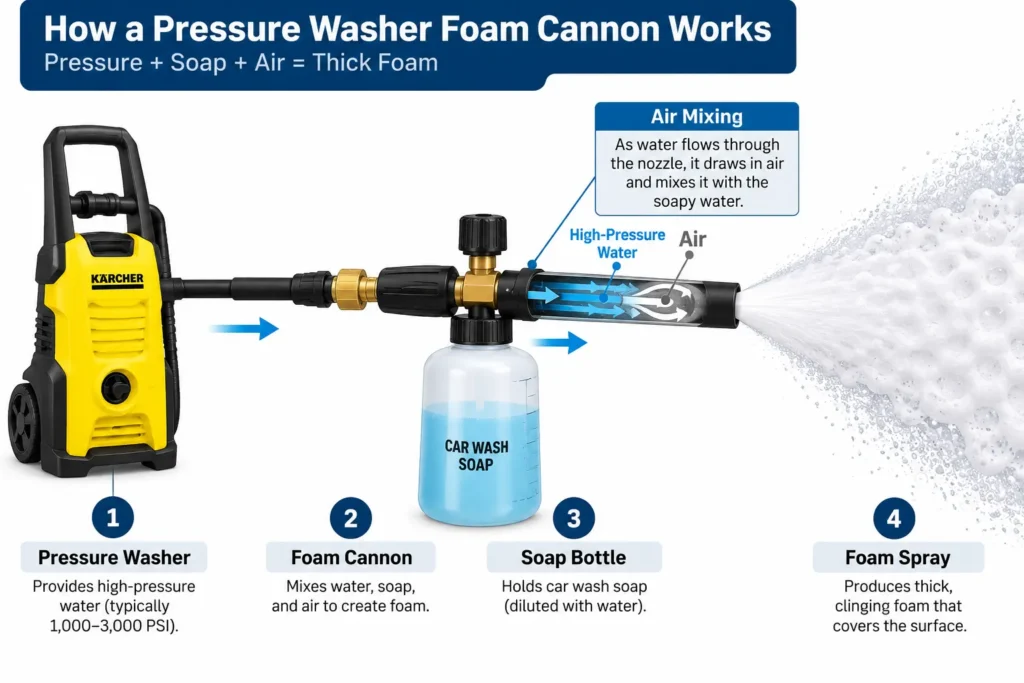
A foam cannon is a pressure-washer attachment that mixes water, car wash soap, and air to create foam. It attaches to the pressure washer’s spray gun or lance, usually through a compatible quick-connect or threaded fitting.
Inside the cannon, pressurized water passes through a restricted orifice. The resulting flow can create a pressure difference that draws soap solution from the attached bottle. The soap, water, and air then pass through the foaming components before being sprayed onto the vehicle
Why Does a Foam Cannon Produce Thicker Foam?
The pressure washer provides the water flow and pressure needed by the cannon’s injector and foaming system. The cannon then aerates the soap solution to produce a denser foam layer.
The result is generally a foam that stays on vertical panels longer than the wetter foam produced by a typical hose-end foam gun.
That additional cling can be useful during a pre-wash because the detergent remains on the surface while it works on loose dirt and road film. However, more foam does not automatically mean better cleaning. Soap formulation, dilution, water quality, temperature, surface contamination, and dwell time also affect the result.
How Does a Foam Gun Work Without a Pressure Washer?
A foam gun attaches to a standard garden hose and uses the available hose water flow to mix water with car wash soap and introduce air into the mixture.
Because a garden hose does not provide the same pressure characteristics as a pressure washer, a typical foam gun produces lighter, wetter foam than a foam cannon.
That does not make a foam gun ineffective. It can still provide a useful pre-wash step by distributing diluted car wash soap over the vehicle before the contact wash.
The main difference is that the foam usually runs off more quickly, so you have less opportunity for a long dwell period compared with a well-matched foam cannon setup.
Does Foam Thickness and Dwell Time Actually Matter?
Dwell time matters, but foam thickness by itself is not a reliable measure of cleaning performance.
The purpose of a pre-wash is to loosen and soften contamination before a wash mitt touches the paint. Keeping the cleaning solution on the surface for an appropriate amount of time can help with that process.
A foam cannon generally has an advantage because its denser foam can remain on vertical surfaces longer. A foam gun’s lighter foam tends to run off more quickly.
However, there is an important distinction:
Longer dwell is useful only when the product and conditions allow it.
A stronger-looking foam is not automatically a better cleaner. The detergent formulation, dilution ratio, temperature, amount of contamination, and whether the foam dries on the paint all affect the outcome.
The practical takeaway is simple: use enough foam to cover the vehicle evenly, allow an appropriate dwell period, and rinse before the product dries on the surface.
Does a Foam Cannon Clean the Car Without a Wash Mitt?
No.
A foam cannon is primarily a pre-wash tool, not a replacement for contact washing.
Foam can help loosen and remove some loose contamination before you touch the vehicle, which can reduce the amount of dirt left on the surface when you begin washing. But heavily contaminated surfaces generally still require a proper contact wash.
A typical process is:
- Rinse loose contamination from the vehicle.
- Apply foam.
- Allow an appropriate dwell period.
- Rinse thoroughly.
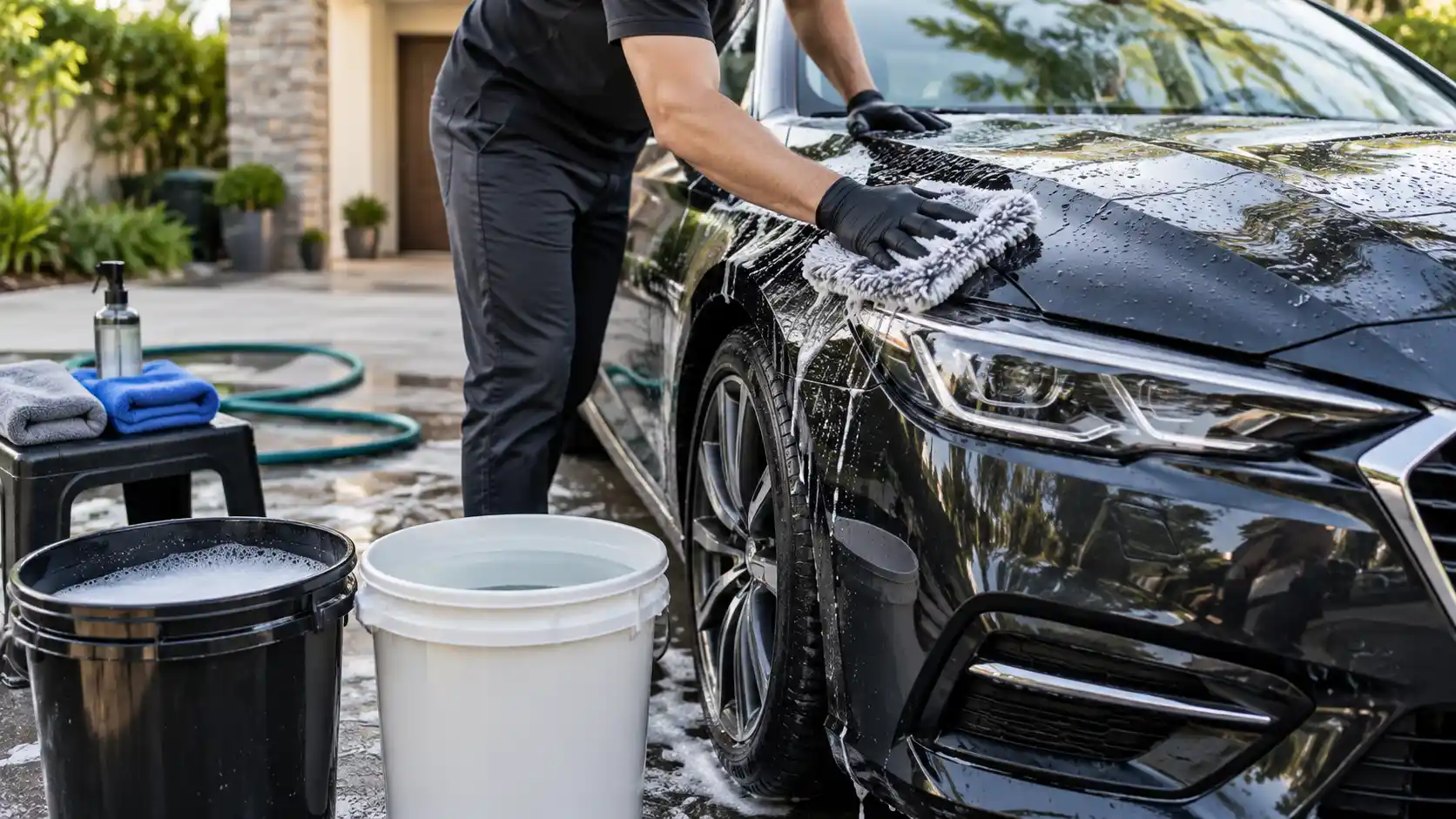
- Perform the contact wash with a suitable wash mitt and car shampoo.
- Rinse and dry the vehicle.
The exact sequence can vary depending on the soap, vehicle condition, and manufacturer’s instructions.
What Does a Foam Cannon Cost Compared With a Foam Gun?
The important cost difference is not necessarily the price of the foam attachment itself.
A foam gun can work with equipment many households already have: a garden hose and outdoor water connection.
A foam cannon requires a compatible pressure washer. If you already own a pressure washer, adding a foam cannon may be a relatively simple equipment upgrade. If you do not own one, however, the pressure washer becomes the larger part of the investment.
That makes the decision easier:
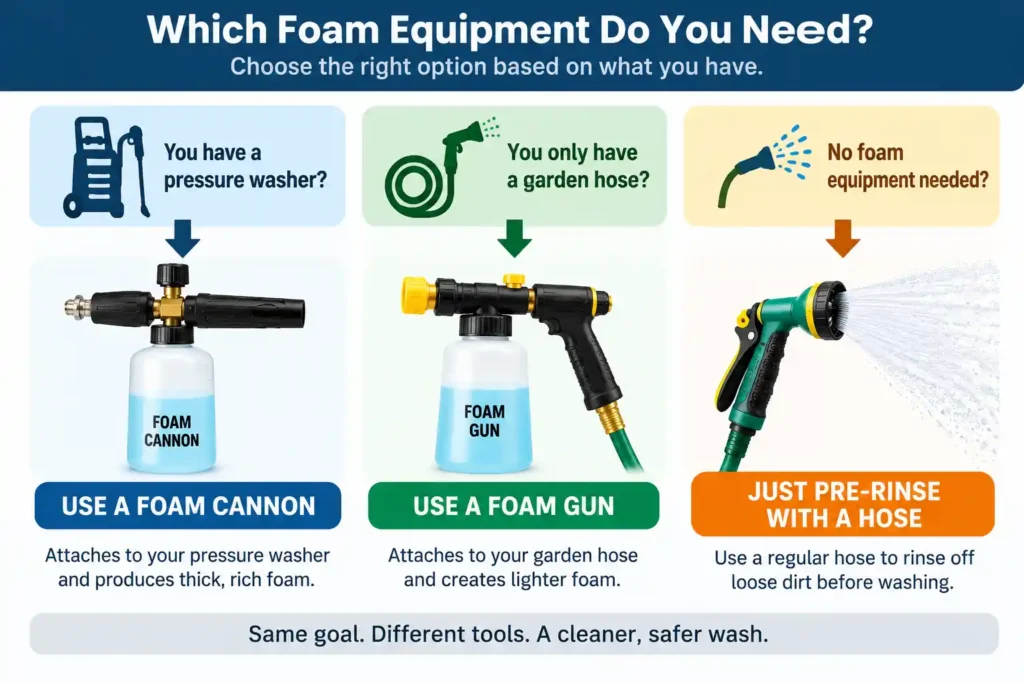
- Already own a compatible pressure washer? A foam cannon makes more sense.
- Do not own a pressure washer? A foam gun avoids buying another machine solely for pre-washing.
- Want a pressure washer for other household jobs too? The additional versatility can make the pressure washer investment easier to justify.
There is no need to buy a pressure washer purely because foam cannons produce thicker foam.
Which Should You Choose?
The best choice depends on your existing equipment and washing habits.
Choose a Foam Cannon If:
- You already own a compatible pressure washer.
- You wash your vehicle frequently.
- You want denser foam and longer potential dwell time.
- You want fast, consistent coverage across large panels.
- You also have other uses for a pressure washer around the home.
Choose a Foam Gun If:
- You do not own a pressure washer.
- You wash your vehicle occasionally.
- You want a simpler setup.
- You do not want to purchase another machine just to create pre-wash foam.
- You are satisfied with lighter foam and shorter dwell time.
Skip Both If:
You are not ready to buy either tool.
A thorough hose rinse followed by a proper contact wash can still be an effective approach. A foam cannon or foam gun is an optional pre-wash tool, not a requirement for safely washing a vehicle.
How Do You Adjust Foam Consistency?
Foam consistency depends on more than the amount of soap you add.
Important variables include:
- Soap formulation.
- Dilution ratio.
- Water pressure.
- Water flow.
- Foam cannon or gun design.
- Orifice size on some foam cannons.
- Adjustment settings.
- Water temperature.
- Water quality.
Start with the soap manufacturer’s recommended dilution rather than assuming that more concentrate will produce better results.
Adding excessive soap can waste product and make rinsing more difficult without necessarily producing a proportionate improvement in cleaning.
Foam cannon performance can also depend on matching the cannon’s orifice and operating requirements to the pressure washer. MTM Hydro, for example, specifies different orifice options for different flow and pressure combinations on its PF22 system.
Can You Use the Same Car Wash Soap in a Foam Cannon and Foam Gun?
Often, yes, but you should follow the soap manufacturer’s instructions.
Dedicated foaming soaps are formulated to generate foam when used with appropriate equipment. A traditional bucket-wash shampoo may also produce foam, but its performance in a foam cannon or foam gun can vary.
More foam is not necessarily the goal. The important question is whether the product provides useful cleaning and lubrication at the recommended dilution.
Before changing the dilution substantially, check the manufacturer’s instructions for the specific soap and application method.
What Pressure Washer PSI Do You Need for a Foam Cannon?
There is no universal PSI rating for every foam cannon.
The required pressure and water flow depend on the specific cannon, its orifice, and the pressure washer.
For example, MTM Hydro lists 1,100 to 5,000 PSI and 1.4 to 5.3 GPM for its PF22.2 foam cannon, while also noting that different orifices may be necessary for different machine flow rates.
This is why buying a foam cannon based only on the pressure washer’s PSI number can be misleading. PSI and GPM both matter, and the manufacturer’s compatibility requirements should take priority.
If your pressure washer has unusually low or high flow, check the foam cannon documentation before purchasing.
What Matters More: Foam Thickness or Cleaning Technique?
For safe car washing, technique matters more than creating the thickest possible layer of foam.
A practical pre-wash should focus on:
- Removing loose dirt before contact washing.
- Using an appropriate cleaning solution.
- Applying enough product for useful coverage.
- Allowing appropriate dwell time.
- Preventing the product from drying on the paint.
- Rinsing thoroughly.
- Using a clean wash mitt during the contact stage.
A foam cannon can make the pre-wash stage more effective and convenient, but it cannot compensate for poor washing technique.
Frequently Asked Questions
Is a foam cannon better than a foam gun?
A foam cannon generally produces denser, more consistent foam because it works with a pressure washer. A foam gun is simpler and does not require a pressure washer. The better choice depends on your equipment, washing frequency, and expectations.
Does a foam cannon remove dirt without touching the car?
A foam cannon can loosen and rinse away some loose contamination before contact washing, but it should not be treated as a complete replacement for hand washing. Heavier contamination usually requires a proper contact wash.
Is a foam gun worth using if I don’t own a pressure washer?
Yes. A foam gun can add a pre-wash step without requiring a pressure washer. Its foam will generally be lighter and less persistent than foam from a pressure-washer cannon, but it can still help distribute cleaning solution before the contact wash.
Can I use a foam gun with a pressure washer?
Do not assume that a hose-end foam gun is compatible with a pressure washer. These tools are designed around different water-pressure conditions. Use the equipment only within the manufacturer’s specified operating requirements.
Can a foam cannon damage car paint?
The foam itself is not inherently damaging when the product and equipment are used correctly. Problems can arise from inappropriate chemicals, excessive pressure, unsuitable techniques, or allowing cleaning products to dry on the vehicle. Follow the product and equipment manufacturer’s instructions.
Can I use any pressure washer with a foam cannon?
Not necessarily. Foam cannons have operating requirements involving pressure, water flow, fittings, and sometimes orifice selection. Check the cannon manufacturer’s specifications against your pressure washer before buying.
Does thicker foam always mean better cleaning?
No. Foam thickness is only one part of the equation. Cleaning performance also depends on the soap formulation, dilution, water conditions, dwell time, and the amount and type of contamination.
Do I still need a wash mitt after using a foam cannon?
Yes. Foam is normally a pre-wash step. After rinsing the foam and loosened contamination, a suitable contact-washing method is still needed to remove remaining bonded or persistent dirt.