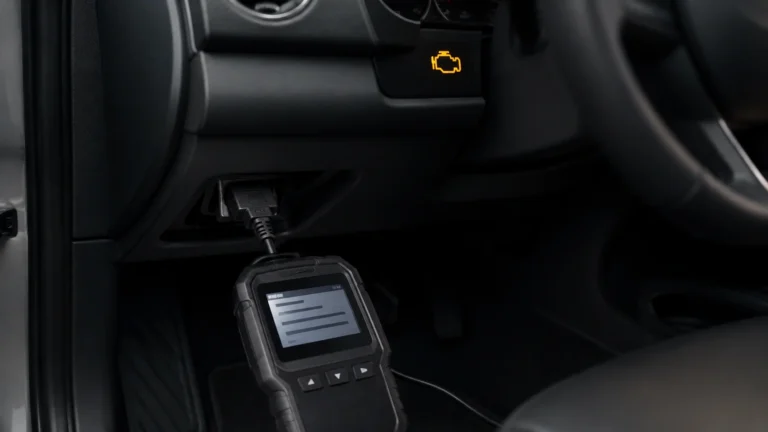
A check engine light rarely explains itself. It just turns on, usually without warning, and leaves the driver guessing whether it’s something minor or something that needs immediate attention.
Every gas-powered car sold in the United States since 1996 is required to have an OBD2 port, the same diagnostic system mechanics use to pull trouble codes. That means any driver with a basic scanner can get the same starting information a repair shop would, often in under two minutes.
This guide walks through exactly how to connect a scanner, read the codes it returns, and figure out what those codes actually mean for your car. It also covers when a code points to something you can fix yourself and when it’s time to call a mechanic instead.
What Does It Mean When the Check Engine Light Turns On?
The check engine light is connected to your car’s onboard computer, officially called the engine control unit, or ECU. When a sensor detects a reading outside its normal range, the ECU logs a diagnostic trouble code and lights up the dashboard warning.
A steady light usually signals a moderate issue, something worth checking soon but not an emergency. A flashing light is a different situation entirely. It typically points to an active engine misfire that could damage the catalytic converter if you keep driving, and it’s worth pulling over and having the car towed rather than continuing the trip.
What Do You Need Before You Start?
Diagnosing a check engine light at home requires very little equipment.
- An OBD2 scanner, ranging from a simple code reader to a more advanced Bluetooth model
- Your car’s ignition key or fob
- A smartphone or notebook, useful for looking up code definitions on the spot
Most scanners cost far less than a single diagnostic visit to a shop, which makes owning one worthwhile even if you only use it a few times a year.
How to Diagnose a Check Engine Light: Step-by-Step Guide
Diagnosing a check engine light with an OBD2 scanner is a straightforward process that works on most vehicles manufactured since 1996. While the exact location of the diagnostic port may vary slightly between models, the scanning procedure is nearly identical. Follow these steps to identify the stored diagnostic trouble codes (DTCs) before deciding on any repairs.
Step 1: Locate the OBD2 Port
Find the OBD2 (On-Board Diagnostics II) port beneath the driver’s side dashboard, typically within 12–24 inches of the steering column. It features a 16-pin trapezoid-shaped connector designed to accept the scanner plug in only one orientation, making incorrect installation unlikely.
Step 2: Connect the Scanner and Turn On the Ignition
Insert the OBD2 scanner securely into the diagnostic port. Turn the ignition to the ON position without starting the engine, or press the start button once without pressing the brake pedal on push-button vehicles. Most scanners power on automatically, while others require you to press the power button before scanning.
Step 3: Scan and Record the Diagnostic Trouble Codes
Select “Read Codes,” “Scan,” or the equivalent option on your scanner. The scan usually completes within a few seconds. Record every diagnostic trouble code (DTC) displayed, including both current and pending codes. Multiple codes often point to related issues, providing a more accurate picture of the underlying problem than a single code alone.
Step 4: Understand What the Trouble Codes Mean
Each OBD2 trouble code follows a standardized format that identifies the affected vehicle system. For example, P-codes relate to the powertrain, while B-, C-, and U-codes correspond to body, chassis, and network communication systems. Use your scanner’s built-in code descriptions or a trusted repair database to understand what each code indicates before replacing any parts.
Quick Tip: An OBD2 code identifies the system reporting a fault—not necessarily the failed component. Always inspect related wiring, sensors, connectors, and live data before replacing parts to avoid unnecessary repairs.
How Do You Read a Diagnostic Trouble Code?
A diagnostic trouble code always starts with a letter identifying the vehicle system involved, followed by a series of numbers.
- P codes relate to the powertrain, covering the engine and transmission
- B codes relate to the body, including airbags, seatbelts, and climate systems
- C codes relate to the chassis, covering brakes, steering, and suspension
- U codes relate to network communication between the car’s onboard computers
The number that follows narrows things down further. A code like P0300, for example, points to a random or multiple cylinder misfire, while P0171 usually indicates the engine is running lean on fuel. Most scanners display a short description alongside the code itself, but cross-checking that description online against your specific make and model adds useful context.
Is a Steady Light Different From a Flashing Check Engine Light?
Yes, and the distinction changes how urgently you should react.
A steady check engine light generally means the issue is worth diagnosing within the next several days, without requiring you to stop driving immediately. A flashing light signals a more serious problem, most often a misfire severe enough to risk damaging the catalytic converter, which is one of the more expensive components to replace. If your light is flashing, reducing speed and getting the car looked at as soon as possible is the safer choice.
What Are Freeze Frame and Live Data, and Why Do They Matter?
Beyond the trouble code itself, many scanners capture additional information that adds useful context to the diagnosis.
Freeze frame data records a snapshot of what the engine was doing the moment the code triggered, including engine speed, coolant temperature, and load. This snapshot can help explain why a code appeared under specific driving conditions, such as only during highway speeds or only on cold starts. Live data, available on more advanced scanners, streams real-time sensor readings as you drive, which is useful for confirming whether a repair actually resolved the issue rather than just clearing the code and hoping.
For a driver troubleshooting an intermittent problem, freeze frame data is often more useful than the code alone, since it narrows down exactly when and under what conditions the fault occurred.
What Should You Do After You Get a Code?
Getting the code is only the first half of the process. The scanner tells you which system triggered the alert, but not always the exact part responsible.
Search the specific code alongside your car’s year, make, and model, since the same code can point to slightly different components depending on the vehicle. Many codes have a handful of common causes, so narrowing down which one applies to your situation often takes a bit of additional research or a visual inspection under the hood.
If the code points to something simple, a loose gas cap, a dirty sensor, or a worn spark plug, it may be something you can address yourself. If it involves more complex systems, like the transmission or emissions control, getting a second opinion from a mechanic is usually worth the cost.
Common Check Engine Light Codes and What They Usually Mean
A handful of codes account for a large share of check engine light triggers across most vehicles.
- P0300 through P0308: cylinder misfire, often caused by worn spark plugs, ignition coils, or fuel delivery issues
- P0171 and P0174: lean fuel mixture, frequently linked to a vacuum leak or failing oxygen sensor
- P0420: catalytic converter efficiency below threshold, sometimes caused by an aging converter or an upstream sensor issue
- P0455: large evaporative emission leak, very often nothing more than a loose or cracked gas cap
- P0128: coolant thermostat below regulating temperature, usually pointing to a stuck-open thermostat
These are common starting points, not guaranteed diagnoses. The same code can stem from different root causes depending on the vehicle’s age, mileage, and maintenance history.
Can You Clear the Code Yourself?
Most scanners include a “clear codes” or “erase” function that turns off the check engine light immediately. This is useful for confirming a repair worked, but it doesn’t fix the underlying issue on its own.
Clearing a code without addressing the cause usually means the light returns within a few days of driving, once the ECU detects the same fault again. It’s generally better to diagnose and, where possible, resolve the issue first, then clear the code as a final step rather than the only one.
When Should You See a Mechanic Instead of Fixing It Yourself?
Some situations call for professional attention regardless of how confident you feel with a wrench.
A flashing check engine light, multiple unrelated codes appearing at once, or a code tied to a major system like the transmission or airbags are all reasonable points to bring in a mechanic. Codes connected to a simple fix, like a loose gas cap or an easily replaceable sensor, are usually safe to tackle at home with basic tools and a repair guide specific to your vehicle.
How Much Can Self-Diagnosing Save You Compared to a Shop Visit?
Many repair shops charge a standalone diagnostic fee just to plug in a scanner and read the codes, often before any actual repair work begins. Owning a scanner eliminates that fee entirely for future issues, and it also gives you leverage when you do need a shop, since you already know which system is affected before you arrive.
That said, a scanner tells you where the problem is, not necessarily how to fix it safely. For codes tied to simple components, the savings are straightforward. For anything involving specialized tools or safety systems, the value of self-diagnosing is mainly in narrowing down the conversation with a mechanic rather than replacing the repair itself.
Choosing the Right OBD2 Scanner for Home Use
Not every scanner offers the same depth of information, and the right choice depends on how often you plan to use it.
A basic code reader covers the essentials well, reading and clearing codes without much extra cost. A more advanced Bluetooth scanner paired with a smartphone app often adds live data streaming, freeze frame details showing conditions at the moment the code triggered, and a more searchable code database. For most home mechanics, a mid-range scanner strikes a reasonable balance between price and the depth of information it provides.
Final Thoughts
Diagnosing a check engine light doesn’t have to be intimidating. With a reliable OBD2 scanner and a basic understanding of diagnostic trouble codes (DTCs), you can quickly identify the system causing the warning and make more informed repair decisions. While an OBD2 scanner won’t always pinpoint the exact failed part, it provides the essential information needed to troubleshoot the issue, avoid unnecessary repairs, and communicate confidently with a mechanic. Whether you’re dealing with a loose gas cap, a sensor problem, or a more complex engine fault, scanning your vehicle is the smartest first step. Investing in a quality OBD2 scanner can save you time, reduce diagnostic costs, and help keep your vehicle running safely and efficiently for years to come.
Frequently Asked Questions
Can a check engine light turn off on its own?
Yes, in some cases. If the underlying issue was minor and temporary, such as a loose gas cap that has since been tightened, the ECU may turn off the light automatically after several successful drive cycles without detecting the fault again.
Will an OBD2 scanner work on any car?
Any gas-powered vehicle sold in the United States since 1996 has a standard OBD2 port, so a basic scanner will work across the vast majority of cars on the road. Some hybrid and electric vehicles use additional proprietary systems for battery diagnostics that a standard scanner won’t fully cover.
Is it safe to drive with the check engine light on?
A steady light usually allows for continued driving in the short term, though it’s worth diagnosing soon. A flashing light signals a more urgent problem and driving further can risk additional damage, so reducing speed and seeking service promptly is the safer approach.
Do I need to buy an expensive scanner to read basic codes?
No. A budget code reader can read and clear the same standardized trouble codes as a more expensive model. Higher-priced scanners mainly add extra features like live data streaming rather than access to different codes.
How often should I check my car with an OBD2 scanner?
Scanning isn’t something you need to do on a regular schedule if your check engine light stays off. It becomes useful the moment the light turns on, or if you want to confirm a repair actually resolved the underlying issue.
Can a bad battery connection cause a false check engine light?
Yes. A loose or corroded battery terminal can cause voltage fluctuations that trigger a false code, particularly ones related to sensor readings. Checking the battery connections is a quick, free step worth trying before assuming a part has failed.