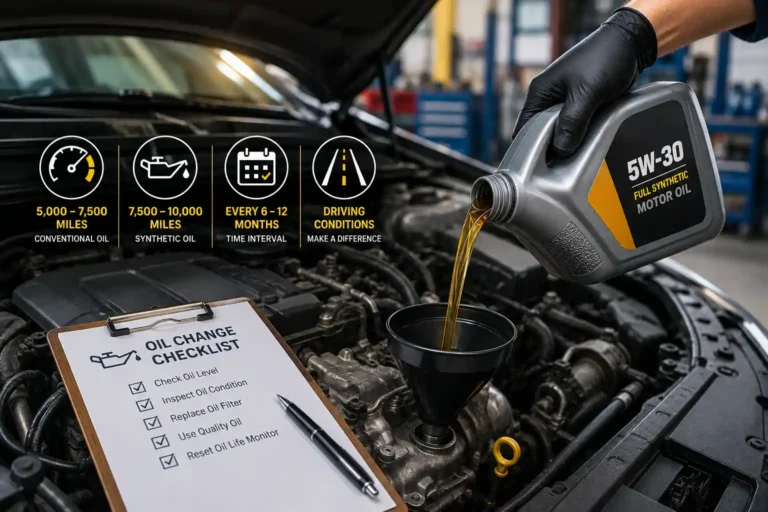
Most modern cars need an oil change every 5,000 to 7,500 miles for conventional oil, or every 7,500 to 10,000 miles for full synthetic oil. The old “every 3,000 miles” rule is outdated for the vast majority of cars built in the last fifteen years, though it still applies in certain older or high-stress situations.
This guide covers why that 3,000-mile number stuck around, what actually determines your real interval, how driving conditions change the math, and why time can matter as much as mileage.
Why Is the 3,000-Mile Oil Change Rule Outdated?
The 3,000-mile rule dates back to a time when conventional motor oils and engine tolerances couldn’t handle longer intervals without breaking down. Oil formulations and engine designs have both improved substantially since then, extending how long oil can protect an engine before it needs replacing.
Quick-lube chains have also had a financial incentive to keep recommending 3,000 miles regardless of what a vehicle’s owner’s manual actually says. Most manufacturers now specify intervals two to three times longer than that old standard for normal driving conditions.
What’s the Real Interval for Conventional Oil?
Conventional oil typically needs changing every 5,000 to 7,500 miles under normal driving conditions. This oil type breaks down faster than synthetic under heat and friction, which is why its interval sits on the shorter end of the modern range.
Conventional oil remains a reasonable, lower-cost choice for older engines or vehicles that aren’t driven under particularly demanding conditions. Checking your specific manufacturer recommendation is still the most reliable way to confirm the right number for your exact engine.
What’s the Real Interval for Synthetic Oil?
Full synthetic oil typically extends the interval to 7,500 to 10,000 miles, and in some cases manufacturers rate it even longer under normal conditions. Synthetic oil resists thermal breakdown and maintains its protective properties longer than conventional oil, which is what allows the extended mileage between changes.
The higher upfront cost of synthetic oil is often offset by needing fewer changes per year, especially for drivers who put on significant highway mileage. Many newer vehicles come from the factory with synthetic oil specified as the standard requirement rather than an upgrade option.
Does Time Matter as Much as Mileage?
Yes, oil degrades from exposure to air and moisture over time even if a car barely gets driven, which is why manufacturers set a time-based limit alongside the mileage-based one. Most recommendations cap intervals at six months to one year regardless of how few miles have accumulated.
A car driven only a few thousand miles a year still needs an oil change on that time schedule, not just a mileage schedule. Skipping oil changes based on low mileage alone can let moisture and acidic byproducts build up inside the engine.
How Does Highway Driving Affect Your Oil Change Interval?
Consistent highway driving is considered easy on oil, since the engine runs at a steady, efficient temperature for extended periods without frequent stopping and restarting. This driving pattern generally allows a vehicle to hit the longer end of its recommended interval range.
A driver who mostly takes long highway trips can often stick to 7,500 miles on conventional oil or the full 10,000 miles on synthetic without added risk. This is one of the few conditions labeled as favorable in most owner’s manual maintenance schedules.
How Does Short-Trip and Stop-and-Go Driving Affect Your Interval?
Frequent short trips and heavy stop-and-go traffic are classified as severe driving conditions in most owner’s manuals, and they shorten your real-world oil change interval. An engine that never fully reaches operating temperature accumulates more condensation and unburned fuel residue in the oil.
Drivers who mostly commute in city traffic or take mostly short trips under ten minutes should plan for the lower end of their oil’s mileage range, sometimes even below it. This is one of the most common reasons an oil life monitoring system triggers earlier than a driver expects.
How Does Cold Weather Driving Affect Your Interval?
Cold weather is also classified as a severe driving condition, since oil thickens in low temperatures and takes longer to circulate and protect the engine at startup. Repeated cold starts put more wear on an engine than the same number of miles driven in moderate temperatures.
Drivers in consistently cold climates, or anyone driving mostly short trips during winter, should treat their maintenance schedule as being on the severe side rather than the normal side. Combining cold weather with short-trip driving is one of the toughest combinations for oil life, even at relatively low mileage.
How Do You Find the Right Interval for Your Specific Car?
Your owner’s manual is the single most reliable source for your exact interval, since manufacturers test and rate intervals specifically for each engine design. Most manuals list both a “normal” and a “severe” schedule, and it’s worth honestly assessing which category your typical driving falls into.
Many newer cars also include a built-in oil life monitoring system that calculates remaining oil life based on actual driving conditions rather than a flat mileage number. This system accounts for your specific combination of trip length, temperature, and driving style, making it generally more accurate than a blanket mileage rule.
Conclusion
Knowing how often to change your oil is one of the easiest ways to protect your engine and avoid unnecessary repair costs. While the old 3,000-mile rule is outdated for most modern vehicles, the ideal interval depends on your oil type, manufacturer recommendations, and everyday driving conditions. Conventional oil generally requires more frequent changes than full synthetic oil, while severe driving habits like short trips, stop-and-go traffic, towing, or extreme temperatures can shorten oil life even further.
For the best results, follow your owner’s manual and trust your vehicle’s oil life monitoring system if equipped. Staying consistent with oil changes improves engine performance, fuel efficiency, and long-term reliability, helping your vehicle run smoothly for many years while reducing the risk of expensive engine damage.
Frequently Asked Questions
How often should you really change your oil?
Most vehicles need an oil change every 5,000 to 7,500 miles with conventional oil or 7,500 to 10,000 miles with full synthetic oil under normal driving conditions. Always follow your owner’s manual or your vehicle’s oil life monitoring system, since the correct interval varies by engine design and driving habits.
Is it bad to change your oil too early?
No. Changing your oil earlier than recommended will not harm your engine. The main downside is spending more money on oil and filters than necessary. Changing it a little early is far safer than delaying an oil change for too long.
Can you mix synthetic and conventional motor oil?
Yes. Synthetic and conventional motor oils are compatible and can be mixed in an emergency without damaging the engine. However, mixing them reduces many of the performance benefits of full synthetic oil, so it’s best to follow the shorter oil change interval afterward.
Does high-mileage oil last longer than regular oil?
Not necessarily. High-mileage oil is designed for vehicles with 75,000 miles or more and contains additives that help reduce leaks, protect seals, and minimize engine wear. Its oil change interval is generally the same as the equivalent conventional or synthetic oil unless the manufacturer states otherwise.
What happens if you wait too long between oil changes?
Driving with old engine oil increases friction, heat, and engine wear because the oil gradually loses its protective properties. Over time, contaminants can form sludge, reduce lubrication, lower fuel efficiency, and potentially cause expensive engine damage that could have been prevented with routine maintenance.
Should you trust your car’s oil life monitoring system?
Yes. Modern oil life monitoring systems are generally more accurate than following a fixed mileage schedule because they calculate oil life using factors such as engine temperature, trip length, engine load, and driving conditions. Unless your owner’s manual says otherwise, you can usually rely on the system to tell you when service is due.
Does oil expire if you don’t drive much?
Yes. Even if your vehicle sits for long periods, engine oil gradually degrades from exposure to moisture, oxygen, and contaminants. That’s why most manufacturers recommend changing the oil at least every 6 to 12 months, even if you haven’t reached the mileage limit.
Is highway driving better for engine oil than city driving?
Yes. Long highway trips place less stress on engine oil because the engine stays at a consistent operating temperature. Frequent short trips, stop-and-go traffic, towing, and extreme temperatures are considered severe driving conditions and usually require more frequent oil changes.