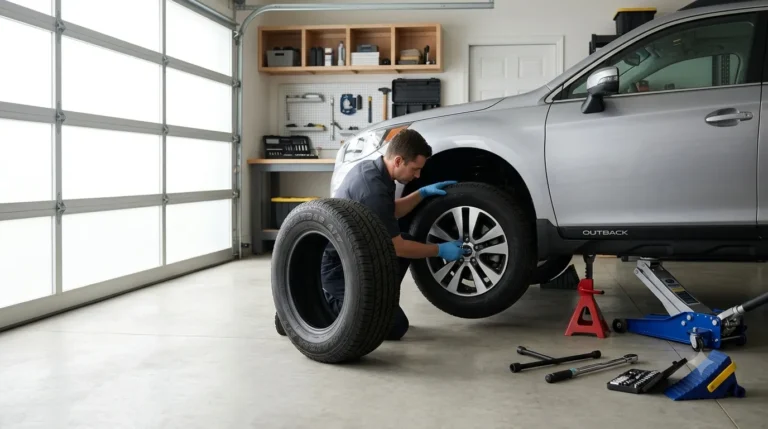
Tire rotation is recommended roughly every 3,000 to 5,000 miles by most manufacturers and tire retailers, timing that lines up conveniently with a typical oil change interval, which is part of why many drivers get both done together at a shop. Doing it yourself at home takes about an hour for a first attempt and requires only a jack, jack stands, and a lug wrench, tools many home mechanics already own for other maintenance tasks.
This guide covers the correct rotation pattern for your drivetrain type, the full step-by-step process, how much you can save doing it yourself, and why skipping rotation altogether shortens tire life more than most drivers realize.
Why Does Tire Rotation Actually Matter?
Tire rotation matters because tires wear unevenly based on their position on the vehicle, and moving them periodically evens out that wear to extend the overall life of the full set. Front tires typically bear more steering and braking load, while a vehicle’s drive wheels, whether front, rear, or all-wheel drive, experience more wear from putting power to the road.
Left unrotated, tires in high-wear positions can wear down significantly faster than tires in lower-wear positions, leading to a mismatched set where some tires need replacement well before others, even though all four started with the same tread depth.
What Tools Do You Need to Rotate Tires at Home?
Rotating tires at home requires a car jack, jack stands, and a lug wrench at minimum. A hydraulic floor jack makes the process considerably easier and faster than the small scissor jack that comes standard in most vehicle trunks, though the trunk jack works fine for an occasional rotation if that’s what you have available.
An impact wrench speeds up the lug nut removal and reinstallation considerably compared to a manual wrench, though it’s not strictly necessary for a home rotation done occasionally rather than as a regular routine.
How Do You Prepare Your Vehicle for a Rotation?
Preparing your vehicle means parking on a flat, level surface and engaging the parking brake before touching any tools. Working on an incline increases the risk of the vehicle shifting once it’s raised, which is a genuinely dangerous situation if anyone is positioned near or under the vehicle at the time.
Place a wheel chock, or a solid block of wood, behind one of the tires that will remain on the ground throughout the process, adding an extra layer of security against the vehicle rolling. Loosen all the lug nuts slightly while the vehicle is still fully on the ground, working in a crisscross pattern rather than around the wheel in order, since the tire’s resistance against the pavement makes loosening far easier now than once the wheel is off the ground.
What Is the Correct Tire Rotation Pattern for Your Vehicle?
The correct rotation pattern depends on whether your vehicle is front-wheel drive, rear-wheel drive, or all-wheel drive, since each drivetrain wears tires in a different pattern. For front-wheel drive vehicles, the rear tires move diagonally to the front, while the front tires move straight back to the rear positions.
For rear-wheel drive vehicles, the pattern reverses, with rear tires moving straight forward and front tires moving diagonally to the rear. All-wheel drive vehicles often use a similar diagonal pattern to front-wheel drive vehicles, though checking your owner’s manual for the manufacturer’s specific recommendation is worth doing, since some all-wheel drive systems have unique requirements around tire matching that affect the ideal rotation approach.
How Do You Lift the Vehicle and Remove the Wheels?
Lifting the vehicle safely means locating the correct jack points listed in your owner’s manual, then raising each corner one at a time, immediately placing a jack stand under that lift point before working on the wheel. Never rely on the jack alone to hold the vehicle up while a wheel is removed, since jacks can settle or fail unexpectedly, and a jack stand provides a stable, mechanical support that doesn’t depend on hydraulic pressure holding steady.
With the wheel elevated and the jack stand in place, finish removing the loosened lug nuts and pull the wheel straight off the hub. Repeat this process for each wheel involved in the rotation, keeping track of which position each tire originally came from if you’re doing a partial rotation involving only some of the wheels.
How Do You Reinstall the Tires in Their New Positions?
Reinstalling the tires means moving each wheel to its new position according to your vehicle’s specific rotation pattern, then lining it up carefully on the wheel studs before threading the lug nuts on by hand. Hand-threading first, before using any tool, helps avoid cross-threading the studs, which can damage them and complicate future tire changes.
Once every lug nut is hand-tight on a given wheel, lower that corner of the vehicle back to the ground using the jack, then finish tightening the lug nuts fully with the lug wrench. Tighten in a star or crisscross pattern rather than working around the wheel sequentially, which distributes clamping force evenly and helps the wheel seat properly against the hub.
What Mistakes Should You Avoid During a Home Tire Rotation?
Using the wrong rotation pattern for your specific drivetrain is one of the more common mistakes, since a pattern designed for front-wheel drive doesn’t distribute wear evenly on a rear-wheel or all-wheel drive vehicle. A handful of other errors show up regularly as well.
- Working on a jack alone without a jack stand, risking serious injury if the jack fails or settles unexpectedly
- Tightening lug nuts in sequential order around the wheel instead of a star pattern, leading to uneven seating
- Skipping the tire pressure check during rotation, missing an easy opportunity to catch a slow leak or underinflated tire
- Forgetting to inspect tread depth and wear patterns while the wheels are off, a good moment to catch developing issues
- Rushing the process on a first attempt, which increases the likelihood of a missed step or improperly torqued lug nut
Taking the extra time on your first rotation, rather than rushing to match how quickly a shop might complete the same job, results in a safer and more thorough outcome.
How Much Money Can You Save Rotating Tires Yourself?
DIY tire rotation saves primarily on labor cost, since shops typically charge a service fee for rotation even though the task itself requires no parts at all. Many tire retailers offer free rotation as part of a tire purchase package, which changes the math considerably, but drivers who bought tires elsewhere or whose free rotation offer has expired often pay a recurring fee every time they have it done professionally.
Over several years of regular rotations at the recommended interval, doing the job yourself can add up to a meaningful amount saved, particularly for drivers who already own or are willing to invest in basic jack and jack stand equipment they’ll reuse for other maintenance tasks like brake work or oil changes.
How Often Should You Rotate Your Tires?
Most manufacturers and tire retailers recommend rotating tires every 3,000 to 5,000 miles, though checking your specific vehicle’s owner manual gives the most accurate interval for your car. Pairing tire rotation with routine oil changes, which often fall on a similar mileage interval, makes it easier to remember and keeps both tasks on a consistent schedule.
Drivers who notice uneven tread wear developing between rotations, or who tow frequently, may benefit from rotating slightly more often than the standard interval, since heavier loads and towing tend to accelerate wear differences between tire positions.
Conclusion
Rotating your own tires at home is one of the easiest and most cost-effective maintenance tasks you can perform to extend tire life and improve vehicle performance. With the right tools, a safe workspace, and the correct rotation pattern for your vehicle, you can complete the job in about an hour while saving money on recurring service fees. Regular tire rotation also promotes even tread wear, improves handling, and helps you get the maximum value from your tires.
The key is to follow your vehicle manufacturer’s recommended rotation interval, use jack stands for safety, and tighten lug nuts correctly before driving. By making tire rotation part of your routine maintenance schedule, you’ll reduce uneven tire wear, improve driving stability, and potentially avoid the expense of replacing tires sooner than necessary. A little time spent in your garage today can lead to safer driving and lower maintenance costs for thousands of miles to come.
Frequently Asked Questions
How long does it take to rotate tires at home for the first time?
A first attempt typically takes close to an hour, including the time spent double-checking the correct rotation pattern and working carefully through each wheel. Subsequent rotations usually go faster once you’re familiar with your vehicle’s jack points and lug nut torque.
Can I rotate my tires myself if I have a spare instead of a matching fifth tire?
Yes, most home rotations only involve the four active tires, and a compact spare typically isn’t included in the rotation pattern since it’s designed for temporary use rather than regular driving.
What happens if I never rotate my tires?
Unrotated tires wear unevenly based on their position, with front and drive wheels typically wearing faster than others, leading to a mismatched set that may require replacing some tires well before others even wear out.
Does tire rotation affect my vehicle’s alignment?
No, tire rotation and wheel alignment are separate services. Rotation simply changes which tire sits in which position, while alignment adjusts the angles of the wheels themselves, though both contribute to even tire wear over time.
Should I check tire pressure while rotating tires?
Yes, checking and adjusting tire pressure while the wheels are off is an efficient use of the time, since you’re already working directly with each tire and can easily catch a slow leak or underinflated tire during the same session.
Will rotating my own tires void any tire warranty?
In most cases, no, as long as you can show the tires were rotated at reasonable intervals and any required documentation is kept. Some tire warranties specifically require professional rotation records to remain valid, so checking your specific warranty terms before relying entirely on DIY rotation is worth doing if warranty coverage matters to you.