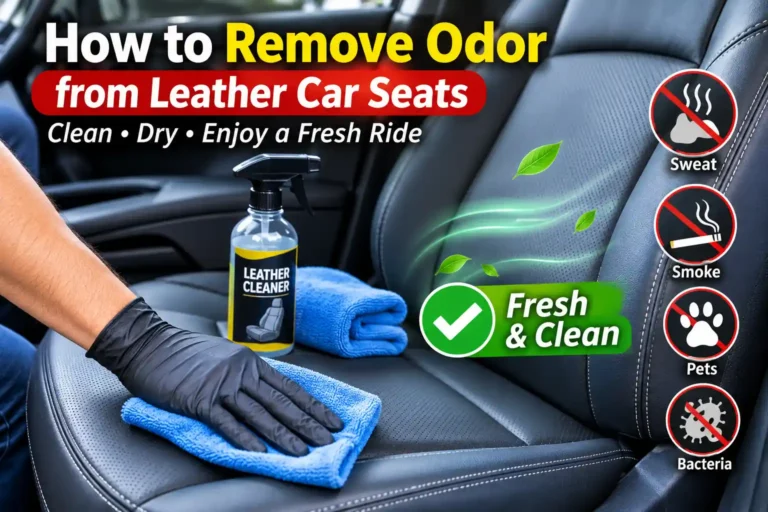
To remove odor from leather car seats, remove the source, clean the upholstery with a product approved for its finish, and let the seat dry completely with good airflow. Adding fragrance or repeatedly soaking the leather won’t solve contamination trapped in seams, perforations, or seat foam.
Start by checking whether the smell actually comes from the seat rather than the carpet, a floor mat, or something underneath it. Sweat and light surface residue may respond to careful cleaning. Smoke throughout the cabin and bodily waste that has soaked into padding need a broader approach. This guide covers routine odor removal, sweat, smoke, and fecal contamination without treating every leather finish the same.
Identify the Leather and the Odor Source
Check your owner’s manual before choosing a cleaner. Many automotive leather seats have a protective surface coating, but uncoated leather, suede, and other specialty materials need different care. Synthetic leather can also have its own cleaning restrictions.
If you aren’t sure what you have, look up the upholstery specification rather than testing it with water or chemicals. A leather cleaner isn’t automatically suitable for every seat material.
With the vehicle parked and switched off, remove loose belongings and inspect the seat, seams, seat rails, and nearby carpet. Use a flashlight rather than reaching blindly beneath the seat, where wiring and sharp components may be present. Don’t disconnect seat wiring or remove the seat for routine cleaning.
Try to identify where the smell is strongest:
- Across the seating surface: Body oils, sweat, or transferred residue may be involved.
- At one seam or perforated area: A spill may have traveled below the surface.
- Throughout the cabin: Smoke, damp carpet, or another interior source may be contributing.
Visible mold, sewage exposure, or substantial contamination inside the cushion calls for professional assessment rather than repeated surface cleaning.
Gather Supplies That Match the Seat Finish
For ordinary surface odors, you need a vacuum with a gentle upholstery attachment, several clean microfiber cloths, and a cleaner approved for the upholstery. Disposable gloves and absorbent towels are useful when handling unpleasant spills or waste.
Choose a cleaner whose instructions cover your seat material, then follow both its label and the vehicle manufacturer’s directions. Avoid improvising chemical mixtures or using a stiff household scrubbing brush.
Work in shade with the seats cool to the touch. Park somewhere secure where you can ventilate the vehicle without exposing it to rain. If the cleaning instructions conflict, follow the more restrictive applicable directions or ask the vehicle manufacturer for guidance.
How to Clean Leather Seats to Remove Surface Odors
The goal is to lift odor-producing residue without driving moisture into the cushion. These steps suit routine cleaning of compatible finished leather, not deeply contaminated foam or specialty upholstery.
1. Remove Loose Debris Before Wiping
Vacuum crumbs and loose dirt with a clean, soft attachment. Use light contact around stitching and avoid dragging a hard nozzle across the upholstery.
For tight spaces, learning how to vacuum between car seats helps remove debris that can otherwise keep producing a smell. Keep tools clear of electrical connectors and seat mechanisms.
If bodily waste is present, skip vacuuming that contamination and follow the separate handling advice below.
2. Test the Cleaner in a Hidden Area
Apply the cleaner as directed to a small, inconspicuous area. Let it dry and check for color transfer, discoloration, tackiness, or a change in sheen before treating a larger section.
Stop if the finish changes. A product that works on one vehicle’s leather may not be appropriate for another vehicle or a previously repaired seat.
3. Clean Small Sections Without Saturating Them
Where the product instructions allow, apply cleaner to a microfiber cloth rather than spraying it directly onto the seat. Wipe gently in small sections, paying attention to areas that contact clothing and skin.
Use only a lightly damp cloth around seams and perforations. Don’t flood stitching, scrub cleaner into holes, or try to flush contamination through the upholstery. Heated and ventilated seats can have components beneath the covering that must remain protected from excess moisture.
For broader routine care, the same material checks apply when you clean leather car seats elsewhere in the cabin.

4. Remove Residue and Let the Seat Dry
Remove cleaner residue using the method specified on the label. Change cloths as they become dirty so you aren’t spreading residue back over the seat.
Allow the upholstery to dry with ventilation and gentle airflow. Don’t use a heat gun, hair dryer, or intense direct heat to speed things up. Avoid sitting on the seat until it is dry.
Evaluate the smell after drying, not while the cleaner’s scent is still strong. A clean surface should not feel sticky or greasy, although appearance alone cannot confirm that deeper contamination is gone.
Removing Sweat and Body-Oil Odors
Sweat-related smells often involve residue transferred from skin, damp clothing, or workout gear. Clean the contact areas using the process above, including the seatback and bolsters rather than just the center cushion.
Wash removable seat covers separately according to their care labels, and remove gym clothes or towels from the cabin. Keeping damp gear off the upholstery reduces repeated contamination.
If the odor remains after one careful cleaning and complete drying, reassess its location. Another gentle cleaning may be reasonable if residue remains and the product instructions permit it. A smell concentrated deep in a seam, however, isn’t a reason to use more liquid or scrub harder.
Removing Smoke Odor from Leather Seats
Smoke odor usually requires cleaning beyond the leather seats because residue can settle on many cabin surfaces. Treating the seat alone may leave the overall smell largely unchanged.
Clean compatible hard surfaces and address carpets, mats, and other affected materials with their own approved methods. The headliner needs particular care because excessive moisture or agitation can damage it. A cabin air filter may also need inspection under the vehicle’s maintenance guidance, but replacing it won’t remove residue from upholstery.
If the task is to remove smoke smell from a used car, approach the cabin as a whole rather than repeating leather treatments. Persistent smoke odor is a reasonable reason to consult an automotive detailer who can assess the affected materials.
Handling Fecal Contamination on Leather Seats
Fecal contamination is a hygiene issue as well as an odor problem. Keep passengers and pets away from the affected area, wear disposable gloves, and remove solid material carefully with disposable towels without pressing it into seams. Bag the waste and wash your hands after handling it.
Don’t vacuum fecal material or use a brush that spreads it across the seat. Blot remaining moisture gently rather than rubbing it outward.
A leather cleaner may remove visible soil, but cleaning is not the same as disinfecting. Don’t assume that a household disinfectant is safe for leather or that a leather-safe cleaner disinfects it. Use a disinfectant only if its label supports the intended use and the upholstery manufacturer permits it, including the required application conditions.
If no compatible treatment can be established, or material has entered perforations, seams, or foam, arrange professional assessment. The affected cushion or upholstery may need specialist treatment or replacement. Don’t return the seat to use simply because the smell is less noticeable.
Urine that has entered seat padding presents a related but separate cleaning problem. It needs a contamination-specific assessment rather than an improvised extension of routine leather cleaning.
What to Do When the Odor Returns
A returning smell suggests that the source remains somewhere, but it doesn’t prove that the leather itself is responsible. Recheck the surrounding carpet, removable items, seams, and the area beneath the seat before choosing another treatment.
If the odor seems deeper than the surface, stop adding cleaner. An automotive upholstery specialist can assess whether the seat covering, cushion, or another cabin material needs attention. Report what caused the odor and which products have already been used.
Leather conditioner isn’t a substitute for removing contamination. Use it only if the vehicle’s upholstery guidance calls for it, after cleaning and drying. Adding more product can leave residue without addressing the source.
Conclusion
Remove odor from leather car seats by locating the source, using a finish-compatible cleaner, and controlling moisture throughout the process. Surface sweat residue may be manageable at home; widespread smoke residue and waste inside seat padding require a different level of treatment. If careful cleaning doesn’t resolve the problem, reassess rather than reaching for stronger chemicals.
Frequently Asked Questions
Can I sprinkle baking soda on leather car seats to remove odors?
Loose baking soda isn’t a good default treatment for leather seats, especially perforated upholstery. Powder can lodge in holes and stitching, and rubbing it into the surface adds unnecessary abrasion. Use a manufacturer-approved cleaning method instead.
Is vinegar safe for removing smells from leather car seats?
Don’t assume vinegar is safe for your leather upholstery. A homemade mixture has no established compatibility with your particular finish, dye, or previous repair. Use it only if the vehicle manufacturer explicitly recommends that method.
Can an ozone generator remove odor from leather car seats?
Ozone is not a substitute for removing the contamination causing the smell. It is harmful to breathe and can affect susceptible interior materials, so a consumer ozone treatment isn’t a sensible first step. Consider professional assessment rather than treating an occupied vehicle or improvising an ozone procedure.
Will an air freshener eliminate odor in leather upholstery?
An air freshener generally adds fragrance rather than removing residue inside upholstery. A stronger scent can make it harder to judge whether cleaning worked. Avoid placing fragrance oils or leaking scent containers directly against leather.
Can new leather seats have a smell without being dirty?
Yes, new upholstery and other interior materials can have an odor without visible contamination. Ventilate the vehicle as permitted by the owner’s manual and avoid unnecessary chemical treatments. If the smell is unusually strong, causes irritation, or resembles burning, have the vehicle inspected rather than assuming it is normal.