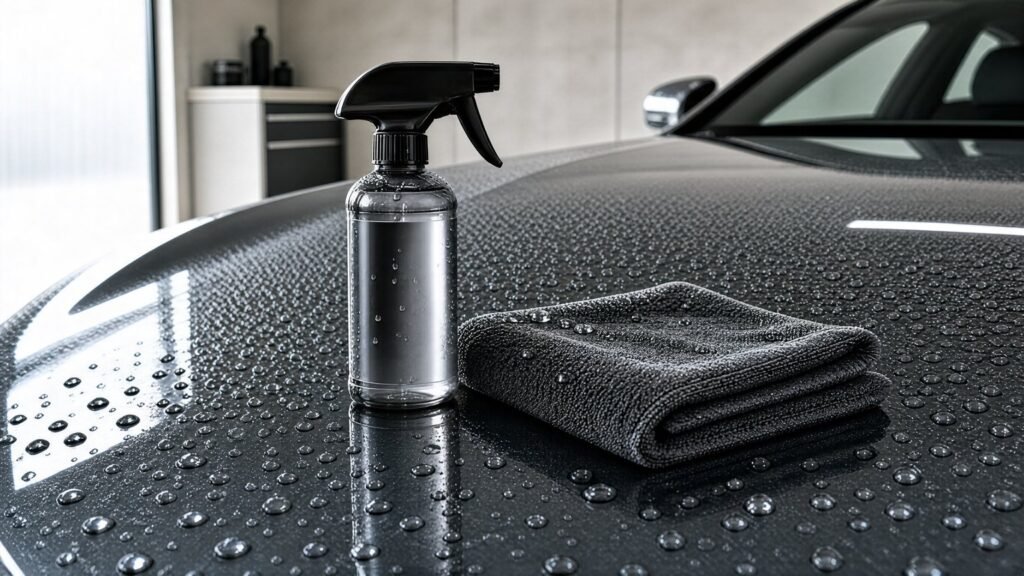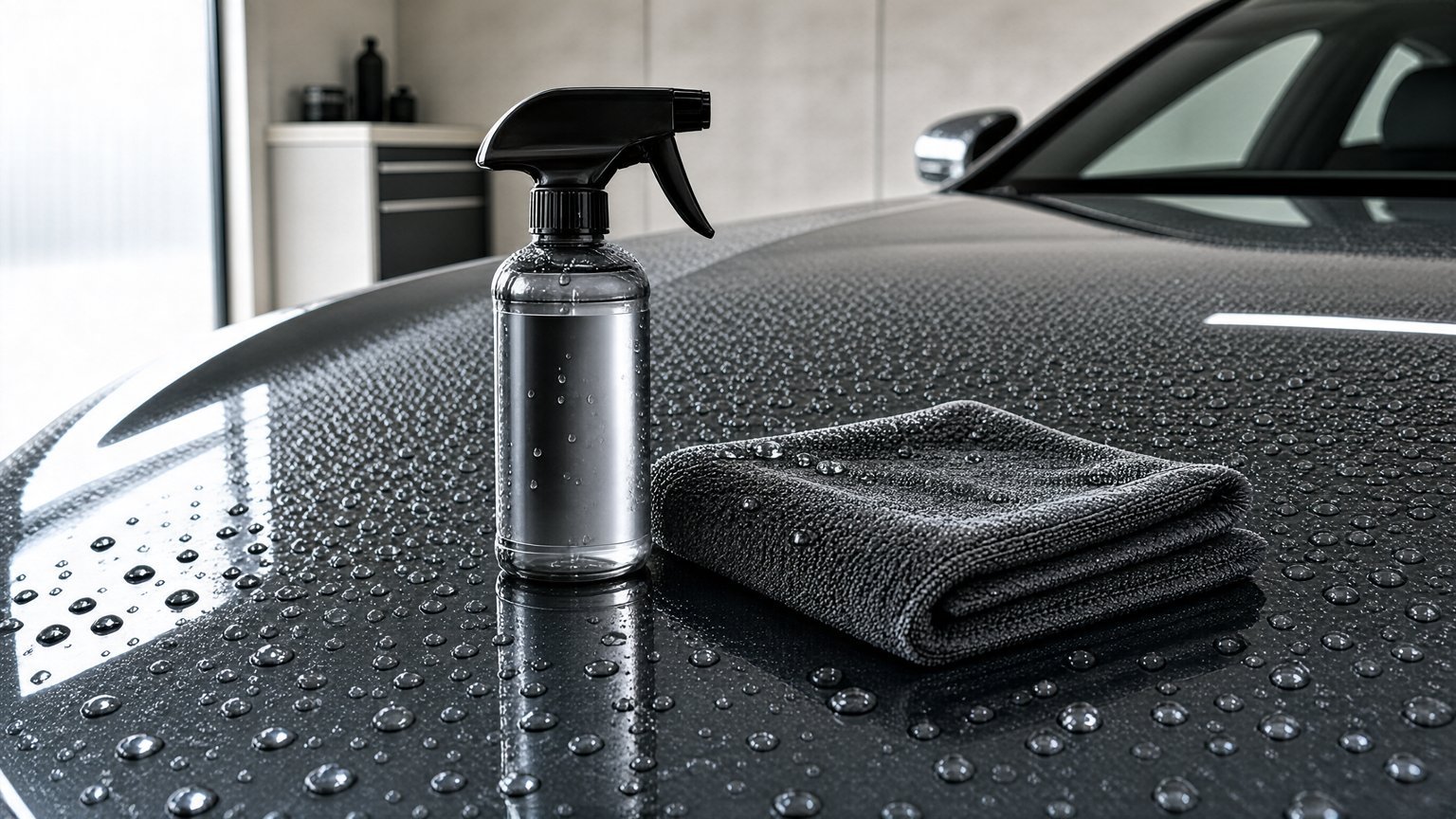

A waterless car wash uses a specially formulated spray that lubricates and encapsulates dirt particles, allowing them to be wiped away with a microfiber towel without any rinsing or hose water at all. It genuinely works for lightly dusty vehicles, but it isn’t a substitute for a full wash on a heavily soiled car, since the lubricant can only handle so much dirt before it starts dragging particles across the paint instead of lifting them away safely.
This guide explains: how waterless wash products actually work, when they’re appropriate to use, their real limitations, and how to use them safely to avoid introducing scratches.
How Does a Waterless Wash Product Actually Work?
Waterless wash formulas vary by manufacturer, but they generally combine cleaning agents with lubricating ingredients designed to loosen or surround light surface contamination while reducing friction during wiping.
Some products specifically use polymers to encapsulate dirt and provide additional lubricity. Optimum, for example, says its Opti-Clean formula uses substantive polymers that encapsulate dirt and grime while lubricating the surface. Meguiar’s similarly describes its Hybrid Ceramic Waterless Wash & Wax as a high-lubricity spray-and-wipe formula designed to clean while providing hydrophobic protection.
The important point is that a waterless wash does not make wiping dirt across paint inherently safe. The product has to provide enough lubrication for the specific amount of contamination, and the towel has to remove that contamination without repeatedly redistributing it.
That is why the technique matters just as much as the bottle. A clean, plush microfiber towel and generous product coverage give the loosened dirt somewhere to go. A dirty towel, insufficient product, or excessive pressure can increase the chance of marring.
When Does a Waterless Wash Actually Make Sense?
Waterless washing works best when the vehicle has light contamination and only needs routine maintenance rather than a deep clean. It is particularly useful in situations where a traditional bucket-and-hose wash would be unnecessary or impractical.
- Light dust and surface contamination: A thin layer of dust, pollen, fingerprints, or light road film is generally better suited to a waterless wash than caked-on mud or heavy grit.
- Limited water access: Waterless washing is practical for apartment residents, people working in parking areas, or anyone without convenient access to a hose. The basic setup requires the cleaning spray and clean microfiber towels.
- Quick maintenance between full washes: If the vehicle has already been thoroughly washed and only develops a light layer of dust afterward, a waterless wash can provide a convenient maintenance clean without setting up another full wash.
- Spot cleaning: When only a small area has light contamination, a waterless product can be more convenient than washing the entire vehicle.
- Show or event preparation: Waterless products can be useful for removing light dust and fingerprints before an event, particularly when there is no convenient access to a hose.
When Should You Avoid Using a Waterless Wash?
The main limitation is the amount and type of contamination on the vehicle. When the surface contains substantial abrasive material, rinsing and a more thorough cleaning process are generally more appropriate.
Any surface that requires aggressive scrubbing: If removing the contamination requires significant pressure, the vehicle is probably too dirty for a waterless wash. Use a conventional wash instead.
Heavily soiled vehicles: Avoid using a waterless wash when the vehicle is covered with heavy mud, thick road grime, or substantial grit. These conditions require more thorough cleaning than a spray-and-wipe method is designed to provide.
Fresh mud and heavy off-road contamination: Mud can contain sand, grit, and other abrasive particles. Rinse away loose contamination before using contact-cleaning methods.
Heavy road-salt buildup: Vehicles with substantial winter road salt and accumulated grime are better handled with a thorough water-based wash rather than relying on a waterless product alone.
Dried bugs and bird droppings: Do not aggressively wipe stubborn dried contamination from the paint. Pre-treat the affected area to soften the residue, then remove it gently. If it does not loosen easily, switch to a more appropriate cleaning method rather than increasing pressure.
What’s the Correct Technique for Using a Waterless Wash Safely?
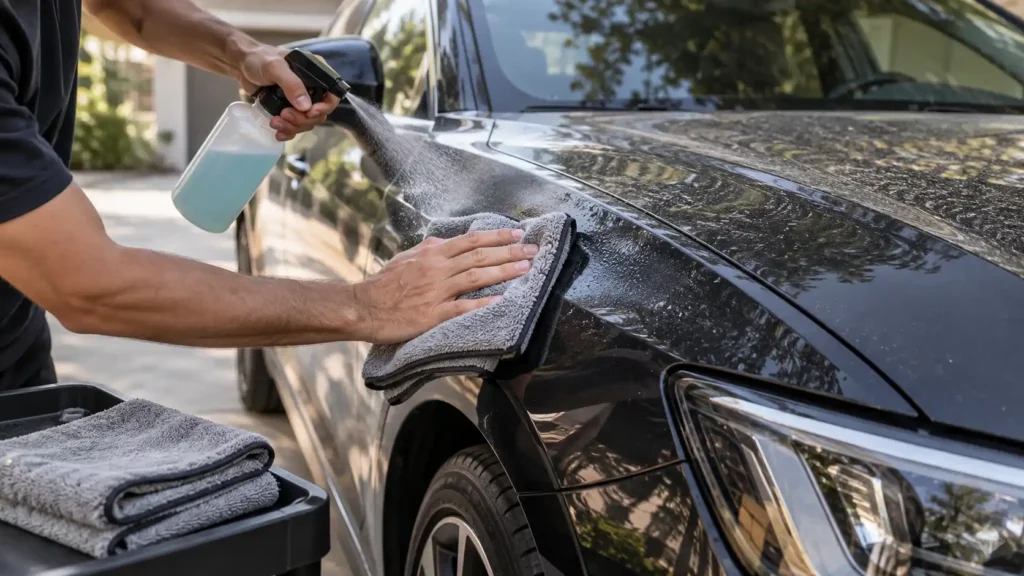
Using a waterless wash safely comes down to generous product coverage, gentle wiping, and clean microfiber towels. Work on a cool surface in small sections, spray enough product to provide lubrication, and wipe with light pressure using a clean towel face. Change towels frequently as they collect dirt, then use a separate dry microfiber towel to buff away remaining residue. If the contamination does not lift easily, do not scrub harder; switch to a more suitable cleaning method instead.
1. Inspect the Vehicle First
Before spraying anything, look at the paint.
If you see heavy mud, loose grit, sand, or thick road contamination, switch to a conventional wash rather than forcing a waterless method beyond its intended use.
2. Work on a Cool Surface
Many manufacturers recommend using waterless wash products on cool surfaces away from direct sunlight. Excessive heat can cause the product to dry before you have properly removed the contamination.
3. Work in Small Sections
Spray one manageable section at a time rather than covering the entire vehicle and allowing the product to dry.
A 2-by-2-foot section is one example recommended by Chemical Guys for one of its waterless products. The exact working area can vary by formula, temperature, and instructions on the bottle.
4. Apply Enough Product
Use enough spray to provide substantial lubrication around the contamination.
Under-applying product simply to make the bottle last longer can work against the purpose of the method because there is less lubrication between the towel, dirt, and paint.
5. Use a Clean, Plush Microfiber Towel
Fold the towel so you have multiple clean working faces.
Make light, controlled passes instead of scrubbing aggressively. Several manufacturers recommend straight or linear wiping motions rather than circular scrubbing.
6. Change to a Clean Towel Face Frequently
As the towel accumulates dirt, switch to another clean section.
Do not continue wiping the vehicle with a towel face that is visibly contaminated. Larger vehicles or dirtier maintenance washes may require several towels rather than trying to complete the entire vehicle with one.
7. Buff With a Separate Clean Towel
After the initial contamination has been removed, use a fresh microfiber towel to remove remaining residue and level the finish.
The final buff is particularly useful with formulas that leave polymers, waxes, or other protective ingredients behind.
Do Waterless Wash Products Provide Any Protection Benefit?
Some waterless wash products do provide additional protection, but the type and durability depend on the specific formula.
For example, Meguiar’s Hybrid Ceramic Waterless Wash & Wax is marketed as providing hydrophobic protection, while Optimum describes Opti-Clean as leaving a slick, glossy finish with additional protection. Other waterless products may use waxes, sealants, or different polymer systems.
This means you should not assume every waterless wash provides the same protection or that every product will last for a particular number of days.
A waterless wash with a protective component can be useful for maintaining an existing finish, but it should not automatically be treated as a replacement for a dedicated wax, sealant, or ceramic coating when longer-term protection is the goal.
The product label and manufacturer documentation should determine what type of protection the specific formula actually provides.
How Does a Waterless Wash Compare to a Rinseless Wash?
Waterless and rinseless washing are related but different methods.
A waterless wash is normally sprayed directly onto the vehicle and wiped away with microfiber towels. There is no bucket of diluted wash solution involved.
A rinseless wash, by contrast, uses a concentrated product diluted into a bucket of water. The vehicle is cleaned with the diluted solution and wash media, but the vehicle does not require a conventional hose rinse afterward.

That difference gives each method a different practical role.
| Method | Water Required | Best Suited To | Main Limitation |
|---|---|---|---|
| Waterless wash | No bucket or hose water | Light dust, fingerprints, light road film, quick touch-ups | Limited by the amount of contamination |
| Rinseless wash | Bucket of diluted solution | Light to moderate contamination when hose access is limited | Still requires water and wash media |
| Traditional wash | Running water or substantial rinse water | Heavy contamination and routine deep cleaning | Requires more setup, water, and equipment |
Rinseless washing can therefore occupy a useful middle ground when a vehicle is too dirty for a spray-and-wipe waterless wash but you still want to avoid setting up a full hose-based wash.
Is a Waterless Wash a Good Option for New Car Owners Learning to Detail?
It can be a useful method for learning basic paint-care habits, particularly because the process teaches several skills that apply to other detailing methods.
A beginner learns to:
- Inspect the surface before cleaning.
- Recognize when contamination is too heavy for a waterless wash.
- Apply sufficient lubrication.
- Use clean microfiber towels.
- Avoid excessive pressure.
- Change towel faces before they become heavily contaminated.
- Separate towels according to their intended surfaces.
Those habits also matter during traditional washing. CarCareGuy’s guide to washing without scratching paint emphasizes the same broader principles: controlling contamination, using clean wash media, minimizing unnecessary friction, and avoiding aggressive pressure.
However, beginners should also learn conventional washing because waterless cleaning does not replace every part of exterior car care. Wheels, tires, underbody areas, heavy contamination, and substantial road grime often require a more thorough cleaning process.
If you are building a complete beginner detailing routine, the CarCareGuy DIY car detailing checklist is a useful next step.
What About Wheels and Tires?
A waterless product may be suitable for lightly contaminated wheels if the product manufacturer specifically allows that surface.
However, heavily contaminated wheels present a different problem. Brake dust and road grime can be substantially heavier than the light dust for which waterless products are normally intended.
Use separate towels and cleaning tools for wheels so contamination from the wheels does not get transferred to painted panels. CarCareGuy’s guide to cleaning wheels safely also recommends dedicated wheel tools for this reason.
If the wheels have substantial brake-dust buildup, a dedicated wheel-cleaning process with appropriate rinsing is generally more practical than trying to wipe the contamination away with a waterless product.
Are Waterless Wash Products Safe for Ceramic Coatings and Other Protected Paint?
Many waterless products are formulated for use on protected paint, but compatibility is product-specific.
For example, Meguiar’s states that its Hybrid Ceramic Waterless Wash & Wax is suitable for ceramic coatings, while Chemical Guys markets certain waterless formulas for coated and non-coated vehicles.That does not mean every waterless wash is automatically appropriate for every coating.
Check the manufacturer’s instructions for your particular product and coating. This is especially important with specialty finishes such as matte or satin paint, where products containing gloss-enhancing ingredients may not be appropriate.

What Are the Biggest Waterless-Wash Mistakes?
Most waterless-wash mistakes come down to using the method beyond its limits or relying on poor wiping technique. The biggest mistakes to avoid are:
- Using it on a heavily dirty vehicle: If the vehicle is covered with mud, heavy grit, or substantial road grime, use a conventional wash instead of forcing a waterless product to handle the contamination.
- Using too little product: Waterless washing depends on adequate lubrication. Applying too little product can increase friction between the towel, dirt, and paint.
- Using one towel for the entire vehicle: Once a microfiber towel has collected visible dirt, switch to a clean towel or a fresh towel section. Continuing with a contaminated towel can redistribute dirt across the paint.
- Scrubbing hard: If contamination does not come away with gentle wiping, do not compensate by increasing pressure. Apply more appropriate product or use a different cleaning method instead.
- Working in direct sunlight: Heat can cause the product to dry too quickly, making it harder to wipe away evenly. Whenever possible, work on a cool surface away from direct sunlight.
- Using the same towels on wheels and paint: Wheel surfaces can carry heavier brake dust and road contamination. Keep wheel towels separate from paint towels to reduce cross-contamination.
- Treating waterless washing as a complete detailing system: A waterless wash is useful for light maintenance cleaning, but it does not replace wheel cleaning, heavy-contamination removal, decontamination, or dedicated long-term paint protection.
For a broader overview of exterior maintenance, see CarCareGuy’s exterior car care guide.
Conclusion
A waterless car wash can be a practical way to maintain a lightly dirty vehicle when you want to avoid setting up a bucket and hose. It works best for light dust, pollen, fingerprints, and minor road film, particularly when water access is limited. The key is knowing when not to use it. Heavy mud, grit, road salt, and stubborn contamination are better handled with a thorough water-based wash.
When using a waterless product, apply enough solution, work in small sections, use clean microfiber towels, and avoid excessive pressure. Treat waterless washing as a convenient maintenance method rather than a complete replacement for traditional washing. Used within those limits, it can save time while helping keep your vehicle looking clean between deeper washes.
Frequently Asked Questions
Is a waterless wash actually safer than a traditional wash?
Not inherently. Its safety depends on the condition of the vehicle, the product, the amount of lubrication, the towels, and the technique.
A waterless wash can be appropriate for a lightly dusty vehicle, while a traditional wash is the better choice when substantial grit, mud, or heavy contamination is present.
How much waterless wash product do I need for a full car?
There is no universal amount because formulas, vehicle sizes, contamination levels, and application methods differ.
Use enough product to provide thorough coverage and lubrication for the section being cleaned, and follow the manufacturer’s instructions. Some manufacturers publish approximate quantities, but those recommendations should not be treated as universal for every waterless wash.
Can I use a waterless wash on wheels?
Some products can be used on lightly contaminated wheels, but always check the product’s stated surface compatibility.
For heavy brake dust, a dedicated wheel cleaner and water-based cleaning process is generally more appropriate. Use separate wheel towels and tools to prevent cross-contamination.
Do waterless wash products work on all paint colors?
The paint color itself is not the main limitation. Waterless products are generally intended for compatible automotive painted surfaces, but the finish type and product formulation matter.
Dark paint can make marring more noticeable, so careful towel management and gentle technique are particularly important. If the vehicle has matte, satin, or another specialty finish, verify compatibility before use.
Can I use a waterless wash on ceramic-coated paint?
Many products are designed for coated vehicles, but compatibility depends on the specific formula and coating.
Check both the waterless wash manufacturer’s instructions and the coating manufacturer’s care recommendations before using the product.
Can a waterless wash remove bird droppings and bug splatter?
It can help with some deposits, particularly when they are fresh or have been properly softened first.
Do not aggressively wipe dried or stubborn contamination. Pre-treat the area when appropriate and use gentle removal rather than increasing pressure.
Is a waterless wash a good long-term replacement for regular washing?
No. It is better viewed as a supplemental maintenance method.
A waterless wash is useful for light contamination and quick cleanups, but it does not replace the deeper cleaning capabilities of a conventional wash when the vehicle has heavy grime, road salt, mud, or heavily contaminated wheels.
What is the difference between a waterless and rinseless car wash?
A waterless wash is normally sprayed directly onto the vehicle and wiped away without a bucket of diluted wash solution.A rinseless wash uses a diluted solution in a bucket and wash media, but it does not require a conventional hose rinse afterward.