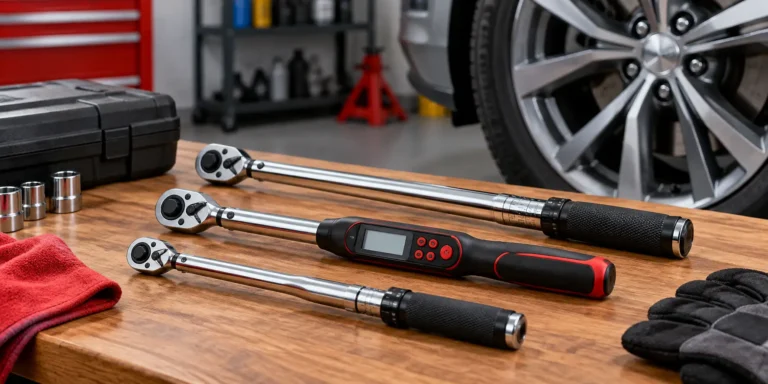
A good torque wrench matters once you start doing your own tire rotations, brakes, suspension work, spark plugs, engine components, or other repairs with manufacturer-specified torque values. The difficult part is choosing the right wrench because the largest torque range is not automatically the best choice.
For most home mechanics, a 1/2-inch torque wrench is the starting point for lug nuts, suspension, and other higher-torque automotive work. A 3/8-inch wrench becomes more useful for lower- and medium-torque fasteners around brakes and the engine bay.
If you want a well-documented mechanical wrench for common higher-torque jobs, the TEKTON TRQ52402 stands out with a 40–200 ft-lb range, ±3% accuracy in both directions, and full-range ISO calibration. For a more affordable one-wrench solution, the LEXIVON LX-183 covers 10–150 ft-lb. Home mechanics who prefer an electronic display and multiple target alerts should look at the GEARWRENCH 85077.
Best Torque Wrenches for Home Mechanics at a Glance
| Torque Wrench | Drive | Torque Range | Published Accuracy | Type | Best For |
| TEKTON TRQ52402 | 1/2″ | 40–200 ft-lb | ±3% CW/CCW | Click | Overall higher-torque automotive work |
| GEARWRENCH 85077 | 1/2″ | 25–250 ft-lb | ±2% CW / ±3% CCW* | Digital | Digital feedback and wide range |
| LEXIVON LX-183 | 1/2″ | 10–150 ft-lb | ±4% CW | Click | Value and general DIY use |
| EPAuto ST-010-1 | 1/2″ | 10–150 ft-lb | ±4% | Click | Budget buyers |
| LEXIVON LX-182 | 3/8″ | 10–80 ft-lb | ±4% | Click | Engine, brake, and medium-torque work |
| eTORK C3250 | 1/2″ | 50–250 ft-lb | ±3% CW / ±6% CCW | Click | Higher-torque jobs |
| ACDelco ARM601-4 | 1/2″ | 14.8–147.5 ft-lb | ±2% CW / ±3% CCW* | Digital | Compact digital wrench |
*Check the manufacturer’s specified accuracy range rather than assuming the stated accuracy applies at every adjustable setting. For example, GEARWRENCH specifies the 85077 accuracy between 20% and 100% of wrench capacity, and ACDelco similarly states its accuracy rating applies from 20% of maximum torque.
How We Selected These Torque Wrenches
This guide is based on current manufacturer specifications, calibration information, exact model identification, torque range, drive size, ratchet design, usability, and current Amazon listing identity.
We did not perform laboratory calibration testing on these tools, so manufacturer accuracy specifications are presented as manufacturer claims rather than our own test results.
For home mechanics, the most important factors were:
- Useful torque range for real automotive maintenance
- 1/2-inch or 3/8-inch drive size
- Published accuracy specification
- Calibration documentation
- Clear torque-setting system
- Audible, tactile, or electronic target feedback
- Ratchet access in tight spaces
- Storage and calibration requirements
- Value relative to the jobs the wrench can perform
1. TEKTON TRQ52402 1/2-Inch Micrometer Torque Wrench
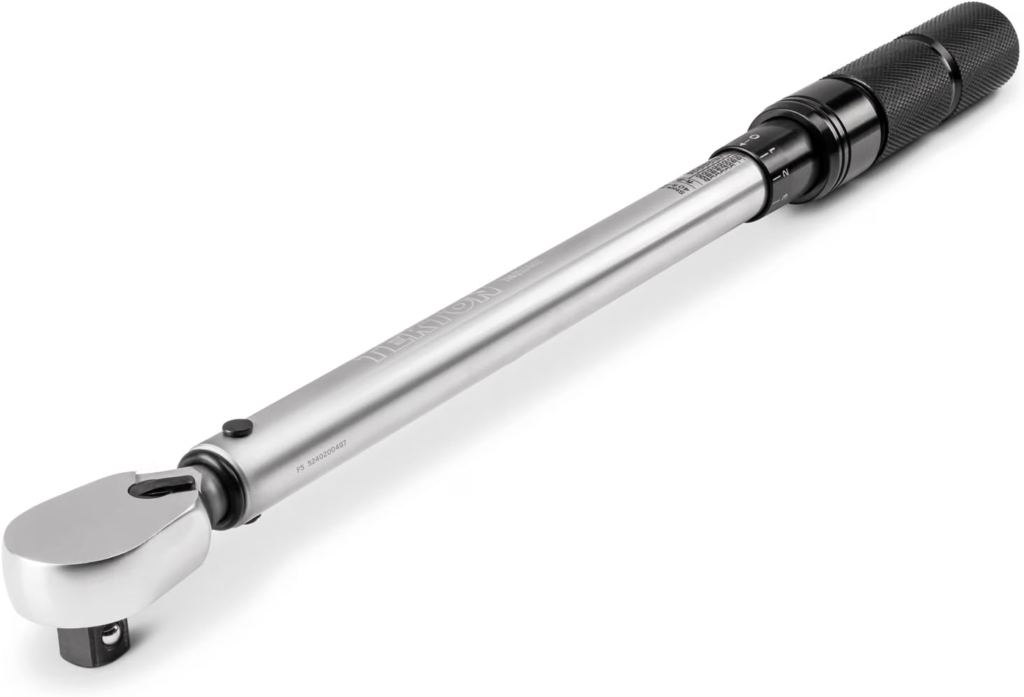
The TEKTON TRQ52402 is a strong starting point for a home mechanic who regularly works on wheels, brakes, suspension, and other fasteners within its 40–200 ft-lb range.
TEKTON specifies ±3% accuracy in both clockwise and counterclockwise directions, rather than only clockwise. It also uses a 90-tooth ratchet with a 4-degree swing arc, which gives you more room to work when there is limited handle movement.
Each wrench includes a serialized calibration certificate, and TEKTON states that this model is calibrated to ISO 6789-1:2017 across its full listed 40–200 ft-lb range.
Best For: Lug nuts, wheel service, suspension, and medium-to-higher-torque automotive fasteners.
Pros
- ±3% stated accuracy in both directions
- Full 40–200 ft-lb ISO-calibrated range
- 90-tooth ratchet
- Tight 4-degree swing arc
- Serialized calibration certificate
- Includes storage case
- Includes 1/2-to-3/8-inch drive reducer
- TEKTON offers a recertification service
Cons
- 40 ft-lb minimum is too high for many small engine fasteners
- Costs more than entry-level click wrenches
- Fixed head rather than flex head
- You will probably still want a smaller 3/8-inch torque wrench eventually
Buying Decision
Choose the TRQ52402 if you want a mechanical torque wrench with unusually clear calibration documentation and your normal jobs fall between 40 and 200 ft-lb.
Don’t choose it as your only wrench if you regularly torque small-engine, valve-cover, intake, or other low-torque fasteners.
2. GEARWRENCH 85077 1/2-Inch Electronic Torque Wrench

The GEARWRENCH 85077 is for home mechanics who want more feedback than a mechanical click provides.
Its electronic system warns you as you approach the target and then uses a vibrating handle, buzzer, and LED indication when the selected torque is reached. GEARWRENCH also provides five measurement units, including ft-lb, in-lb, Nm, kg-m, and kg-cm.
The wrench covers 25–250 ft-lb and uses a 72-tooth ratchet with a 5-degree swing arc. GEARWRENCH publishes accuracy of ±2% clockwise and ±3% counterclockwise between 20% and 100% of the wrench’s scale.
Best For: DIY mechanics who prefer digital readings and clear target alerts.
Pros
- Wide 25–250 ft-lb range
- ±2% clockwise stated accuracy in its specified accuracy range
- Digital torque display
- Vibrating, audible, and LED target alerts
- Five measurement units
- 72-tooth ratchet
- 5-degree swing arc
- Oil- and solvent-resistant housing
Cons
- Significantly more expensive than basic click wrenches
- Requires batteries
- More electronics means more complexity
- Not designed for truly low-torque automotive work
- Calibration accuracy warranty is shorter than the general tool warranty
Buying Decision
Buy the GEARWRENCH 85077 if electronic feedback will genuinely make your work easier. It is particularly useful when an audible click might be difficult to detect or when you regularly move between different measurement units.
If you simply need to torque lug nuts and occasional suspension bolts, a quality mechanical wrench can do the job for considerably less.
3. LEXIVON LX-183 1/2-Inch Click Torque Wrench
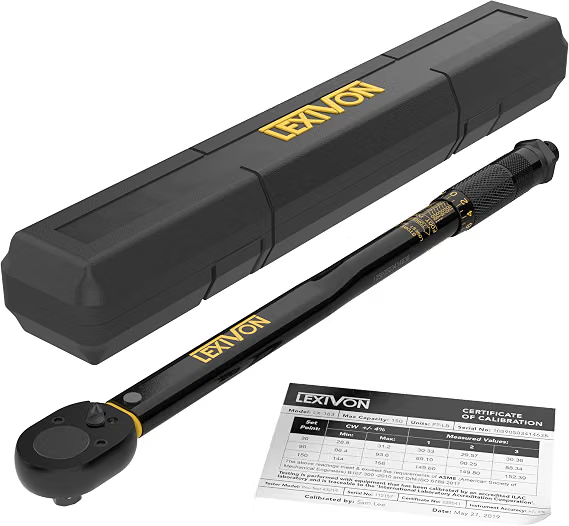
The LEXIVON LX-183 hits a useful middle ground for someone buying a first torque wrench without moving into premium-tool pricing.
Its 10–150 ft-lb range is unusually broad for common DIY automotive work. LEXIVON states that the wrench is pre-calibrated to ±4% and includes a calibration certificate with a traceable serial number.
The dual-scale markings use bright lettering against the dark body, helping make the setting easier to read in garage lighting. The ratchet reverses in both directions, although LEXIVON specifies torque measurement in the clockwise direction.
Best For: Home mechanics who want one affordable 1/2-inch wrench for wheel and general automotive work.
Pros
- Useful 10–150 ft-lb range
- ±4% stated accuracy
- Calibration certificate included
- Easy-to-read contrasting scale
- Hardened Chrome Vanadium ratchet head
- Reversible ratchet
- Protective storage case
- No batteries required
Cons
- Torque measurement is specified clockwise
- ±4% tolerance is wider than some premium alternatives
- Very low settings are not where a broad-range 1/2-inch click wrench is most useful
- A separate 3/8-inch wrench remains preferable for many smaller fasteners
Buying Decision
The LX-183 makes sense if you are assembling your first home-mechanic toolbox and need a capable 1/2-inch torque wrench without paying for digital features.
Its 10–150 ft-lb scale gives it more versatility than many high-range-only wrenches, but that does not eliminate the value of owning a separate lower-range wrench.
4. EPAuto ST-010-1 1/2-Inch Click Torque Wrench
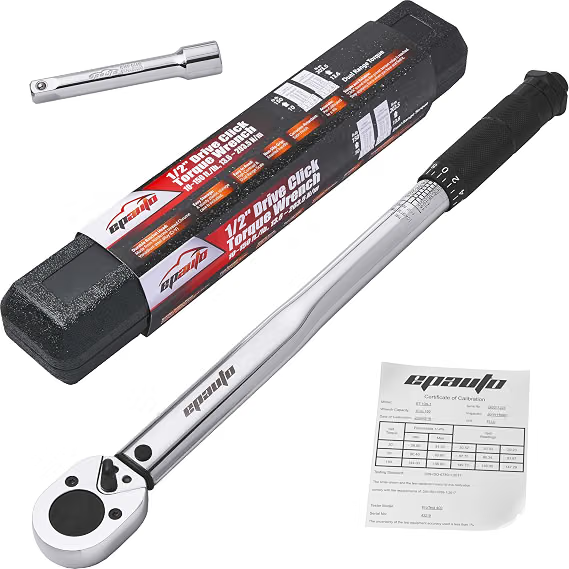
The EPAuto ST-010-1 keeps things simple. It is a mechanical 1/2-inch click wrench with a 10–150 ft-lb range, dual-scale markings, a knurled handle, and a storage case.
Published specifications list the wrench as pre-calibrated to ±4%. The reversible ratchet can turn in either direction, while torque measurement is specified in the clockwise direction.
Best For: Occasional DIY jobs and budget-conscious home mechanics.
Pros
- Affordable entry point
- 10–150 ft-lb range
- ±4% stated accuracy
- Audible and tactile click
- Chrome Vanadium ratchet head
- Non-slip knurled grip
- Dual-range scale
- Storage case included
- No batteries or electronics
Cons
- Basic ratchet design
- Less refined than premium mechanical wrenches
- Clockwise torque measurement
- Not the tool I would choose for frequent precision engine assembly
Buying Decision
Choose EPAuto if you need a straightforward torque wrench for tire rotations, occasional brake work, or other normal home-garage tasks and want to keep your investment modest.
If you use a torque wrench frequently, TEKTON’s calibration documentation and ratchet design provide good reasons to spend more.
5. LEXIVON LX-182 3/8-Inch Click Torque Wrench

A 1/2-inch wrench is not the answer to every automotive fastener.
The LEXIVON LX-182 gives you a 3/8-inch drive and 10–80 ft-lb range, making it better suited to many engine-bay, brake, motorcycle, and medium-torque jobs than a long 1/2-inch wrench.
LEXIVON states that the LX-182 ships pre-calibrated to ±4%. Like the LX-183, it uses an easy-to-read dual scale and a click mechanism that tells you when the target has been reached.
Best For: Brake work, engine components, motorcycles, and lower-to-medium automotive torque values.
Pros
- More appropriate 3/8-inch drive for smaller fasteners
- 10–80 ft-lb range
- ±4% stated accuracy
- Calibration documentation
- Compact compared with high-torque 1/2-inch wrenches
- Easy-to-read scale
- Protective case
Cons
- Cannot replace a high-range 1/2-inch wrench
- 80 ft-lb maximum may be below the specified torque of many wheel fasteners
- Mechanical click wrenches require proper storage after use
Buying Decision
If you already own a 1/2-inch wrench, the LX-182 is arguably more useful than buying another 1/2-inch model.
A 3/8-inch + 1/2-inch combination gives a home mechanic much better coverage than trying to make one broad-range wrench handle everything.
6. eTORK C3250 1/2-Inch Click Torque Wrench

The eTORK C3250 moves the useful range upward to 50–250 ft-lb, making it more appropriate for owners working on higher-torque wheel, suspension, truck, trailer, or mechanical fasteners.
eTORK publishes accuracy of ±3% clockwise and ±6% counterclockwise. It uses a mechanical click/release mechanism and includes an individual calibration certificate.
The company also operates a factory repair and calibration center in Georgia, which is worth considering if you intend to keep the wrench for years rather than treating it as a disposable tool.
Best For: Trucks, trailers, suspension, wheel service, and higher-torque fasteners.
Pros
- 50–250 ft-lb range
- ±3% stated clockwise accuracy
- Individual calibration certificate
- Dual scale
- Positive locking adjustment knob
- Long handle provides useful leverage
- Carrying case included
- Manufacturer calibration service available
Cons
- 50 ft-lb minimum makes it unsuitable for many common engine fasteners
- 45-tooth mechanism is less fine than newer high-tooth ratchets
- Long handle requires more working room
- You will need another wrench for lower-torque work
Buying Decision
Buy the C3250 because you need its upper range, not simply because 250 ft-lb looks better on a specification sheet.
For normal passenger-car work below 150–200 ft-lb, a lower-range wrench can provide a more useful operating window.
7. ACDelco ARM601-4 1/2-Inch Digital Torque Wrench
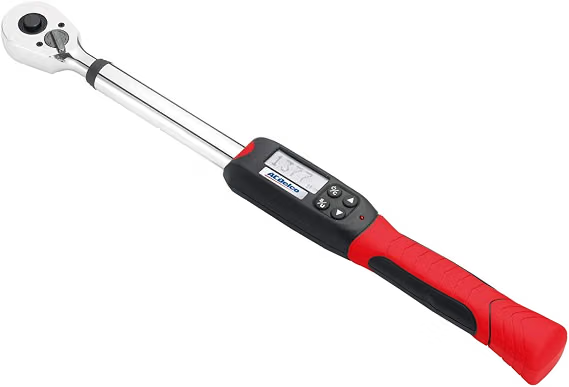
The ACDelco ARM601-4 provides another route into digital torque measurement without the 250 ft-lb maximum of the GEARWRENCH.
Its adjustable range is 14.8–147.5 ft-lb, and ACDelco specifies ±2% clockwise and ±3% counterclockwise accuracy from 20% to 100% of maximum torque.
It provides an LCD display, peak and trace modes, and audible confirmation. The official specifications list a 17-5/16-inch overall length, making it substantially shorter than the 25.75-inch GEARWRENCH 85077.
Best For: Home mechanics who want digital feedback without a very long high-torque wrench.
Pros
- Digital LCD display
- ±2% CW / ±3% CCW published accuracy within specified range
- Audible torque alert
- Peak and trace modes
- Multiple measurement units
- Relatively compact body
- Works in both directions
- Calibration certificate associated with the product listing
Cons
- Lower maximum torque than GEARWRENCH 85077
- Requires batteries
- Published accuracy specification does not apply all the way down to the minimum adjustable setting
- More complicated than a basic click wrench
Buying Decision
The ARM601-4 is worth considering if you want an electronic wrench primarily for normal passenger-car torque ranges rather than heavy suspension or truck work.
For frequent jobs above roughly 150 ft-lb, the GEARWRENCH’s 250 ft-lb upper limit is much more useful.
Which Torque Wrench Should a Home Mechanic Buy?
The answer depends more on what you repair than on which wrench has the biggest numbers.
If You Want Your First Torque Wrench
Start with a 1/2-inch wrench if your main jobs are:
- Tire rotations
- Wheel installation
- Brake caliper brackets
- Suspension work
- Hub and axle-related work
- Other medium-to-high-torque automotive fasteners
The LEXIVON LX-183 and EPAuto ST-010-1 provide broad 10–150 ft-lb ranges at the value end of the market.
The TEKTON TRQ52402 is a stronger choice when your jobs stay above 40 ft-lb and you value tighter stated accuracy and better calibration documentation.
If You Do More Than Basic Maintenance
Eventually, buy two torque wrenches.
A practical home-garage setup is:
3/8-inch torque wrench: lower- and medium-torque engine and brake work
1/2-inch torque wrench: wheels, suspension, chassis, and higher-torque work
Trying to cover every fastener with one wrench usually creates compromises at either the low or high end of its range.
3/8-Inch vs. 1/2-Inch Torque Wrench
Choose 3/8-Inch When:
You regularly work with smaller fasteners or need better access around an engine bay.
A 3/8-inch wrench is commonly more comfortable for medium-torque work because the wrench itself is shorter and the sockets are smaller.
Choose 1/2-Inch When:
Your jobs involve lug nuts, suspension, larger brake components, trucks, trailers, or higher torque values.
The longer handle also gives you more leverage when the required torque climbs above 100 ft-lb.
Important: Drive size alone does not tell you whether a wrench is suitable. Always check whether the required torque falls within the manufacturer’s specified range.
Click vs. Digital Torque Wrench
Click-type and digital torque wrenches can both be used to tighten fasteners to a specified torque. The main differences are how they provide torque feedback, their features, maintenance requirements, and price. For most home mechanics, the right choice depends on how often the wrench will be used and which features are needed.
Click Torque Wrench
A click torque wrench is a simple and practical option for most home garages. You set the required torque value, apply force smoothly, and stop when the wrench produces a click at the preset torque.
Its main advantages are its simple mechanical design, lack of batteries, and generally lower cost. A quality click wrench can also provide years of service when it is used correctly and stored according to the manufacturer’s instructions.
Digital Torque Wrench
A digital torque wrench uses an electronic display to show the applied torque and may provide audible, visual, or vibration alerts as you approach the target value.
Digital models can be useful when you regularly work with different torque specifications or want an easy-to-read torque display. However, they generally cost more and require batteries. Having a digital display does not automatically mean the wrench is more accurate; the manufacturer’s accuracy specification and calibration are more important.
Click vs. Digital Torque Wrench: Key Differences
| Feature | Click Torque Wrench | Digital Torque Wrench |
|---|---|---|
| Operation | Mechanical click indicates the preset torque has been reached | Digital display shows torque and electronic alerts may indicate the target |
| Ease of use | Simple and straightforward | Easy-to-read digital feedback |
| Battery | Not required | Usually required |
| Price | Generally less expensive | Generally more expensive |
| Torque reading | Read from the mechanical scale | Displayed electronically |
| Warnings | Mechanical click or tactile feedback | Audible, visual, and sometimes vibration alerts |
| Torque units | Depends on the model and scale | Many models support multiple units |
| Maintenance | Simple mechanical maintenance | Battery and electronic components require additional care |
| Accuracy | Depends on the model, condition, and calibration | Depends on the model, condition, and calibration |
| Best suited for | Routine automotive work and home garages | Users who want digital readings and additional feedback features |
Which Type Should You Choose?
For most home mechanics, a quality click torque wrench is sufficient for routine automotive work. It is simple, reliable, and does not require batteries.
A digital torque wrench may be worth considering if you prefer a digital display, regularly switch between torque units, or want additional audible and visual alerts.
Ultimately, the manufacturer’s stated accuracy, torque range, calibration, and proper use matter more than whether the wrench is click-type or digital.
What Torque Range Do Home Mechanics Need?
There is no universal torque range that works for every vehicle or repair. Home mechanics may encounter small fasteners measured in inch-pounds, engine fasteners in lower ft-lb ranges, wheel fasteners in the middle of a 1/2-inch wrench’s range, and suspension or axle fasteners requiring substantially higher torque.
- Check the vehicle’s service manual or manufacturer specifications before buying a torque wrench if you already know which repairs you plan to perform.
- Do not choose a torque wrench based only on its maximum torque rating.
- Choose a wrench whose usable range comfortably covers the torque specifications you regularly encounter.
- For example, if your typical jobs require 20–70 ft-lb, a 50–250 ft-lb torque wrench is a poor match despite its higher maximum torque.
- Selecting an appropriate torque range makes the wrench more practical for everyday use and helps you work within its intended operating range.
Accuracy Matters More Than Maximum Torque
A torque wrench is a measuring instrument.
Look for manufacturers that clearly state:
- Accuracy percentage
- Clockwise and/or counterclockwise accuracy
- Applicable portion of the torque range
- Calibration standard
- Whether an individual calibration certificate is included
Also remember that a reversible ratchet does not necessarily mean the wrench measures torque accurately in both directions.
LEXIVON, for example, describes the LX-183 as having a reversible ratchet while specifying torque measurement in the clockwise direction. TEKTON specifically rates the TRQ52402 in both directions.
How to Use a Torque Wrench Correctly
Using the correct technique is just as important as choosing a quality torque wrench. Set the exact torque specified by the vehicle or component manufacturer, hold the wrench at its intended grip position, and apply force smoothly and steadily. When a click-type wrench reaches the preset torque or a digital wrench provides its target alert, stop applying force.
Do not repeatedly click the wrench on a fastener that has already reached the specified torque in an attempt to make the result more accurate. Repeatedly applying torque can lead to over-tightening.
Use a standard ratchet, breaker bar, or suitable impact wrench when removing stubborn fasteners. A torque wrench should generally be reserved for controlled final tightening rather than used as a general-purpose breaker bar.
How to Store a Click Torque Wrench
Many traditional micrometer click torque wrenches use an internal spring mechanism, so proper storage can help maintain the tool’s condition and performance. Always follow the storage instructions provided by the manufacturer of your specific wrench.
For many click-type models, this means returning the wrench to its lowest marked torque setting after use. Do not force the adjustment below the wrench’s minimum setting.
For example, the TEKTON 24335 manual instructs users to store the wrench at its lowest torque setting. Split-beam torque wrenches use a different design, so their storage requirements may not be the same.
When Should a Torque Wrench Be Recalibrated?
There is no single recalibration interval that applies to every torque wrench. The appropriate frequency depends on factors such as the tool’s design, how frequently it is used, how it is stored, whether it has been overloaded, and the manufacturer’s recommendations.
A torque wrench should be checked or recalibrated sooner when:
- It has been dropped or damaged.
- It has been subjected to excessive torque or overload.
- The click mechanism feels or sounds inconsistent.
- You suspect the torque readings are inaccurate.
- The wrench is used frequently for safety-critical or precision applications.
For occasional home use, careful handling, correct storage, and following the manufacturer’s calibration guidance are generally more useful than relying on a fixed calendar interval alone.
Common Torque-Wrench Buying Mistakes
Buying Only by Maximum Torque
A 250 ft-lb maximum sounds impressive, but it does not help if most of your work is below the wrench’s useful lower range.
Confusing ft-lb With in-lb
One foot-pound equals 12 inch-pounds.
A mistake between those units can dramatically over-tighten a small fastener.
Assuming Digital Means Better
Digital feedback is useful, but the display itself does not guarantee superior accuracy.
Compare the actual accuracy specification and calibrated range.
Using a 1/2-Inch Wrench for Every Job
A large wrench is cumbersome around small engine fasteners and may not cover the required low torque correctly.
Using a Torque Wrench to Remove Bolts
Use a breaker bar or appropriate ratchet for loosening. Save the calibrated tool for final tightening.
Final Buying Guide
For the typical home mechanic, there is no true do-everything torque wrench.
The TEKTON TRQ52402 is a compelling 1/2-inch choice if your work fits inside its 40–200 ft-lb range because its ±3% dual-direction rating, 90-tooth mechanism, serialized calibration certificate, and full-range ISO calibration are unusually well documented.
The LEXIVON LX-183 provides a broader 10–150 ft-lb adjustment range and lower-cost entry point for occasional DIY automotive work, while the EPAuto ST-010-1 is an even simpler budget-oriented alternative.
For a more complete home garage, pair a 1/2-inch wrench with a 3/8-inch model such as the LEXIVON LX-182. That combination gives you much more useful coverage across engine, brake, wheel, and suspension work than trying to force every job through one wrench.
If you prefer electronic feedback, choose between the GEARWRENCH 85077 for its wide 25–250 ft-lb range and the more compact ACDelco ARM601-4 for lower-to-medium automotive torque work.
The final rule is simple: buy the wrench whose calibrated range covers the specifications you actually use—not the one with the biggest maximum number.
Torque Wrench FAQs
What size torque wrench is best for a home mechanic?
For most home mechanics, a 1/2-inch drive torque wrench is the best first choice. It is well suited to common automotive jobs such as wheel, brake, suspension, and other higher-torque fasteners. A 3/8-inch torque wrench is a useful addition for lower- and medium-torque engine and brake fasteners.
Is a 3/8-inch or 1/2-inch torque wrench better?
Neither size is universally better. A 3/8-inch torque wrench is generally better for lower- and medium-torque applications, while a 1/2-inch torque wrench is better suited to higher-torque jobs such as wheels and suspension. Choose the size based on the torque range required for the work you perform.
Is a cheap torque wrench good enough for home use?
A budget torque wrench can be suitable for occasional home use if it has a clearly stated accuracy specification, appropriate torque range, calibration documentation, and proper storage instructions. For frequent automotive work or applications where accurate torque is especially important, a wrench with reliable calibration support may be a better choice.
Do I need a digital torque wrench?
No, you do not need a digital torque wrench for most home automotive repairs. A quality click-type torque wrench can handle most routine tightening jobs. Digital torque wrenches mainly provide additional features such as live torque readings, multiple measurement units, audible or visual alerts, and vibration feedback.
Can I use a torque wrench to loosen lug nuts?
You should not normally use a torque wrench to loosen lug nuts. Use a breaker bar or suitable wheel-removal tool to loosen the lug nuts. After installing the wheel, use a properly calibrated torque wrench to tighten the lug nuts to the vehicle manufacturer’s specified torque.
Should I torque lug nuts with an impact wrench?
An impact wrench can be useful for removing wheels and carefully running lug nuts down during installation. However, final lug nut tightening should be performed with a suitable torque wrench according to the vehicle manufacturer’s specified torque. This helps ensure the fasteners are tightened to the required specification.
Should I buy one torque wrench or two?
If you mainly perform tire rotations and basic high-torque automotive maintenance, a 1/2-inch torque wrench may provide sufficient coverage. If you regularly work on engine, brake, suspension, and wheel fasteners, having both a 3/8-inch and 1/2-inch torque wrench provides a wider range of usable torque settings.