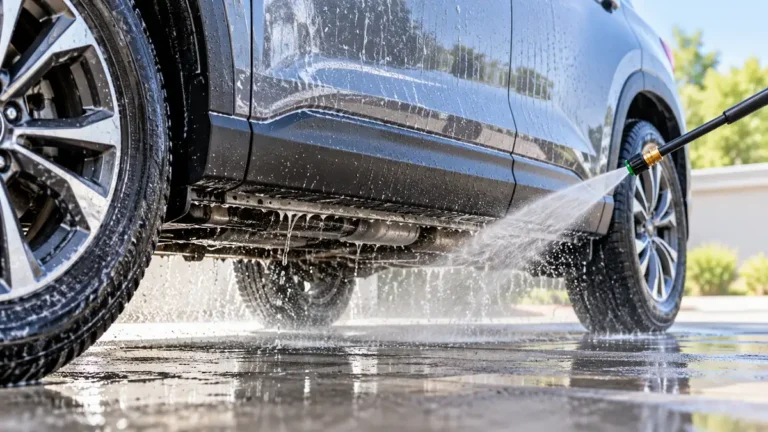
The safest way to clean your car’s undercarriage is to flush away dirt, mud, and road salt with a garden hose or pressure washer while avoiding unnecessary high-pressure contact with sensitive components. For most routine undercarriage cleaning, you do not need to raise the vehicle or crawl underneath it. A strong stream of water can reach much of the underside through the wheel wells and from the sides.
Undercarriage cleaning is especially important after driving on salted roads, through mud, or in coastal conditions. Road salt and other contaminants can accumulate underneath the vehicle and contribute to corrosion when they remain in contact with susceptible components. This guide explains how to clean a car undercarriage safely, what tools to use, how often to wash it, and which mistakes to avoid.
Why Should You Clean Your Car’s Undercarriage?
Cleaning your car’s undercarriag undercarriage helps remove road salt, mud, dirt, and other contaminants that can contribute to corrosion and component deterioration. The underside is exposed to road spray and debris that may not be removed during a normal exterior wash, so periodic underbody rinsing is an important part of vehicle maintenance, particularly in areas where road salt or heavy mud is common.
Mazda owner guidance explains that road chemicals and salt can collect underneath a vehicle and accelerate rusting and deterioration of components such as fuel lines, the frame, floor pan, and exhaust system if they are not removed. Ford likewise recommends frequent underbody flushing, with additional attention for vehicles operated in coastal, dusty, or muddy environments.
The goal is not necessarily to make every component underneath look spotless. The practical objective is to remove corrosive or abrasive contamination before it remains trapped against vulnerable areas for extended periods.
What Do You Need to Clean an Undercarriage?
You can clean most car undercarriages with basic washing equipment, including a garden hose, spray nozzle, and suitable brush. A pressure washer or dedicated undercarriage attachment can make the job easier when heavy mud or road grime has accumulated, but specialized equipment is not required for routine rinsing.
For routine undercarriage cleaning, useful equipment includes:
- Garden hose with a strong spray nozzle: Suitable for rinsing loose dirt, salt, and road grime.
- Pressure washer: Useful for heavier contamination when used with an appropriate spray pattern and distance.
- Undercarriage washer attachment: Helps direct water beneath the vehicle without requiring you to crawl underneath it.
- Wheel-well brush: Useful for loosening mud that water alone does not remove.
- Safety glasses: Help protect your eyes from spray-back and loosened debris.
- Work gloves: Useful when handling dirty equipment or inspecting accessible areas after washing.
You generally do not need jack stands or ramps just to rinse the undercarriage. Raising the vehicle adds a safety risk that is unnecessary for routine washing.
If you need to physically work underneath the vehicle rather than simply wash it, follow the vehicle manufacturer’s lifting instructions and use properly rated support equipment. Never crawl underneath a vehicle supported only by a jack.
How Do You Clean the Undercarriage Step by Step?
The best way to clean a car undercarriage is to rinse loose contamination first, flush the wheel wells and underside systematically, loosen stubborn mud when necessary, and rinse everything again. The process should remove contamination without directing excessive pressure at sensitive components.
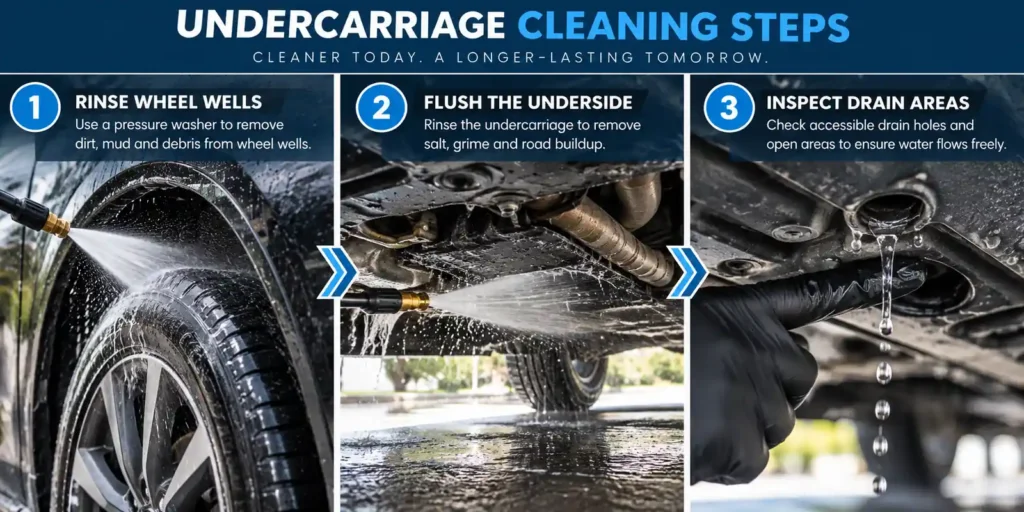
1. Park on a Suitable Surface
Start by parking the vehicle on a stable, reasonably level surface where water can drain safely. Routine undercarriage cleaning should be performed without placing yourself underneath the vehicle.
If the vehicle has recently been driven hard, allow hot components to cool before washing. You do not need to raise the vehicle simply to rinse the undercarriage.
2. Rinse the Wheel Wells First
Wheel wells are important areas to clean because they receive direct exposure to road spray, mud, salt, gravel, and other debris. Rinsing them first helps remove contamination before you move to the rest of the underbody.
Spray the inner wheel-well surfaces from several suitable angles instead of holding the nozzle against one small area. The objective is to flush contamination outward rather than force water deeper into openings.
3. Rinse the Underside Systematically
A systematic undercarriage rinse helps ensure that road salt, mud, and debris are not left behind in commonly contaminated areas. Work from the front toward the rear or from one side to the other so you can keep track of the areas you have already cleaned.
Pay particular attention to:
- Frame and structural areas
- Suspension components
- Wheel-well liners
- Exhaust components
- Areas behind the wheels
- Lower body areas where dirt accumulates
- Accessible drain holes and channels
Mazda specifically advises keeping drain holes in areas such as rocker panels and frame members clear because trapped water can contribute to rust.
4. Use a Pressure Washer Carefully if Needed
A pressure washer can make undercarriage cleaning faster when mud is heavily compacted, but higher pressure is not automatically better. The safest pressure-washing method depends on the vehicle, nozzle, pressure setting, distance, and component being cleaned.
Ford’s owner guidance for applicable vehicle surfaces specifies limits including a 2,000-psi maximum, a 40-degree spray pattern, and a 12-inch nozzle distance. Those figures are Ford guidance for the applicable surfaces and should not be treated as a universal setting for every vehicle or underbody component.
Mazda also warns that placing a high-pressure washer nozzle too close to the vehicle can damage or deform parts. For an unfamiliar vehicle, check the owner’s manual before using concentrated high-pressure spray.
5. Remove Stubborn Mud Only When Necessary
Heavy mud may require more than a simple rinse, but increasing pressure is not always the best solution. Allow caked-on dirt to soften with additional water before using a brush on accessible areas.
A long-handled, vehicle-safe brush can help remove stubborn mud from suitable wheel-well areas. Avoid aggressive brushes against painted, coated, rubber, or delicate components unless the vehicle or component manufacturer specifically permits them.
6. Rinse the Undercarriage Again
A second rinse removes loosened dirt, salt, and mud after brushing or additional cleaning. This step is particularly useful because contamination can move from one area to another during the cleaning process.
Mazda’s underbody guidance emphasizes thoroughly flushing the underside and wheel housings rather than simply wetting accumulated road grime.
7. Let the Vehicle Dry
Allowing the vehicle to dry after undercarriage cleaning helps remove remaining water from accessible surfaces and reduces the amount of moisture left behind. Normal airflow will remove much of the remaining water, while a short drive can help dry the brakes.
If you plan to park the vehicle for an extended period immediately after washing, Ford recommends driving for a few minutes after underbody cleaning in applicable vehicles. Wet brakes may temporarily have reduced braking performance, so drive cautiously until normal brake feel returns.
How Often Should You Wash the Undercarriage?
How often you should wash your car’s undercarriage depends on driving conditions rather than one universal schedule. Vehicles exposed to road salt, coastal air, mud, gravel roads, or heavy road spray generally need more frequent underbody cleaning than vehicles driven primarily in clean, dry conditions.
If You Drive on Salted Winter Roads
Road salt is one of the most important reasons to clean a vehicle’s undercarriage during winter. Frequent rinsing helps remove salt and deicing chemicals before they remain underneath the vehicle for extended periods.
Mazda recommends thoroughly flushing the underbody and wheel housings at the end of winter and suggests monthly flushing during the season. Ford also recommends frequent underbody washing when salt is used on roads.
After particularly heavy exposure to salt or slush, an additional rinse is sensible rather than waiting for the next scheduled wash.
If You Live Near the Coast
Coastal environments can expose vehicles to salt and moisture even when winter road salt is not involved. Regular undercarriage cleaning can help remove accumulated contaminants before they contribute to corrosion.
Ford recommends frequent underbody cleaning for vehicles operated in coastal environments. A fixed monthly schedule should not be treated as a universal requirement because exposure varies by location, weather, parking conditions, and driving habits.
If You Drive Mostly in Dry Conditions
Drivers in dry climates generally do not need to clean the undercarriage as frequently as drivers exposed to road salt or heavy mud. However, periodic rinsing can still remove accumulated dust, dirt, gravel, and organic debris.
If you frequently drive on unpaved or gravel roads, inspect the underside periodically and rinse it when significant debris has accumulated.
After Heavy Mud or Off-Road Driving
Heavy mud and debris should be removed when practical after significant off-road or unpaved-road driving. Mud can remain packed around wheel wells, suspension components, and other areas where ordinary washing may not reach effectively.
Ford notes that suspension components may require regular cleaning when vehicles are operated in dusty or muddy environments because dirt, rocks, and other debris can accumulate around those components.
Can You Clean an Undercarriage Without a Pressure Washer?
Yes, you can clean a car undercarriage without a pressure washer by using a garden hose with a strong spray nozzle. A hose can remove loose road salt, dirt, mud, and road grime, although heavily compacted contamination may require additional rinsing or manual cleaning.
A pressure washer mainly provides greater cleaning force. It can be useful for heavy mud, but it is not essential for routine undercarriage maintenance.
A hose can also be the better choice when you are uncertain about how much pressure a particular vehicle component, coating, or aftermarket treatment can tolerate. Manufacturer guidance should take priority over generic pressure-washing recommendations.
Is a Self-Serve Car Wash Undercarriage Spray Worth Using?
A self-serve car wash with a dedicated undercarriage spray can be a convenient way to rinse road salt and dirt without purchasing a pressure washer. It can be particularly useful during winter or after driving through muddy conditions.
However, self-serve equipment varies between facilities. Spray pressure, nozzle design, coverage, and operating distance are not standardized, so it is not accurate to assume every self-serve undercarriage wand performs the same as a particular home pressure washer.
If you use one, keep the spray moving and avoid concentrating high-pressure water on a vulnerable component at close range.
What Areas Should You Pay Extra Attention To?
The areas that deserve the most attention during an undercarriage wash are those exposed directly to road spray or designed with recesses where mud and salt can accumulate. Wheel wells, accessible frame areas, suspension components, exhaust areas, and drain channels are all worth checking during a thorough rinse.
Wheel Wells
Wheel wells collect road spray, mud, salt, gravel, and other debris because of their proximity to the tires. Cleaning these areas thoroughly can remove contamination before it remains packed around the wheel-well liner and nearby components.
Flush the inner surfaces and accessible areas behind the wheels thoroughly while keeping the spray moving.
Frame and Structural Areas
Frame sections and other structural areas can collect dirt and salt along ledges, seams, and protected recesses. These areas are especially worth inspecting on vehicles that regularly encounter winter road salt or muddy conditions.
Rinse accessible frame areas thoroughly, but do not aggressively scrape corrosion simply to make the surface look cleaner.
Suspension Components
Suspension components can accumulate mud and debris, especially on vehicles driven on muddy or unpaved roads. A thorough rinse can remove loose contamination and make it easier to identify visible problems during an inspection.
Avoid forcing concentrated high-pressure water directly into sensitive areas unless the vehicle manufacturer specifically permits that cleaning method.
Exhaust System
The exhaust system is exposed to water, salt, dirt, and road debris from underneath the vehicle. Normal rinsing can remove surface contamination without requiring aggressive scrubbing.
Avoid attempting to scrub hot exhaust components immediately after driving. Allow them to cool before cleaning.
Drain Holes and Channels
Drain holes and channels help water escape from parts of the vehicle body and underbody. When these openings become blocked with dirt or debris, trapped moisture can contribute to corrosion.
Check accessible drain openings during cleaning and remove loose debris without inserting tools into openings that could damage components.
What Mistakes Should You Avoid When Cleaning the Undercarriage?
The most important undercarriage cleaning mistakes involve unsafe vehicle access, excessive pressure, aggressive chemicals, and failing to remove heavy contamination. A careful rinse is generally safer than trying to make the underside spotless with excessive pressure or aggressive tools.
Getting Underneath a Vehicle Supported Only by a Jack
Never crawl underneath a vehicle that is supported only by a jack. Routine undercarriage washing normally does not require you to get underneath the vehicle, so raising it solely for cleaning is unnecessary.
If physical access is required for inspection or repair, use the manufacturer’s specified lifting points and properly rated support equipment. NHTSA safety guidance warns about the danger of being underneath a vehicle supported by a jack.
Holding the Pressure Washer Too Close
Holding a pressure washer too close to the vehicle can damage trim, seals, coatings, and other components. The risk increases when a narrow spray pattern is concentrated on one area.
Use the vehicle manufacturer’s pressure-washing guidance rather than assuming one pressure or distance is safe for every vehicle.
Staying on One Area Too Long
Keeping high-pressure water focused on one small area for an extended period can create unnecessary stress even when the overall pressure setting is appropriate. A moving spray provides more even cleaning while reducing prolonged exposure to one component.
Keep the nozzle moving and use an appropriate spray pattern and distance.
Using Strong Chemicals Without Checking Compatibility
Aggressive chemicals are usually unnecessary for routine undercarriage cleaning. Some cleaners may not be compatible with painted surfaces, rubber components, plastics, coatings, or other materials underneath the vehicle.
If a specialized cleaner or degreaser is needed, check its label and the vehicle manufacturer’s guidance before applying it.
Ignoring Packed Mud
Simply wetting thick mud does not necessarily remove it. Heavy contamination may remain attached to the underside and continue holding moisture and debris against components.
Use repeated rinsing to soften and remove the buildup and, where appropriate, use a suitable brush on accessible areas.
Forgetting the Brakes After Washing
Water on brake components can temporarily affect braking performance after an undercarriage wash. This is normally temporary, but drivers should be aware of the change immediately after washing.
Follow the vehicle manufacturer’s instructions and drive cautiously until normal brake feel returns.
Does Rust-Proofing Mean You Can Skip Undercarriage Washing?
No. Rust-proofing or undercoating does not eliminate the need to remove accumulated road salt, mud, and other contaminants from the vehicle’s underside. Protective treatments can provide an additional barrier, but they do not make routine underbody cleaning unnecessary.
Mazda states that road chemicals and salt can accelerate rusting and deterioration of underbody components even when anti-corrosive materials are present.
Aftermarket rust-proofing systems vary considerably, so follow the maintenance instructions supplied with the specific treatment. Do not assume that every coating can tolerate the same pressure-washing technique.
Can Pressure Washing Damage the Undercarriage?
Yes, pressure washing can damage parts of a vehicle if the pressure, spray pattern, distance, or application is inappropriate. The correct technique varies by vehicle and component, which is why the owner’s manual should take priority over a generic pressure-washer setting.
Ford guidance for applicable vehicle surfaces specifies a maximum pressure of 2,000 psi, a 40-degree spray pattern, and a 12-inch nozzle distance. These specifications should not be presented as universal undercarriage settings for every vehicle.
Mazda similarly warns that placing a high-pressure nozzle too close to the vehicle can damage or deform parts. The safest approach is to use an appropriate spray pattern, maintain reasonable distance, keep the nozzle moving, and follow vehicle-specific instructions.
When Should You Have the Undercarriage Professionally Cleaned or Inspected?
Professional undercarriage cleaning or inspection can be worthwhile when contamination is severe, corrosion is already visible, or the job requires safely raising the vehicle. Professional service is also appropriate when you are concerned about damaged structural, brake, suspension, fuel, or exhaust components.
Consider professional service when:
- Heavy corrosion is already present.
- Thick mud has accumulated in difficult-to-reach areas.
- The vehicle needs to be raised for a detailed inspection.
- You suspect damage to brake, fuel, exhaust, suspension, or structural components.
- An aftermarket undercoating or rust-proofing system needs specialized maintenance.
- You are not comfortable safely accessing the underside of the vehicle.
A professional inspection is particularly appropriate if cleaning reveals flaking metal, significant rust, damaged lines, leaks, or other mechanical problems.
Frequently Asked Questions About Car Undercarriage Cleaning
These frequently asked questions cover common concerns about cleaning a car’s undercarriage, including how often to wash it, whether a pressure washer is necessary, and whether underbody cleaning can damage the vehicle. The answers are based on general vehicle-maintenance principles and manufacturer guidance where applicable.
Is Undercarriage Washing Necessary If I Don’t Drive in Winter?
Undercarriage washing is less critical for vehicles that never encounter road salt, but it can still remove mud, dust, gravel, and other accumulated debris. Ford recommends regular underbody flushing in several conditions beyond winter salt exposure, including coastal, dusty, and muddy environments.
The frequency can be reduced when exposure is low, but occasional underbody rinsing remains useful as part of general vehicle maintenance.
How Often Should I Wash My Undercarriage After Driving on Salted Roads?
There is no universal interval that applies to every vehicle, but undercarriage cleaning should become more frequent when road salt and deicing chemicals are being used. Mazda recommends monthly underbody and wheel-housing flushing during the winter season and thorough flushing at the end of winter, while Ford recommends frequent underbody washing when salt is used on roads.
An additional rinse after particularly heavy salt or slush exposure is sensible.
Can I Use a Pressure Washer on the Undercarriage?
Yes, a pressure washer can be used for undercarriage cleaning when it is operated appropriately. Pressure, nozzle type, spray pattern, distance, and the vehicle’s own restrictions all matter.
Avoid holding concentrated high-pressure spray close to sensitive components, and consult the owner’s manual for vehicle-specific restrictions.
Can I Use a Garden Hose Instead of a Pressure Washer?
Yes. A garden hose with a suitable spray nozzle can remove loose salt, dirt, mud, and road grime from the undercarriage.
A pressure washer is mainly useful when additional cleaning force is needed for heavier contamination. A hose may also be preferable when you want a gentler rinse.
Should I Raise My Car to Clean Underneath It?
Usually not. Routine undercarriage washing can generally be performed from the sides and through the wheel wells without placing yourself underneath the vehicle.
If you need to physically work underneath the vehicle, use the manufacturer’s specified lifting procedure and proper support equipment. Never work underneath a vehicle supported only by a jack.
Can Undercarriage Washing Cause Rust?
Normal undercarriage rinsing does not inherently cause rust. The more important concern is allowing corrosive salt, dirt, and moisture to remain against susceptible components for extended periods.
After washing, follow the vehicle manufacturer’s drying guidance. Ford recommends driving for a few minutes after underbody cleaning before extended parking in applicable vehicles.
Does Undercoating Replace Undercarriage Washing?
No. Undercoating and rust-proofing treatments do not remove the need to clean accumulated road salt and debris. Mazda specifically notes that road chemicals and salt can contribute to deterioration of underbody components even when anti-corrosive materials are present.
Follow the maintenance instructions for the particular undercoating product installed on the vehicle.
The Best Undercarriage Cleaning Routine Depends on Exposure
The best car undercarriage cleaning routine is based on how and where the vehicle is driven. Regular rinsing is particularly valuable after exposure to road salt, coastal conditions, heavy mud, and unpaved roads, while vehicles driven mainly in clean and dry conditions generally require less frequent attention.
For routine cleaning, use a garden hose or appropriately configured pressure washer, flush the wheel wells and underside thoroughly, clear accessible drain areas, and avoid close-range concentrated spray on vulnerable components.
Most importantly, do not raise a vehicle simply to make routine washing easier. If the job requires physical access underneath the vehicle, treat it as a vehicle-support safety task rather than an ordinary washing step.