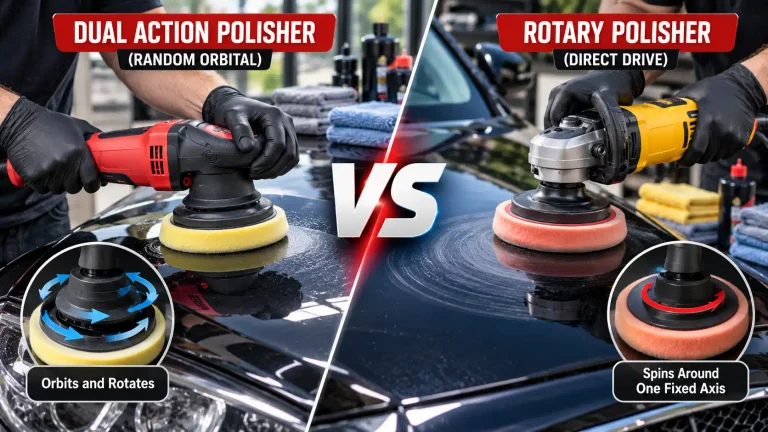
If you’re choosing a machine to remove swirl marks, restore gloss, or correct dull automotive paint, the dual action polisher vs rotary polisher decision matters more than the brand name on the tool. Both machines use abrasive pads and compounds or polishes to improve a finish, but they move differently—and that changes how quickly they correct defects and how easy they are to control.
The short answer: For most first-time users and car enthusiasts, a dual action (DA) polisher is the better choice. Its oscillating motion helps spread abrasive action and makes it more forgiving. A rotary polisher can remove substantial defects efficiently in experienced hands, but its direct rotation makes heat buildup, holograms, and paint damage more serious concerns. Neither tool is inherently damage-proof, and not every scratch can be safely polished away.
Dual Action vs Rotary Polisher: Quick Comparison
| Feature | Dual action (random orbital) polisher | Rotary polisher |
|---|---|---|
| Pad motion | Orbits and rotates | Spins around one fixed axis |
| Ideal user | Beginner, DIY enthusiast, and professional finisher | Experienced detailer and body-shop technician |
| Common jobs | Swirl reduction, light-to-moderate correction, final polishing | Heavy correction and targeted defect removal |
| Heat concentration | Generally more distributed | Can concentrate heat more quickly |
| Paint damage risk | Lower, but not zero | Higher if technique or pad selection is wrong |
| Hologram risk | Generally lower with appropriate technique | More likely if not refined properly |
| Correction speed | Depends on machine, pad, polish, and paint | Often faster on demanding correction jobs |
| Learning curve | More forgiving | Steeper |
| Pad movement under load | Free-spinning DA rotation can stall; forced-rotation DAs behave differently | Direct rotation continues under load |
| Best first purchase? | Usually yes | Usually no |
| Check Price on Amazon | Check Price on Amazon |
What Is a Dual Action Polisher?
A dual action polisher, often called a DA polisher or random orbital polisher, combines two movements: the backing plate travels in an orbit while the pad also rotates. On common free-spinning DA machines, pad rotation can slow or stall with excessive pressure or on curves. This can reduce aggressive cutting in those situations, although it does not make the machine completely safe.
Because the abrasive contact moves around the panel rather than tracing only one continuous circular path, a DA is often easier to control while removing wash-induced swirls, mild oxidation, and superficial clear-coat scratches. It also works well for refining paint before applying wax or a coating.
Advantages of a Dual Action Polisher
- More forgiving while learning machine polishing.
- Usually less prone to concentrated heat and rotary-style holograms.
- Useful for both one-step polishing and multi-step correction.
- Suitable for many daily-driver paint-maintenance projects.
- Available in compact, standard, and long-throw designs.
Limitations of a Dual Action Polisher
- A free-spinning pad may stall on curved panels or under excess pressure.
- Heavy defects may take more time, and some cannot be safely removed.
- Large backing plates are awkward around tight contours.
- Poor pad choice, contaminated paint, excessive passes, or careless handling can still damage the finish.
Example Dual Action Polisher: Griot’s Garage G9 Random Orbital Polisher
The Griot’s Garage G9 is a corded, free-spinning random-orbital machine with a manufacturer-stated 9 mm orbit, 1,000 W motor, six speed settings, and a 6-inch backing plate. It is worth considering for enthusiasts who want a dedicated paint-correction tool for regular vehicle care.
Why consider it: Its standard-sized orbit makes it relevant for general swirl correction and finish improvement without stepping straight into a rotary machine.
What to check before buying: Confirm the included backing plate, pad compatibility, operating voltage, and whether polishing pads and compounds need to be purchased separately. A 6-inch setup may not be ideal for very narrow panels.
What Is a Rotary Polisher?
A rotary polisher drives its pad in one continuous rotation around a fixed axis. Unlike a standard free-spinning DA, its rotation is directly driven by the motor. This can make a rotary highly effective for aggressive cutting and specific paint-correction tasks, particularly when an experienced operator matches the tool to the defect and paint condition.
The trade-off is greater responsibility for pad angle, pressure, speed, and time spent on any one area. Heat and abrasive action can concentrate at edges and body lines, where paint is often especially vulnerable. Rotary polishing can also leave holograms or buffer trails, which may require a finishing step.
Advantages of a Rotary Polisher
- Strong cutting capability for demanding correction work.
- Direct pad rotation can be useful for experienced operators tackling severe defects.
- Effective with appropriate pads and compounds during multi-stage correction.
- Offers precise control to trained users familiar with panel geometry and paint thickness.
Limitations of a Rotary Polisher
- Greater risk of excessive heat and clear-coat removal.
- Easier to leave holograms if technique or finishing is inadequate.
- More demanding on edges, contours, repainted panels, and unknown paint systems.
- Usually an inappropriate first machine for someone learning on their own vehicle.
Example Rotary Polisher: DEWALT DWP849X Variable-Speed Polisher
The DEWALT DWP849X is a corded, variable-speed rotary polisher with a manufacturer-stated 12-amp motor and support for 7- to 9-inch polishing applications. The manufacturer describes soft start and speed controls that help the operator manage different tasks.
Why consider it: It is a relevant example of a full-size rotary designed for more demanding polishing work.
What to check before buying: Its large pad format, tool weight, accessories, and 120 V power requirement may make it less suitable for occasional DIY jobs or work on small panels. It is not a beginner-safe substitute for proper training.
How Do Their Polishing Movements Affect Paint Correction?
The movement pattern determines how an abrasive works against the surface. A DA’s orbit distributes its contact path over a broader pattern, generally reducing the tendency to hold abrasion and heat in one exact track. A rotary’s fixed rotation provides direct, continuous pad movement; it can remove material efficiently but needs careful handling to avoid localized overcorrection.
Two qualifications matter. First, not every DA works the same way: free-spinning and gear-driven forced-rotation models behave differently under load. Second, neither movement guarantees a particular outcome. The paint system, remaining clear-coat thickness, abrasive, pad, machine speed, pressure, and operator technique all influence the result.
Which Polisher Removes Swirl Marks and Scratches Better?
For ordinary wash swirls and light surface defects, a DA with the correct pad-and-polish combination is usually the more sensible starting tool. The goal is not maximum cutting power; it is removing only enough material to improve the visible finish while retaining as much clear coat as possible.
For heavy oxidation, sanding marks, and demanding correction, an experienced technician may choose a rotary for certain stages of the job. But this is not permission to chase every scratch until it disappears. If a mark extends too deeply through the paint system, attempting to remove it completely may cause irreversible damage.
Important: Neither a rotary nor a DA can safely fix missing paint, exposed primer, or a deep scratch that requires refinishing. A fingernail-catching scratch deserves closer assessment before any aggressive polishing.
Which Polisher Is Safer for Beginners?
A dual action polisher is generally safer for beginners, but safer is not the same as safe in every situation. Before machine polishing, wash and decontaminate the paint, inspect the surface under good lighting, and test the least aggressive suitable pad-and-polish combination in a small area. Keep the pad appropriately positioned, manage pressure, and follow the product and machine instructions.
Avoid extended polishing on sharp body lines, plastic trim, or areas with suspected thin or previously repaired paint. Stop if the surface becomes unusually hot, the pad behaves abnormally, or a defect seems too deep to correct. Paint-depth measurement and professional assessment are valuable when paint history is unknown.
A rotary demands additional practice. A training panel—not a valuable vehicle—is a better place to learn how rotary pad speed, angle, and pressure affect the finish.
Can a Rotary Polisher Produce a Better Finish Than a DA?
Both machines can create a high-quality finish. Rotary polishers may be efficient during heavy correction, but they can leave holograms that show up strongly under direct sunlight or inspection lights. A DA is often used for the final refinement stage because its motion can help reduce that risk.
Finish quality is determined by the whole process, not machine type alone. A suitable finishing pad and polish, clean surfaces, proper technique, and inspection lighting matter more than claims that one tool always makes paint shinier.
Do You Need Both Machines for Car Detailing?
Most home detailers do not need both. A capable DA, a limited selection of compatible pads, and an appropriate polish or compound can cover many maintenance and moderate-correction tasks.
Some professionals use a rotary for selected high-cut work and a DA for refinement. That combination is useful only when the work demands it and the operator understands both machines. Buying a second polisher is not automatically the next step toward better results.
What Should You Look for When Buying a Car Polisher?
1. Type of Drive and Orbit
Check whether a DA is free-spinning or forced-rotation. Its orbit or throw is the diameter of its eccentric movement, commonly specified in millimeters. A larger orbit can help cover paint efficiently, but it is not inherently better for every panel shape or task.
2. Backing Plate and Pad Size
A large pad covers broad, flat panels but is harder to manage around mirrors, bumpers, narrow pillars, and curves. Choose a machine that accepts appropriate pad sizes and make sure the backing plate and pad are compatible.
3. Speed Control
Variable speed helps match the machine to the compound, pad, paint, and polishing stage. Compare manufacturer-specified OPM (orbits per minute) on DA tools and RPM (revolutions per minute) on rotary tools carefully; they are not directly equivalent performance measures.
4. Weight, Vibration, and Ergonomics
A polisher that is uncomfortable or difficult to hold consistently can lead to poor technique. Grip placement, vibration, cord management, and session length all matter, especially when correcting a whole vehicle.
5. The Cost of a Complete Setup
Budget for pads, compounds or polishes, microfiber towels, inspection supplies, and paint preparation—not just the machine. Verify whether a product listing is a bare tool or a kit, as listing variations can differ.
An Alternative for Beginners: Chemical Guys TORQX Random Orbital Polisher
Chemical Guys TORQX BUF503 Random Orbital Polisher
The TORQX BUF503 is another random-orbital polisher to evaluate if you are shopping for a beginner-oriented detailing tool. It has an 8 mm orbital movement according to published product specifications and is intended for polishing and automotive paint-care tasks.
Why consider it: It provides a second DA option to compare against the Griot’s G9 when you care about ergonomics, included accessories, or building a detailing setup around one tool.
What to check before buying: Confirm the exact model, its package contents, power requirements, compatible backing plates, and whether the linked listing is the machine alone rather than a bundled kit.
Dual Action vs Rotary Polisher: Which Is Better for Your Situation?
| Your situation | Recommended starting point | Reason |
|---|---|---|
| First time machine polishing | Free-spinning DA | More forgiving motion and a gentler learning curve |
| Light swirls on a daily driver | DA | Effective correction and finish refinement with proper pads |
| Restoring gloss before wax or coating | DA | Convenient for controlled polishing |
| Heavy defects on a professional job | Rotary or a capable DA, after inspection | The correct tool depends on defect depth and paint condition |
| Final finishing after aggressive compounding | Often DA | Useful for reducing hologram risk |
| Unknown or thin paint | Inspect before polishing | Tool choice cannot make excessive clear-coat removal safe |
| Buying one machine for home use | DA | Better fit for common DIY detailing needs |
Common Mistakes to Avoid
- Buying solely on power or top speed. Higher numbers do not necessarily mean a better finish.
- Using an aggressive pad before testing. Start with the least aggressive combination that can reasonably address the defect.
- Polishing contaminated paint. Trapped grit can introduce additional scratches.
- Assuming a DA cannot burn paint. Excess pressure, prolonged work, edges, and poor technique still create risk.
- Using a rotary to chase deep scratches. Some defects need touch-up or refinishing, not more abrasion.
- Ignoring holograms in direct sunlight. Inspect the finish under appropriate lighting before declaring correction complete.
- Treating a kit as proof of value. Compare the included pads and liquids with what your particular job needs.
Frequently Asked Questions
Is a dual action polisher better than a rotary polisher?
For most beginners and home detailing jobs, yes: a DA is generally easier to control and less prone to concentrated paint damage. A rotary remains useful for demanding correction work in trained hands.
Can a dual action polisher remove scratches?
Yes, it can reduce or remove some shallow clear-coat scratches with an appropriate pad and compound. It cannot safely correct every scratch, especially damage that extends beyond the clear coat.
Does a rotary polisher remove paint faster?
It can remove clear coat faster in many aggressive correction scenarios because of its direct rotation, but actual cutting depends on the pad, abrasive, paint system, speed, pressure, and technique.
Can you burn paint with a dual action polisher?
Yes. The risk is generally lower than with a rotary, but it is not zero. Thin paint, sharp edges, prolonged polishing, and an unsuitable pad or abrasive can still cause damage.
Is a dual action polisher the same as an orbital polisher?
Many detailing products use dual action and random orbital interchangeably, but not every tool marketed simply as an orbital buffer has the same correction capability. Check the actual mechanism and product specifications.
What is the difference between OPM and RPM?
OPM refers to orbital cycles per minute; RPM refers to full rotations per minute. Because a DA combines movement types, OPM and rotary RPM figures cannot be treated as direct equivalents for cutting performance.
Should I use a rotary or DA polisher for black paint?
A DA is usually the better choice for a novice working on black paint, where holograms and swirls can be especially visible. The exact polish and pad still need to match the paint condition.
Do professionals use dual action polishers?
Yes. Professional detailers may use DAs for correction and finishing and rotaries for tasks where direct-drive cutting offers an advantage. The equipment choice depends on the job, not simply the operator’s experience.
Final Verdict: Dual Action or Rotary Polisher?
Buy a dual action polisher if you are learning paint correction, maintaining your own vehicle, or want one versatile machine. It provides a more forgiving entry point for correcting common swirls and improving finish quality.
Consider a rotary polisher if you have experience, understand the condition of the paint, and regularly handle jobs requiring more aggressive or targeted correction. Its capabilities are useful, but mistakes can be expensive.
For most DIY buyers comparing dual action polisher vs rotary polisher, the DA is the better fit—not because a rotary cannot deliver excellent results, but because a DA better matches the risk, skills, and typical tasks involved in home detailing.