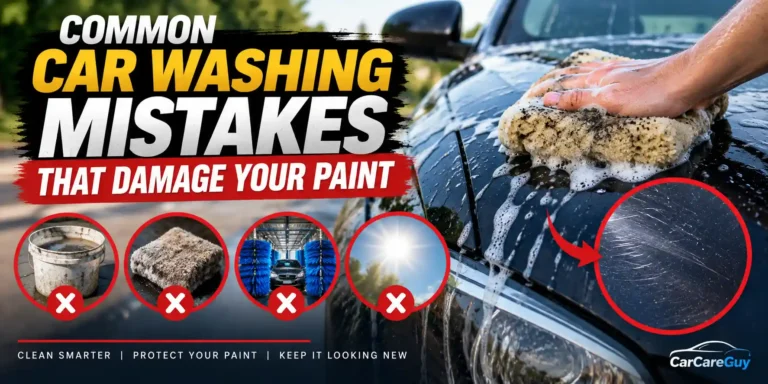
The most damaging car washing mistakes are using the wrong tools, washing in direct sunlight, and drying with the wrong technique, all of which introduce fine scratches called swirl marks that accumulate over repeated washes. These mistakes are easy to make because they don’t cause obvious damage after a single wash, which means many drivers repeat them for years without realizing the cumulative effect on their paint.
This guide covers the specific mistakes that cause the most paint damage, why each one matters, and the simple corrections that prevent them going forward.
Why Do Swirl Marks Happen From Washing, Not Just Driving?
Swirl marks are fine, circular scratches in the clear coat caused by dirt and grit being dragged across the paint’s surface, most visible under direct sunlight or bright artificial light. While some contamination comes from driving itself, washing is actually one of the most common sources of swirl marks, since improper technique grinds trapped particles directly against the paint.
This is counterintuitive to many drivers, who assume washing can only help their paint’s condition. In reality, a poorly executed wash using dirty tools or the wrong motion can introduce more visible damage than simply leaving the car dirty for another week.
What Are the Most Common Car Washing Mistakes?
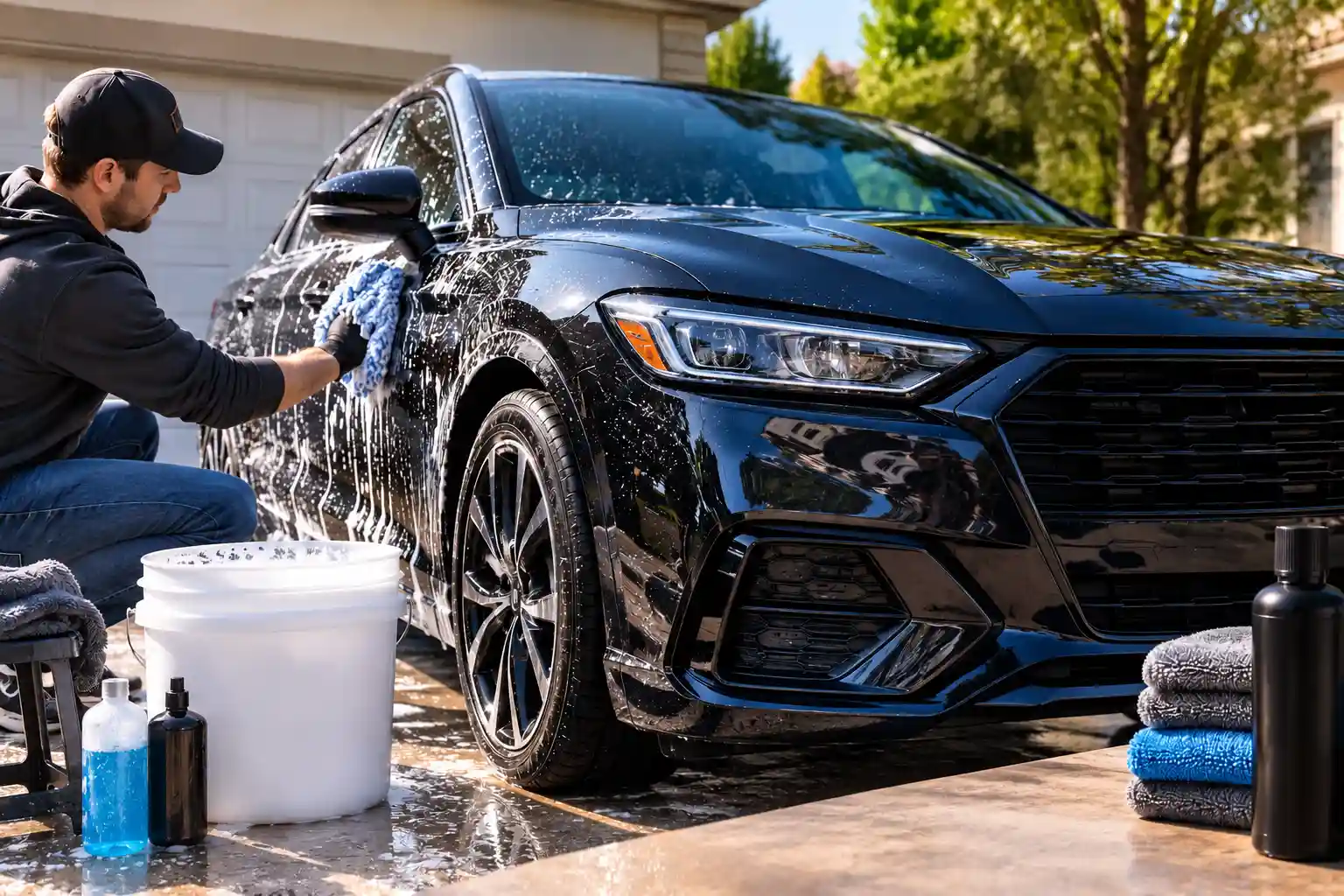
The most common car washing mistakes are washing hot paint, using one bucket for everything, choosing the wrong soap, drying with an unsuitable towel, washing the wheels after the body, and wiping dirt from dry paint. These habits can increase the risk of water spots, swirl marks, and premature loss of paint protection.
1. Washing a Car in Direct Sunlight or on Hot Paint
Washing a car on hot paint can cause soap and rinse water to dry before you finish the panel, increasing the chance of water spots and streaking. Whenever possible, wash in the shade and work on one section at a time.
2. Using One Bucket for Soap and Rinsing
Using the same bucket for washing and rinsing can put dirt picked up from the vehicle back onto your wash mitt. A separate rinse bucket helps reduce the amount of loose grit that gets carried back onto the paint.
For a lower-risk wash process, rinse the mitt frequently and keep the wash solution as clean as practical.
3. Using Dish Soap Instead of Car Wash Soap
Dish soap is not the best choice for routine vehicle washing. Automotive wash soaps are specifically formulated for painted and clear-coated surfaces, while dishwashing detergents can remove existing wax protection.
A dedicated car wash soap is the better choice when you want to clean the vehicle while maintaining its existing paint protection.
4. Drying the Car With a Regular Bath Towel
A regular bath towel is not an ideal choice for drying automotive paint. A quality microfiber drying towel is designed to absorb water efficiently while providing a soft surface for paint.
For example, dedicated automotive microfiber drying towels are specifically designed to reduce drying time and minimize streaking.
5. Washing the Body Before the Wheels
Wheels and tires can carry brake dust, road grime, and other contaminants. Cleaning them before the freshly washed body helps prevent dirty water and splashes from getting onto paint you have already cleaned.
A practical sequence is wheels and tires first, followed by the exterior paint.
6. Wiping Dirt From Paint Without Rinsing First
Wiping a heavily dirty vehicle with a dry or barely damp towel can move abrasive contaminants across the paint. For a conventional wash, rinse away as much loose dirt as possible before making contact with the paint with a wash mitt.
For especially dirty vehicles, a pre-wash or foam step can help loosen contaminants before the contact wash.
Why Does Washing in Direct Sunlight Cause Problems?
Washing in direct sunlight speeds up water evaporation before you can properly rinse soap away, which leaves behind mineral deposits and soap residue that dry into visible spots on the paint. The heat from sun-warmed paint accelerates this drying process even further, sometimes causing water spots to form within seconds of application.
Washing in shade, or early morning and evening when the sun is lower and paint temperature is cooler, gives you enough working time to properly rinse each section before it dries. This single change alone eliminates one of the most common causes of water spotting that drivers otherwise attribute to their water quality rather than their wash timing.
Why Does the Two-Bucket Method Matter So Much?
The two-bucket method uses one bucket for soapy water and a separate bucket of clean rinse water, with a grit guard at the bottom of each to trap dirt that settles out of the wash mitt. Dipping the mitt in the rinse bucket before returning it to the soap bucket removes trapped dirt particles before they get carried back onto the paint.
Using a single bucket skips this cleaning step entirely, meaning every dip reintroduces whatever grit the mitt picked up on the previous pass directly back into the soap solution you’re about to apply to the paint again. This is one of the simplest and cheapest fixes on this entire list, requiring only a second bucket and two grit guards.
What’s Wrong With Drying a Car Using a Regular Towel?
Regular bath towels and cotton cloths have a coarser, less uniform fiber structure than dedicated microfiber drying towels, which means they’re more likely to trap grit against the paint while dragging across the surface during drying. This friction, especially when the towel isn’t perfectly clean, is a direct cause of fine surface scratches.
A proper microfiber drying towel, or a specialized water-absorbing chamois-style towel, glides across the surface with far less friction while still soaking up water efficiently. Pairing this with a blotting motion rather than a dragging wipe further reduces the risk of introducing scratches during what should be the final, protective step of the wash.
Does the Order You Wash Different Parts of the Car Actually Matter?
Yes, washing from cleanest to dirtiest, roof and upper panels first, then working down toward the wheels last, follows the natural pattern of how dirt and grime accumulate on a vehicle. Wheels carry the heaviest concentration of abrasive brake dust, so washing them last, with entirely separate tools, prevents that contamination from ever reaching the rest of the car’s paint.
Reversing this order, or mixing wheel and body washing tools, is a subtle mistake that doesn’t cause obvious damage in a single wash but compounds over time as tiny amounts of abrasive grit get transferred repeatedly. Establishing a consistent top-to-bottom, cleanest-to-dirtiest routine removes this risk entirely without adding meaningful time to the process.
Is Skipping the Pre-Rinse Step a Bigger Mistake Than It Seems?
Skipping the initial pre-rinse and going straight to soap and a mitt means you’re applying pressure and friction to a surface that still has loose dirt sitting directly on the paint. That loose dirt gets trapped between the mitt and the clear coat during the first pass, acting as an abrasive even before the actual washing motion begins.
A thorough pre-rinse, ideally with enough water pressure to dislodge loose grime on its own, removes the bulk of surface contamination before any tool ever touches the paint. This single step, often rushed or skipped entirely by drivers in a hurry, meaningfully reduces the amount of grit your wash mitt has to deal with during the rest of the process.
Does Using the Wrong Sponge or Mitt Material Make a Difference?
Yes. The material of your wash sponge or mitt can affect how much dirt is moved across the paint during a car wash. A quality microfiber wash mitt is generally a better choice than a traditional flat foam sponge because its deeper fibers can help capture and hold loose dirt away from the paint surface.
Why Microfiber Mitts Are Better for Car Washing
Traditional foam sponges have a relatively flat surface, so dirt and grit can remain between the sponge and the paint as you wash. A microfiber mitt has a deeper, looped fiber structure that can capture contaminants within the material rather than keeping them directly against the paint.
That does not make microfiber completely scratch-proof. Wash technique, how dirty the vehicle is, how often the mitt is rinsed, and the condition of the mitt all affect the risk of creating swirl marks.
Can a Sponge Cause Swirl Marks?
It can contribute to paint marring when abrasive dirt is trapped between the washing material and the paint. The material itself is only one part of the equation, but choosing a wash mitt designed to hold contaminants away from the paint can reduce unnecessary friction during a contact wash.
For most routine car washing, replacing an old foam sponge with a quality microfiber wash mitt is a relatively simple way to improve your wash process. Pair it with thorough rinsing and a clean wash solution to further reduce the amount of grit being dragged across the paint.
Frequently Asked Questions
Can washing my car too often actually damage the paint?
Washing frequently isn’t harmful on its own, as long as proper technique and clean tools are used each time, since the paint itself isn’t damaged by water and soap contact. The risk comes specifically from technique mistakes repeated across many washes, not from wash frequency itself.
Is it a mistake to wash my car right after driving on the highway?
It’s not a mistake to wash right after highway driving, but letting the car cool down first, especially in warm weather, helps avoid the rapid water evaporation and spotting that comes from washing hot paint. Waiting even 15 to 20 minutes for the surface to cool makes a noticeable difference in wash quality.
Does a touchless car wash avoid all these mistakes automatically?
Touchless car washes avoid the physical contact mistakes like dirty mitts and towels, since there’s no direct tool contact with the paint, but they don’t eliminate every risk. Facilities that don’t properly maintain their water filtration or use overly aggressive chemical cleaners can still cause issues, just different ones than manual washing mistakes.
How do I know if my paint already has swirl marks from past washing mistakes?
Swirl marks show up most clearly under direct, angled sunlight or a bright flashlight held at an angle to the paint, appearing as fine, circular scratch patterns across the surface. A car that looks perfectly clean and glossy under normal indoor lighting can still reveal significant swirl marks once examined this way.
Can swirl marks from washing mistakes be fixed, or are they permanent?
Swirl marks can typically be corrected through machine polishing, which removes a microscopic layer of clear coat to level out the fine scratches and restore gloss. This isn’t a washing fix, though, so preventing swirl marks through proper technique remains far easier and cheaper than correcting them after the fact.