The best car vacuum for your needs is one that reaches your vehicle’s tight spaces, handles the debris you collect, and has a power source that suits where you park. For most owners, useful attachments and a manageable hose matter more than an impressive voltage or suction claim on the box.
Start by deciding whether you need a portable vacuum for quick cleanups or a larger machine for thorough detailing. Then compare the nozzle, power source, filter, and bin capacity against your actual cleaning routine. You may not need a dedicated car vacuum if a household model already has the right tools and can reach your vehicle.
Choose a Vacuum Type That Fits Your Routine
Cordless handheld vacuums are convenient for crumbs and occasional touch-ups. A corded shop vacuum or household vacuum with a hose can be a better fit for longer cleaning sessions, provided you have a suitable power outlet nearby.
| Vacuum type | Best fit | Main trade-off |
|---|---|---|
| Cordless handheld | Quick cleanups and cars parked away from outlets | Battery runtime and bin size can limit longer jobs |
| Corded household vacuum | Owners who already have a suitable hose and attachments | May be awkward to carry or position around a vehicle |
| Corded shop vacuum | Larger cleaning jobs and removable floor mats | Bulkier to store and move |
| 12-volt car vacuum | Cleaning away from household power using a compatible vehicle outlet | Cord management and outlet compatibility matter |
A dedicated car vacuum is convenient, not automatically necessary. Before buying one, check whether your existing vacuum can reach the footwells, has a narrow attachment, and is suitable for the debris you want to pick up.
If you clean multiple vehicles or frequently deal with sand and dirt, a larger canister and longer working time may be worth the storage space. For a commuter car that mainly collects crumbs, a compact handheld may be sufficient.
Prioritize Attachments and Reach
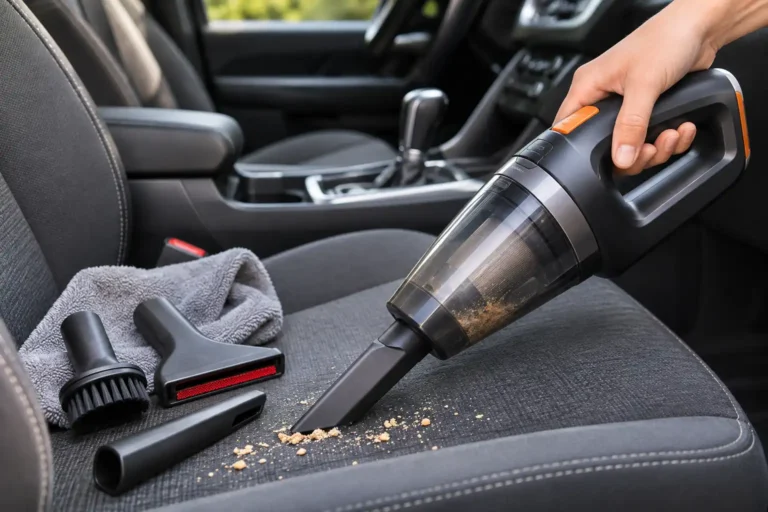
The most useful car vacuum attachment is usually a crevice tool: its narrow opening helps reach between seats, along seat rails, and into door pockets. Check its length and shape, not just whether one appears in the accessory list.
A useful car-cleaning kit may also include:
- A soft brush: For loosening dust around vents, seams, and other delicate interior surfaces. Use gentle pressure and check the brush for trapped grit.
- A wider upholstery nozzle: For covering seats and carpeted areas without relying on a narrow crevice tool for the entire job.
- A flexible hose: For positioning the nozzle in footwells and between seats without fitting the whole vacuum body into the gap.
- A powered or rubberized pet-hair tool: For lifting embedded hair, if the manufacturer includes or supports one for the model.
Consider the combined reach of the hose and nozzle. A long nozzle attached to a bulky handheld body can still be difficult to maneuver in a narrow seat gap. Conversely, a flexible hose can make a larger vacuum easier to use inside the cabin, although the machine itself still needs a place to sit.
If you remove floor mats to clean them, make sure the nozzle also works on broad, flat surfaces. A single narrow tool can reach tight spaces but makes large mats slower to clean.
Understand Suction and Airflow Claims
Suction and airflow both contribute to debris pickup, but a single advertised number does not tell you how well a vacuum will clean a car. The nozzle design, airflow path, filter condition, and type of debris also affect the result.
Manufacturers may describe performance using air watts, airflow, sealed suction, or other measurements. These figures describe different things, and measurements taken under different conditions are not necessarily directly comparable. A higher battery voltage or motor wattage alone does not prove that one vacuum will pick up more dirt.
For a practical comparison, look for independent tests using similar surfaces and debris, along with clear explanations of how the vacuums were tested. Check whether replacement filters are available and whether the vacuum has an appropriate tool for your main problem, such as embedded hair or loose gravel.
If a listing provides only a large power number without explaining the measurement, treat it as limited buying information rather than proof of superior cleaning.
Match the Power Source to Where You Park
Choose cordless power for freedom of movement, a household plug for access to continuous power, or a 12-volt model if you need to use a compatible vehicle outlet. Each option solves a different problem.
Cordless Batteries
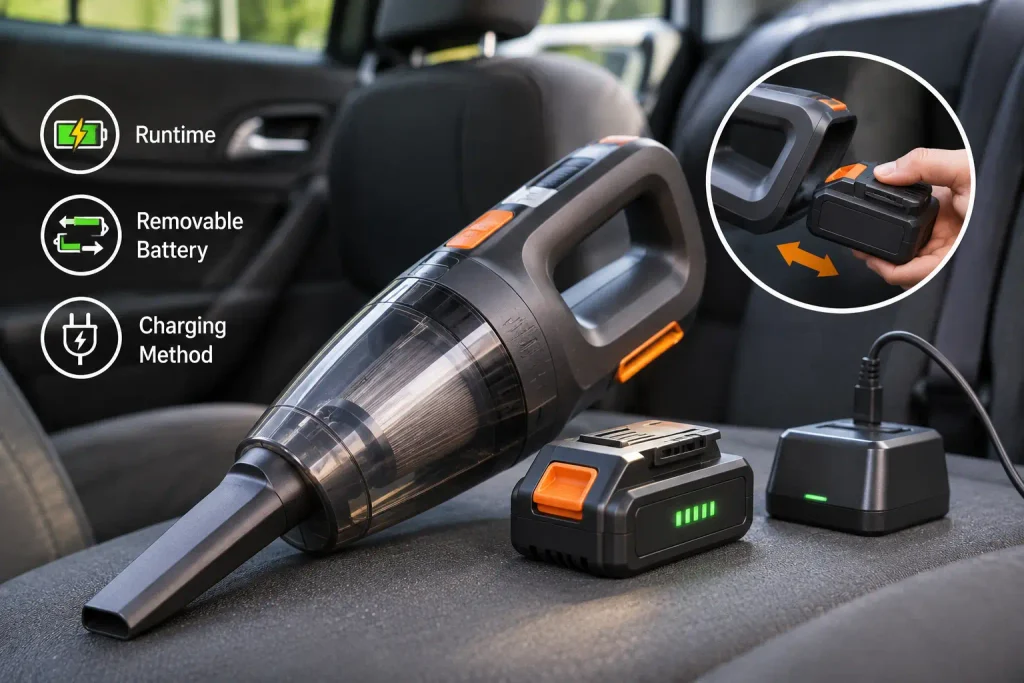
A cordless vacuum avoids a trailing cord and can be convenient in an apartment parking lot or driveway. Check the stated runtime, charging method, and whether the battery is removable or replaceable. Runtime claims may depend on the power setting and attachment, so confirm the conditions behind the figure when available.
A small battery may be adequate for spot cleaning but less convenient for a full interior. If you already own compatible cordless tools, a vacuum in the same battery system could reduce the need for another charger, but confirm that the specific battery and vacuum are compatible.
Follow the manufacturer’s storage and charging instructions. Avoid leaving a battery in a hot vehicle if its instructions prohibit that temperature or storage location.
Household Power
A corded vacuum avoids battery recharging during a long session. Before buying, check the cord length and where the vacuum can sit while you reach both sides of the car.
If an extension cord is necessary, use one rated for the vacuum and the conditions of use, and follow the vacuum and cord manufacturers’ instructions. Keep electrical connections dry. For outdoor use, follow the applicable instructions for outdoor-rated equipment and ground-fault protection.
Vehicle Power Outlets
A 12-volt vacuum can be useful when household power is unavailable, but the plug must fit your vehicle’s outlet and the vacuum’s electrical requirements must be within the outlet’s rating. Check both the vehicle owner’s manual and the vacuum instructions before use.
Also check the manufacturer’s guidance on whether the outlet operates with the vehicle off. Do not run an engine in an enclosed or poorly ventilated space to power a vacuum.
Check the Filter and Dust Bin
A filter traps debris before air leaves the vacuum, while the bin or bag holds what you collect. Both need attention if you want consistent operation and straightforward cleanup.
A small transparent bin makes it easy to see when emptying is needed, but it can fill quickly with sand, leaves, or pet hair. A larger canister is more convenient for heavily soiled interiors, though it adds bulk. Look at how the bin opens and whether you can empty it without reaching into the dirt.
Check whether filters are washable, how they must be dried, and how often the manufacturer recommends replacement. A washable filter can reduce the need for replacements, but it still requires care. Never reinstall a wet filter unless the manufacturer explicitly permits it.
If fine dust or allergies are a concern, look for a clearly identified filtration specification and a sealed system, rather than assuming that any product labeled “HEPA” filters all exhaust air. Replacement filter availability matters too: a filter is only useful if you can maintain or replace it as directed.
Decide Whether You Need Wet Pickup
Choose a wet/dry vacuum only if you expect to pick up liquids and the manufacturer specifically permits it. A dry-only car vacuum should not be used on spills, damp carpet, or wet debris.
Wet/dry machines can add flexibility, but they may require a different filter setup or preparation before liquid pickup. Follow the model’s instructions, then empty and clean the tank as directed. Wet pickup alone does not necessarily wash or fully dry upholstery; an extractor is a different type of machine.
For a spilled drink, check your upholstery care instructions as well. If liquid has reached electrical components, avoid disturbing them and seek appropriate professional help. Do not vacuum gasoline, solvents, or other hazardous substances unless the equipment is specifically rated for that use and its instructions permit it.
Consider Pet Hair, Sand, and Other Difficult Debris
Match the vacuum and attachment to the material you clean most often. Loose crumbs and dust are different challenges from hair caught in carpet fibers or sand packed into floor mats.
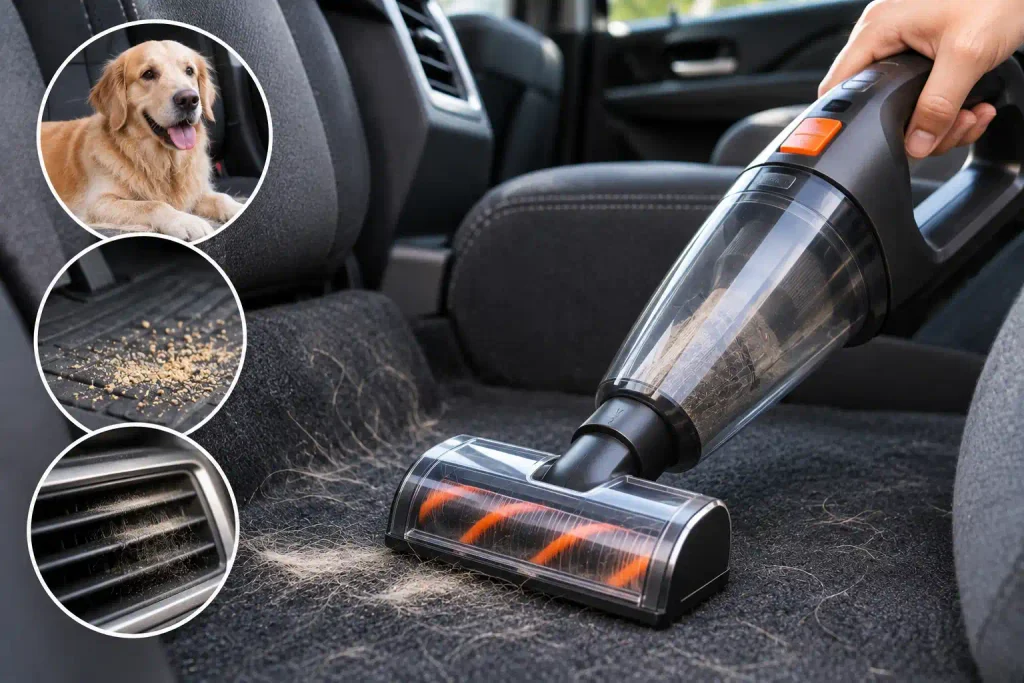
For pet hair, a powered brush or a suitable rubberized attachment may help lift strands before suction carries them away. Check that a powered brush is intended for the surface you are cleaning, and remove tangled hair according to the manufacturer’s instructions. On delicate upholstery, start gently in an inconspicuous area.
For sand and grit, remove mats when practical and loosen debris before vacuuming. A crevice tool helps with seams and rails, while a wider nozzle is more efficient on open carpet. An interior brush can assist, but use a clean, appropriate brush so grit is not dragged across sensitive surfaces.
If your main problem is fine dust rather than bulky debris, easy filter maintenance and a well-sealed system may matter more than a large tank.
Compare Maintenance, Storage, and Total Cost
The purchase price is only part of the decision. Check the cost and availability of replacement filters, bags, batteries, and any attachment you need that is not included.
A compact vacuum is easier to store in a small space, but storing it in the car may expose it or its battery to temperatures outside the manufacturer’s recommended range. A larger machine needs more room, though it may be easier to empty less often during a substantial cleanup.
Before buying, confirm these details on the exact model or kit:
- Which attachments are included, and whether the hose is included or sold separately.
- Whether the battery and charger are included with a cordless model.
- How the filter is cleaned and where replacements can be obtained.
- Whether the bin or bag is large enough for your usual cleaning session.
- How the warranty and service process work for the product.
A lower-cost vacuum can be the better purchase if it has the tools and capacity you need. Paying more for wet pickup, an extra battery, or a large tank makes sense only if you will use those features.
How to Choose the Right Car Vacuum
For most routine cleanups, start with a manageable vacuum that has a genuinely useful crevice tool and enough reach for your seats and footwells. Choose cordless if you value portability or park away from power; choose a corded machine if longer sessions and larger debris capacity matter more.
Before purchasing, try your existing household vacuum if it has suitable attachments. If it handles your car comfortably, a separate vacuum may not be necessary.
FAQ
The right choice depends on your vehicle and cleaning habits, but a few questions can narrow the options quickly.
Can You Use a Regular Vacuum to Clean a Car?
Yes. A household vacuum can clean a car if its hose and attachments reach the necessary areas and its manufacturer permits the intended use. Keep the machine stable outside the vehicle, use appropriate power connections, and avoid picking up liquids with a dry-only model.
Is a Cordless Vacuum Powerful Enough for a Car?
A cordless vacuum can be sufficient for routine car cleaning, especially for crumbs and dust. For embedded pet hair, heavy sand, or a full interior, compare its attachments and runtime with the job rather than choosing on voltage alone.
Is a Car Vacuum With a HEPA Filter Necessary?
A HEPA filter is not necessary for every owner, but it may be worth considering if fine particles are a particular concern. Check the product’s specific filtration claims and maintenance requirements, and look at whether the vacuum’s exhaust path is sealed.